Question 11 Mark
Given that $HCF\ (306, 657) = 9$, find $LCM (306, 657)$.
AnswerAs we know that, $HCF$ $\times$ $LCM =$ Product of two numbers
$LCM (306, 657) =$ $\frac{306 \times 657}{HCF(306,657)}$ = $\frac{306 \times 657}{9}$ = 22338.
View full question & answer→Question 21 Mark
Find the $LCM$ and $HCF$ of $12, 15$ and $21$ integers by applying the prime factorisation method.
Answer$12, 15$ and $21$
$12=2^2 \times 3 $
$ 15=3 \times 5 $
$ 21=3 \times 7 $
$ H C F=3 $
$ \text { LCM }=2^2 \times 3 \times 5 \times 7=420$
View full question & answer→Question 31 Mark
Find the $LCM$ and $HCF$ of $8, 9$ and $25$ integers by applying the prime factorisation method.
Answer$8, 9$ and $25$
$ 8=2 \times 2 \times 2=2^3 $
$ 9=3 \times 3=3^2 $
$ 25=5 \times 5=5^2 $
$ H C F=1 $
$ L C M=2^3 \times 3^2 \times 5^2=1800$
View full question & answer→Question 41 Mark
Find the $LCM$ and $HCF$ of $17, 23$ and $29$ integers by applying the prime factorisation method.
AnswerGiven numbers are: $17, 23$ and $29$
Since the three numbers are prime, we have
$17 = 1 \times 17$
$23 = 1 \times 23$
$29 = 1 \times 29$
$\Rightarrow$ $HCF = 1$
and $LCM = 17 \times 23 \times 29 = 11339$
View full question & answer→Question 51 Mark
Find the LCM and HCF of 510 and 92 pairs of integers and verify that LCM $\times$ HCF = product of the two numbers.
Answer510 and 92
510= 2 × 3 × 5× 17
92 = 2 × 2 × 23
HCF = 2
LCM = 2 × 2 × 3 × 5 × 17 × 23 = 23460
Product of two numbers 510 and 92 = 510 × 92 = 46920
HCF × LCM = 2 × 23460 = 46920
Hence, product of two numbers = HCF × LCM
View full question & answer→Question 61 Mark
Find the $LCM$ and $HCF$ of $26$ and $91$ pairs of integers and verify that $LCM$ $\times$ $HCF =$ product of the two numbers.
Answer$26$ and $91$
$26= 2 \times 13$
$91 = 7 \times 13$
$HCF = 13$
$LCM = 2 \times 7 \times 13 = 182$
Product of two numbers $26$ and $91 = 26 \times 91 = 2366$
$HCF \times LCM = 13 \times 182 = 2366$
Hence, product of two numbers $= HCF \times LCM$
View full question & answer→Question 71 Mark
Express $7429$ as a product of its prime factors.
Answer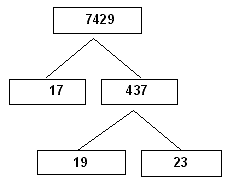
So, $7429 = 17$ $\times$ $19$ $\times$ $23$. View full question & answer→Question 81 Mark
Express $5005$ as a product of its prime factors.
Answer$5005 = 5$ $\times$ $7$ $\times$ $11$ $\times$ $13$
View full question & answer→Question 91 Mark
Express $3825$ as a product of its prime factors.
Answer$3825=3 \times 3 \times 5 \times 5 \times 17=3^2 \times 5^2 \times 17$
View full question & answer→Question 101 Mark
Express $156$ as the product of its prime factors.
Answer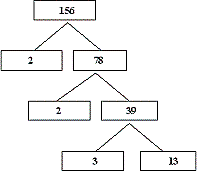
So, the factors of $156$ are $2$ $\times$ $2$ $\times$ $3$ $\times$ $13$ View full question & answer→Question 111 Mark
Express $140$ as a product of its prime factors.
Answer$140 = 2 \times 2 \times 5 \times 7 = 2^2 \times 5 \times 7$
View full question & answer→Question 121 Mark
If $P$ is prime number, then $\sqrt{ P }$ is irrational number. Agree / Disagree.
AnswerAgree : If $P$ is prime number, then $\sqrt{ P }$ is irrational number.
View full question & answer→Question 131 Mark
Which type of number is $\pi$ ?
Answer$\pi$ is an irrational number.
View full question & answer→Question 141 Mark
Which type of number is $\sqrt{4}+3$ ?
Answer$\sqrt{4}+3=2+3=5$, which is rational number.
View full question & answer→Question 151 Mark
$7 \times 11 \times 26+13$ is a prime number. Yes/No.
Answer$7 \times 11 \times 26+13=13[7 \times 11 \times 2+1]$ is not a prime number. It is divisible by $13$ .
View full question & answer→Question 161 Mark
Which type of numbers are $\{4,6,8,9,10,12,14 \ldots\}$ ?
View full question & answer→Question 171 Mark
What is the Fundamental Theorem of Arithmetic ?
AnswerEvery composite number can be expressed as a product of primes in a unique way, this fact is known as Fundamental Theorem of Arithmetic.
View full question & answer→Question 181 Mark
If $\operatorname{HCF}(a, b)=a$, then find $\operatorname{LCM}(a, b)$.
Answer$HCF$ $\times$ $LCM$ $=$ The multiplication of both digits (numbers)
$\operatorname{HCF}(a, b) \times \operatorname{LCM}(a, b)=a \times b$
$\therefore a \times \operatorname{LCM}(a, b)=a \times b $
$\therefore \operatorname{LCM}(a, b)=\frac{a \times b}{a}=b$
View full question & answer→Question 191 Mark
If $a, b, c$ is prime number, then what is the ratio of $HCF$ and $LCM ?$
AnswerThe $HCF$ of prime number $a, b, c=1$ and $LCM$ $=a b c$,
$\therefore$ The ratio of $HCF$ and $LCM$ $=\frac{1}{a b c}=1: a b c$
View full question & answer→Question 201 Mark
Which type of the number $\sqrt{289}+1$ is ?
Answer$\sqrt{289}+1=17+1=18=$ Integer.
View full question & answer→Question 211 Mark
Which type of number $\sqrt{9}+2$ is?
Answer$\sqrt{9}+2=3+2=5$ rational number.
View full question & answer→Question 221 Mark
If $n$ is a natural number then $\sqrt{n}$ is which type of number ?
Answer$n$ is a natural number
if $n=5$ then $\sqrt{5}$ is irrational number.
If $n=4$ then $\sqrt{4}=2$ is rational number
Hence if $n$ is natural number then $\sqrt{n}$ may be rational or irrational number.
View full question & answer→Question 231 Mark
Find the smallest number, when divided by $5, 6, 7, 8$ the remainder is $3$ and the number is divisible by $9 .$
Answer$\operatorname{LCM}(5,6,7,8)=2 \times 3 \times 4 \times 5 \times 7$
$=6 \times 20 \times 7 $
$ =8 \times 15 \times 7 $
$ =840$
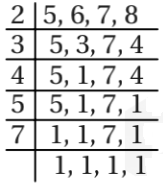
The required number is of the form $840 k+3$
But $840 k+3$ is divisible by $9$
$\therefore k=2$
$\therefore$ The required number
$ =840 \times 2+3 $
$ =1680+3 $
$=1683$ View full question & answer→Question 241 Mark
Find the ratio of $LCM$ and $HCF$ of $5,15$ and $20$ .
Answer$
\frac{\operatorname{LCM}(5,15,20)}{\operatorname{HCF}(5,15,20)}=\frac{60}{5}=\frac{12}{1}
$
$\therefore$ The required ratio $=12: 1$
View full question & answer→Question 251 Mark
The $HCF$ of two numbers is $16$ and their $LCM$ is $136$ What can we say about these numbers?
AnswerWe know that $HCF$ is always a factor of $LCM$.
But here $16$ is not a factor of $136$
$\therefore$ These numbers do not exist.
View full question & answer→Question 261 Mark
Five bells start to ring together. Each bell is ringing at the interval $6, 7, 8, 9$ and $12$ seconds respectively. In one hour how many times they will ring together? (When they start to ring together, it is not counted)
AnswerFive bells start to ring together. Each bell is ringing at the interval $6, 7, 8, 9$ and $12$ seconds respectively. In one hour how many times they will ring together? (When they start to ring together, it is not counted) $\operatorname{LCM}(6,7,8,9,12)=504$ sec.
and $\frac{504}{60}=8.4$ minutes
After $8.4 min$. they all ring together
$\therefore$ In one hour, i.e. in $60$ minutes,
$\frac{60}{8.4}=\frac{60 \times 10}{8.4}=7.14285$
Thus they will ring together $7$ times in one hour.
View full question & answer→Question 271 Mark
If $\operatorname{HCF}(a, b)=8$ and $\operatorname{LCM}(a, b)=64$ and if $a>b$ then find the value of $a$.
Answer$
\begin{aligned}
a b & =\operatorname{HCF}(a, b) \times \operatorname{LCM}(a, b) \\
\therefore a b & =8 \times 64 \\
a b & =2^3 \times 2^6=2^9
\end{aligned}
$
But $\operatorname{HCF}(a, b)=8=2^3$
$\therefore$ One of the number is 8
Other number $=\frac{2^9}{2^3}=2^6=64$
But $a>b$ So $64>8$
$
\therefore a=64 \text { and } b=8
$
View full question & answer→Question 281 Mark
What will be the $LCM$ and $HCF$ of given $3$ numbers $15,24,$ and $40 ?$
Answer$15=5 \times 3=5^1 \times 3^1 $
$24=2 \times 2 \times 2 \times 3=2^3 \times 3^1 $
$40=2 \times 2 \times 2 \times 5=2^3 \times 5^1 $
$\text { LCM }=2^3 \times 3^1 \times 5^1=8 \times 3 \times 5=120$
(Product of the greatest power of each prime factor involved in the numbers)
Note : Product of three numbers is not equal to the product of their $LCM$ and $HCF$
$HCF$ $=1$ (Product of the smallest power of each common prime factor in the numbers)
View full question & answer→Question 291 Mark
LCM of two numbers is equal to their product. Then find its HCF ?
AnswerHCF of two numbers
$=\frac{\text { Product of two numbers }}{\text { LCM of two numbers }}$
$=\frac{\text { Product of two numbers }}{\text { Product of two numbers }}$
$=1 \text { ( } \because \text { Given) }$
View full question & answer→Question 301 Mark
Find the value of $x$ from the following factor tree.
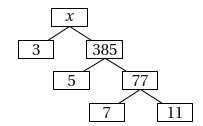
Answer$
x=3 \times 5 \times 7 \times 11=1155
$
View full question & answer→Question 311 Mark
How many minimum square handkerchieps are maid from the following piece of cloth?
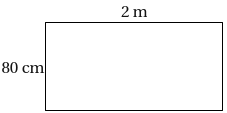
AnswerLength $l=2 m =200 cm$
Breadth $b=80 cm$
Step $: 1$ Find $HCF$ $(200,80)$
$200=2^3 \times 5^2 $
$80=2^4 \times 5$
$\therefore \text { HCF }=(200,80) 2^3 \times 5=40$
Area of given cloth piece $l^2=(40)^2$
$\therefore l^2=1600 cm ^2$
Step $: 2$ Area of given cloth piece $=l \times b$
$=80 \times 200$
$=16000 cm ^2$
Step $: 3$ Number of square handkerchief
$=\frac{\text { Area of given cloth piece }}{\text { Area of square }} $
$=\frac{16000}{1600}=10$
View full question & answer→Question 321 Mark
Find the $HCF$ of $3^{125}-1$ and $3^5-1$.
AnswerRemember : $HCF$ of $a^m-1$ and $a^n-1$ is $a^n-1$ where $m>n$
$\therefore$ $HCF$ of $3^{125}-1$ and $3^5-1$
$\left.=3^5-1=243-1\right] $
$=242$
$\therefore$ $HCF$ of $3^{125}-1$ and $3^5-1$ is $242$
View full question & answer→Question 331 Mark
If $n \in N$ the find the last digit of $6^n-5^n$.
AnswerFor $n \in N$, the last digit of $6^n$ is $6$
For $n \in N$, the last digit of $5^n$ is $5$
$\therefore$ The last digit of $6^n-5^n$ is $6-5=1$
View full question & answer→Question 341 Mark
Find the maximum positive integer which divides $290,460$ and $552$ left the remainder $4,5$ and $6$ respectively.
Answer$
\begin{aligned}
\text { Maximum positive integer } & =\operatorname{HCF}[290-4,460-5,552-6] \\
& =\operatorname{HCF}[288,455,546] \\
& =13
\end{aligned}
$
View full question & answer→Question 351 Mark
If $n$ is even then which number of $(10)^n-1$ is divided by $11$ ?
AnswerTaking $n=2$, we get
$(10)^n-1=(10)^2-1$
$=100-1$
$=99$
$\therefore 99$ is divided by $11$ .
View full question & answer→Question 361 Mark
What is the smallest prime number ?
Answer$2$ is the Smallest Prime Number.
View full question & answer→