Questions · Page 1 of 3

2 Marks Questions

🎯

Test yourself on this topic

50 questions · timed · auto-graded

Question 12 Marks
If a line divides any two sides of a triangle in the same ratio, then the line is parallel to the third side.
Answer
Image
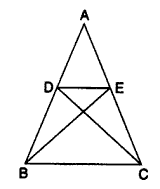
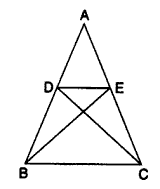
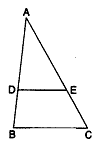
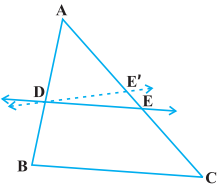
This theorem can be proved by taking a line $DE$ such that $\frac{ AD }{ DB }=\frac{ AE }{ EC }$ and assuming that $DE$ is not parallel to $BC$ $($see Fig. $6.12).$
If $DE$ is not parallel to $BC$, draw a line $DE ^{\prime}$ parallel to $BC$.
So,
$\frac{ AD }{ DB }=\frac{ AE ^{\prime}}{ E ^{\prime} C } \quad \text { (Why ?) } $
$\text{Therefore,} $
$\frac{ AE }{ EC }=\frac{ AE ^{\prime}}{ E ^{\prime} C } \quad \text { (Why?) }$
Adding $1$ to both sides of above, you can see that $E$ and $E ^{\prime}$ must coincide. $($Why $?)$
Let us take some examples to illustrate the use of the above theorems.
View full question & answer
Question 22 Marks
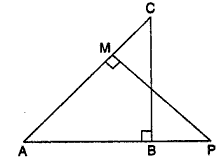
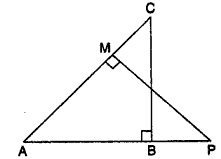
In the figure, $ABC$ and $AMP$ are two right triangles, right angled at $B$ and $M$ respectively. Prove that:
  1. $\triangle ABC \sim \triangle AMP$
  2. $\frac{{CA}}{{PA}} = \frac{{BC}}{{MP}}$
Answer
Given: In the figure, $ABC$ and $AMP$ are two right triangles, right angled at $B$ and $M$ respectively, To prove:
  1. $\triangle $$ABC$ $ \sim $ $\triangle $$AMP$
  2. $\frac{{CA}}{{PA}} = \frac{{BC}}{{MP}}$
Proof:
  1. In $\triangle $ABC $ \sim $ $\triangle $AMP
    $\angle$ABC = $\angle$$AMP (1) ........ [$Each equal to $90^\circ$$]$
    $\angle$BAC=$\angle$$MAP (2).........[$Common angle$]$
    In view of $(1)$ and $(2)$
    $\triangle $$ABC$ $ \sim $ $\triangle $$AMP ..........AA$ similarity criterion
  2. $\triangle $$ABC$ $ \sim $ $\triangle $$AMP.........$ Proved above in$(i)$
    $\therefore $ $\frac{{CA}}{{PA}} = \frac{{BC}}{{MP}}$$.........$Corresponding sides of two similar triangles are proportional.
View full question & answer
Question 32 Marks
In the figure, $ABC$ and $AMP$ are two right triangles, right angled at $B$ and $M$ respectively. Prove that:
  1. $\triangle ABC \sim \triangle AMP$
  2. $\frac{{CA}}{{PA}} = \frac{{BC}}{{MP}}$
Answer
Given: In the figure, $ABC$ and $AMP$ are two right triangles, right angled at $B$ and $M$ respectively,
To prove:
  1. $\triangle $ABC $ \sim $ $\triangle $AMP
  2. $\frac{{CA}}{{PA}} = \frac{{BC}}{{MP}}$
Proof:
  1. In $\triangle $$ABC$ $ \sim $ $\triangle $$AMP$
    $\angle$ABC = $\angle$$AMP (1) ........ [$Each equal to $90^\circ$$]$
    $\angle$BAC=$\angle$$MAP (2).........[$Common angle$]$
    In view of $(1)$ and $(2)$
    $\triangle $$ABC$ $ \sim $ $\triangle $$AMP ..........AA$ similarity criterion
  2. $\triangle $$ABC$ $ \sim $ $\triangle $$AMP.........$Proved above in$(i)$
    $\therefore $ $\frac{{CA}}{{PA}} = \frac{{BC}}{{MP}}$.........Corresponding sides of two similar triangles are proportional.
View full question & answer
Question 42 Marks
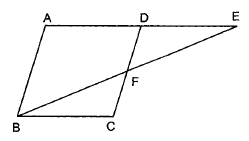
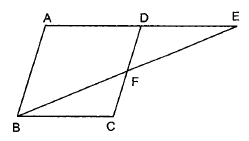
$E$ is a point on side $AD$ produced of a parallelogram $ABCD$ and $BE$ intersects $CD$ at $F$. Prove that $\Delta A B E \sim \Delta C F B.$
Answer
In $ \Delta$'s $ABE$ and $CFB$, we have

$ \angle$$AEB =$ $ \angle$$CBF [$Alternate angles$]$
$ \angle$$A =$ $ \angle$$C [$Opposite angles of a parallelogram$]$
Thus, by $AA$-criterion of similarity, we have,
$ \Delta A B E \sim \Delta C F B.$
View full question & answer
Question 52 Marks
$E$ is a point on side $AD$ produced of a parallelogram $ABCD$ and $BE$ intersects $CD$ at $F$. Prove that $\Delta A B E \sim \Delta C F B.$
Answer
In $\Delta$'s $ABE$ and $CFB$, we have

$\angle$ $AEB =\angle$ $CBF$ $[$Alternate angles$]$
$\angle$ $A$ =$\angle$ $C$ $[$Opposite angles of a parallelogram$]$
Thus, by $AA$-criterion of similarity, we have,
$\Delta A B E \sim \Delta C F B.$
View full question & answer
Question 62 Marks
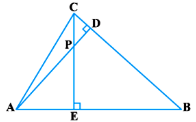
In the figure, altitudes $AD$ and $CE$ of $\triangle$ $ABC$ intersect each other at the point $P$. Show that: $\vartriangle PDC \sim \vartriangle BEC$
Answer
In $\triangle $$PDC$ and $\triangle $$BEC$, we have
$\angle$$PDC =$$\angle$$BEC ..........(1) [$Each equal to $90^\circ$$]$
$\angle$$DCP =$ $\angle$$BEC ..........(2) [$Common angle$]$
In view of $(1)$ and $(2),$
$\triangle $$PDC$ $ \sim $ $\triangle $$BEC [AA$ similarity criterion$]$
View full question & answer
Question 72 Marks
In the figure, altitudes $AD$ and $CE$ of $\triangle$$ABC$ intersect each other at the point $P$. Show that: $\vartriangle AEP \sim \vartriangle ADB$
Answer
In $\triangle $AEP and $\triangle $$ADB$, we have
$AEP=$ $\angle$ $ADP .........(1) [$Each equal to $90^\circ$$]$
$\angle$EAP=$\angle$$DAB ..... (2) [$Common angle$]$
In view of $(1)$ and $(2),$
$\triangle $$AEP$$ \sim $$\triangle $$ADB [AA$ similarity criterion$]$
View full question & answer
Question 82 Marks
In the figure, altitudes $AD$ and $CE$ of $\triangle$$ABC$ intersect each other at the point $P$. Show that: $\vartriangle ABD \sim \vartriangle CBE$
Answer
In $\triangle $$ABD$ and $\triangle $$CBE, ....... (1) [$Each equal to $90^\circ$$]$
$\angle$$ABC =$ $\angle$$CBE ...... (2) [$Common angle$]$
In view of $(1)$ and $(2),$
$\triangle $$ABD$ $ \sim $ $\triangle $$CBE.......[AA$ similarity criterion$]$
View full question & answer
Question 92 Marks
In the figure, altitudes $AD$ and $CE$ of $\triangle$$ABC$ intersect each other at the point $P$. Show that: $\vartriangle AEP \sim \vartriangle CDP$
Answer
In $\triangle $$AEP$ and $\triangle $$CDP,$
$\angle$$AEP =$ $\angle$$CDF ...... (1) [$Each equal to $90^\circ$$]$
$\angle$$EPA =$ $\angle$$DPC ...... (2) [$vert.opp. $\angle$$s]$
In view of $(1)$ and $(2),$
$\triangle AEP \sim \triangle CDP$$ .........[AA$ similarity criterion$]$
View full question & answer
Question 102 Marks
In the figure, if $\triangle$$ABE$ $\cong$ $\triangle$$ACD$. Show that $\triangle$$ADE ~$ $\triangle$$ABC$
Answer
Given: In the figure, $\triangle ABE \cong \triangle ACD$
To prove: $\triangle ADE \sim \triangle ABC$
Proof:
$\because \triangle ABE \cong \triangle ACD$$........[$Given$]$
$\therefore $ $AB = AC........[CPCT]$
$AE = AD ........(1)$
Also, $\angle$ $DAE=$ $\angle$ $BAC.......[$Common $\angle$ $].......(2)$
In view of $(1)$ and $[SAS$ similarity criterion$]$
View full question & answer
Question 112 Marks
In the figure, if $\triangle$$ABE$ $\cong$ $\triangle$$ACD$. Show that $\triangle$$ADE ~$ $\triangle$$ABC$.
Answer
Given: In the figure, $\triangle ABE \cong \triangle ACD$
To prove: $\triangle ADE \sim \triangle ABC$
Proof:
$\because \triangle ABE \cong \triangle ACD$$........[$Given$]$
$\therefore$ $AB = AC........[CPCT]$
$AE = AD ........(1)$
Also, $\angle$ $DAE=$ $\angle$ $BAC.......[$Common $\angle].......(2)$
In view of $(1)$ and $[SAS$ similarity criterion$]$
View full question & answer
Question 122 Marks
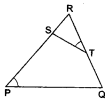
$S$ and $T$ are points on sides $PR$ and $QR$ of $\triangle PQR$ such that $\angle P = \angle R T S$. Show that $\triangle R P Q \sim \triangle R T S$.
Answer
According to questions it is given that $S$ and $T$ are points on sides $PR$ and $QR$ of  $\triangle PQR$ such that $\angle P = \angle R T S$

To Prove $\triangle R P Q \sim \triangle R T S$
Proof In $\triangle RPQ$ and $\triangle RTS$, we have
$\angle P = \angle R T S$ $($given$)$
$\angle R = \angle R$ $($common$)$
$\therefore \quad \triangle R P Q \sim \triangle R T S$ $[$by $AA$-similarity$]$.
View full question & answer
Question 132 Marks
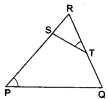
$S$ and $T$ are points on sides $PR$ and $QR$ of $\triangle PQR$ such that $\angle P = \angle R T S$. Show that $\triangle R P Q \sim \triangle R T S$.
Answer
According to questions it is given that $S$ and $T$ are points on sides $PR$ and $QR$ of $\triangle$ $PQR$ such that $\angle$$P = \angle R T S$

To Prove $\triangle R P Q \sim \triangle R T S$
Proof In $\triangle RPQ$ and $\triangle RTS$, we have
$\angle P = \angle R T S$ (given)
$\angle R = \angle R$ (common)
$\therefore \quad \triangle R P Q \sim \triangle R T S$ $[$by $AA$-similarity$]$.
View full question & answer
Question 142 Marks
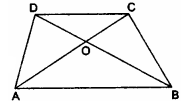
Diagonal $AC$ and $BD$ of a trapezium $ABCD$ with $AB || DC$ intersect each other at point $O$. Using a similarity criterion for two triangles, show that $\frac { O A } { O C } = \frac { O B } { O D }$.
Answer

Given $A$ trapezium $ABCD$ in which $A B \| D C$. The diagonals $AC$ and $BD$ intersect at $O$.
To Prove In $\triangle OAB$ and $\triangle OCD$, we have
$\angle O A B = \angle O C D$ [alternate angles, since $A B \| D C$]
and $\angle O B A = \angle O D C$ [alternate angles, since $A B \| D C$]
$\therefore \quad \triangle O A B \sim \Delta O C D$ $[$by $AA$-similarity$]$.
Hence, $\frac { O A } { O C } = \frac { O B } { O D }$
View full question & answer
Question 152 Marks
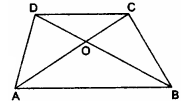
Diagonal $AC$ and $BD$ of a trapezium $ABCD$ with $AB || DC$ intersect each other at point $O$. Using a similarity criterion for two triangles, show that $\frac { O A } { O C } = \frac { O B } { O D }$.
Answer

Given $A$ trapezium $ABCD$ in which $A B \| D C$. The diagonals $AC$ and $BD$ intersect at $O$.
To Prove In $\triangle OAB$ and $\triangle OCD$, we have
$\angle O A B = \angle O C D$ [alternate angles, since $A B \| D C$]
and $\angle O B A = \angle O D C$ [alternate angles, since $A B \| D C$]
$\therefore \quad \triangle O A B \sim \Delta O C D$ $[$by $AA$-similarity$]$.
Hence, $\frac { O A } { O C } = \frac { O B } { O D }$
View full question & answer
Question 162 Marks
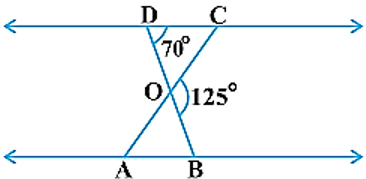
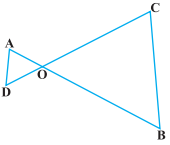
In Figure, $\triangle$$ODC$ $\sim$ $\triangle$$OBA$, $\angle$$BOC = 125^\circ$ and $\angle$$CDO = 70^\circ$.
Find $\angle$$DOC$, $\angle$$DCO$ and $\angle$$OAB$.

Answer
From the given figure,
$\angle DOC + 125^\circ = 180^\circ $[linear pair]
$\angle DOC = 55^\circ$
Now, in $\triangle$$DOC,$
$\angle DCO + \angle ODC + \angle DOC = 180^\circ$[angle sum property of a triangle]
$\angle DCO +70^\circ + 55^\circ=180^\circ$
$\angle DCO = 55^\circ$
Now, $\triangle ODC \cong \triangle OBA$ [given]
$\therefore \angle OAB = \angle OCD = 55^\circ$
View full question & answer
Question 172 Marks
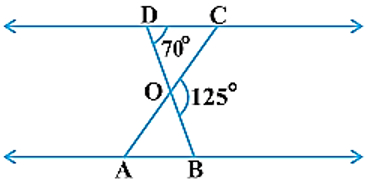
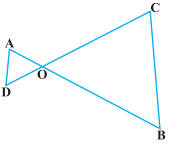
In Figure, $\triangle$$ODC$ $\sim$ $\triangle$$OBA$, $\angle$$BOC = 125^\circ$ and $\angle$$CDO = 70^\circ$. Find $\angle$$DOC$, $\angle$$DCO$ and $\angle$$OAB$.

Answer
From the given figure,
$\angle DOC + 125^\circ = 180^\circ $$[$linear pair$]$
$\angle DOC = 55^\circ$
Now, in $\triangle$$DOC,$
$\angle DCO + \angle ODC + \angle DOC = 180^\circ$$[$angle sum property of a triangle$]$
$\angle DCO +70^\circ + 55^\circ=180^\circ$
$\angle DCO = 55^\circ$
Now, $\triangle ODC \cong \triangle OBA$ $[$given$]$
$\therefore \angle OAB = \angle OCD = 55^\circ$
View full question & answer
Question 182 Marks
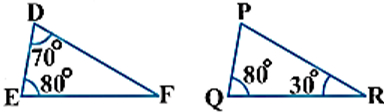
State the pair of triangles in the figure below are similar. Write the similarity criterion used by you for answering the question and also write the pair of similar triangles in the symbolic form:
Answer
In triangle $DEF,$ we have
$\angle D+\angle E+\angle F=180^{\circ}$ $($Sum of angles of triangle$)$
$70^{\circ}+80^{\circ}+\angle \mathrm{F}=180^{\circ}$
$\angle F=30^{\circ}$
In $PQR,$ we have
$\angle P+\angle Q+\angle R=180^{\circ}$
$\angle P+80^{\circ}+30^{\circ}=180^{\circ}$
$\angle \mathrm{P}=70^{\circ}$
In triangle $DEF$ and $PQR$, we have
$\angle D=\angle P=70^{\circ}$
$\angle F=\angle Q=80^{\circ}$
$\angle F=\angle R=30^{\circ}$
Hence, $\triangle DEF ~ \triangle PQR (AAA$ similarity$)$
View full question & answer
Question 192 Marks
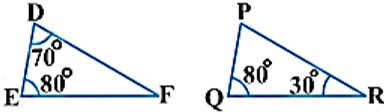
State the pair of triangles in the figure below are similar. Write the similarity criterion used by you for answering the question and also write the pair of similar triangles in the symbolic form:
Answer
In triangle $DEF$, we have
$\angle D+\angle E+\angle F=180^{\circ}$ $($Sum of angles of triangle$)$
$70^{\circ}+80^{\circ}+\angle \mathrm{F}=180^{\circ}$
$\angle F=30^{\circ}$
In $PQR$, we have
$\angle P+\angle Q+\angle R=180^{\circ}$
$\angle P+80^{\circ}+30^{\circ}=180^{\circ}$
$\angle \mathrm{P}=70^{\circ}$
In triangle $DEF$ and $PQR$, we have
$\angle D=\angle P=70^{\circ}$
$\angle F=\angle Q=80^{\circ}$
$\angle F=\angle R=30^{\circ}$
Hence, $\triangle DEF ~ \triangle PQR (AAA$ similarity$)$
View full question & answer
Question 202 Marks
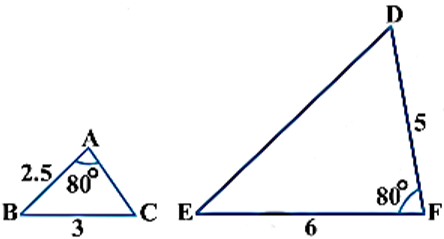
State the pair of triangles in the figure below are similar. Write the similarity criterion used by you for answering the question and also write the pair of similar triangles in the symbolic form:
Answer
In triangle $ABC$ and $DEF$, we have
$AB = 2.5, BC = 3$
$\angle \mathrm{A}=80^{\circ}$
$EF = 6$
$DF = 5$
$\angle F=80^{\circ}$
$\frac{A B}{D F}=\frac{2.5}{5}=\frac{1}{2}$
And, $\frac{B C}{E F}=\frac{3}{6}=\frac{1}{2}$
$\angle A = \angle F$
Hence, $\vartriangle$$ABC$ $\sim \vartriangle$$DEF ($by $SAS$ Rule$)$.
View full question & answer
Question 212 Marks
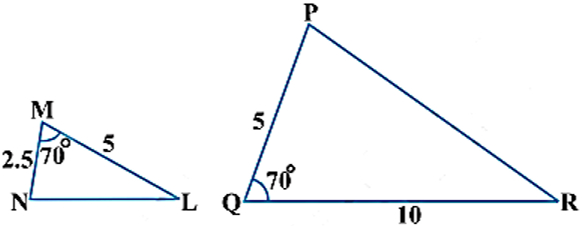
State the pair of triangles in the figure below are similar. Write the similarity criterion used by you for answering the question and also write the pair of similar triangles in the symbolic form:
Answer
In triangle $MNL$ and $QPR$, we have
$\angle M=\angle Q=70^{\circ}$
but
$\frac{M N}{P Q}=\frac{2.5}{5}=\frac{1}{2}$
$\frac{\mathrm{ML}}{\mathrm{QR}}=\frac{5}{10}=\frac{1}{2}$
$\Rightarrow \frac{\mathrm{MN}}{\mathrm{PQ}} = \frac{\mathrm{ML}}{\mathrm{QR}}$
Therefore, $\vartriangle$$MNL$ $\sim$ $\vartriangle$$QPR$ are similar.
View full question & answer
Question 222 Marks
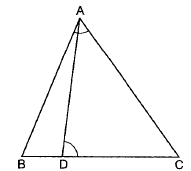
$D$ is a point on the side $BC$ of a triangle $ABC$ such that $\angle ADC =$$\angle BAC$.Show that $CA^2= CB$$\cdot$$CD$.
Answer
Given:$\triangle\mathrm{ABC}$
where ​​​​​​ $\angle$$ADC =$ $\angle$$BAC$
To Prove : $CA^2= CB.CD$
Proof: In $\triangle$$ABC$ and $\triangle$$DAC$, we have

$\angle$$ADC =$ $\angle$$BAC$ and $\angle$$C =$ $\angle$$C$
Therefore, by $AA$-criterion of similarity, we obtain
$\Delta A B C \sim \Delta D A C$
$\Rightarrow \quad \frac { A B } { D A } = \frac { B C } { A C } = \frac { A C } { D C }$
$\Rightarrow \quad \frac { C B } { C A } = \frac { C A } { C D }$
$\Rightarrow CA^2= CB.CD$
View full question & answer
Question 232 Marks
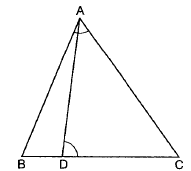
$D$ is a point on the side $BC$ of a triangle $ABC$ such that $\angle$$ADC =$ $\angle$$BAC.$ Show that $CA^2= CB \cdot CD.$
Answer
Given:$\triangle\mathrm{ABC}$
where ​​​​​​ $\angle$$ADC =$ $\angle$$BAC$
To Prove : $CA^2= CB.CD$
Proof: In $\triangle$$ABC$ and $\triangle$$DAC$, we have

$\angle$$ADC =$ $\angle$$BAC$ and $\angle$$C =$ $\angle$$C$
Therefore, by $AA$-criterion of similarity, we obtain
$\Delta A B C \sim \Delta D A C$
$\Rightarrow \quad \frac { A B } { D A } = \frac { B C } { A C } = \frac { A C } { D C }$
$\Rightarrow \quad \frac { C B } { C A } = \frac { C A } { C D }$
$\Rightarrow$ $CA^2= CB.CD$
View full question & answer
Question 242 Marks
State the pair of triangles in the figure below are similar. Write the similarity criterion used by you for answering the question and also write the pair of similar triangles in the symbolic form:
Answer
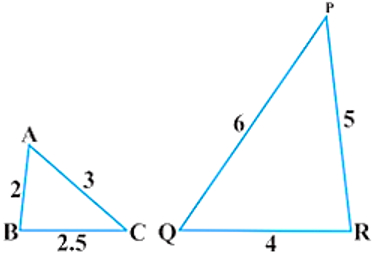
From the triangle, $\frac{A B}{Q R}=\frac{B C}{P R}=\frac{A C}{P Q}=0.5$
Hence the corresponding sides are propotional. Thus the corresponding angles will be equal.
The triangles $ABC$ and $QRP$ are similar i.e, $\vartriangle ABC \sim \vartriangle QRP$ by $SSS$ similarity.
View full question & answer
Question 252 Marks
State the pair of triangles in the figure below are similar. Write the similarity criterion used by you for answering the question and also write the pair of similar triangles in the symbolic form:
Answer
From the figure:
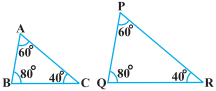
$\angle$$A =$ $\angle$$P = 60^\circ$
$\angle$$B =$ $\angle$$Q = 80^\circ$
$\angle$$C =$ $\angle$$R = 40^\circ$
Therefore, $\triangle \mathrm{ABC} \sim \triangle \mathrm{PQR}$ $[$By $AAA$  similarity$]$
Now corresponding sides of triangles will be propotional, 
$\frac{A B}{PQ}=\frac{B C}{QR}=\frac{C A}{RP}$
View full question & answer
Question 262 Marks
Prove that the line joining the mid points of any two sides of a triangle is parallel to the third side.
Answer
Given: A $\triangle ABC$ in which $D$ and $E$ are the mid-points of sides $AB$ and $AC$ respectively. $DE$ is the line joining $D$ and $E$.
To prove:$DE$ $\parallel$ $BC$
Proof:
$\because $ $D$ is the mid-point of $AB$
$\therefore $ $AD=DB$
$\therefore $ $\frac{{AD}}{{DB}} = 1$$.....(1)$
$\because $ $E$ is the mid-point of $AC$

$\therefore $ $AE=EC$
$\therefore $ $\frac{{AE}}{{EC}} = 1$$.....(2)$
From $(1)$ and $(2)$ $\frac{{AD}}{{DB}} = \frac{{AE}}{{EC}}$
$\therefore \frac{{AE}}{{EC}} = 1......(2)$....By converse of basic proportionality theorem
View full question & answer
Question 272 Marks
Prove that a line draw through the mid point of one side of a triangle parallel to another side bisects the third side.
Answer
Guven: A $DABC$ in which $D$ is the mid-point of $AB$ and $DE$ $\parallel$ $BC$.
To prove: $E$ is the mid-point of $AC$
Proof:
$\therefore DE||BC$
$\therefore \frac{{AD}}{{DB}} = \frac{{AE}}{{EC}}$ $(1)......... [$By basic proportionality theorem$]$
$\because $ $D$ is the midpoint of $AB$
$\therefore AD = DB\,\,\therefore \frac{{AD}}{{DB}} = 1$
$\therefore \frac{{AE}}{{EC}} = 1......From(1)$
$\therefore AE = EC$,
$\therefore $ $E$ is the mid-point of $AC$.
View full question & answer
Question 282 Marks
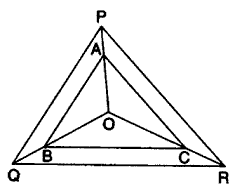
In figure $A, B$ and $C$ are points on $OP, OQ$ and $OR$ respectively such that $AB || PQ$ and $AC || PR$. Show that $BC || QR$.
Answer
In $\triangle OPQ,$$\because AB||PQ$
$\therefore \frac{{OA}}{{AP}} = \frac{{OB}}{{BQ}}$$......(1)$
By basic proportionality theorem
In $\triangle OPR,\,\,\,\because AV||PR$ $\therefore \frac{{OA}}{{AP}} = \frac{{OC}}{{CR}}$$.......[$By basic proportionality theorem$]$
From $(1)$ and $(2)$
$\frac{{OB}}{{BQ}} = \frac{{OC}}{{OR}}$
$\therefore BC||QR$$......[$By converse basic proportionality theorem$]$
View full question & answer
Question 292 Marks
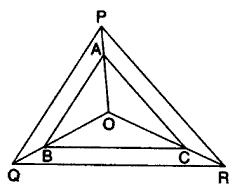
In figure $A, B$ and $C$ are points on $OP, OQ$ and $OR$ respectively such that $AB || PQ$ and $AC || PR$. Show that $BC || QR$.
Answer
In $\triangle OPQ,$$\because AB||PQ$
$\therefore \frac{{OA}}{{AP}} = \frac{{OB}}{{BQ}}$$......(1)$
By basic proportionality theorem
In $\triangle OPR,\,\,\,\because AV||PR$
$\therefore \frac{{OA}}{{AP}} = \frac{{OC}}{{CR}}$$.......[$By basic proportionality theorem$]$
From $(1)$ and $(2)$
$\frac{{OB}}{{BQ}} = \frac{{OC}}{{OR}}$
$\therefore BC||QR$$......[$By converse basic proportionality theorem$]$
View full question & answer
Question 302 Marks
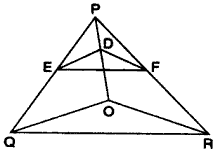
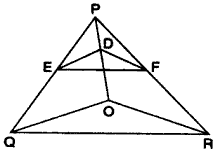
In figure, $DE || OQ$ and $DF || OR$. Show that $EF || QR$.

Answer
In $\triangle PQO$ $\because DE||OQ$
$\therefore \frac{{PD}}{{DO}} = \frac{{PE}}{{EQ}}$ $....... (1) [$By basic proportionality theorem$]$
In $\triangle PRO\,\because DF||OR$
$\therefore \frac{{PD}}{{DO}} = \frac{{PF}}{{FR}}$$....... (2) [$By basic proportionality theorem$]$
from $(1)$ and $(2)$, $\frac{{PE}}{{EQ}} = \frac{{PF}}{{FR}}$
$\therefore $ $EF||QR$ $...... [$By converse of basic proportionality theorem$]$
View full question & answer
Question 312 Marks
In figure, $DE || OQ$ and $DF || OR$. Show that $EF || QR$.
Answer
In $\triangle PQO$ $\because DE||OQ$
$\therefore \frac{{PD}}{{DO}} = \frac{{PE}}{{EQ}}$$ ....... (1) $[By basic proportionality theorem]
In $\triangle PRO\,\because DF||OR$
$\therefore \frac{{PD}}{{DO}} = \frac{{PF}}{{FR}}$$....... (2) $[By basic proportionality theorem]
from $(1)$ and $(2)$, $\frac{{PE}}{{EQ}} = \frac{{PF}}{{FR}}$
$\therefore $ $EF||QR$ ...... [By converse of basic proportionality theorem]
View full question & answer
Question 322 Marks
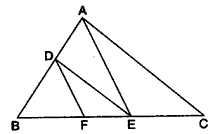
In figure $DE || AC$ and $DF || AE$. Prove that $\frac{{BF}}{{FE}} = \frac{{BE}}{{EC}}$
Answer
In $\triangle ABE,$ we have $DF||AE,$then
$\frac{{BD}}{{AD}} = \frac{{BF}}{{FE}}\,$ $[$By BPT$] ...... (i)$
In $\triangle ABC,$ we have $DE||AC,$ then
$\frac{{BD}}{{AD}} = \frac{{BE}}{{EC}}\,$ $[$By BPT$] ...... (2)$
From $(i)$ and $(2)$, We get
$\frac{{BF}}{{FE}} = \frac{{BE}}{{EC}}$
View full question & answer
Question 332 Marks
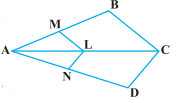
In the given figure, $L M \| C B$ and $\mathrm { LN } \| \mathrm { CD }$. Prove that $\frac { A M } { A B } = \frac { A N } { A D }$.
Answer
According to question it is given that In $\triangle ALM$, $L M \| C B$
$\therefore \quad \frac { A B } { A M } = \frac { A C } { A L }$ Therefore, by Thales' theorem
$\Rightarrow \frac { A M } { A B } = \frac { A L } { A C }$ $..........(i)$
In $\triangle ALN$, $L N \| C D$
$\therefore \quad \frac { A C } { A L } = \frac { A D } { A N }$ Therefore by Thales theorem
$\Rightarrow \frac { A L } { A C } = \frac { A N } { A D }$ $...........(ii)$
From $(i)$ and $(ii)$ we get
$\frac { A M } { A B } = \frac { A N } { A D }$
View full question & answer
Question 342 Marks
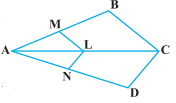
In the given figure, $L M \| C B$ and $\mathrm { LN } \| \mathrm { CD }$. Prove that $\frac { A M } { A B } = \frac { A N } { A D }$.
Answer
According to question it is given that In $\triangle ALM$, $L M \| C B$
$\therefore \quad \frac { A B } { A M } = \frac { A C } { A L }$
Therefore, by Thales' theorem
$\Rightarrow \frac { A M } { A B } = \frac { A L } { A C }$ $..........(i)$
In $\triangle ALN$, $L N \| C D$
$\therefore \quad \frac { A C } { A L } = \frac { A D } { A N }$
Therefore by Thales theorem
$\Rightarrow \frac { A L } { A C } = \frac { A N } { A D }$ $...........(ii)$
From $(i)$ and $(ii)$ we get
$\frac { A M } { A B } = \frac { A N } { A D }$
View full question & answer
Question 352 Marks
$E$ and $F$ are points on the sides $PQ$ and $PR$ respectively of a $\triangle$$PQR$. For $PQ = 1.28\ cm$, $PR = 2.56\ cm, PE = 0.18\ cm$ and $PF = 0.36\ cm,$ state whether $EF || QR.$ 
Answer
We have
$PQ = 1.28\ cm, PR = 2.56\ cm, PE = 0.18\ cm, PF = 0.36\ cm$
$EQ = PQ - PE = 1.28 - 0.18 = 1.10\ cm$
and $FR = PR - PF = 2.56 - 0.36 = 2.20\ cm$
Now we can find
$\frac{{PE}}{{EQ}} = \frac{{0.18}}{{1.10}} = \frac{9}{{55}}$
$\frac{{PF}}{{PR}} = \frac{{0.36}}{{2.20}} = \frac{9}{{55}}$ $\therefore \frac{{PE}}{{EQ}} = \frac{{PF}}{{FR}}$
$\therefore EF ||QR$ (By converse of basic proportionality theorem)
View full question & answer
Question 362 Marks
$E$ and $F$ are points on the sides $PQ$ and $PR$ respectively of a $\triangle$$PQR$. For $PQ = 1.28\ cm, PR = 2.56\ cm, PE = 0.18\ cm$ and $PF = 0.36\ cm$, state whether $EF || QR$.
Answer
We have
$PQ = 1.28\ cm, PR = 2.56\ cm, PE = 0.18\ cm, PF = 0.36\ cm$
$EQ = PQ - PE = 1.28 - 0.18 = 1.10\ cm$
and $FR = PR - PF = 2.56 - 0.36 = 2.20\ cm$
Now we can find
$\frac{{PE}}{{EQ}} = \frac{{0.18}}{{1.10}} = \frac{9}{{55}}$
$\frac{{PF}}{{PR}} = \frac{{0.36}}{{2.20}} = \frac{9}{{55}}$
$\therefore \frac{{PE}}{{EQ}} = \frac{{PF}}{{FR}}$
$\therefore EF ||QR$ (By converse of basic proportionality theorem)
View full question & answer
Question 372 Marks
It is given that E and F are points on the sides $PQ$ and $PR$ respectively of a $\triangle$$PQR$. For $PE = 4\ cm, QE = 4.5\ cm, PF = 8\ cm$ and $RF = 9\ cm$, state whether $EF||QR$.
Answer
From the given information, we can have
$\frac{{PE}}{{EQ}} = \frac{4}{{4.5}} = \frac{{40}}{{45}} = \frac{8}{9}.....(I)$
$\frac{{PF}}{{RF}} = \frac{8}{9}....(II)$
From $(I)$ and $(II)$, it is clear that $\frac{{PE}}{{QE}} = \frac{{PF}}{{RF}}$
Therefore, $EF||QR$ (By converse of basic proportionality theorem)
View full question & answer
Question 382 Marks
It is given that $E$ and $F$ are points on the sides $PQ$ and $PR$ respectively of a $\triangle$$PQR$. For $PE = 4\ cm, QE = 4.5\ cm, PF = 8\ cm$ and $RF = 9\ cm$, state whether $EF||QR$.
Answer
From the given information, we can have
$\frac{{PE}}{{EQ}} = \frac{4}{{4.5}} = \frac{{40}}{{45}} = \frac{8}{9}.....(I)$
$\frac{{PF}}{{RF}} = \frac{8}{9}....(II)$
From $(I)$ and $(II)$, it is clear that $\frac{{PE}}{{QE}} = \frac{{PF}}{{RF}}$
Therefore, $EF||QR$ (By converse of basic proportionality theorem)
View full question & answer
Question 392 Marks
$E$ and $F$ are points on the sides $PQ$ and $PR$ respectively of a $\triangle$$PQR$. For $PE = 3.9\ cm, EQ = 3\ cm, PF = 3.6\ cm$ and $FR = 2.4\ cm$ case, state whether $EF || QR$.
Answer
We have
$\frac{{PE}}{{EQ}} = \frac{{3.9}}{3} = \frac{{1.3}}{1}.....(I)$
$\frac{{PF}}{{FR}} = \frac{{3.6}}{{2.4}} = \frac{3}{2} = \frac{{1.5}}{1}....(II)$
From $(I)$ and $(II)$,
we get
$\frac{{PE}}{{EQ}} \ne \frac{{PF}}{{FR}}$
Therefore, $EF$ is not parallel to $QR$. (By converse of basic proportionality theorem)
View full question & answer
Question 402 Marks
$E$ and $F$ are points on the sides $PQ$ and $PR$ respectively of a $\triangle$ $PQR$. For $PE = 3.9\ cm, EQ = 3\ cm, PF = 3.6\ cm$ and $FR = 2.4\ cm$ case, state whether $EF || QR$.
Answer
We have
$\frac{{PE}}{{EQ}} = \frac{{3.9}}{3} = \frac{{1.3}}{1}.....(I)$
$\frac{{PF}}{{FR}} = \frac{{3.6}}{{2.4}} = \frac{3}{2} = \frac{{1.5}}{1}....(II)$
From $(I)$ and $(II),$
we get
$\frac{{PE}}{{EQ}} \ne \frac{{PF}}{{FR}}$
Therefore, $EF$ is not parallel to $QR.$ $($By converse of basic proportionality theorem$)$
View full question & answer
Question 412 Marks
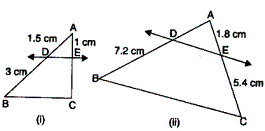
In figure $(i)$ and $(ii), DE || BC$.
Find $EC$ in $(i)$ and $AD$ in $(ii)$
Answer
In $\triangle ABC,$
  1. ​​​​ $\because DE||BC$
    $\therefore \frac{{AD}}{{DB}} = \frac{{AE}}{{EC}}$ ..... By Basic Proportionality theorem
    $\Rightarrow \frac{{1.5}}{3} = \frac{1}{{EC}}$
    $\Rightarrow EC = \frac{3}{{1.5}}$$EC = 2cm$
  2. In​​​​​​​ $\vartriangle ABC,\because DE||BC$
    $\therefore \frac{{AD}}{{DB}} = \frac{{AE}}{{EC}}......$By Basic Proportionality theorem​​​​​​​
    $\therefore \frac{{AD}}{{DB}} = \frac{{1.8}}{{5.4}}$
    $\Rightarrow \frac{{7.2 \times 1.8}}{{5.4}}$
    $\Rightarrow$ $AD = 2.4cm$
View full question & answer
Question 422 Marks
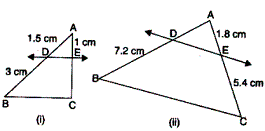
In figure $(i)$ and $(ii), DE || BC$.
Find $EC$ in $(i)$ and $AD$ in $(ii)$
Answer
In $ \triangle ABC,$
  1. ​​​​ $ \because DE||BC$
    $ \therefore \frac{{AD}}{{DB}} = \frac{{AE}}{{EC}}$ ..... By Basic Proportionality theorem
    $ \Rightarrow \frac{{1.5}}{3} = \frac{1}{{EC}}$
    $ \Rightarrow EC = \frac{3}{{1.5}}$ $EC = 2\ cm$
  2. In​​​​​​​ $ \vartriangle ABC,\because DE||BC$
    $ \therefore \frac{{AD}}{{DB}} = \frac{{AE}}{{EC}}......$ By Basic Proportionality theorem​​​​​​​
    $ \therefore \frac{{AD}}{{DB}} = \frac{{1.8}}{{5.4}}$
    $ \Rightarrow \frac{{7.2 \times 1.8}}{{5.4}}$
    $ \Rightarrow$ $AD = 2.4\ cm$
View full question & answer
Question 432 Marks
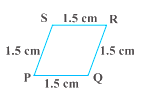
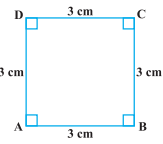
State whether the following quadrilaterals are similar or not:
Answer
The given quadrilateral $PQRS$ and $ABCD$ are not similar because their corresponding sides are proportional, i.e. $1:2$, but their corresponding angles are not equal. Or we can say that $PQRS$ is a rhombus and $ABCD$ is a square, so they cannot be similar.
View full question & answer
Question 442 Marks
In Figure, $OA$ $\cdot$ $OB = OC$ $\cdot$ $OD$. Show that ​$\angle$​ $A =$ ​$\angle$$C$ and ​$\angle$$B =$ ​$\angle$$D$
Answer
In ​$\triangle $$​AOD$ and ​$\triangle $$BOC$,
$OA$ ​$ \times$​ $OB = ​OC$ $ \times$ $OD​$
i.e $\frac{{OA}}{{OC}} = \frac{{OD}}{{OB}}$
And ​$\angle$​ $AOD =$ ​$\angle$​ $BOC [$Vertically opposite Angles$]$
​$\therefore $​ ​$\triangle $$​AOD$ ​$ \sim $​$\triangle $$BOC [$By $SAS]$
​$\therefore $​ ​$\angle$​$A =$ ​$\angle$​$C$ and ​$\angle$​$B =$ ​$\angle$$D [$Corresponding angles of similar ​$\triangle $​ $]$
View full question & answer
Question 452 Marks
In Figure, $OA$ $\cdot$ $OB = OC$ $\cdot$ $OD$. Show that ​$\angle$​ $A =$ ​$\angle$$C$ and ​$\angle$$B =$ ​$\angle$$D$
Answer
In ​$\triangle ​$$AOD$ and ​$\triangle $$BOC$,
$OA$ ​$ \times$​ $OB = ​OC$ $ \times$ $OD​$
i.e $\frac{{OA}}{{OC}} = \frac{{OD}}{{OB}}$
And ​$\angle$​ $AOD =$ ​$\angle$​ $BOC [$Vertically opposite Angles$]$
​$\therefore $​ ​$\triangle $​$AOD$ ​$ \sim $​$\triangle $$BOC [$By $SAS]$
​$\therefore $​ ​$\angle$​$A =$ ​$\angle$​$C$ and ​$\angle$​$B =$ ​$\angle$$D [$Corresponding angles of similar ​$\triangle $​ $]$
View full question & answer
Question 462 Marks
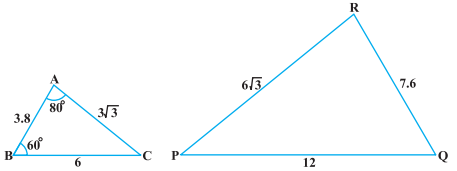
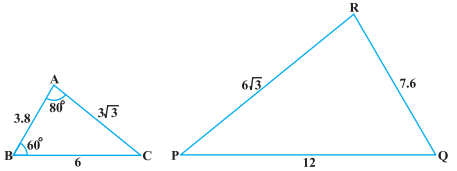
Observe the Fig. given below and then find $\angle$$P$.
Answer
In $\triangle$$ABC$ and $\triangle$$PQR$,
$\frac{\mathrm{AB}}{\mathrm{RQ}}=\frac{3.8}{7.6}=\frac{1}{2}, \frac{\mathrm{BC}}{\mathrm{QP}}=\frac{6}{12}=\frac{1}{2} $ and $\frac{\mathrm{CA}}{\mathrm{PR}}=\frac{3 \sqrt{3}}{6 \sqrt{3}}=\frac{1}{2}$
That is, $\frac{\mathrm{AB}}{\mathrm{RQ}}=\frac{\mathrm{BC}}{\mathrm{QP}}=\frac{\mathrm{CA}}{\mathrm{PR}}$
So,$\triangle \mathrm{ABC} \sim \triangle \mathrm{RQP}$ $(SSS$ similarity criterion$)$
Therefore, $\angle$$C =$ $\angle$$P ($Corresponding angles of similar triangles$)$
But $\angle$$C = 180^\circ –$ $\angle$$A –$ $\angle$$B ($Angle sum property of triangle$)$
$\angle$$C = 180^\circ – 80^\circ – 60^\circ$
$\angle$$C = 40^\circ$
So, $\angle$$P = 40^\circ$
View full question & answer
Question 472 Marks
Observe the Fig. given below and then find $\angle$$P$.
Answer
In $\triangle$$ABC$ and $\triangle$$PQR$,
$\frac{\mathrm{AB}}{\mathrm{RQ}}=\frac{3.8}{7.6}=\frac{1}{2}, \frac{\mathrm{BC}}{\mathrm{QP}}=\frac{6}{12}=\frac{1}{2} $ and $\frac{\mathrm{CA}}{\mathrm{PR}}=\frac{3 \sqrt{3}}{6 \sqrt{3}}=\frac{1}{2}$
That is, $\frac{\mathrm{AB}}{\mathrm{RQ}}=\frac{\mathrm{BC}}{\mathrm{QP}}=\frac{\mathrm{CA}}{\mathrm{PR}}$
So,$\triangle \mathrm{ABC} \sim \triangle \mathrm{RQP}$ $(SSS $similarity criterion$)$
Therefore, $\angle$$C =$ $\angle$$P ($Corresponding angles of similar triangles$)$
But $\angle$$C = 180^\circ –$ $\angle$$A – $$\angle$$B ($Angle sum property of triangle$)$ 
$\angle$$C = 180^\circ – 80^\circ – 60^\circ$
$\angle$$C = 40^\circ$
So, $\angle$$P = 40^\circ$
View full question & answer
Question 482 Marks
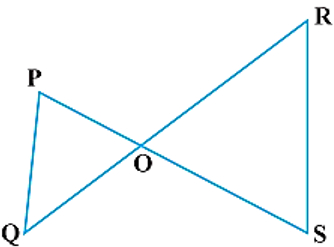
In Figure, if $PQ || RS$, prove that $\triangle POQ \sim \triangle SOR$.
Answer
From the given figure we have,
$PQ || RS ($Given$)$
So, $\angle$$P =$ $\angle$$S ($Alternate angles$)$
and $\angle$$Q =$ $\angle$$R ($Alternate angles$)$
Also, $\angle$$POQ =$ $\angle$$SOR ($Vertically opposite angles$)$
Therefore, $\triangle POQ \sim \triangle SOR$ $(AAA$ similarity criterion$)$
View full question & answer
Question 492 Marks
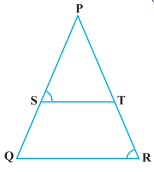
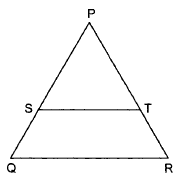
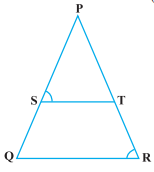
In Fig. $\frac { P S } { S Q } = \frac { P T } { T R }$ and $\angle P S T = \angle P R Q.$ Prove that $ \triangle$$PQR$ is an isosceles triangle.
Answer
According to the question,we are given that,
$\frac { P S } { S Q } = \frac { P T } { T R }$

$\Rightarrow \quad S T \| Q R$ $[$By using the converse of Basic Proportionality Theorem$]$
$\Rightarrow \quad \angle P S T = \angle P Q R$ $[$Corresponding angles$]$
$\Rightarrow \quad \angle P R Q = \angle P Q R$ $[ \because \angle P S T = \angle P R Q ( \text { Given } ) ]$
$\Rightarrow$ $PQ = PR [$ $\because$ Sides opposite to equal angles are equal$]$
$\Rightarrow \quad \Delta$ $PQR$ is isosceles.
View full question & answer
Question 502 Marks
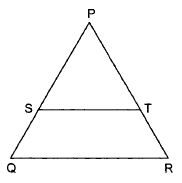
In Fig. $\frac { P S } { S Q } = \frac { P T } { T R }$ and $\angle P S T = \angle P R Q.$ Prove that $ \triangle$$PQR$ is an isosceles triangle.
Answer
According to the question,we are given that,
$\frac { P S } { S Q } = \frac { P T } { T R }$

$\Rightarrow \quad S T \| Q R$ $[$By using the converse of Basic Proportionality Theorem$]$
$\Rightarrow \quad \angle P S T = \angle P Q R$ [Corresponding angles]
$\Rightarrow \quad \angle P R Q = \angle P Q R$ $[ \because \angle P S T = \angle P R Q ( \text { Given } ) ]$
$\Rightarrow$ $PQ = PR [$ $\because$ Sides opposite to equal angles are equal$]$
$\Rightarrow \Delta$ $PQR$ is isosceles.
View full question & answer