Questions · Page 2 of 2

3 Marks Question

Question 513 Marks
The diagonals of a quadrilateral ABCD intersect each other at the point O such that  $\frac{{AO}}{{BO}} = \frac{{CO}}{{DO}}$. Show that ABCD is a trapezium.
Answer
Given: The diagonals of a quadrilateral ABCD intersect each other at the point O such that $\frac{{AO}}{{BO}} = \frac{{CO}}{{DO}}$
To prove: ABCD is trapezium.
Construction: Through O draw a line OE||BA intersecting AD at E.
Proof: In $\triangle DBA$$\because OE||BA$
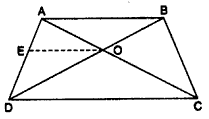
 
$\therefore \frac{{DO}}{{BO}} = \frac{{DE}}{{AE}} \Rightarrow \frac{{CO}}{{AO}} = \frac{{DE}}{{AE}}$
$\because \frac{{AO}}{{BO}} = \frac{{CO}}{{DO}}\,[Given]$
$\Rightarrow \frac{{DO}}{{BO}} = \frac{{CO}}{{AO}} \Rightarrow \frac{{AO}}{{CO}} = \frac{{AE}}{{DE}}$.........[Taking reciprocals]
$\therefore $In $\triangle ADC$
OE $\parallel$ CD ...........[By converse basic proportionality theorem]
But OE $\parallel$ BA
BA $\parallel$ CD........[By construction]
The quadrilateral ABCD is a Trapezium.
View full question & answer
Question 523 Marks

Give two different examples of each of the following:

  1. similar figures.
  2. non-similar figures.
Answer
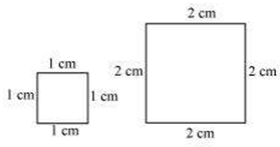
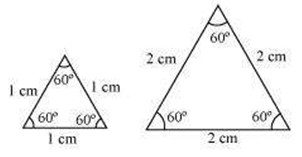
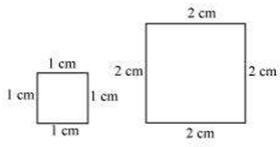
  1. Two examples of similar figures are:
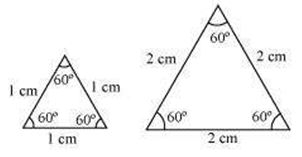
    1. Two equilateral triangles with sides 1 cm and 2 cm respectively
    2. Two squares with sides 1 cm and 2 cm respectively
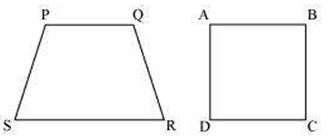
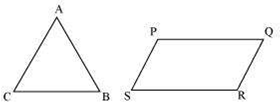
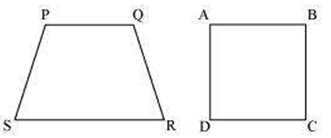
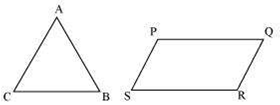
  2. Now two examples of non-similar figures are:
    1. Trapezium and square
    2. Triangle and parallelogram
View full question & answer
Question 533 Marks
Give two different examples of each of the following:
  1. similar figures.
  2. non-similar figures.
Answer
  1. Two examples of similar figures are:
    1. Two equilateral triangles with sides 1 cm and 2 cm respectively
    2. Two squares with sides 1 cm and 2 cm respectively
  2. Now two examples of non-similar figures are:
    1. Trapezium and square
    2. Triangle and parallelogram
View full question & answer
Question 543 Marks
Answer
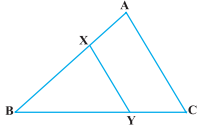
Since XY $\parallel$ AC
​$\therefore $​ ​$\angle$​BXY = ​$\angle$​BAC
​$\angle$​BYX = ​$\angle$BCA​ [Corresponding angles]
​$\therefore $​ ​$\triangle $​BXY ​$\cong$​ $\triangle $BAC [AA similarity]
​$\therefore $​ ​​  $\frac{{ar\left( {\triangle BXY} \right)}}{{ar\left( {\triangle BAC} \right)}} = \frac{{B{X^2}}}{{B{A^2}}}$
But ar(​$\triangle $​BXY)=ar(XYCA)
​$\therefore $​ 2(​$\triangle $​BXY)=ar($\triangle $BXY)+ar(XYCA)
= ar($\triangle $BAC)
$\therefore \frac{{ar\left( {\triangle BXY} \right)}}{{ar\left( {\triangle BAC} \right)}} = \frac{1}{2}$
$\therefore \frac{{B{X^2}}}{{B{A^2}}} = \frac{1}{2}$
​$\Rightarrow $​ $\therefore \frac{{BX}}{{BA}} = \frac{1}{{\sqrt 2 }}$
​$\therefore $​$\frac{{BA - BX}}{{BA}} = \frac{{\sqrt 2 - 1}}{{\sqrt 2 }}$
​$\Rightarrow $​$\frac{{AX}}{{AB}} = \frac{{\sqrt 2 - 1}}{{\sqrt 2 }} = \frac{{2 - \sqrt 2 }}{2}$
View full question & answer
Question 553 Marks
Answer
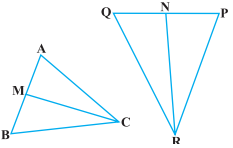
  1. $\triangle$ABC $\sim\triangle$PQR (Given)
    So, $\frac{A B}{P Q}=\frac{B C}{Q R}=\frac{C A}{R P}$ ...(1) (corresponding sides of similar triangles are proportional)
    and $\angle$A = $\angle$P, $\angle$B = $\angle$Q and $\angle$C = $\angle$R ...(2)
    But AB = 2 AM and PQ = 2 PN (As CM and RN are medians)
    So, from (1),
    i.e., $\frac{A M}{P N}=\frac{C A}{R P}$ ...(3)
    Also, ∠ MAC = ∠ NPR [From (2)] ...(4)
    So, from (3) and (4),
    $\triangle$AMC $\sim\triangle$PNR (SAS similarity criterion) ...(5)
  2. From (5), $\frac{\mathrm{CM}}{\mathrm{RN}}=\frac{\mathrm{CA}}{\mathrm{RP}}$  ...(6) (corresponding sides of similar triangles are proportional)
    But $\frac{C A}{R P}=\frac{A B}{P Q}$ [From (1)] ...(7)
    Therefore,$\frac{C M}{R N}=\frac{A B}{P Q}$ [From (6) and (7)] ...(8)
  3. Again,$\frac{A B}{P Q}=\frac{B C}{Q R}$  [From (1)]
    Therefore $\frac{\mathrm{CM}}{\mathrm{RN}}=\frac{\mathrm{BC}}{\mathrm{QR}}$ [From (8)] ...(9)
    Also, $\frac{C M}{R N}=\frac{A B}{P Q}=\frac{2 B M}{2 Q N}$
    i.e., $\frac{\mathrm{CM}}{\mathrm{RN}}=\frac{\mathrm{BM}}{\mathrm{QN}}$ ...(10)
    i.e.,$\frac{\mathrm{CM}}{\mathrm{RN}}=\frac{\mathrm{BC}}{\mathrm{QR}}=\frac{\mathrm{BM}}{\mathrm{QN}}$ [From (9) and (10)]
    Therefore, $\triangle$CMB $\sim\triangle$RNQ (SSS similarity criterion)
View full question & answer
Question 563 Marks

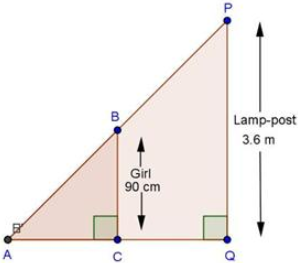
A girl of height 90 cm is walking away from the base of a lamp-post at a speed of 1.2 m/sec. If the lamp is 3.6 m above the ground, find the length of her shadow after 4 seconds.

View full question & answer
Question 573 Marks
A girl of height 90 cm is walking away from the base of a lamp-post at a speed of 1.2 m/sec. If the lamp is 3.6 m above the ground, find the length of her shadow after 4 seconds.
Answer
We have,

Height of girl = 90 cm = 0.9 m
Height of lamp-post = 3.6 m
Speed of girl = 1.2 m/sec
Time taken = 4 sec.
$\therefore$ Distance moved by girl (CQ) = Speed $\times$ Time
= 1.2 $\times$ 4
= 4.8 m
Let length of shadow (AC) = x cm
In $\Delta$ABC and $\Delta$APQ
$\angle ACB = \angle AQP$ [Each 90°]
$\angle BAC = \angle PAQ$ [Common]
Then, $\Delta$ABC ~ $\Delta$APQ [By AA similarity]
$\therefore \frac{{AC}}{{AQ}} = \frac{{BC}}{{PQ}}$ [Corresponding parts of similar $\Delta$ are proportional]
$ \Rightarrow \frac{x}{{x + 4.8}} = \frac{{0.9}}{{3.6}}$
$\Rightarrow \frac{x}{{x + 4.8}} = \frac{1}{4}$
$\Rightarrow$ 4x = x + 4.8
$\Rightarrow$ 4x - x = 4.8
$\Rightarrow$ 3x = 4.8
$\Rightarrow x = \frac{{4.8}}{3} = 1.6m$
$\therefore$ Length of shadow = 1.6 m
View full question & answer
Question 583 Marks
View full question & answer
Question 593 Marks
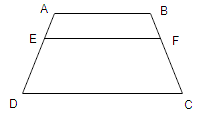
ABCD is a trapezium with AB || DC. E and F are two points on non-parallel sides AD and BC respectively, such that EF is parallel to AB. Show that $\frac{AE}{ED}=\frac{BF}{FC}$ 
Answer
Given, In trapezium ABCD,
$AB || DC$ and $EF || DC$ 
To prove $\frac{AE}{ED}=\frac{BF}{FC}$ 
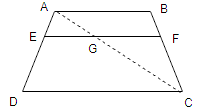
Construction: Join AC to intersect EF at G.

Proof Since, $AB || DC$ and $EF || DC$ 
$EF || AB$ [since, lines parallel to the same line are also parallel to each other ]...... (i)
In $\triangle ADC$, $EG || DC$ [$\because $ $EF || DC$]
By using basic proportionality theorem,
$\frac{AE}{ED}=\frac{AG}{GC}$ ....(ii)
In $\triangle ABC$, $ GF || AB$ [$\because $ $EF || AB$  from (i)]
By using basic proportionality theorem ,
$\frac{CG}{AG}=\frac{CF}{BF}$ or $\frac{AG}{GC}=\frac{BF}{CF}$ [ On taking reciprocal of the terms]............. (iii)
From Equations (ii) and (iii), we get
$\frac{AE}{ED}=\frac{BF}{FC}$ 
Hence Proved.
View full question & answer
Question 603 Marks
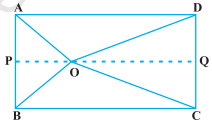
$O$ is any point inside a rectangle $ABCD$ see Fig. Prove that $OB^2 + OD^2 = OA^2 + OC^2 .$
Answer
Through $O,$ draw $PQ \| BC$ so that $P$ lies on $AB$ and $Q$ lies on $DC.$
Now, $PQ \| BC$
Therefore, $PQ \perp AB$ and $PQ \perp DC  ( \angle B =  90^{\circ}$ and $\angle C = 90^\circ )$
So, $\angle BPQ = 90^\circ$ and $\angle CQP = 90^\circ$
Therefore, $BPQC$ and $APQD$ are both rectangles.
Now, from $\triangle OPB$
$OB^2 = BP^2 + OP^2 ...(1)$
Similarly, from $\triangle OQD,$
$OD^2 = OQ^2 + DQ^2 ...(2)$
From $\triangle OQC,$ we have
$OC^2 = OQ^2 + CQ^2...(3)$
and from $\triangle OAP,$ we have
$OA^2 = AP^2 + OP^2 ...(4)$
Adding $(1)$ and $(2),$
$OB^2 + OD^2 = BP^2 + OP^2+ OQ^2 + DQ^2$
$= CQ^2 + OP^2 + OQ^2 + AP^2 ($As $BP = CQ$ and $DQ = AP)$
$= CQ^2 + OQ^2 + OP^2 + AP^2$
$OB^2 + OD^2= OC^2 + OA^2 [$From $(3)$ and $(4)]$
Hence proved.
View full question & answer
Question 613 Marks
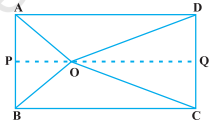
$O$ is any point inside a rectangle $ABCD$ see Fig. Prove that $OB^2 + OD^2 = OA^2 + OC^2$
.
Answer
Through $O,$ draw $PQ \| BC$ so that $P$ lies on $AB$ and $Q$ lies on $DC.$
Now, $PQ \| BC$
Therefore, $PQ \perp AB$ and $PQ \perp  DC ( \angle B = 90^\circ$ and $\angle C = 90^\circ )$
So, $\angle BPQ = 90^\circ$ and $\angle CQP = 90^\circ$
Therefore, $BPQC$ and $APQD$ are both rectangles.
Now, from $\triangle OPB$
$OB^2 = BP^2 + OP^2 ...(1)$
Similarly, from $\triangle OQD,$
$OD^2 = OQ^2 + DQ^2 ...(2)$
From $\triangle OQC,$ we have
$OC^2 = OQ^2 + CQ^{2 }...(3)$
and from $\triangle OAP,$ we have
$OA^2 = AP^2 + OP^2 ...(4)$
Adding $(1)$ and $(2),$
$OB^2 + OD^2 = BP^2 + OP^2+ OQ^2 + DQ^2$
$= CQ^2 + OP^2 + OQ^2 + AP^2 ($As $BP = CQ$ and $DQ = AP)$
$= CQ^2 + OQ^2 + OP^2 + AP^2$
$OB^2 + OD^{2 }= OC^2 + OA^2 [$From $(3)$ and $(4)]$
Hence proved.
View full question & answer
Question 623 Marks
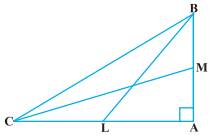
$BL$ and $CM$ are medians of ​$\triangle $​ABC$ right angled at $A.$ Prove that $4(BL^2+ CM^2) = 5BC^2$
Answer

$BL$ and $CM$ are medians of a $\triangle ABC$ in which $\angle  A=90^\circ$
From $\triangle  ABC, BC^2 = AB^2 + AC^2 ....(i)$
From right angled $ \vartriangle ABL,$
$BL^2 = AL^2+ AB^2$
i.e $B{L^2} = {\left( {\frac{{AC}}{2}} \right)^2} + A{B^2}$
$\Rightarrow  4BL^2= AC^2+ 4AB^2 .....(ii)$
From right angled  $\triangle CMA,$
$CM^2 = AC^2+ AM^2$
i.e $C{M^2} = A{C^2} + {\left( {\frac{{AB}}{2}} \right)^2}[$mid$-$point$]$
$\Rightarrow  C{M^2} = A{C^2} + \frac{{A{B^2}}}{4}$
$\Rightarrow  4C{M^2} = 4A{C^2} + A{B^2} .....(iii)$
Adding $(ii)$ and $(iii),$ we get
i.e. $4(BL^2 + CM^{2)} = 5(AC^2+ AB^2) = 5BC^2 [$From $(i)]$
View full question & answer
Question 633 Marks
$BL$ and $CM $ are medians of ​$\triangle ​ABC$ right angled at $A.$ Prove that $4(BL^2+ CM^2) = 5BC^2$​​​​​​​
Answer

$BL$ and $CM$ are medians of a $\triangle ABC$ in which $\angle A=90^\circ$
From $\triangle ABC, BC^2 = AB^2 + AC^2 ....(i)$
From right angled $ \triangle ABL,$
$BL^2 = AL^2+ AB^2$
i.e $B{L^2} = {\left( {\frac{{AC}}{2}} \right)^2} + A{B^2}$
$\Rightarrow 4BL^2= AC^2+ 4AB^2 .....(ii)$
From right$-$angled $\triangle CMA,$
$CM^2 = AC^2+ AM^2$
i.e $C{M^2} = A{C^2} + {\left( {\frac{{AB}}{2}} \right)^2}[$mid$-$point$]$
$\Rightarrow  C{M^2} = A{C^2} + \frac{{A{B^2}}}{4}$
$\Rightarrow  4C{M^2} = 4A{C^2} + A{B^2} .....(iii)$
Adding $(ii)$ and $(iii),$ we get
i.e. $4(BL^2 + CM^{2)} = 5(AC^2+ AB^2) = 5BC^2 [$From $(i)]$
View full question & answer
Question 643 Marks
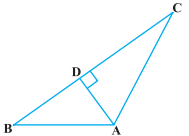
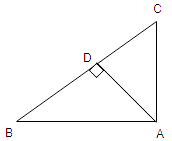
In the given figure, if $AD \bot BC$, prove that $AB^2 + CD^2 = BD^2 + AC^2.$
Answer

In right angled $\triangle BDA$,
By pythagoras theorem
$AB^2 = AD^2 + BD^2 ...(i)$
And in right angled $\triangle CDA$ ,
By pythagoras theorem
$AC^2 = CD^2 + AD^2 ...(ii)$
On subtracting Eq$(ii)$ from Eq$(i) ,$ we get
$AB^2 - AC^2 = [AD^2 + BD^2] - [CD^2 + AD^2]$
$AB^2 - AC^2 = AD^2 + BD^2 - CD^2 - AD^2$
$AB^2 - AC^2 = BD^2 - CD^2$
$\therefore AB^2 + CD^2 = BD^2 + AC^2$​​​​​​​
View full question & answer
Question 653 Marks
Answer

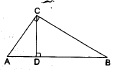
 ​​​​​​In $\triangle $ACD and $\triangle $ ABC $\angle A = \angle A $ (Common)  $\angle ADC = \angle ACB$ ( each 90°) Thus, By AA similarity criteria  $\triangle ADC \sim \triangle ACB$ Thus, $\frac {AD} {AC} = \frac {AC} {AB} $ $\Rightarrow AC^2 = AD ×AB$... (i)  Similarly, $$$\triangle CDB \sim \triangle ACB $ And, $\frac {DC} {BC} = \frac {BC} {AB} $ $\Rightarrow BC^2 = DB ×AB$... (ii)  Dividing (ii) by (i)  $\frac {BC^2 } {AC^2 } = \frac {DB} {AD} $ Hence Proved  $$
View full question & answer
Question 663 Marks
Answer
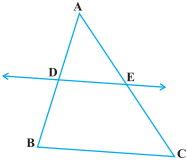
DE || BC (Given)
therefore $\frac{\mathrm{AD}}{\mathrm{DB}}=\frac{\mathrm{AE}}{\mathrm{EC}}$    (by BPT)
or $\frac{D B}{A D}=\frac{E C}{A E}$     (by taking reciprocal on both sides)
or $\frac{D B}{A D}+1=\frac{E C}{A E}+1$   (add 1 on both sides)
we get  $\frac{A B}{A D}=\frac{A C}{A E}$
So $\frac{A D}{A B}=\frac{A E}{A C}$
Hence proved
View full question & answer
Question 673 Marks
If in two triangles, sides of one triangle are proportional to (i.e., in the same ratio of ) the sides of the other triangle, then their corresponding angles are equal and hence the two triangles are similiar.
Answer
Image
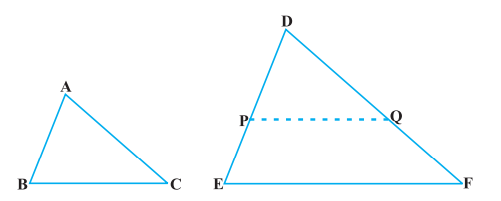
This theorem can be proved by taking two triangles $ABC$ and $DEF$ such that $\frac{ AB }{ DE }=\frac{ BC }{ EF }=\frac{ CA }{ FD }(<1)($ see Fig. 6.26):
Cut $DP = AB$ and $DQ = AC$ and join $PQ$.
It can be seen that $\frac{ DP }{ PE }=\frac{ DQ }{ QF }$ and $PQ \| EF$ (How?)
So, $\angle P =\angle E$ and $\angle Q =\angle F$.
Therefore,
$\frac{ DP }{ DE }=\frac{ DQ }{ DF }=\frac{ PQ }{ EF }$
So,
$\frac{ DP }{ DE }=\frac{ DQ }{ DF }=\frac{ BC }{ EF } \quad \text { (Why?) }$
So,
$BC = PQ \quad \text { (Why?) }$
Thus,
$\Delta ABC \cong \Delta DPQ$
(Why ?)
So,
$\angle A =\angle D , \angle B =\angle E \text { and } \angle C =\angle F \text { (How ?) }$
View full question & answer
Question 683 Marks
If one angle of a triangle is equal to one angle of the other triangle and the sides including these angles are proportional, then the two triangles are similar
Answer
Image
This criterion is referred to as the SAS (Side-Angle-Side) similarity criterion for two triangles.
As before, this theorem can be proved by taking two triangles $ABC$ and DEF such that $\frac{ AB }{ DE }=\frac{ AC }{ DF }(<1)$ and $\angle A =\angle D$ (see Fig. 6.28). Cut DP = AB, DQ $= AC$ and join $PQ$.
$\text { Now, } PQ \| EF \text { and } \triangle ABC \cong \triangle DPQ $
$\text { So, } \angle A =\angle D , \angle B =\angle P \text { and } \angle C =\angle Q $
$\text { Therefore, } \Delta ABC \sim \Delta DEF $
$\text { We now take some examples to illustrate the use of these criteria. }$
View full question & answer
3 Marks Question - Page 2 - Maths STD 10 Questions - Vidyadip