Questions

4 Marks Questions

🎯

Test yourself on this topic

10 questions · timed · auto-graded

Question 14 Marks
If a line is drawn parallel to one side of a triangle to intersect the other two sides in distinct points, the other two sides are divided in the same ratio.
Answer
Image
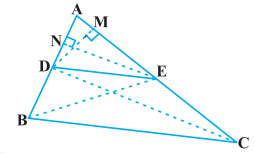
Proof: We are given a triangle $A B C$ in which a line parallel to side $BC$ intersects other two sides $AB$ and $AC$ at $D$ and $E$ respectively $($see Fig. $6.10)$.
We need to prove that $\frac{ AD }{ DB }=\frac{ AE }{ EC }$.
Let us join $BE$ and $CD$ and then draw $DM \perp AC$ and $EN \perp AB$.
Now, area of $\triangle ADE \left(=\frac{1}{2}\right.$ base $\times$ height $)=\frac{1}{2} AD \times EN$.
Recall from Class $IX,$ that area of $\triangle ADE$ is denoted as $\operatorname{ar}( ADE )$.
So,
$\operatorname{ar}( ADE )=\frac{1}{2} AD \times EN$
Similarly,
$\operatorname{ar}( BDE )=\frac{1}{2} DB \times EN ,$
$\operatorname{ar}( ADE )=\frac{1}{2} AE \times DM \text { and } \operatorname{ar}( DEC )=\frac{1}{2} EC \times DM .$
Therefore,
$\frac{\operatorname{ar}( ADE )}{\operatorname{ar}( BDE )}=\frac{\frac{1}{2} AD \times EN }{\frac{1}{2} DB \times EN }=\frac{ AD }{ DB }$
and
$\frac{\operatorname{ar}( ADE )}{\operatorname{ar}( DEC )}=\frac{\frac{1}{2} AE \times DM }{\frac{1}{2} EC \times DM }=\frac{ AE }{ EC }$
Note that $\triangle BDE$ and $DEC$ are on the same base $DE$ and between the same parallels $BC$ and $DE$.
So,
$\operatorname{ar}( BDE )=\operatorname{ar}( DEC )$
Therefore, from $(1), (2)$ and $(3),$ we have :
$\frac{ AD }{ DB }=\frac{ AE }{ EC }$
Is the converse of this theorem also true $($For the meaning of converse, see Appendix $1)?$ To examine this, let us perform the following activity:
View full question & answer
Question 24 Marks
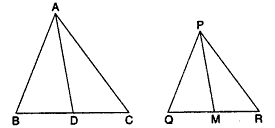
If $AD$ and $PM$ are medians of triangles $ABC$ and $PQR,$ respectively where $\triangle   ABC   \sim \triangle PQR,$ Prove that $\frac{{AB}}{{PQ}} = \frac{{AD}}{{PM}}$
Answer
Given: $AD$ and $PM$ are median of triangles $ABC$ and $PQR$ respectively where $\triangle ABC \sim \triangle PQR$

To prove: $\frac{{AB}}{{PQ}} = \frac{{AD}}{{PM}}$
Proof: $\triangle ABC \sim \triangle PQR ........$Given
$\therefore \frac{{AB}}{{PQ}} = \frac{{BC}}{{QR}} = \frac{{CA}}{{RP}} .......(1).....[ \because$ Corresponding sides of two similar triangles are proportional$]$
and $\angle A = \angle P, \angle B = \angle Q, \angle C = \angle R, ..........(2) [ \because$ corresponding sides of two similar triangles are proportional$]$
But $BC = 2BD$ and $QR = 2QM.............. \because AD$ and $PM$ are medians
So, from$(1), \frac{{AB}}{{PQ}} = \frac{{2BD}}{{2QM}}$
$\Rightarrow \frac{{AB}}{{PQ}} = \frac{{BD}}{{QM}} ........(3)$
Also, $\angle ABD = \angle PQM .........(4)..........$ From $(2)$
$\therefore \triangle ABD \sim \triangle PQM .......SAS$ similarity criterion
$\therefore \frac{{AB}}{{PQ}} = \frac{{AD}}{{PM}} ........ [\because$ Corresponding sides of two similar triangles are proportional$]$
View full question & answer
Question 34 Marks
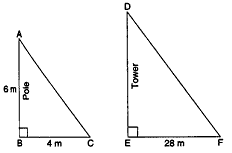
A vertical pole of length $6\ m$ casts a shadow $4\ m$ long on the ground and at the same time a tower casts a shadow $28\ m$ long. Find the height of the tower.
Answer
Let $AB$ denoted the vertical pole of length $6m.\ BC$ is the shadow of the pole on the ground $BC = 4m.$
Let $DE$ denote the tower.
$EF$ is shadow of the tower on the ground.
$EF = 28\ m.$
Let the height of the tower be $h\ m.$

In $\triangle ABC$ and $\triangle DEF,$
$\angle B = \angle E ......[$Each equal to $90^\circ$  because pole and tower are standing vertical to the ground$]$
$ \angle C = \angle F .....[$Same elevation$]$
$ \angle A = \angle D \because$ shadows are cast at the same time
$\therefore \triangle ABC$ and $\triangle DEF,$
$\angle B= \angle E ............[$Each equal to $90^\circ$ because pole and tower are standing vertical to the ground.$]$
$ \angle A= \angle D ( \because$ shadows are cast at the same time$)$
$ \therefore \vartriangle ABC ~ \vartriangle DEF ......(AA$ similarity criterion$)$
$ \therefore \frac{{AB}}{{DE}} = \frac{{BC}}{{EF}} ...........[ \because$ corresponding sides of two similar triangles are proportional$]$
$ \Rightarrow \frac{6}{h} = \frac{4}{{28}} $
$ \Rightarrow h = \frac{{6 \times 28}}{4} \Rightarrow h = 42$
Hence, the height of the tower is $42\ m$
View full question & answer
Question 44 Marks
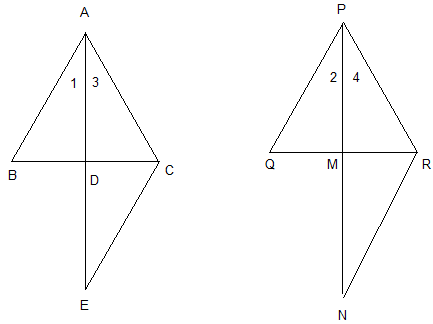
Sides $AB$ and $AC$ and median $AD$ of a triangle $ABC$ are respectively proportional to sides $PQ$ and $PR$ and median $PM$ of another triangle $PQR.$ Show that $\Delta A B C \sim \Delta P Q R$.
Answer

Given : In $\Delta A B C \text { and } \Delta P Q R$ The $AD$ and $PM$ are their medians,
such that $\frac { A B } { P Q } = \frac { A D } { P M } = \frac { A C } { P R }$
To prove : $\Delta A B C \sim \Delta P Q R$
Construction : Produce $AD$ to $E$ such that $AD = DE$ and produce $PM$ to $N$ such that $PM = MN.$
Join $CE$ and $RN.$
Proof : In $\Delta A B D \text { and } \Delta E D C$
$AD=DE$
$\angle A D B = \angle E D C ($vertically opposite angles$)$
$BD=DC\text{(as AD is a median)}$
$\therefore \quad \Delta A B D \equiv \Delta E D C($ By $SAS$ congruency$)$
or, $AB=CE ($By $CPCT)$
Similarly, $PQ = RN $
$\frac { A B } { P Q } = \frac { A D } { P M } = \frac { A C } { P R }$ (Given)
or, $\frac { C E } { R N } = \frac { 2 A D } { 2 P M } = \frac { A C } { P R }$
or $\frac{CE}{RN}=\frac{AE}{PN}=\frac{AC}{PR}$
So $∆ACE \sim ∆PRN$
$\angle 3=\angle 4$
Similarly $\angle 1=\angle 2$
$\angle 1+\angle3=\angle2+\angle4$
So $\angle A=\angle P\text{ and}$
$\frac{AB}{PQ}=\frac{AC}{PR}\text{(given)} $
Hence $∆ABC\sim ∆PQR$
View full question & answer
Question 54 Marks
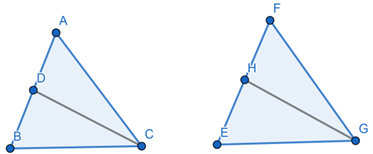
$CD$ and $GH$ are respectively the bisectors of $\angle ACB$ and  $\angle EGF$ such that $D$ and $H$ lie on sides $AB$ and $FE$ of $\triangle ABC$ and $\triangle EFG$ respectively. If $\triangle ABC \sim\triangle FEG,$ show that:
  1. $\frac{C D}{G H}=\frac{A C}{F G}$
  2. $\triangle DCB  \sim\triangle HGE$
  3. $\triangle DCA  \sim\triangle HGF$
Answer

Given, $\triangle ABC \sim\triangle FEG ….(1)$
$(i)$ Corresponding angles of similar triangles
$\Rightarrow \angle BAC = \angle EFG ….(2)$
And $\angle ABC = \angle FEG …(3)$
$\Rightarrow \angle ACB = \angle FGE$
$ \Rightarrow \frac{1}{2}\angle ACB = \frac{1}{2}\angle FGE $
$ \Rightarrow \angle ACD = \angle FGH$ and $\angle BCD = \angle EGH ……(4)$
$Consider \triangle ACD$ and $\triangle FGH$
$\Rightarrow$ From $(2)$ we have
$\Rightarrow \angle DAC = \angle HFG$
From $(4)$ we have
$\Rightarrow \angle ACD = \angle EGH$
Also, $\angle ADC = \angle FGH$
If the $\angle A=\angle F ,$ then by angle sum property of triangle $3^{rd}$  angle will also be equal.
By $AAA$ similarity, in two triangles, if the angles are equal, then sides opposite to the equal angles are in the same ratio (or proportional) and hence the triangles are similar.
$\therefore\triangle ADC \sim\triangle FHG$
$(ii) $ By Converse proportionality theorem
$\Rightarrow \frac{C D}{G H}=\frac{A C}{F G} $
$(iii)$ Consider $\triangle DCB$ and $\triangle HGE$
From eq$(3)$ we have
$\Rightarrow \angle DBC = \angle HEG$
From $(4)$ we have
$\Rightarrow \angle BCD = \angle FGH$
Also, $\angle BDC = \angle EHG$
$\therefore\triangle DCB \sim\triangle HGE$
Hence proved.
View full question & answer
Question 64 Marks
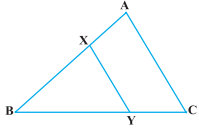
In the given figure, the line segment $XY$ is parallel to side $AC$ of $\triangle ABC$ and it divides the triangle into two parts of equal areas. Find the ratio $\frac{\mathrm{A} \mathrm{X}}{\mathrm{AB}}$.
Answer
Since $XY \parallel AC$
$​\therefore ​\angle BXY = ​\angle BAC$
$​\angle BYX = ​\angle BCA​ [$Corresponding angles$]$
$​\therefore ​\triangle BXY ​\cong \triangle BAC [AA$ similarity$]$
$​\therefore ​​ \frac{{ar\left( {\triangle BXY} \right)}}{{ar\left( {\triangle BAC} \right)}} = \frac{{B{X^2}}}{{B{A^2}}}$
$But ar(​\triangle BXY)=ar(XYCA)$
$​\therefore 2(​\triangle BXY)=ar(\triangle BXY)+ar(XYCA)$
$= ar(\triangle BAC)$
$\therefore \frac{{ar\left( {\triangle BXY} \right)}}{{ar\left( {\triangle BAC} \right)}} = \frac{1}{2}$
$\therefore \frac{{B{X^2}}}{{B{A^2}}} = \frac{1}{2}$
$​\Rightarrow \therefore \frac{{BX}}{{BA}} = \frac{1}{{\sqrt 2 }}$
$​\therefore \frac{{BA - BX}}{{BA}} = \frac{{\sqrt 2 - 1}}{{\sqrt 2 }}$
$​\Rightarrow \frac{{AX}}{{AB}} = \frac{{\sqrt 2 - 1}}{{\sqrt 2 }} = \frac{{2 - \sqrt 2 }}{2}$
View full question & answer
Question 74 Marks
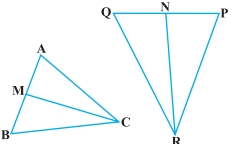
In Fig. $CM$ and $RN$ are respectively the medians of $\triangle ABC$ and $\triangle PQR$. If $\triangle ABC \sim\triangle PQR,$ prove that:
  1. $\triangle AMC \sim\triangle PNR$
  2. $\frac{C M}{R N}=\frac{A B}{P Q}$
  3. $\triangle CMB \sim\triangle RNQ$
Answer
  1. $\triangle ABC \sim\triangle PQR ($Given$)$
    So, $\frac{A B}{P Q}=\frac{B C}{Q R}=\frac{C A}{R P} ...(1) ($corresponding sides of similar triangles are proportional$)$
    and $\angle A = \angle P, \angle B = \angle Q and \angle C = \angle R ...(2)$
    But $AB = 2 AM and PQ = 2 PN ($As $CM$ and $RN$ are medians$)$
    So, from $ (1),$
    i.e., $\frac{A M}{P N}=\frac{C A}{R P} ...(3)$
    Also, $∠ MAC = ∠ NPR [$From $(2)] ...(4)$
    So, from $(3)$ and $(4),$
    $\triangle AMC \sim\triangle PNR (SAS$ similarity criterion$) ...(5)$
  2. From $(5), \frac{\mathrm{CM}}{\mathrm{RN}}=\frac{\mathrm{CA}}{\mathrm{RP}} ...(6) ($corresponding sides of similar triangles are proportional$)$
    But $\frac{C A}{R P}=\frac{A B}{P Q} [$From $(1)] ...(7)$
    Therefore, $\frac{C M}{R N}=\frac{A B}{P Q} [$From $(6)$ and $(7)] ...(8)$
  3. Again, $\frac{A B}{P Q}=\frac{B C}{Q R} [$From $(1)]$
    Therefore $\frac{\mathrm{CM}}{\mathrm{RN}}=\frac{\mathrm{BC}}{\mathrm{QR}} [$From $(8)] ...(9)$
    Also, $\frac{C M}{R N}=\frac{A B}{P Q}=\frac{2 B M}{2 Q N}$
    i.e.,$ \frac{\mathrm{CM}}{\mathrm{RN}}=\frac{\mathrm{BM}}{\mathrm{QN}} ...(10)$
    i.e., $\frac{\mathrm{CM}}{\mathrm{RN}}=\frac{\mathrm{BC}}{\mathrm{QR}}=\frac{\mathrm{BM}}{\mathrm{QN}} [$From $(9)$ and $(10)]$
    Therefore, $\triangle CMB \sim\triangle RNQ (SSS$ similarity criterion$)$
View full question & answer
Question 84 Marks
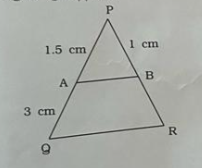
In $ \triangle PQR, QR \| AB. $

Image

Answer the following questions from the figure:
$(1)$ Find the value of $BR.$
$(2)$ Find the value of $PQ.$
$(3)$ Find the value of $PR.$
$(4)$ Which triangle is similar to $\triangle PAB$ ?
Answer
In $\triangle P Q R, Q R \| A B$, side $A B$ of $\triangle P Q R$ intersects $P Q$ and $P R$ at $A$ and respectively.
$(1) \frac{A P}{A Q}=\frac{P B}{B R} ($Theorem $6.1)$
$\therefore \frac{1.5}{3}=\frac{1}{B R} \therefore B R=\frac{1 \times 3}{1.5} \therefore B R=2 \ cm$
$(2)$ Here, point $A$ is on line segment $P Q$.
$\therefore P A+A Q=P Q$
$\therefore 1.5+3=P Q$
$\therefore P Q=4.5 \ cm$
$(3)$ Here, point $B$ is on line segment $P R$.
$\therefore P B+B R=P R$
$\therefore 1+2=P R$
$\therefore P R=3 \ cm$
$(4) \triangle P A B$ is similar to $\triangle P Q R$
So, $\triangle P A B \sim \triangle P Q R$.
View full question & answer
Question 94 Marks
Prove that: If a line is drawn parallel to one side of a triangle to intersect the other two sides in distinct points, the other two sides are divided in the same ratio.
Answer
In $\triangle A B C$,  a line DE is drawn parallel to side BC (DE∥BC), intersecting sides AB and AC at distinct points D and E, respectively.
To Prove: $\frac{A D}{D B}=\frac{A E}{E C}$
Draw $B M \perp A E$ and $C N \perp A D$. Join BE and CD.
The area of a triangle is given by the formula: Area $=\frac{1}{2} \times$ base $\times$ height.
Consider $\triangle A D E$  and $\triangle B D E:$
Ratio of their areas:
$\frac{\operatorname{Area}(\triangle A D E)}{\operatorname{Area}(\triangle B D E)}=\frac{\frac{1}{2} \times A D \times C N}{\frac{1}{2} \times D B \times C N}$
$\frac{\operatorname{Area}(\triangle A D E)}{\operatorname{Area}(\triangle B D E)}=\frac{A D}{D B}$ ...(1)
Consider $\triangle A D E$ and $\triangle C D E$ :
Ratio of their areas: 
$\frac{\operatorname{Area}(\triangle A D E)}{\operatorname{Area}(\triangle C D E)}=\frac{\frac{1}{2} \times A E \times B M}{\frac{1}{2} \times E C \times B M}$
$\frac{\operatorname{Area}(\triangle A D E)}{\operatorname{Area}(\triangle C D E)}=\frac{A E}{E C}$ ...(2)
Both triangles,$\triangle B D E$ and $\triangle C D E$,  are on the same base, DE, and are between the same parallel lines, DE and BC.
Therefore, their areas are equal:
$\operatorname{Area}(\triangle B D E)=\operatorname{Area}(\triangle C D E)$ ...(3)
The numerators of the ratios in Equation 1 and 2 are the same $(\operatorname{Area}(\triangle A D E))$. The denominators are also equal from Equation 3.
Therefore, the ratios must be equal:
$\frac{\operatorname{Area}(\triangle A D E)}{\operatorname{Area}(\triangle B D E)}=\frac{\operatorname{Area}(\triangle A D E)}{\operatorname{Area}(\triangle C D E)}$
Substituting the results from Equation 1 and Equation 2:
$\frac{A D}{D B}=\frac{A E}{E C}$
Hence, the theorem is proved.
View full question & answer
Question 104 Marks
E and F are points on the sides PQ and PR respectively of a $\triangle$PQR. For PE = 3.9 cm, EQ = 3 cm, PF = 3.6 cm and FR = 2.4 cm case, state whether EF || QR.###E and F are points on the sides PQ and PR respectively of a \begin{equation}\triangle \mathrm{PQR} .\end{equation}following cases, state whether \begin{equation}\mathrm{EF} \| \mathrm{QR}.\end{equation}
(i) $\mathrm{PE}=3.9 \mathrm{~cm}, \mathrm{EQ}=3 \mathrm{~cm}, \mathrm{PF}=3.6 \mathrm{~cm}$ and $\mathrm{FR}=2.4 \mathrm{~cm}$.(ii) $\mathrm{PE}=4 \mathrm{~cm}, \mathrm{QE}=4.5 \mathrm{~cm}, \mathrm{PF}=8 \mathrm{~cm}$ and $\mathrm{RF}=9 \mathrm{~cm}$.
Answer
We have
$\frac{{PE}}{{EQ}} = \frac{{3.9}}{3} = \frac{{1.3}}{1}.....(I)$
$\frac{{PF}}{{FR}} = \frac{{3.6}}{{2.4}} = \frac{3}{2} = \frac{{1.5}}{1}....(II)$
From (I) and (II),
we get
$\frac{{PE}}{{EQ}} \ne \frac{{PF}}{{FR}}$
Therefore, EF is not parallel to QR. (By converse of basic proportionality theorem)
View full question & answer