Questions

4 Marks Questions

🎯

Test yourself on this topic

19 questions · timed · auto-graded

Question 14 Marks
If $\sin (\text{A} − \text{B}) = \sin \text{A} \cos \text{B} − \cos \text{A} \sin \text{B}$ and $\cos (\text{A − B}) = \cos\text{A} \cos\text{B} + \sin \text{A} \sin \text{B},$ find the values of sin $15^\circ $ and cos $15^\circ .$
Answer
Given:
$\sin(\text {A}-\text{B})=\sin\text {A}\cos\text {B}-\cos\text{A}\sin\text {B}\ \dots(1)$
$\cos(\text {A}-\text{B})=\cos\text {A}\cos\text {B}+\sin\text{A}\sin\text {B}\ \dots(2)$
To find: The values of $\sin 15^{\circ}$ and $\cos 15^{\circ}$
In this problem we need to find $\sin 15$ and $\cos 15^{\circ}$
Hence to get $15^{\circ}$ angle we need to choose the value of $A$ and $B$ such that $(A-B)=15^{\circ}$
So if we choose $A=45^{\circ}$ and $B=30^{\circ}$
Then we get, $(A-B)=15^{\circ}$
Therefore by substituting $A=45^{\circ}$ and $B=30^{\circ}$ in equation (1)
We get,
$\sin(45^\circ-30^\circ)=\sin45^\circ\cos30^\circ-\cos45^ \circ\sin30^\circ$
Therefore,
$\sin(15^\circ)= \sin45^\circ\cos30^\circ-\cos45^\circ \sin30^\circ\ \dots(3)$
Now we know that,
$\sin45^\circ=\cos45^ \circ=\frac{1}{\sqrt{2}},\ \sin30^ \circ=\frac{1}{2},\ \cos30^\circ= \frac{\sqrt{3}}{2}$
Now by substituting above values in equation $(3)$
We get,
$\sin(15^\circ)=\bigg (\frac{1}{\sqrt{2}}\bigg)\times\bigg (\frac{\sqrt{3}}{2}\bigg)-\bigg(\frac {1}{\sqrt{2}}\bigg)\times\bigg(\frac{1} {2}\bigg)$
$=\frac{\sqrt{3}} {2\sqrt{2}}-\frac{1}{2\sqrt{2}}$
$=\frac{\sqrt{3}-1} {2\sqrt{2}}$
Therefore,
$\sin(15^\circ)=\frac {\sqrt{3}-1}{2\sqrt{2}}\ ....(4)$
Now by substituting $A = 45^\circ $ and $B = 30^\circ $ in equation $(2)$
We get,
$\cos(45^\circ-30^ \circ)=\cos45^\circ\cos30^\circ+\sin45^ \circ\sin30^\circ$
Therefore,
$\cos(15^\circ)= \cos45^\circ\cos30^\circ+\sin45^\circ \sin30^\circ\ \dots(5)$
Now we know that,
$\sin45^\circ=\cos45^ \circ=\frac{1}{\sqrt{2}},\ \sin30^ \circ=\frac{1}{2},\ \cos30^\circ=\frac {\sqrt{3}}{2}$
Now by substituting above values in equation $(5)$
We get,
$\cos(15^\circ)=\bigg (\frac{1}{\sqrt{2}}\bigg)\times\bigg (\frac{\sqrt{3}}{2}\bigg)+\bigg(\frac {1}{\sqrt{2}}\bigg)\times\bigg(\frac{1} {2}\bigg)$
$=\frac{\sqrt{3}} {2\sqrt{2}}+\frac{1}{2\sqrt{2}}$
$=\frac{\sqrt{3}+1} {2\sqrt{2}}$
Therefore,
$\cos(15^\circ)=\frac {\sqrt{3}+1}{2\sqrt{2}}\ \dots(6)$
Therefore from equation (4) and (6)
$\sin(15^\circ)=\frac {\sqrt{3}-1}{2\sqrt{2}}$
$\cos(15^\circ)=\frac {\sqrt{3}+1}{2\sqrt{2}}$
View full question & answer
Question 24 Marks
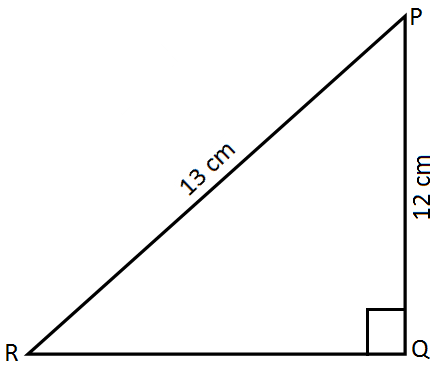
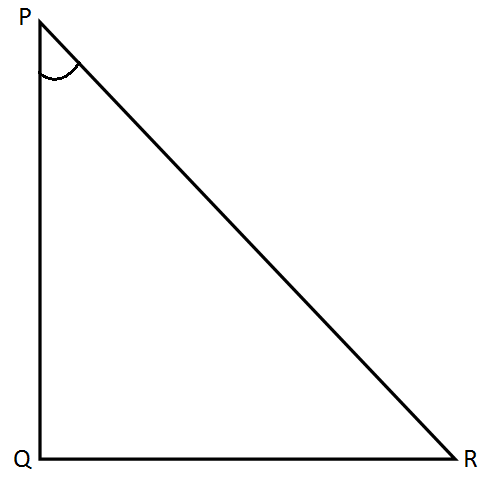
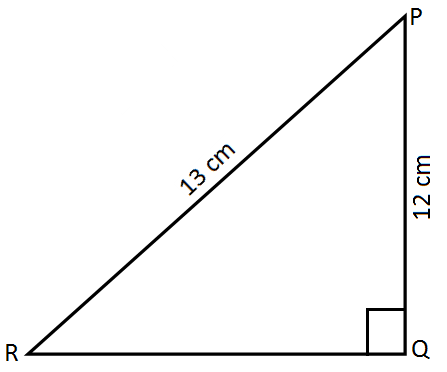
In the given figure, find tan $P$ and cot $R.$ Is tan $P =$ cot $R?$
Answer
The given figure is below:

To Find:
tan $P$, cot $R$
In the given right angled? $PQR$, length of side $QR$ is unknown.
Therefore, to find length of side QR we use Pythagoras Theorem
Hence, by applying Pythagoras theorem in $\triangle\text{PQR},$
We get,
$P R^2=P Q^2+Q R^2$
Now, we substitute the length of given side $PR$ and $PQ$ in the above equation
$13^2=12^2+\text{QR}^2$
$\text{QR}^2=13^2-12^2$
$\text{QR}^2=169-144$
$\text{QR}^2=25$
$\text{QR}^2=\sqrt{25}$
$\text{QR}^2=5$
By definition, we know that
$\tan\text{P}=\frac{\text{Perpendicular side opposite to }\angle \text{P}}{\text{Base side adjacent to }\angle \text{P}}$
$\tan\text{P}=\frac{\text{QR}}{\text{PQ}}$
$\tan\text{P}=\frac{5}{12}\ \dots(1)$
Also, by definition, we know that
$\cot\text{P}=\frac{\text{Base side adjacent to }\angle \text{R}}{\text{Perpendicular side opposite to }\angle \text{R}}$
$\cot\text{R}=\frac{\text{QR}}{\text{PQ}}$
$\cot\text{R}=\frac{5}{12}\ \dots(2)$
Comparing equation $(1)$ and $(2)$ , we come to know that $R.H.S$ of both the equation are equal
Therefore, $L.H.S$ of both the equation are also equal
$\tan\text{P}=\cot\text{R}$
Yes, $\tan\text{P}=\cot\text{R}=\frac{5}{12}$
View full question & answer
Question 34 Marks
Evaluate the following:
$\frac{\sin30^\circ-\sin90^\circ+2\cos0^\circ}{\tan30^\circ\tan60^\circ}$
Answer
We have,
$\frac{\sin30^\circ-\sin90^\circ+2\cos0^\circ}{\tan30^\circ\tan60^\circ}\ \dots(1)$
Now,
$\sin30^\circ=\frac{1}{2},\ \sin90^\circ=\cos0^\circ=1,$ $\tan30^\circ=\frac{1}{\sqrt{3}},\tan60^\circ=\sqrt{3}$
So by substituting above values in equation $(1)$
We get,
$\frac{\sin30^\circ-\sin90^\circ+2\cos0^\circ}{\tan30^\circ\tan60^\circ}$
$=\frac{\frac{1}{2}-1+2\times1}{\frac{1}{\sqrt{3}}\times\sqrt{3}}$
Now, $\sqrt{3}$ present in the denominator of above expression gets cancelled and we get,
$\frac{\sin30^\circ-\sin90^\circ+2\cos0^\circ}{\tan30^\circ\tan60^\circ}$
$=\frac{\frac{1}{2}-1+2}{1}$
$=\frac{1}{2}-1+2$
Now by taking LCM in the above expression we get,
$\frac{\sin30^\circ-\sin90^\circ+2\cos0^\circ}{\tan30^\circ\tan60^\circ}$
$=\frac{1}{2}-\frac{1\times2}{1\times2}+\frac{2\times2}{1\times2}$
$=\frac{1}{2}-\frac{2}{2}+\frac{4}{2}$
$=\frac{1-2+4}{2}$
$=\frac{5-2}{2}$
$=\frac{3}{2}$
Therefore,
$\frac{\sin30^\circ-\sin90^\circ+2\cos0^\circ}{\tan30^\circ\tan60^\circ}=\frac{3}{2}$
View full question & answer
Question 44 Marks
If $\sec\theta=\frac{5}{4},$ find the value of $\frac{\sin\theta-2\cos\theta}{\tan\theta-\cot\theta}.$
Answer
Given: $\sec\theta=\frac{5}{4}\ \dots(1)$
To find the value of $\frac{\sin\theta-2\cos\theta}{\tan\theta-\cot\theta}$
Now we know that $\sec\theta=\frac{1}{\cos\theta}$
Therefore,
$\cos\theta=\frac{1}{\cos\theta}$
Therefore from equation (1)
$\cos\theta=\frac{1}{\frac{5}{4}}$
$\cos\theta=\frac{4}{5}\ \dots(2)$
Also, We Know that $\cos^2\theta+\sin^2\theta=1$
Therefore,
$\sin^2\theta=1-\cos^2\theta$
$\sin^2\theta=\sqrt{1-\cos^2\theta}$
Substituting the value of $\cos\theta$ from equation $(2)$
We get,
$\sin^2\theta=\sqrt{1-\Big(\frac{4}{5}\Big)^2}$
$=\sqrt{1-\frac{4^2}{5^2}}$
$=\sqrt{1-\frac{16}{25}}$
$=\sqrt{\frac{25-16}{25}}$
$=\sqrt{\frac{9}{25}}$
$=\frac{3}{5}$
Therefore,
$\sin\theta=\frac{3}{5}\ \dots(3)$
Also, we know that $\sec^2\theta=1+\tan^2\theta.$
Therefore,
$\tan^2\theta=\sec^2-1$
Therefore
$\tan^2\theta=\Big(\frac{5}{4}\Big)^2-1$
$=\frac{25}{16}-1$
$=\frac{9}{16}$
Therefore,
$\tan\theta=\sqrt{\frac{9}{16}}$
$=\frac{3}{4}$
Therefore,
$\tan\theta=\frac{3}{4}\ \dots(4)$
Also $\cot\theta=\frac{1}{\tan\theta}$
Therefore, from equation (4)
We get,
$\cot\theta=\frac{1}{\frac{3}{4}}$
$\cot\theta=\frac{4}{3}\ \dots(5)$
Substitutiing the value of $\cos\theta,\sin\theta,\cot\theta$ and $\tan\theta$ from equation (2) (3) (4) and (5) respectictively in the expression below
$\frac{\sin\theta-2\cos\theta}{\tan\theta-\cot\theta}$
We get,
$\frac{\sin\theta-2\cos\theta}{\tan\theta-\cot\theta}=\frac{\frac{3}{5}-2\Big(\frac{4}{5}\Big)}{\frac{3}{4}-\frac{4}{3}}$$$
$=\frac{\frac{3}{5}-\frac{8}{5}}{\frac{(3\times3)-(4\times4)}{4\times3}}$
$=\frac{\frac{3-8}{5}}{\frac{9-16}{4\times3}}$
$=\frac{\frac{-5}{5}}{\frac{-7}{12}}$
$=\frac{12}{7}$
Therefore, $\frac{\sin\theta-2\cos\theta}{\tan\theta-\cot\theta}=\frac{12}{7}$
View full question & answer
Question 54 Marks
In the following, one of the six trigonometric ratios is given. Find the values of the other trigonometric ratios.
$\sec\theta=\frac{13}{5}$
Answer
$\sec\theta=\frac{13}{5}$
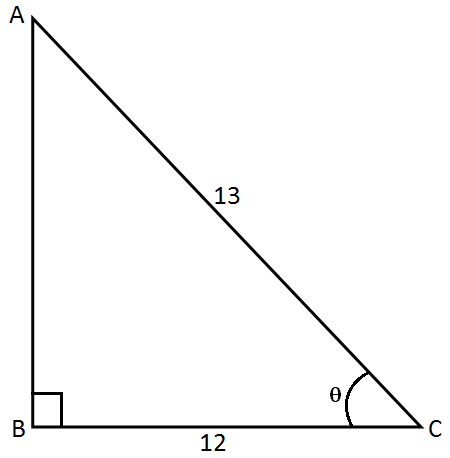
$\sec\theta=\frac{\text{hypotenuse}}{\text{adjacent side}}=\frac{13}{5}$
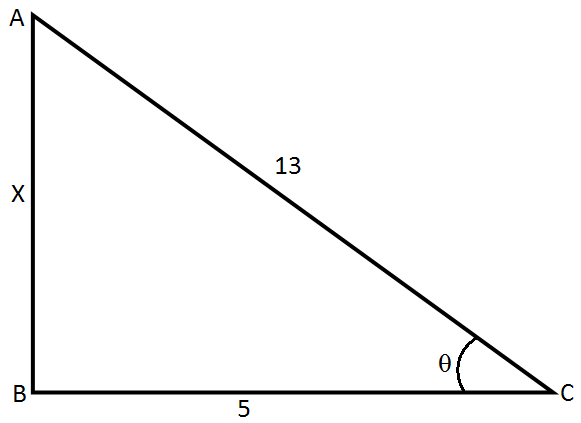
Now consider a right angled $\triangle^\text{le}\text{ABC,}$

By applying pythagoras theorem
$\text{AC}^2=\text{AB}^2+\text{BC}^2$
$169=\text{x}^2+25$
$\text{x}^2=169-25=144$
$\text{x}=12$
$\cos\theta =\frac{1}{\sec\theta}=\frac{1}{\frac{13}{5}}=\frac{5}{13}$
$\tan\theta =\frac{\text{opposite side}}{\text{adjacent side}}=\frac{12}{5}$
$\sin\theta =\frac{\text{opposite side}}{\text{hypotenuse}}=\frac{12}{13}$
$\text{cosec }\theta =\frac{1}{\sin\theta}=\frac{1}{\frac{12}{13}}=\frac{13}{12}$
$\sec\theta =\frac{1}{\cos\theta}=\frac{1}{\frac{5}{13}}=\frac{13}{5}$
$\cot\theta =\frac{1}{\tan\theta}=\frac{1}{\frac{12}{5}}=\frac{5}{12}$
View full question & answer
Question 64 Marks

If $3\cot\theta=2,$ find the value of $\frac{4\sin\theta-3\cos\theta}{2\sin\theta+6\cos\theta}.$

Answer

Given: $3\cot\theta=2$

Therefore,

$\cot\theta=\frac{2}{3}\ \dots(1)$

Now, we know that $\cot\theta=\frac{\cos\theta}{\sin\theta}$

Therefore equuation (i) becomes

$\frac{\cos\theta}{\sin\theta}=\frac{2}{3}\ \dots(2)$

Now by applying Invetendo to equation (ii)

We get,

$\frac{\sin\theta}{\cos\theta}=\frac{3}{2}\ \dots(3)$

Now, multipalying by $\frac{4}{3}$ on botha sides

We get,

$\frac{4}{3}\times\frac{\sin\theta}{\cos\theta}=\frac{4}{3}\times\frac{3}{2}$

Therefore, 3 cancels out on R.H.S and

We get,

$\frac{4\sin\theta}{3\cos\theta}=\frac{2}{1}$

Now by applying dividendo in above equation

We get,

$\frac{4\sin\theta-3\cos\theta}{3\sin\theta}=\frac{2-1}{1}$

$\frac{4\sin\theta-3\cos\theta}{3\sin\theta}=\frac{1}{1}\ \dots(4)$

Now, multiplying by $\frac{2}{6}$ on both sides of equation (3)

We get,

$\frac{2}{6}\times\frac{\sin\theta}{\cos\theta}=\frac{2}{6}\times\frac{3}{2}$

Therefore, 2 cancels out on R.H.S and

We get,

$\frac{2\sin\theta}{6\cos\theta}=\frac{3}{6}$

$\frac{2\sin\theta}{6\cos\theta}=\frac{1}{2}$

Now by applying componendo in above equation

We get,

$\frac{2\cos\theta+6\sin\theta}{6\sin\theta}=\frac{1+2}{2}$

$\frac{2\cos\theta+6\sin\theta}{6\sin\theta}=\frac{3}{2}\ \dots(5)$

Now, by dividing equation (4) by equation (5)

We get,

$\frac{\frac{4\sin\theta-3\cos\theta}{3\sin\theta}}{\frac{2\cos\theta+6\sin\theta}{6\sin\theta}}=\frac{\frac{1}{1}}{\frac{3}{2}}$

Therefore,

$\frac{4\sin\theta-3\cos\theta}{3\sin\theta}\times\frac{6\sin\theta}{2\cos\theta+6\sin\theta}=\frac{1}{1}\times\frac{2}{3}$

$\frac{4\sin\theta-3\cos\theta}{3\sin\theta}\times\frac{2\times(3\sin\theta)}{2\cos\theta+6\sin\theta}=\frac{1}{1}\times\frac{2}{3}$

Therefore, on L.H.S $(3\sin\theta)$ cancels out and we get,

$\frac{2\times(4\sin\theta-3\cos\theta)}{2\cos\theta+6\sin\theta}=\frac{2}{3}$

Now, by taking 2 in the numerator of L.H.S on the R.H.S

We get,

$\frac{4\sin\theta-3\cos\theta}{2\cos\theta+6\sin\theta}=\frac{2}{3\times2}$

Therefore, 2 cancels out on R.H.S. and

We get,

$\frac{4\sin\theta-3\cos\theta}{2\cos\theta+6\sin\theta}=\frac{1}{3}$

Hence,

$\frac{4\sin\theta-3\cos\theta}{2\cos\theta+6\sin\theta}=\frac{1}{3}$

View full question & answer
Question 74 Marks
In the following, one of the six trigonometric ratios is given. Find the values of the other trigonometric ratios.
$\cot\theta=\frac{12}{5}$
Answer
Given: $\cot\theta=\frac{12}{5}\ \dots(1)$
By definition,
$\cot\theta=\frac{1}{\tan\theta}$
$\cos \theta=\frac{\text{Base}}{\text{Perpendicular}}\ \dots(2)$
By Comparing $(1)$ and $(2)$
We get,
Base $= 12$ and
Perpendicular side $= 5$

Therefore,
By Pythagoras theorem,
$\mathrm{AC}^2=\mathrm{AB}^2+\mathrm{BC}^2$
Now we substitute the value of base side (AB) and the perpendicular side (BC) and get hypotenuse (AC)
$\text{AC}^2=12^2+5^2$
$\text{AC}^2=144+25$
$\text{AC}^2=169$
$\text{AC}=\sqrt{169}$
$\text{AC}=13$
Hence, Hypotenuse $= 13$
Now, $\sin\theta=\frac{\text{Perpendicular}}{\text{Hypotenuse }}$
Therefore,
$\sin\theta=\frac{5}{13}$
Now, $\text{cosec }\theta=\frac{1}{\sin\theta}$
Therefore,
$\text{cosec }\theta=\frac{\text{Hypotenuse }}{\text{Perpendicular }}$
$\text{cosec }\theta=\frac{13}{5}$
Now, $\cos\theta=\frac{\text{Base}}{\text{Hypotenuse}}$
Therefore,
$\cos\theta=\frac{12}{13}$
Now, $\sec\theta=\frac{1}{\cos\theta}$
Therefore,
$\sec\theta=\frac{\text{Hypotenuse}}{\text{Base}}$
$\sec\theta=\frac{13}{12}$
Now, $\tan\theta=\frac{1}{\cot\theta}$
Therefore,
$\tan\theta=\frac{\text{Perpendicular}}{\text{Base}}$
$\tan\theta=\frac{5}{12}$
View full question & answer
Question 84 Marks

If $\cos\theta=\frac{3}{5},$ find the value of $\frac{\sin\theta-\frac{1}{\tan\theta}}{2\tan\theta}.$

Answer

Given: $\cos\theta=\frac{3}{5}\ ...(1)$

To find the value of $\frac{\sin\theta-\frac{1}{\tan\theta}}{2\tan\theta}$

Now, we know the following trigonometric identity

$\cos^2\theta+\sin^2\theta=1$

Therefore, by substituting the value of $\cos\theta$ from equation (1),

We get,

$\Big(\frac{3}{5}\Big)^2+\sin^2\theta=1$

Therefore,

$\sin^2\theta=1-\Big(\frac{3}{5}\Big)^2$

$=1-\frac{(3)^2}{(5)^2}$

$=1-\frac{9}{25}$

$\sin^2\theta=\frac{25-9}{25}$

$=\frac{16}{25}$

Therefore by taking square root on both sides

We get,

$\sin\theta=\sqrt{\frac{16}{25}}$

$=\sqrt{\frac{16}{25}}$

$=\frac{4}{5}$

Therefore,

$\sin\theta=\frac{4}{5}\ ...(2)$

Now, we know that

$\tan\theta=\frac{\sin\theta}{\cos\theta}\ ..(3)$

therefore by substituting the value of $\sin\theta$ and $\cos\theta$ from equation (2) and (1) respectively

We get,

$\tan\theta=\frac{\frac{4}{5}}{\frac{3}{5}}=\frac{4}{3}\ ...(4)$

Now, by substituting the value of $\sin\theta$ and $\tan\theta$ from equation (2) and (4) respectively in the expression below,

$\frac{\sin\theta-\frac{1}{\tan\theta}}{2\tan\theta}$

We get,

$\frac{\sin\theta-\frac{1}{\tan\theta}}{2\tan\theta}=\frac{\frac{4}{5}-\frac{1}{\frac{4}{3}}}{2\times\frac{4}{3}}$

$=\frac{\frac{4}{5}-\frac{3}{4}}{\frac{2\times4}{3}}$

$=\frac{\frac{4\times4}{5\times4}-\frac{3\times5}{4\times5}}{\frac{8}{3}}$

Therefore,

$\frac{\sin\theta-\frac{1}{\tan\theta}}{2\tan\theta}=\frac{\frac{16}{20}-\frac{15}{20}}{\frac{8}{3}}$

$=\frac{\frac{1}{20}}{\frac{8}{3}}$

$=\frac{3}{160}$

Therefore, $\frac{\sin\theta-\frac{1}{\tan\theta}}{2\tan\theta}=\frac{3}{160}$

View full question & answer
Question 94 Marks

If $3\cos\theta − 4 \sin \theta = 2 \cos \theta + \sin \theta$ find $\tan\theta.$

Answer

Given: $3\cos \theta -4\sin \theta =2\cos\theta+\sin\theta$

To find: $\tan\theta$

Now consider the given expression

$3\cos\theta -4\sin\theta=2\cos\theta+\sin\theta$

Now by dividing both sides of the above expression by $\cos\theta$

We get,

$\frac{3\cos\theta-4\sin\theta}{\cos\theta}=\frac{2\cos\theta+\sin\theta}{\cos\theta}$

Now by separating the denominator for each terms

We get,

$\frac{3\cos\theta}{\cos\theta}-\frac{4\sin\theta}{\cos\theta}=\frac{2\cos\theta}{\cos\theta}+\frac{\sin\theta}{\cos\theta}$

Now in the above expression $\cos\theta$ present in both numerator and denominator gets cancelled

Therefore,

$3-\frac{4\sin\theta}{\cos\theta}=2+\frac{\sin\theta}{\cos\theta}$

Now we know that,

$\frac{\sin\theta}{\cos\theta}=\tan\theta$

Therefore by substituting $\frac{\sin\theta}{\cos\theta}=\tan\theta$ in equation (1)

We get,

$3-4\tan\theta=2+\tan\theta$

Now by taking $\tan\theta$ on L.H.S

We get,

$-\tan\theta -4\tan\theta =2-3$

Therefore,

$-5\tan\theta=-1$

$5\tan\theta=1$

$\tan\theta=\frac{1}{5}$

Hence $\tan\theta=\frac{1}{5}$

View full question & answer
Question 104 Marks

If $\sin\theta=\frac{12}{13},$ find the value of $\frac{\sin^2\theta-\cos^2\theta}{2\sin\theta\cos\theta}\times\frac{1}{\tan^2\theta}.$

Answer

Given: $\sin\theta=\frac{12}{13}\dots(1)$

To Find: The value of expression $\frac{\sin^2\theta-\cos^2\theta}{2\sin\theta\cos\theta}\times\frac{1}{\tan^2\theta}$

Now, we know that,

$\sin\theta=\frac{\text{Perpendicular side opposite to }\angle\theta}{\text{Hypotenuse}}\dots(2)$

Now when we compare equation (1) and (2)

We get,

Perpendicular side opposite to $\angle\theta=12$

And

Hypotenuse = 13

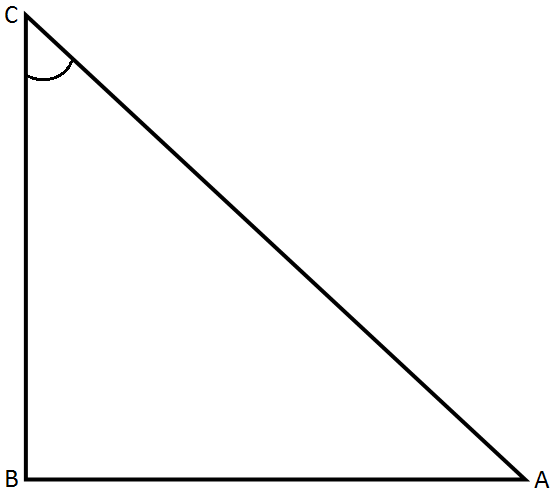
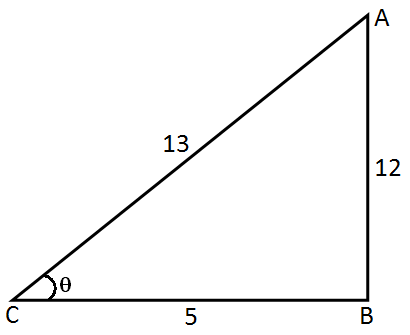
Therefore, Triangle representing angle $\theta$ is as shown below

Base side BC is unknown and it can be found by using Pythagoras theorem

Therefore by applying Pythagoras theorem

We get,

$\text{AC}^2=\text{AB}^2+\text{BC}^2$

Therefore by substituting the values of known sides

We get,

$13^2=12^2+\text{BC}^2$

Therefore,

$\text{BC}^2=13^2-12^2$

$\text{BC}^2=169-144$

$\text{BC}^2=25$

$\text{BC}=\sqrt{25}$

Therefore,

$\text{BC}=5 \dots(3)$

Now, we know that

$\cos\theta=\frac{\text{Base side adjacent to} \angle\theta}{\text{Hypotenuse}}$

Now from figure (a)

We get,

$\cos\theta=\frac{\text{BC}}{\text{AC}}$

Therefore from figure (a) and equation (3),

$\cos\theta=\frac{5}{13}\dots(4)$

Now we know that,

$\tan\theta=\frac{\sin\theta}{\cos\theta}$

Therefore, substituting the value of $\sin\theta$ and $\cos\theta$ from equation (1) and (4)

We get,

$\tan\theta=\frac{\frac{12}{13}}{\frac{5}{13}}$

$\tan\theta=\frac{12}{13}\times\frac{13}{5}$

Therefore 13 gets cancelled and we get

$\tan\theta=\frac{12}{5}\dots(5)$

Now we substitute the value of $\sin\theta,\cos\theta$ and $\tan\theta$ from equation (1), (4) and (5) respectively in the expression below

$\frac{\sin^2\theta-\cos^2\theta}{2\sin\theta\cos\theta}\times\frac{1}{\tan^2\theta}$

Therefore,

We get,

$\frac{\sin^2\theta-\cos^2\theta}{2\sin\theta\cos\theta}\times\frac{1}{\tan^2\theta}=\frac{\Big(\frac{12}{13}\Big)^2-\Big(\frac{5}{13}\Big)^2}{2\times\Big(\frac{12}{13}\Big)\times\Big(\frac{5}{13}\Big)}\times\frac{1}{\Big(\frac{12}{5}\Big)^2}$

Therefore by further simplifying we get,

$\frac{\sin^2\theta-\cos^2\theta}{2\sin\theta\cos\theta}\times\frac{1}{\tan^2\theta}=\frac{\frac{(12)^2}{(13)^2}-\frac{(5)^2}{(13)^2}}{2\times\Big(\frac{12}{13}\Big)\times\Big(\frac{5}{13}\Big)}\times\frac{1}{\frac{(12)^2}{(5)^2}}$

$=\frac{\frac{144}{169}-\frac{25}{169}}{\frac{2\times12\times5}{13\times13}}\times\frac{25}{144}$

$=\frac{\frac{144-25}{169}}{\frac{120}{169}}\times\frac{25}{144}$

$=\frac{119}{169}\times\frac{169}{120}\times\frac{25}{144}$

Now 169 gets cancelled and $=\frac{25}{120}$ gets reduced to $=\frac{5}{24}$

Therefore

$\frac{\sin^2\theta-\cos^2\theta}{2\sin\theta\cos\theta}\times\frac{1}{\tan^2\theta}=\frac{119}{1}\times\frac{1}{24}\times\frac{5}{144}$

$=\frac{119\times5}{24\times144}$

$=\frac{595}{3456}$

Therefore the value of $\frac{\sin^2\theta-\cos^2\theta}{2\sin\theta\cos\theta}\times\frac{1}{\tan^2\theta}$ is $\frac{595}{3456}$

That is $\frac{\sin^2\theta-\cos^2\theta}{2\sin\theta\cos\theta}\times\frac{1}{\tan^2\theta}=\frac{595}{3456}$

View full question & answer
Question 114 Marks

Evaluate the following:

$4\big(\sin^460^\circ+\cos^430^\circ\big)-3\big(\tan^260^\circ-\tan^245^\circ\big)+5\cos^245^\circ$

Answer

We have,

$4\big(\sin^460^\circ+\cos^430^\circ\big)-3\big(\tan^260^\circ-\tan^245^\circ\big)+5\cos^245^\circ\dots(1)$

Now,

$\sin60^\circ=\cos30^\circ=\frac{\sqrt{3}}{2} ,\cos45^\circ=\frac{1}{\sqrt{2}},\tan60^\circ =\sqrt{3} ,\tan45^\circ=1 $

So by substituting above values in equation (1)

We get,

$4\big(\sin^460^\circ+\cos^430^\circ\big)-3\big(\tan^260^\circ-\tan^245^\circ\big)+5\cos^245^\circ$

$=4\bigg(\Big(\frac{\sqrt{3}}{2}\Big)^4+\Big(\frac{\sqrt{3}}{2}\Big)^4\bigg)-3\Big(\big(\sqrt{3}\big)^2-1^2\Big)+5\times\Big(\frac{1}{\sqrt{2}}\Big)^2$

$=4\Bigg(\frac{\big(\sqrt{3}\big)^4}{2^4}+\frac{\big(\sqrt{3}\big)^4}{2^4}\Bigg)-3(3-1)+5\times\frac{1^2}{\big(\sqrt{2}\big)^2}$

$=4\Big(\frac{9}{16}+\frac{9}{16}\Big)-3(2)+5\times\frac{1}{2}$

$=4\Big(\frac{9+9}{16}\Big)-6+\frac{5}{2}$

$=4\Big(\frac{18}{16}\Big)-6+\frac{5}{2}$

Now, $=\frac{18}{16}$ gets reduced to $ \frac{9}{8}$

Therefore,

$4\big(\sin^460^\circ+\cos^430^\circ\big)-3\big(\tan^260^\circ-\tan^245^\circ\big)+5\cos^245^\circ$

$=4\Big(\frac{9}{8}\Big)-6+\frac{5}{2}$

$=\frac{36}{8}-6+\frac{5}{2}$

Now, $\frac{36}{8}$ gets reduced to $\frac{9}{2}$

Therefore,

$4\big(\sin^460^\circ+\cos^430^\circ\big)-3\big(\tan^260^\circ-\tan^245^\circ\big)+5\cos^245^\circ$

$=\frac{9}{2}-6+\frac{5}{2}$

Now by taking LCM

We get,

$4\big(\sin^460^\circ+\cos^430^\circ\big)-3\big(\tan^260^\circ-\tan^245^\circ\big)+5\cos^245^\circ$

$=\frac{9}{2}-\frac{6\times2}{1\times2}+\frac{5}{2}$

$=\frac{9}{2}-\frac{12}{2}+\frac{5}{2}$

$=\frac{9-12+5}{2}$

$=\frac{14-12}{2}$

$=\frac{2}{2}$

$=1$

Therefore,

$4\big(\sin^460^\circ+\cos^43^\circ\big)-3\big(\tan^260^\circ-\tan^245^\circ\big)+5\cos^245^\circ=1$

View full question & answer
Question 124 Marks
If $\cos\theta=\frac{12}{13},$ show that $\sin\theta(1-\tan\theta)=\frac{35}{156}.$
Answer
Given: $\cos\theta=\frac{12}{13}\ \dots(1)$
To show that $\sin\theta(1-\tan\theta)=\frac{35}{156}$
Now, we know that $\cos\theta=\frac{\text{Base side adjacent to}\angle\theta}{\text{Hypotenuse}}\ \dots(2)$
Therefore, by comparing equation $(1)$ and $(2)$
We get,
Base side adjacent to $\angle\theta=12$
And
Hypotenuse $= 13$

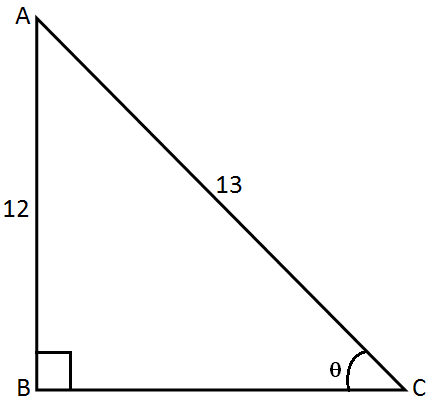
Therefore from above figure
Base side $BC = 12$
Hypotenuse $AC = 13$
Side AB is unknown and it can be determined by using Pythagoras theorem
Therefore by applying Pythagoras theorem
We get,
$A C^2=A B^2+B C^2$
Therefore by substituting the values of known sides
We get,
$13^2=A B^2+12^2$
Therefore,
$\text{AB}^2=169-144$
$\text{AB}^2=25$
$\text{AB}=\sqrt{25}$
Therefore,
$\text{AB}=5\ \dots(3)$
Now, we know that
$\sin\theta=\frac{\text{Perpendicular side opposite to}\angle\theta}{\text{Hypotenuse}}$
Now from figure (a)
We get,
$\sin\theta=\frac{\text{AB}}{\text{AC}}$
Therefore,
$\sin\theta=\frac{5}{13}\ \dots(4)$
Now, we know that
$\tan\theta=\frac{\text{Perpendicular side opposite to}\angle\theta}{\text{Base side adjacent to }\angle\theta}$
Now from figure (a)
We get,
$\tan\theta=\frac{\text{AB}}{\text{BC}}$
Therefore,
$\tan\theta=\frac{5}{12}\ \dots(5)$
Now L.H.S. of the equation to be proved is as follows
$\text{L.H.S.}=\sin\theta(1-\tan\theta)\ \dots(6)$
Substituting the value of $\sin\theta$ and $\tan\theta$ from equation (4) and (5) respectively
We get,
$\text{L.H.S.}=\frac{5}{13}\Big(1-\frac{5}{12}\Big)$
Taking L.C.M inside the bracket
We get,
$\text{L.H.S.}=\frac{5}{13}\Big(\frac{1\times12}{1\times12}-\frac{5}{12}\Big)$
Therefore,
$\text{L.H.S.}=\frac{5}{13}\Big(\frac{12-5}{12}\Big)$
$\text{L.H.S.}=\frac{5}{13}\Big(\frac{7}{12}\Big)$
Now, by opening the bracket and simplifying
We get,
$\text{L.H.S.}=\frac{5\times7}{13\times12}$
$\text{L.H.S.}=\frac{35}{156}\ \dots(7)$
From equation (6) and (7), it can be shown that
$\sin\theta(1-\tan\theta)=\frac{35}{156}$
View full question & answer
Question 134 Marks
If $\tan(\text{A}-\text{B})=\frac{1}{\sqrt{3}}$ and $\tan(\text{A}+\text{B})=\sqrt{3},0^\circ<\text{A + B}\leq90^\circ,\text{A}>\text{B}$ find A and B.
Answer
Given:
$\tan(\text{A}-\text{B})=\frac{1}{\sqrt{3}}\ \dots(1)$
$\tan(\text{A}+\text{B})=\sqrt{3}\ \dots(2)$
We know that,
$\tan30^\circ=\frac{1}{\sqrt{3}}\ \dots(1)$
$\tan60^\circ-=\sqrt{3}\ \dots(4)$
Now by comparing equation $(1)$ and $(3)$
We get,
$A - B = 30 ...(5)$
Now by comparing equation $(2)$ and $(4)$
We get,
$A + B = 60 ...(6)$
Now to get the values of A and B, let us solve equation $(5)$ and $(6)$ simultaneously
Therefore by adding equation $(5)$ and $(6)$
We get,
$\text{A}-\text{B}=90\\\text{A}+\text{B}=0\\\overline{2\text{A}\ \ \ \ \ \ =90}$
Therefore,
$2\text{A}=90$
$\Rightarrow\text{A}=\frac{90}{2}$
$\Rightarrow\text{A}=45^\circ$
Hence $A = 45^\circ$
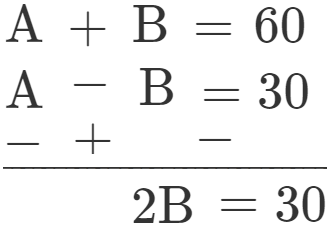
Now by subtracting equation $(5)$ from equation $(6)$
We get,

Therefore,
$2\text{B}=30$
$\Rightarrow\text{B}=\frac{30}{2}$
$\Rightarrow\text{B}=15^\circ$
Hence $B = 15^\circ$
Therefore the values of $A$ and $B$ are as follows
$A = 45^\circ $ and $B = 15^\circ$
View full question & answer
Question 144 Marks
Evaluate the following:
$\frac{4}{\cot^230^\circ}+\frac{1}{\sin^260^\circ}-\cos^245^\circ$
Answer
We have
$\frac{4}{\cot^230^\circ}+\frac{1}{\sin^260^\circ}-\cos^245^\circ\ \dots(1)$
Now,
$\cot30^\circ=\sqrt{3},\ \cos45^\circ=\frac{1}{\sqrt{2}},\ \sin60^\circ=\frac{\sqrt{3}}{2}$
So by substituting above values in equation $(1)$
We get,
$\frac{4}{\cot^230^\circ}+\frac{1}{\sin^260^\circ}-\cos^245^\circ$
$=\frac{4}{\big(\sqrt{3}\big)^2}+\frac{1}{\Big(\frac{\sqrt{3}}{2}\Big)^2}-\Big(\frac{1}{\sqrt{2}}\Big)^2$
$=\frac{4}{3}+\frac{1}{\frac{\big(\sqrt{3}\big)^2}{2^2}}-\frac{1^2}{\big(\sqrt{2}\big)^2}$
$=\frac{4}{3}+\frac{2^2}{\big(\sqrt{3}\big)^2}-\frac{1}{2}$
$ =\frac{4}{3}+\frac{4}{3}-\frac{1}{2}$
Now $LCM$ of denominator of above expression is $6$
Therefore by taking $LCM$ we get,
$\frac{4}{\cot^230^\circ}+\frac{1}{\sin^260^\circ}-\cos^245^\circ$
$=\frac{4\times2}{3\times2}+\frac{4\times2}{3\times2}-\frac{1\times3}{2\times3}$
$ =\frac{8}{6}+\frac{8}{2}-\frac{3}{6}$
$=\frac{8+8-3}{6}$
$ =\frac{16-3}{6}$
$ =\frac{13}{6}$
Hence,
$\frac{4}{\cot^230^\circ}+\frac{1}{\sin^260^\circ}-\cos^245^\circ=\frac{13}{6}$
View full question & answer
Question 154 Marks
In $\triangle\text{PQR},$ right angled at $Q, PQ = 4cm$ and $RQ = 3cm$. Find the values of sin $P$, sin $R$, sec $P$ and sec $R.$
Answer
Given:
$\triangle\text{PQR}$ is right angled at vertex $Q.$
$PQ = 4cm$
$RQ = 3cm$
To find:
$\sin\text{P},\sin\text{R},\sec\text{P},\sec\text{R}$
Given $\triangle\text{PQR}$ is as shown below

Hypotenuse side PR is unknown.
Therefore, we find side PR of $\triangle\text{PQR}$ by Pythagoras theorem
By applying Pythagoras theorem to $\triangle\text{PQR}$
We get,
$P R^2=P Q^2+R Q^2$
Substituting values of sides from the above figure
$\text{PR}^2=4^4+3^2$
$\text{PR}^2=16+9$
$\text{PR}^2=25$
$\text{PR}=\sqrt{25}$
$\text{PR}=5$
Hence, Hypotenuse = 5
Now by definition,
$\sin\text{P}=\frac{\text{Perpendicular side opposite to }\angle\text{P}}{\text{Hypotenuse}}$
$\sin\text{P}=\frac{\text{RQ}}{\text{PR}}$
Substituting values of sides from the above figure
$\sin\text{P}=\frac{3}{5}$
Now by definition,
$\sin\text{R}=\frac{\text{Perpendicular side opposite to }\angle\text{R}}{\text{Hypotenuse}}$
$\sin\text{R}=\frac{\text{PQ}}{\text{PR}}$
Substituting values of sides from the above figure
$\sin\text{R}=\frac{4}{5}$
By definition,
$\sec\text{P}=\frac{1}{\cos\text{P}}$
$\sec\text{P}=\frac{1}{\frac{\text{Base side adjacent to }\angle\text{P}}{\text{Hypotenuse}}}$
$\sec\text{P}=\frac{\text{Hypotenuse}}{\text{Base side adjacent to }\angle\text{P}}$
Substituting values of sides from the above figure
$\sec\text{P}=\frac{\text{PR}}{\text{PQ}}$
$\sec\text{P}=\frac{5}{4}$
By definition,
$\sec\text{R}=\frac{1}{\cos\text{R}}$
$\sec\text{P}=\frac{1}{\frac{\text{Base side adjacent to }\angle\text{P}}{\text{Hypotenuse}}}$
$\sec\text{R}=\frac{\text{Hypotenuse}}{\text{Base side adjacent to }\angle\text{R}}$
Substituting values of sides from the above figure
$\sec\text{R}=\frac{\text{PR}}{\text{RQ}}$
$\sec\text{R}=\frac{5}{3}$
$\sin\text{P}=\frac{3}{5},\ \sin\text{R}=\frac{4}{5},\ \sec\text{P}=\frac{5}{4}$ and $\sec\text{R}=\frac{5}{3}$
View full question & answer
Question 164 Marks
Evaluate the following:
$\tan^230^\circ+\tan^260^\circ+\tan^245^\circ$
Answer
We have to find the following expression
$\tan^230^\circ+\tan^260^\circ+\tan^245^\circ\dots(1)$
Now,
$\tan30^\circ=\frac{1}{\sqrt3},\ \tan60^\circ=\sqrt3,\ \tan45^\circ=1$
So by substituting above values in equation $(1)$
We get,
$\tan^230^\circ+\tan^260^\circ+\tan^245^\circ$
$=\Big(\frac{1}{\sqrt3}\Big)^2+(\sqrt3)^2+(1)^2$
$=\frac{1^2}{(\sqrt3)^2}+(\sqrt3)^2+1$
$=\frac{1}{3}+3+1$
$=\frac{1}{3}+4$
Now by taking LCM
We get,
$\tan^230^\circ+\tan^260^\circ+\tan^245^\circ$
$=\frac{1}{3}+\frac{4\times3}{1\times3}$
$=\frac{1}{3}+\frac{12}{3}$
$=\frac{1+12}{3}$
$=\frac{13}{3}$
Therefore,
$\tan^230^\circ+\tan^260^\circ+\tan^245^\circ=\frac{13}{3}$
View full question & answer
Question 174 Marks
If $\cos\theta=\frac{5}{13},$ find the value of $\frac{\sin^2\theta-\cos^2\theta}{2\sin\theta\cos\theta}\times\frac{1}{\tan^2\theta}.$
Answer
We have,
$\cos\theta=\frac{5}{13}$
In $\triangle\text{ABC},$

$\text{AC}^2=\text{AB}^2+\text{BC}^2$
$\Rightarrow(13)^2=\text{AB}^2+(5)^2$
$\Rightarrow169=\text{AB}^2+25$
$\Rightarrow\text{AB}^2=169-25$
$\Rightarrow\text{AB}=12$
$\therefore\sin\theta=\frac{12}{13}$ and $\tan\theta=\frac{12}{5} $
Now, $\frac{\sin^2\theta-\cos^2\theta}{2\sin\theta\cos\theta}\times\frac{1}{\tan^2\theta}=\frac{\Big(\frac{12}{13}\Big)^2-\Big(\frac{5}{13}\Big)^2}{2\times\frac{12}{13}\times\frac{5}{13}}\times\frac{1}{\Big(\frac{12}{5}\Big)^2}$
$=\frac{\frac{144-25}{169}}{\frac{120}{169}}\times\frac{25}{144}$
$=\frac{119}{120}\times\frac{25}{144}$
$=\frac{119\times5}{24\times144}=\frac{595}{3456}$
View full question & answer
Question 184 Marks
If $\sin\theta=\frac{3}{5},$ evaluate $\frac{\cos\theta-\frac{1}{\tan\theta}}{2\cot\theta}.$
Answer
Given: $\sin\theta=\frac{3}{5}\ \dots(1)$
$\frac{\cos\theta-\frac{1}{\tan\theta}}{2\cot\theta}$
To find the value of
Now, we know the following trigonometric identity
$\cos^2+\sin^2\theta=1$
Therefore, by substituting the value of $\sin\theta$ from equation $(1),$
We get,
$\cos^2\theta+\Big(\frac{3}{5}\Big)^2=1$
Therefore,
$\cos^2\theta=1-\Big(\frac{3}{5}\Big)^2$
$=1-\frac{(3)^2}{(5)^2}$
$=1-\frac{9}{25}$
Now by taking $L.C.M$
We get,
$\cos^2\theta=\frac{25-9}{25}$
$=\frac{16}{25}$
Therefore by taking square root on both sides
We get,
$\cos\theta=\sqrt{\frac{16}{25}}$
$=\frac{\sqrt{16}}{\sqrt{25}}$
$=\frac{4}{5}$
Therefore,
$\cos\theta=\frac{4}{5}\ \dots(2)$
Now, we know that
$\tan\theta=\frac{\sin\theta}{\cos\theta}$
Therefore by substituting the value of $\sin\theta$ and $\cos\theta$ from equation (1) and (2) respectively
We get,
$\tan\theta=\frac{\frac{3}{5}}{\frac{4}{5}}$
$\tan\theta=\frac{3}{5}\times\frac{5}{4}$
$=\frac{3}{4}$
$\tan\theta=\frac{3}{4}\ \dots(3)$
Also, we know that
$\cot\theta=\frac{1}{\tan\theta}$
Therefore from equation (4),
We get,
$\cot\theta=\frac{1}{\frac{3}{4}}$
$=\frac{4}{3}$
Therefore,
$\cot\theta=\frac{4}{3}\ \dots(4)$
Now, by substituting the value of $\cos\theta,\tan\theta$ and $\cot\theta$ from equation (2), (3) and (4) respectively in the expression below
$\frac{\cos\theta-\frac{1}{\tan\theta}}{2\cot\theta}$
We get,
$=\frac{\cos\theta-\frac{1}{\tan\theta}}{2\cot\theta}=\frac{\frac{4}{5}-\frac{1}{\frac{3}{4}}}{2\times\frac{4}{3}}$
$=\frac{\frac{4}{5}-\frac{4}{3}}{\frac{2\times4}{3}}$
$=\frac{\frac{4\times3}{5\times3}-\frac{4\times5}{3\times5}}{\frac{8}{3}}$
$=\frac{\cos\theta-\frac{1}{\tan\theta}}{2\cot\theta}=\frac{\frac{12}{15}-\frac{20}{15}}{\frac{8}{3}}$
$=\frac{\frac{-8}{15}}{\frac{8}{3}}$
$=\frac{-8}{15}\times\frac{3}{8}$
$=\frac{-1}{5}$
Therefore, $\frac{\cos\theta-\frac{1}{\tan\theta}}{2\cot\theta}=\frac{-1}{5}$
View full question & answer
Question 194 Marks
If $\sec\text{A}=\frac{5}{4},$ verify that $\frac{3\sin\text{A}-4\sin^3\text{A}}{4\cos^3\text{A}-3\cos\text{A}}=\frac{3\tan\text{A}-\tan^3\text{A}}{1-3\tan^2\text{A}}.$
Answer
Given:
$\sec\text{A}=\frac{5}{4}\dots(1)$
To verify:
$=\frac{3\sin\text{A}-4\sin^3\text{A}}{4\cos^3\text{A}-3\cos\text{A}}=\frac{3\tan\text{A}-\tan^3\text{A}}{1-3\tan^2\text{A}}\dots(2)$
Now we know that $\sec\text{A}=\frac{1}{\cos\text{A}}$
Therefore $\cos\text{A}=\frac{1}{\sec\text{A}}$
Now, by substituting the value of sec A from equation $(1)$
We get,
$\cos\text{A}=\frac{1}{\frac{5}{4}}$
$=\frac{4}{5}$
Therefore,
$\cos\text{A}=\frac{4}{5}\dots(3)$
Now, we know the following trigonometric identity
$\cos^2\text{A}+\sin^2\text{A}=1$
Therefore,
$\sin^2\text{A}=1-\cos^2\text{A}$
Now by substituting the value of cos A from equation $(3)$
We get,
$\sin^2\text{A}=1-\Big(\frac{4}{5}\Big)^2$
$=1-\frac{\big(4\big)^2}{\big(5\big)^2}$
$=1-\frac{16}{25}$
Now by taking L.C.M
We get,
$\sin^2\text{A}=\frac{25-16}{25}$
$=\frac{9}{25}$
Now, by taking square root on both sides
We get,
$\sin\text{A}=\sqrt{\frac{9}{25}}$
$=\frac{\sqrt{9}}{\sqrt{25}}$
$=\frac{3}{5}$
Therefore,
$\sin\text{A}=\frac{3}{5}\dots(4)$
Now, we know that $\tan\text{A}=\frac{\sin\text{A}}{\cos\text{A}}$
Now by substituting the value of sin A and cos A from equation $(3)$ and $(4)$ respectively
We get,
$\tan\text{A}=\frac{\frac{3}{5}}{\frac{4}{5}}$
$=\frac{3}{5}\times\frac{5}{4}$
$=\frac{3}{4}$
Therefore
$\tan\text{A}=\frac{3}{4}\dots(5)$
Now from the expression of equation $(2)$
$\text{L.H.S}=\frac{3\sin\text{A}-4\sin^3\text{A}}{4\cos^3\text{A}-3\cos\text{A}}$
Now by substituting the value of cos A and sin A from equation $(3)$ and $(4)$
We get,
$\text{L}.\text{H}.\text{S}=\frac{3\Big(\frac{3}{5}\Big)-4\Big(\frac{3}{5}\Big)^3}{4\Big(\frac{4}{5}\Big)^3-3\Big(\frac{4}{5}\Big)}$
Therefore,
$\text{L}.\text{H}.\text{S}=\frac{\frac{9}{5}-4\Big(\frac{27}{125}\Big)}{4\Big(\frac{64}{125}\Big)-\frac{12}{5}}$
$=\frac{\frac{9}{5}-\frac{108}{125}}{\frac{256}{125}-\frac{12}{5}}$
Now by taking $L.C.M$ of both numerator and denominator
We get,
$\text{L}.\text{H}.\text{S}=\frac{\frac{9\times25}{5\times25}-\frac{108}{125}}{\frac{256}{125}-\frac{12\times25}{5\times25}}$
$=\frac{\frac{225}{125}-\frac{108}{125}}{\frac{256}{125}-\frac{300}{125}}$
$=\frac{\frac{225-108}{125}}{\frac{256-300}{125}}$
$=\frac{\frac{117}{125}}{\frac{-44}{125}}$
$=\frac{-117}{44}$
$=\frac{3\sin\text{A}-4\sin^3\text{A}}{4\cos^3\text{A}-3\cos\text{A}}=\frac{-117}{44}\dots(6)$
Now from the expression of equation $(2)$
$\text{R}.\text{H}.\text{S}=\frac{3\tan\text{A}-\tan^3\text{A}}{1-3\tan^2\text{A}}$
Now by substituting the value of tan A from equation $(5)$
We get,
$\text{R}.\text{H}.\text{S}=\frac{3\Big(\frac{3}{4}\Big)-\Big(\frac{3}{4}\Big)^3}{1-3\Big(\frac{3}{4}\Big)^2}$
$=\frac{\frac{9}{4}-\frac{27}{64}}{1-\frac{3\times9}{16}}$
Now by taking $L.C.M$
We get,
$\text{R}.\text{H}.\text{S}=\frac{\frac{9\times16}{4\times16}-\frac{27}{64}}{\frac{16-27}{16}}$
$=\frac{\frac{144}{64}-\frac{27}{64}}{\frac{-11}{16}}$
$=\frac{\frac{144-27}{64}}{\frac{-11}{16}}$
$=\frac{\frac{117}{64}}{\frac{-11}{16}}$
$=\frac{117}{64}\times\frac{16}{-11}$
$16\times4=64$
Now,
Therefore,
$\text{R}.\text{H}.\text{S}=\frac{117}{4}\times\frac{1}{-11}$
$=\frac{117\times1}{4\times-11}$
$=\frac{117}{-44}$
$=\frac{117}{-44}$
Therefore,
$\frac{3\tan\text{A}-\tan^3\text{A}}{1-3\tan^2\text{A}}=\frac{-117}{44}\dots(7)$
Now by comparing equation $(6)$ and $(7)$
$\frac{3\sin\text{A}-4\sin^3\text{A}}{4\cos^3\text{A}-3\cos\text{A}}=\frac{3\tan\text{A}-\tan^3\text{A}}{1-3\tan^2\text{A}}$
We get, $L.H.S. = R.H.S.$
View full question & answer
4 Marks Questions - Maths STD 10 Questions - Vidyadip