Questions

[2 Mark Questions]

🎯

Test yourself on this topic

31 questions · timed · auto-graded

Question 12 Marks
Explain : Self-pollination and cross-pollination.
Answer
→ Self-pollination : If the transfer of pollen occurs in the same flower from stamen to the stigma or it takes place between two different flowers of the same plant is called self-pollination.
→ Cross-pollination : If the pollen is transferred from one flower to another it is called cross-pollination.
→ This transfer of pollen from one flower to another is achieved by agents like wind, water or animals.
View full question & answer
Question 22 Marks
Write the difference between gamate and zygote and state its contribution in sexual reproduction.
Answer
Gamate Zygote
$1$. Produced after meiosis in reproductive organs. $1$. It is formed after the fertilization
$2$. It is unitary $(n)$ $2$. It is binary $(2n)$
$3$. Gamates join and form zygote $3$. Embryo develops from zygote.
View full question & answer
Question 32 Marks
What are the advantages of sexual reproduction over asexual reproduction?.
Answer
In sexual reproduction, both male and female reproductive cells arise from separate male and female parents. The traits of the parent with different traits are passed on to the offspring through sexual reproduction. Hence, generation to generation variation occurs. Species diversity arises due to continuous variations and sexual reproduction is also important for development. Some harmful recessive genes are not expressed.
View full question & answer
Question 42 Marks
Define : Regeneration
Answer
If the individual is somehow cut or broken up into many pieces, many of these pieces grow into separate individuals it is known as regeneration.
View full question & answer
Question 52 Marks
What is the difference in the method of reproduction between unicellular and multicellular organism ?
Answer
Unicellular organism reproduce mostly through asexual mode of reproduction only some organism undergo sexual reproduction. Where as multicellular organism almost undergo sexual mode of reproduction.
In unicellular organism, asexual reproduction by the method of regenerative reproduction is not possible, whereas it is possible for simple multicellular organism.
View full question & answer
Question 62 Marks
What is the difference in fission between Amoeba and Leishmania ?
Answer
Cell division in Amoeba can occur in any plane whereas is Leshmania, there is a whip - like structure at one end so binary fission occurs in a definite plane.
View full question & answer
Question 72 Marks
Why is variation beneficial to the species but not necessarily for the individual ?
Answer
The variation found in different species give them the ability to survive in changing environment. If there is sudden change in the atmospheric conditions then some species might extinct. But some of them can live because of variation.
The one who lives can reproduce and produce new offsprings of there species and forms their new population. So we can say that variation is beneficial
View full question & answer
Question 82 Marks
State four types of asexual reproduction.
Answer
$(1)$ Binary fission
$(2)$ Budding
$(3)$ Multiple fission
$(4)$ Fragmentation.
View full question & answer
Question 92 Marks
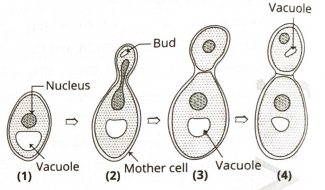
Explain reproduction by budding in yeast with diagram.
Answer
→ First of all a small part is emerged from a parentcell. After that nucleus is then divided into two daughter cell. From that daughter nucleus is separated.
→ Gradually it separates from the parent cell as its reaches its proper size. See the figure.
Image
View full question & answer
Question 102 Marks
What is the importance of $DNA$ copying in reproduction?
Answer
$(1)$ By replication an organism inherits its anatomy to its offspring.
$(2)$ The same anatomy may be maintained with slight variations in the offspring of each generation.
$(3)$ Variation occurs from generation to generation by the process of differentiation which takes place during the formation of foetus. This variation further adapts the organism to the environment.
$(4)$ It explains the theory of long term development.
View full question & answer
Question 112 Marks
How is the movement of leaves of the sensitive plant different from the movement of a shoot towards light?
View full question & answer
Question 122 Marks
Which part of the brain maintains posture and equilibrium of the body?
Answer
  • Cerebellum is the part of the brain that maintains posture and equilibrium of the body.
View full question & answer
Question 132 Marks
How are involuntary actions and reflex actions different from each other?
Answer
Involuntary actions Reflex actions
$1$. These are controlled by medulla a part of hind-brain. $1$. These are controlled by spinal cord in general.
$2$. Functioning of internal body parts are involuntary actions. $2$. It is involuntary response to external stimuli without the knowledge of cerebrum.
$૩$. Such actions go on continued under normal condition also. e.g., heartbeats, breathing, peristalsis, etc. $3$. It is shown under a condition of emergency. Such as to pull hand away on touching to hot object.
$4$. It occurs in controlled rhythmic way. $4$. It is a quick action.
View full question & answer
Question 142 Marks
Difference between: Cerebrum and Cerebellum
Answer
Cerebrum Cerebellum
$1$. It is a major part of the fore-brain. $1$. It is a part of the hind-brain.
$2$. It coordinates thoughts and various other senses. $2$. It coordinates the functions of voluntary muscles and thereby maintains the body equilibrium.
$૩$. It is the largest and most complex part of the brain. $3$. It is part lying behind the cerebrum, on the dorsal side beneath the pons.
View full question & answer
Question 152 Marks
Give scientific reason : The hormones secreted from the endocrine glands are present everywhere in the body.
Answer
  • The hormones are secreted from the endocrine glands which are ductless glands.
  • These glands are richly supplied with blood.
  • The secretions are directly poured in the blood stream.
  • As the blood circulates in all the parts the body, these hormones are carried and hence present everywhere in the body.
View full question & answer
Question 162 Marks
Give scientific reason : The foot is very suddenly lifted off as soon as it comes in contact with a burning coal.
Answer
  • It is a reflex action-In this phenomenon, the impulse commencing from the sensory organ (the skin of the foot) enters into the spinal cord through the sensory nerve fibres.
  • The impulse is analysed in the spinal cord and the responsive motor impulse is transmitted through the motor
  • nerve fibres to the effector organ (the foot muscles) to contract and thereby show the response.
  • So the foot is very suddenly lifted off as soon as it comes in contact with a burning coal.
View full question & answer
Question 172 Marks
Give scientific reason : The central nervous system is very well protected.
Answer
  • The central nervous system Comprises of a brain and a spinal cord.
  • Brain is contained in a fluid-filled balloon which absorbs mechanical shocks and thereby protect it from any severe injuries.
  • Moreover, the brain is enclosed in a strong bony box the cranium of the skull and the spinal cord is enclosed in
  • a long and strong bony vertebral column.
  • Thus, the central nervous system (of the human) is very well protected.
View full question & answer
Question 182 Marks
Give scientific reason : The roots in plants grow against the direction of light.
Answer
  • The roots in plants show positive tropic movement in the direction of water and gravitational force, i.e., The roots show positive hydrotropism and positive geotropism.
  • Thus, the roots bend in the direction of water and gravitational force.
  • So it grows against the direction of light.
View full question & answer
Question 192 Marks
Difference between: Plant hormones and Animal hormones
Answer
Plant hormones Animal hormones
$1$. Plant hormones are secreted by plant cells but no specific glands are there. $1$. Animal hormones are secreted from endocrine glands.
$2$. Plant hormones are either growth promoting or growth inhibiting. $2$. There is no inhibitor hormone for growth in animals.
$૩$. Plant hormones reach to their target site by simple diffusion. $3$. Animal hormones reach to their target site through blood circulation.
$4$. Secretion of it is not regulated by feedback mechanism. $4$. Secretion of some hormones regulated by feedback mechanism.
View full question & answer
Question 202 Marks
How does our body respond when adrenaline is secreted into the blood?
Answer
  • Adrenaline prepares our body in an emergency situation.
  • When adrenaline is secreted into the blood body shows following responses :
  • The heart beats faster, breathing rate increases, blood pressure increases, skeletal muscles become more active, etc.
  • This is known as fight or flight response.
View full question & answer
Question 212 Marks
Explain hormones related with growth in human.
Answer
  • Growth hormone and thyroxin are related with growth in human.
  • $(1)$ Growth hormone:
  • It is secreted by the pituitary gland.
  • Growth hormone regulates growth and development of the body.
  • $(2)$ Thyroxin:
  • It is secreted by thyroid gland.
  • Iodine is essential for the synthesis of thyroxin hormone.
  • Thyroxin regulates carbohydrate, protein and fat metabolism in the body.
  • This is necessary for balanced growth of body.
View full question & answer
Question 222 Marks
How do auxins promote the growth of a tendril around a support?
Answer
  • Auxins are growth promoting plant hormones that induce cell elongation.
  • When tendril comes in contact with a support, auxin stimulates faster growth on to a part of tendril away from the support.
  • This causes the tendril to coil around the support.
View full question & answer
Question 232 Marks
What are plant hormones?
Answer
  • Plant hormones are chemical compounds produced by plant itself and help to coordinate growth, development and responses to the environment.
View full question & answer
Question 242 Marks
How do we detect the smell of an agarbatti (incense stick)?
Answer
  • Olfactory receptors in our nose are stimulated by the smell of agarbatti.
  • This causes generation of impulse which is received at dendrite of sensory neuron.
  • Such impulse is transmitted to brain.
  • In cerebrum message is interpreted and we detect the smell.
View full question & answer
Question 252 Marks
What happens at the synapse between two neurons?
Answer
  • Synapse is the gap between nerve endings of axon of one neuron and dendrites of another neuron.
  • At the end of axon, the electrical impulse sets off the release of some chemicals.
  • These chemicals cross the synapse and start a similar electrical impulse in a dendrite of the next neuron.
View full question & answer
Question 262 Marks
What is the difference between a reflex action and walking?
Answer
  • Reflex action is an involuntary action controlled by spinal cord.
  • Thinking is not involved in such action.
  • Walking is a voluntary action and is controlled by a cerebellum, a part of hind-brain.
  • This action is shown as per wish of an individual.
View full question & answer
Question 272 Marks
How is central nervous system protected?
Answer
  • A central nervous system is made-up of brain and spinal cord.
  • Brain is a delicate organ and it is an important organ for a variety of activity, therefore, it needs to be carefully protected.
  • Brain is protected in a bony box called cranium.
  • Inside the bony box, the brain is covered by meninges.
  • Fluid between the meninges protects brain by shock absorption.
  • Spinal cord is protected in a hard skeletal structure called vertebral column or backbone.
View full question & answer
Question 282 Marks
Why reflex arcs have been evolved in animals? Explain.
Answer
  • Reflex arcs have been evolved in animals because the thinking process of the brain is not fast enough.
  • Many animals have very little or none of the complex neuron network needed for thinking.
  • So it is quite likely that reflex arcs have evolved as efficient way of functioning in the absence of true thought processes. However, even after complex neuron networks have come into existence, reflex arcs continue to be more efficient for quick responses.
View full question & answer
Question 292 Marks
Explain why we give slow response compared to reflex in any activity involved thinking.
Answer
  • Thinking is a complex activity and it is bound to involve a complicated interaction of many nerve impulses from many neurons.
  • Thinking centres are located in fore-brain.
  • It receives signals through nerves (Sensory) from various parts of the body.
  • Thinking centres analyse the signals and prepare the instructions.
  • From brain instructions are transmitted to effector organ through nerves (Motor).
  • It takes more time to respond.
  • In reflex action, instruction is generally given by spinal cord.
  • So, the time to transmit impulse from organs to brain and from brain back to organ is saved in reflex action.
  • That is why we give slow response when thinking is involved.
View full question & answer
Question 302 Marks
What is the meaning of reflex actions? Give examples.
Answer
  • The meaning of reflex actions: Reflex action is involuntary instant action without the involvement of brain for bringing about important reaction needed for survival.
  • Examples of reflex action:
  • $(1)$ Removal or withdrawal of hand or leg when anything sharp or hot touches unknowingly
  • $(2)$ Coughing, Sneezing, Yawning
  • $(3)$ Knee jerk response
  • $(4)$ Movement of diaphragm
  • $(5)$ Contriction of pupil in bright light
  • $(6)$ Mouth starts watering when smell or sight of favourite/ delicious food is there.
View full question & answer
Question 312 Marks
How do we respond to touching a hot object?
Answer
  • There are touch (Thigmo) receptors in the skin.
  • Skin is thus the sense organ.
  • Touching a hot object may cause injury.
  • But due to touch receptors in the skin which have the specialised tips of some nerve cells, due to which there is instant sensation of heat.
  • We therefore, withdraw the hand in response to touching a hot object.
View full question & answer
[2 Mark Questions] - Science STD 10 Questions - Vidyadip