Question 12 Marks
What precaution should be taken to avoid the overloading of domestic electric circuits ?
Answer$(i)$ Proper fuse wires must be used.
$(ii)$ Proper earthing must be provided.
$(iii)$ More than one appliance must not be connected in a single socket.
$(iv)$ Low power and high power appliances must be connected in separate circuits (having current ratings respectively $5 A$ and $15 A$ )
$(v)$ Wires must be used with good quality of insulation.
View full question & answer→Question 22 Marks
Answer→ Electric fuse is very important component in every domestic circuit. When a fuse is connected in the live wire between supply and any appliance, it protects the appliance against any possible damage due to overloading and due to voltage fluctuations. When live wire and neutral wire come in direct contact, (which is due to damage of insulation of wires or due to some fault in the appliance) current in the circuit increases abruptly. This is called "short circuiting."
→ When current passing through fuse increases beyond certain limit, fuse gets melted due to Joule heating and so path of current is broken and so current stops flowing further and so appliance is saved.
→ When we connect many high power appliances in a single socket or when we switch on many high power appliances at a time, quite heavy current is drawn from the supply. This is called "overloading."
View full question & answer→Question 32 Marks
When does an electric short circuit occur ?
AnswerDue to damage to the insulation or due to some fault in the appliance, if live wire and neutral wire happen to come in direct contact, current increases abruptly in the circuit. Here current gets a path of very low resistance (or in other words, path of current is made very short.) Such a phenomenon is called short circuiting.
View full question & answer→Question 42 Marks
Draw the diagram of an electromagnet.
Answer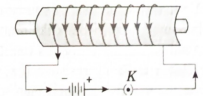
→ Above is the diagram of an electromagnet with soft iron core.
→ When key is made closed, circuit is completed and so current starts passing through the solenoid which quickly produces strong magnetic field inside the magnetic core. (At this time, end $P$ behaves like magnetic north pole and end $Q$ behaves like magnetic south pole.)
→ When the key is made open, circuit is broken and so current stops flowing through the solenoid which quickly diminishes the magnetic field inside the magnetic core. Hence the solenoid does not behave like a magnet.
→ Thus, above device behaves like a magnet as long as current passes through the solenoid.
→ Such a temporary magnet is called an "electromagnet." View full question & answer→Question 52 Marks
State and explain the Joule's law of heating.
Answer
- The quantity of heat generated in a conductor when a current flows through it is
- $(1)$ directly proportional to the square of current for a given resistance and the time-interval for which the current flows.
- $(2)$ directly proportional to the resistance for a given current and time-interval.
- $(3)$ directly proportional to the time for which the current flows through the resistor for a given resistance and current, i.e.,$H=I^2 R t$
- This mathematical expression (equation) is called the Joule law of heating.
- From the Joule's law of heating it is clear that the heat $(H)$ produced in a conductor due to electric current depends upon
- $(1)$ the current $(I)$
- $(2)$ the resistance $(R)$ of the conductor
- $(3)$ the time $(t)$ for which the current flows.
View full question & answer→Question 62 Marks
Write the Joule's law of heating. State the factors on which heat generated in a conductor due to electric current depends.
Answer
- The quantity of heat generated in a conductor when a current flows through it is
- $(1)$ directly proportional to the square of current for a given resistance and the time-interval for which the current flows.
- $(2)$ directly proportional to the resistance for a given current and time-interval.
- $(3)$ directly proportional to the time for which the current flows through the resistor for a given resistance and current, i.e., $H=I^2 R t$
- This mathematical expression (equation) is called the Joule law of heating.
- From the Joule's law of heating it is clear that the heat $(H)$ produced in a conductor due to electric current depends upon
- $(1)$ the current $(I)$
- $(2)$ the resistance $(R)$ of the conductor
- $(3)$ the time $(t)$ for which the current flows.
View full question & answer→Question 72 Marks
If n number of electrons pass through the cross-section of a conductor in time t, what is the electric current flowing through it?
Answer
- If n electrons pass through the cross-section of a conductor in time t, the amount of electric charge passing through the cross-section would be
- $Q=n e ;$; where, $e =$ charge of an electron
- Now according to definition of electric
- current,
- $I=\frac{Q}{t}$
- $I=\frac{n e}{t}$
View full question & answer→Question 82 Marks
State the formula of an electric current and define its unit.
Answer
- If a net amount of electric charge $Q$, flows across any cross-section of a conductor in time t, then the current $l$, through the cross-section is
- $I=\frac{Q}{t} \ldots \ldots(12.1)$
- $SI$ unit of electric charge is coulomb $C$ . and time is second $(s)$.
- The $SI$ unit of electric current is ampere $(A)$, named after the French scientist, Andre-Marie Ampere.
- Hence from equation $(12.1)$, $A =\frac{C}{s}$
- Definition of ampere $A$. :
- If $1$ coulomb charge flows through any cross-section of a conductor in $1$ second, then the electric current flowing through the conductor is said to be $1$ ampere. i.e., $1 A=\frac{1 C}{1 s}=1 Cs ^{-1}$
View full question & answer→Question 92 Marks
Name the substances used to make a conducting wire, resistive wire and resistor.
Answer
- A conducting wire is made from metals like copper or aluminium.
- A resistive wire is made from alloys like Nichrome.
- Carbon resistors are made from the proper mixture of graphite and resin (polymer) e.g., sealing-wax, cotton, etc.
View full question & answer→Question 102 Marks
Explain the cause of resistance in a conductor and differentiate between conductors and insulators.
Answer
- The electric current flowing in a conductor is due to the motion of the free electrons in a fixed direction. These electrons collide with the ions, atoms or molecules of the conductor.
- This retards their motion.
- Hence, there is opposition to electric current.
- This opposition is called the resistance of the conductor $(R)$.
- Good conductors like copper, aluminium, etc., offer low resistance to the flow of current.
- This is because they contain a large number of free electrons.
- In insulators, there are free electrons.
- As a result, practically no electric current flows through them even on application of voltage across them.
- Thus, the resistance of the insulators is very high.
View full question & answer→Question 112 Marks
In a voltmeter there are $20$ divisions between $0$ mark and $0.5 \ V$ mark. Calculate the least count of the voltmeter.
Answer
- Range of voltmeter $= 0.5 \ V$
- No. of divisions $= 20$
- $\therefore \text { The least count of the voltmeter }=\frac{\text { Range }}{\text { Total no.of division }}$
- $=\frac{0.5 V}{20}=0.025 V$
View full question & answer→Question 122 Marks
An ammeter has a range $(0-3 A)$ and there are $30$ divisions on its scale. Calculate the least count of the ammeter.
Answer
- Here, range of ammeter $=3$ ampere (i.e., The maximum current that can be measured by the given ammeter is $3A.$)
- No. of divisions on scale of ammeter $=30$
- The least count of the ammeter $=\frac{\text { Range of the ammeter }}{\text { Total no.of divisions }}$
- $=\frac{3 A}{30}=0.1 A$
- (i.e., Minimum current that can be accurately measured by a given ammeter is $0.1 A.$)
View full question & answer→Question 132 Marks
The potential difference between the terminals of an electric heater is $60 \ V$ when it draws a current of $4 A$ from the source. What current will the heater draw, if the potential difference is increased to $120 \ V?$
Answer
- Solution: We are given, potential difference $V=60 V$, current $I =4 A$.
- According to the Ohm's law, resistance of heater coil $R=\frac{V}{I}=\frac{60 V}{4 A}=15 \Omega$
- When the potential difference is increased to $120 \ V$ the current is given by current $=\frac{ V }{ R }=\frac{120 V}{15 \Omega}=8 A$.
- Thus, the current through the heater becomes $8 A.$
View full question & answer→Question 142 Marks
A. How much current will an electric bulb draw from a $220 \ V$ source, if the resistance of the bulb filament is $1200 \Omega $ ? $B.$ How much current will an electric heater coil draw from a $220 \ V$ source, if the resistance of the heater coil is $100\Omega ?$
Answer
- We are given, source voltage $V =220 V$; Resistance of bulb filament $R=1200 \Omega$.
- Now, $V=I R$
- $I =\frac{ V }{ R }=220 V / 1200 \Omega=0.18 A$
- We are given, source voltage $V =220 V$,
- Resistance of heater coil $R=100 \Omega$.
- Now, $V= R$
- $\therefore I =\frac{ V }{ R }=220 V / 100 \Omega=2.2 A$
View full question & answer→Question 152 Marks
Give the scientific reason : Fairy decorative lights are always connected in parallel.
Answer
- If the fairy lights are connected in series, the equivalent resistance offered will be greater and the brightness of the bulbs will be affected.
- But in parallel connection all the bulbs will glow with same intensity and if any one bulb gets fused the other bulbs will continue to glow.
View full question & answer→Question 162 Marks
Give the scientific reason : It is not advisable to connect an electric bulb and electric heater in series.
Answer
- An electric bulb and electric heater have different resistances and the requirement of current for their proper functioning is different.
- Moreover, sometimes the devices may get damaged.
- If one of the devices stops and the circuit breaks, the other device cannot be used.
View full question & answer→Question 172 Marks
An electric heater of resistance $8 \Omega $ draws $15 A$ from the service mains for $2$ hours. Calculate the rate at which heat is developed in the heater.
Answer
- Here, $I=15 A ; R =8 \Omega ; t =2 h$
- The rate at which heat is developed in the heater means its electric power,
- $P =I^2 R$
- $=(15)^2 \times 8=225 \times 8=1800 W=1800 \frac{ J }{s}$
View full question & answer→Question 182 Marks
Which uses more energy, a $250 \ W \ TV$ set in $1 h$, or a $1200 \ W$ toaster in $10$ minutes ?
Answer
- For $TV$ set :
- Power $P =250 W=250 \frac{ J }{ s }$
- Time $t =1 h=3600 s$
- Electric energy (used by $TV$ set)
- $= P \times t$
- $=250 \frac{ J }{ s } \times 3600 s$
- $=900000=900 kJ$
- For Toaster :
- Power $P =1200 W=1200 \frac{ J }{ s }$
- Time $t=10$ minute $=10 \times 60=600 s$
- Electric energy (used by toaster)
- $= P \times t$
- $=1200 \frac{ J }{ s } \times 600 s=720000=720 kJ$
- From above calculations, it is clear that a $250 \ W \ TV$ set in $1 h$ consumes more electric energy than a $1200 \ W$ toaster in $10$ minute.
View full question & answer→Question 192 Marks
Two lamps, one rated $100 \ W$ at $220 \ V$, and the other $60 \ W$ at $220 \ V$ are connected in parallel to electric mains supply. What current is drawn from the line if the supply voltage is $220 \ V ?$
Answer
- The resistance of $100 \ W$ lamp,
- $R _1=\frac{V^2}{P_1}=\frac{220^2}{100}=\frac{220 \times 220}{100}=\frac{4840}{10} \Omega=484 \Omega$
- The resistance of 60 W lamp,
- $R _2=\frac{V^2}{P_2}=\frac{220^2}{60}=\frac{220 \times 220}{60}=\frac{4840}{60} \Omega=806.7 \Omega$
- When, these lamps are connected in parallel, their equivalent resistance $R$ is given by
- $\frac{1}{R_P}=\frac{1}{R_1}+\frac{1}{R_2}=\frac{R_2 \times R_1}{R_1 R_2}$
- $\therefore R_p=\frac{R_1 R_2}{R_2 \times R_1}$
- $=\frac{484 \times 806.7}{484+806.7}=\frac{39442.8}{1290.7}=302.6 \Omega$
- The current drawn from the line,
- $I =\frac{V}{R_P}=\frac{220}{302.6}=0.7270 \approx 0.73 A \Omega$
View full question & answer→Question 202 Marks
How much work is done in moving a charge of $2 \ C$ across two points having a potential difference $12 \ V?$
Answer
- Solution: The amount of charge $Q$ that flows between two points at potential difference $V (=12 V)$ is $2 \ C$ . Thus, the amount of work $W$, done in moving the charge is
- $W=V Q$
- $=12 \ V \times 2 C$
- $=24 \ J$
View full question & answer→Question 212 Marks
A battery of $9 \ V$ is connected in series with resistors of $0.2 \Omega, 0.3 \Omega, 0.4 \Omega, 0.5 \Omega$ and $12 \Omega$ respectively. How much current would flow through the $12 \Omega$ resistor?
Answer
- Since all the given resistors are connected in series, their equivalent resistance
- $R_5=0.2+0.3+0.4+0.5+12=13.4 \Omega$
- The current through the circuit,
- $I=\frac{V}{R_s}=\frac{9}{13.4}=0.67 A$
- In a series combination, the same current $I$ flows through all the resistors, so the current flowing through $12 \Omega$ resistor
- $=0.67 A$.
View full question & answer→Question 222 Marks
When a $12 \ V$ battery is connected across an unknown resistor, there is a current of $2.5mA$ in the circuit. Find the value of the resistance of the resistor.
Answer
- Here, $V =12 V ; I =2.5 mA=2.5 \times 10^{-3} A ; R =$ ?
- The resistance of the resistor $R=\frac{V}{I}$
- $=\frac{12}{2.5 \times 10^{-3}}$
- $=4800 \Omega$
- $=4.8 k \Omega$
View full question & answer→Question 232 Marks
An electric refrigerator rated $400 \ W$ operates $8$ hours/ day. What is the cost of the energy to operate it for $30$ days at Rs. $3.00$ per $kWh ?$
AnswerThe total energy consumed by the refrigerator in $30$ days would be
$400 W \times 8.0$ hour $/$ day $\times 30$ days
$=96000 \ Wh$
$=96 \ kWh \left(\because 1 kWh =10^3 Wh \right)$
Thus, the cost of the energy to operate the refrigerator for $30$ days is $96 kWh \times Rs. 3.00$ per kWh $Rs. 288.00.$
View full question & answer→Question 242 Marks
An electric bulb is connected to a $220 V$ generator. The current is $0.50 A$. What is the power of the bulb?
Answer
- Solution: Power $P = VI$
- $= 220V × 0.50A$
- $= 110J/s$
- $= 110 W$
View full question & answer→Question 252 Marks
$100 \ J$ of heat is produced in each second in a $4 \Omega$ resistance. Find the potential difference across the resistor.
Answer
- $H=100 J R=4 \Omega, t=1 s, V=$ ?
- Now, Heat $H=I^2 R t$
- So, we have the current through the resistor as
- $I =\sqrt{\frac{H}{R t}}$
- $=\sqrt{\frac{100 J}{(4 \Omega \times 1 s)}}$
- $=5 A$
- Thus, the potential difference across the resistor, $V$ is
- $V=I R$
- $=5 A \times 4 \Omega$
- $=20 V$
View full question & answer→Question 262 Marks
A wire of given material having length $l$ and area of cross-section $A$ has a resistance of $4 \Omega$. What would be the resistance of another wire of the same material having length $\frac{1}{2}$ and area of cross-section $2A?$
Answer
- For first wire:
- $R_1=\rho \frac{l}{A}=4 \Omega$
- Now, for second wire:
- $R _2=\rho \frac{\frac{l}{A}}{2 A}=\left(\frac{1}{4}\right) \rho \frac{l}{A}$
- $R _2=\frac{1}{4} R _1,\left(\because R _1=\rho \frac{l}{A}\right)$
- $\therefore R_2=\frac{1}{4} \times 4\left(\because R_1=4 \Omega\right.$ given $)$
- $\therefore R_2=1 \Omega$
- The resistance of the another wire is $1 \Omega$.
View full question & answer→Question 272 Marks
Resistance of a metal wire of length $1 \ m$ is $26 \Omega$ at $20^{\circ} C$. If the diameter of the wire is $0.3 \ mm$ , what will be the resistivity of the metal at that temperature? Using Table $2$ (on page $116$), predict the material of the wire.
Answer
- We are given the resistance $R$ of the wire $26 \Omega$, the diameter $d =0.3 mm=3 \times 10^{-4} m$, and the length $l$ of the wire $=1 m$.
- Therefore, from equation $R =\rho=\frac{l}{A}$ the resistivity of the given metallic wire is
- $\rho=\frac{R A}{l}$
- $=\left(R \pi d ^2 / 4 l\right)\left(\because A =\pi r ^2=\pi\left(\frac{d}{2}\right)^2=\frac{\pi d ^2}{4}\right)$
- $\therefore \rho=\frac{26 \times 3.14 \times\left(3 \times 10^{-4}\right)^2}{4 \times 1}$
- $\therefore \rho=1.84 \times 10^{-6} \Omega m$
- The resistivity of the metal at $20^{\circ} C$ is $1.84 \times 10^{-6} \Omega m$.
- From Table $2$ (on page $116$), we see that this is the resistivity of manganese.
View full question & answer→Question 282 Marks
How is heat produced by an electric current?
Answer
- A cell or a battery is a source of electrical energy.
- The chemical reactions within a cell or battery generate potential difference between its two terminals.
- This p.d. gets the electrons in motion to flow through any circuit, i.e., through a resistor or a system of resistors connected to the cell or battery.
- So to maintain this flow, the source has to keep expending its energy.
- But only a part of the source energy in maintaining the current may be consumed into useful work.
- The rest of the source energy is converted into heat to raise the temperature of the electrical gadgets.
View full question & answer→Question 292 Marks
State the characteristics of the parallel combination of resistors.
Answer
- Characteristics of a parallel combination of resistors are as follows:
- $(1)$ The potential difference across each of the resistors is the same and is equal to the total potential difference across the parallel combination.
- $(2)$ The total current is equal to the sum of the currents through the individual resistors.
- $(3)$ The reciprocal of the equivalent resistance of the combination is equal to the sum of the reciprocals of the individual resistances and hence the equivalent resistance is less than any of the individual resistances or smaller than the smallest resistance.
- $(4)$ The current through each resistor is inversely proportional to the resistance of the resistor.
View full question & answer→Question 302 Marks
State the characteristics of the series combination of resistors.
Answer
- Characteristics of a series combination of resistors are as follows :
- $(1)$ The same current flows through each resistor and is equal to the total current flowing in the series circuit.
- $(2)$ The potential difference (voltage) across the combination is equal to the sum of the potential differences across the individual resistors.
- $(3)$ The equivalent resistance of the combination is equal to the sum of the individual resistances and hence is greater than any of the individual resistances or greater than the largest resistance.
- $(4)$ The potential difference across each resistor is directly proportional to the resistance of the resistor.
View full question & answer→Question 312 Marks
Use the data in Table $2$ to answer the following :
$A$. Which is a better conductor, iron or mercury?
$B$. Which material is the best conductor?
Answer
- $A$. The electrical resistivity of iron is $10.0 × 10^{-8}Ω\ m$ whereas that of mercury is $94.0 × 10^{-8}Ω\ m.$
- As the resistivity of iron is less than that of mercury. Iron $(Fe)$ is a better conductor than mercury $(Hg)$.
- $B$. Silver metal has the lowest electrical resistivity of $1.60 × 10^{-8}Ω\ m$, therefore silver metal is the best conductor of electricity.
View full question & answer→Question 322 Marks
Why are coils of electric toasters and electric irons made of an alloy rather than a pure metal?
Answer
- The coils of electrical heating devices such as electric toasters and electric irons are made of an alloy.
- e.g., Nichrome rather than a pure metal because:
- $(1)$ the resistivity of an alloy e.g .. Nichrome is much higher than that of its constituent metals.
- $(2)$ alloys do not oxidise (i.e., burn) readily at high temperature (i.e., when it is red hot at $800 °C$)
- $(3)$ alloy has a high melting point.
View full question & answer→Question 332 Marks
Let the resistance of an electrical component remain constant while the potential difference across the two ends of the component decreases to half of its former value. What change will occur in the current through it?
Answer
- According to Ohm's law, $I=\frac{V}{R}$
- Here, as $R =$ constant, $I \propto V$.
- So, when the potential difference across the two ends of the electrical component decreases to half of its former value, the current through it will also decreases to half of its former value.
View full question & answer→Question 342 Marks
Will current can flow more easily through a thick wire or a thin wire of the same material, when connected to the same source? Why?
Answer
- The current will flow more easily through a thick wire than through a thin wire of the same material and having the same length when connected to the same source.
- Because, the resistance of a wire is inversely proportional to its area of cross-section.
- A thick wire has more area of cross-section and hence less resistance compared to a thin wire provided the two wires have the same length.
- Hence, a current can flow more easily through a thick wire compared to a thin wire when connected to the same source.
View full question & answer→Question 352 Marks
On what factors does the resistance of a conductor depend?
Answer
- The resistance $R$ of a conductor depends on:
- $(1)$ its length $l$ as $R \propto l$
- $(2)$ its area of cross section (i.e., thickness of the conductor) as $R \propto \frac{1}{A}$
- $(3)$ the nature of the material of the conductor (i.e., resistivity of material of the conductor)
- $(4)$ its temperature
View full question & answer→Question 362 Marks
Give the scientific reason : In a tungsten electric-bulb, a coil of wire, rather than a straight wire, is used.
Answer
- A coil of wire has much greater surface area than a straight wire if enclosed in the same bulb.
- This results in more emission of light.
- Hence, in a tungsten electric-bulb, a coil of wire, rather than a straight wire, is used.
View full question & answer→Question 372 Marks
State the factors on which the resistivity of a material depends.
Answer
- Resistivity of a material depends on
- $(1)$ nature/ type of material.
- $(2)$ temperature of the material.
- $(3)$ the pressure exerted on the material at small extent.
- Resistivity of metallic substances increases with temperature while resistivity of semi-conductor substances decreases with temperature.
- Resistivity of alloys increases very slowly with temperature than in case of metals.
- In other words one can say that, as resistivity of alloys is $100$ times than that of pure metals, it is approximately independent of temperature.
- Insulators have practically no free electrons and as such have a very high resistivity, which decreases slowly with rise in temperature.
View full question & answer→Question 382 Marks
Give the scientific reason : For domestic purposes, different electrical devices are connected in parallel instead of connecting them in series.
Answer
- Each device gets the full and same voltage as that of the electric supply.
- Also each device gets proper current depending on its resistance.
- If one of the devices is switched OFF/ON, other electrical devices remain unaffected.
View full question & answer→Question 392 Marks
How much energy is given to each coulomb of charge passing through a $6V$ battery ?
Answer
- Solution : Here the term, 'each coulomb' means 'every $1$ coulomb'. So $Q = 1$ coulomb, potential
- difference $V = 6 ~volt$, Energy = work done, $W = ?$
- Now, $W = VQ$
- $= 6 V × 1 C$
- $= 6 J$
- Since the work done on cach coulomb of charge is $6 J, 6 J$ energy is given to each coulomb of charge passing through a $6 V$ battery.
View full question & answer→Question 402 Marks
What is meant by saying that the potential difference between two points is $1\ V?$
Answer
- The potential difference between two points (in a electric field) is said to be $1$ volt if $1 \ J$ of work is done to move a charge of $1 \ C$ from one point to another point.
$1 V=\frac{1 J}{1 C }$
View full question & answer→Question 412 Marks
Calculate the number of electrons constituting one coulomb of charge.
Answer
- We know that one electron possesses a negative charge of $1.6 \times 10^{-19} C$. i.e., charge on $1$ electron $=-1.6 \times 10^{-19} C$
- Charge No. of electrons
- $-1.6 \times 10^{-19} C :: 1$
- $-1 C :: \text { (?) }$
- $\therefore$ No. of electron constituting $-1 C$ of charge
- $=\frac{-1 C \times 1}{-1.6 \times 10^{-19 C}}$
- $=\frac{10}{1.6} \times 10^{18}=6.25 \times 10^{18}$
- Thus, $6.25 \times 10^{18}$ electrons taken together constitute $1$ coulomb of charge.
- In other words, the $SI$ unit of electric charge coulomb $C.$ is equivalent to the charge contained in $6.25 \times 10^{18}$ electrons.
View full question & answer→Question 422 Marks
Define the unit of current.
Answer
- The $SI$ unit of current is called an ampere $(A).$
- If $1$ coulomb charge flows through any cross-section of a conductor in $1$ second, then the electric current flowing through the conductor is said to be $1$ ampere.
- i.e., $1 A=\frac{1 C }{1 s}=1 Cs ^{-1}$
View full question & answer→Question 432 Marks
A current of $0.5 \ A$ is drawn by a filament of an electric bulb for $10$ minutes. Find the amount of electric charge that flows through the circuit.
Answer
- We are given,
- $I =0.5 A ; t =10 \ min=600 s \text {. }$
- Now,
- $I =\frac{ Q }{\tau}$
- $Q = It$
- $=0.5 A \times 600 s$
- $=300 C$
View full question & answer→Question 442 Marks
An electric motor takes $5 \ A$ from a $220 \ V$ line. Determine the power of the motor and the energy consumed in $2 \ h.$
Answer
- Here, $I =5 A, V =220 V, t =2 h=(2 \times 60 \times 60) s =7200 s$
Power $P = VI =220 \times 5=1100 W=1100 J / s$
Now,
Energy consumed $W = Pt =1100 J / s \times 7200 s$
$=7920000 J$
$=7.92 \times 10^6 \ J$
OR
Energy consumed $W = Pt =1100 W \times 2 h$
$=2200 \ Wh$
$=2.2 \times 10^3 \ Wh$
$=2.2 \ kWh$
View full question & answer→Question 452 Marks
State various practical applications of heating effect of electric current in everyday life.
Answer
- The heating effect of current is used in
- $(1)$ the working of electrical heating devices such as an electric (laundry) iron, electric toaster, electric oven, electric kettle and heater, etc.
- $(2)$ an electric bulb (called incandascent lamp) for producing light by heating its filament.
- $(3)$ an electric fuse for protecting household wiring and electrical appliances.
View full question & answer→Question 462 Marks
An electric iron of resistance $20 \Omega$ takes a current of $5 A$. Calculate the heat devloped in $30 s.$
Answer
- Here, current $I=5 A$,
- resistance $R=20 \Omega$, time $t=30$ s
- Now,
- Heat produced $H =I^2 Rt$
- $=(5)^2 \times 20 \times 30$
- $=25 \times 20 \times 30$
- $=15000 \ J$
- $=15 \ kJ$
View full question & answer→Question 472 Marks
Compute the heat generated while transferring $96000$ coulomb of charge in one hour through a potential difference of $50V.$
Answer
- Solution: Here, charge, $96000 C$ ,
- time $t =1 h=60 \times 60=3600 s$,
- potential difference $V =50 V$
- Now,
- Heat generated $H = VIt$
- $= V \left(\frac{Q}{t}\right) t \left(\because I=\frac{Q}{t}\right)$
- $= VQ$3
- $=50 \times 96000$
- $=4800000 \ J$
- $=4.8 \times 10^6 \ J$
- or
- $=4.8 \times 10^3 \times 10^3 \ J$
- $=4.8 \times 10^3 \ kJ$
- $=4800 \ kJ$
View full question & answer→Question 482 Marks
Why does the cord of an electric heater not glow while the heating element does?
Answer
- The heating element of an electric heater is made of an alloy (such as Nichrome) which has high resistance (partly due to high resistivity) whereas the cord is made of copper metal which has very low resistance (partly due to low resistivity).
- Now, the heating element of an electric heater made of Nichrome glows because it becomes red- hot due to the large amount of heat (according to $H = I^2Rt$) is produced on passing current.
- On the other hand, the connecting cord of the electric heater made of copper does not glow because relatively very less (negligible) heat (according to $H = I^2Rt$) is produced in it by passing the same current.
View full question & answer→Question 492 Marks
What does a switch do in the working of a torch ?
AnswerIn the working of a torch, a switch provides conducting link between the cell (or a battery) and the bulb. When torch is made "on", current flows through the bulb and so it glows.
→ When the switch is made "off", current stops flowing through the bulb and so it does not glow anymore.
View full question & answer→Question 502 Marks
Define unit of electric current ?
AnswerWhen $1 C$ net charge passes through any cross-section of a conductor in $1 s$, amount of electric current flowing through that conductor is said to be $1 A$.
View full question & answer→