Question 14 Marks
Explain about atmospheric refraction on a large scale by the example of twinkling of stars.
Answer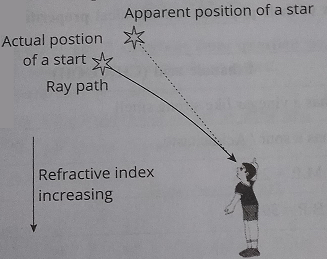
→ Twinkling of stars is due to atmospheric refraction of starlight.
→ While entering the atmosphere of earth, the starlight undergoes refraction continuously because of changing refractive index.
→ As the starlight approaches surface of earth, it bends towards the normal and so when we see towards the star near the horizon, that star appears slightly higher than its actual position, as shown in above figure. Since atmospheric conditions of earth are not stationary, apparent position of star keeps on changing slightly. Moreover, since the stars are very far, they are like point size sources of light. Hence path of starlight goes on varying slightly, the apparent position of the star goes on fluctuating and amount of starlight entering observer's eye goes on flickering. Because of this, sometimes that star appears brighter and some other time fainter. That is why stars are said to be twinkling.
View full question & answer→→ Twinkling of stars is due to atmospheric refraction of starlight.
→ While entering the atmosphere of earth, the starlight undergoes refraction continuously because of changing refractive index.
→ As the starlight approaches surface of earth, it bends towards the normal and so when we see towards the star near the horizon, that star appears slightly higher than its actual position, as shown in above figure. Since atmospheric conditions of earth are not stationary, apparent position of star keeps on changing slightly. Moreover, since the stars are very far, they are like point size sources of light. Hence path of starlight goes on varying slightly, the apparent position of the star goes on fluctuating and amount of starlight entering observer's eye goes on flickering. Because of this, sometimes that star appears brighter and some other time fainter. That is why stars are said to be twinkling.