Questions

[3 Mark Questions]

🎯

Test yourself on this topic

20 questions · timed · auto-graded

Question 13 Marks
Everyone should have knowledge about his/her blood group as well as the blood group of family members. There are four blood group A, B, AB and O.
You consult your family doctor and get more knowledge about blood group.
(1) How is the knowledge of blood grouping essential?
(2) Whether the blood group of an individual is a hereditary character or an acquired character?
(3) Whether the son inherits blood group from his father and the daughter inherits blood group from her mother?
(4) Whether the blood group of the offspring is under the influence of both the parents (father and mother)?
(5) Whether the genes of blood groups have their dominant and recessive expression?
Answer
(1) Blood grouping is essential in a case of blood transfusion.
(2) The blood group of an individual is a hereditary character.
(3) No
(4) Yes, the blood group of the offspring is under the influence of both the parents.
(5) Yes, genes for blood group A and B are dominant and for group O is recessive. [But A and B are equally dominant with each other and hence called co-dominant.]
View full question & answer
Question 23 Marks
Ramesh has two daughters and his wife Maya is pregnant again. He desires to have a son. So he forces his wife Maya to go for sonography for sex determination of the child.
Answer the questions based on this information.
(1) Who is responsible for the birth of a girl or boy child, father's or mother's sex chromosome?
(2) In case of Ramesh's daughters, which set of sex chromosome is not present in them?
(3) Is sex determination test illegal? Why?
Answer
(1) Father's sex chromosome is responsible for the birth of a girl or boy child.
(2) In case of Ramesh's daughters, Y-chromosome is not present in them.
(3) Yes, sex determination test is illegal because this is misused by people who do not want a particular child and it leads to illegal sex-selective abortion of female foetuses. It would disturb sex-ratio in human society.
View full question & answer
Question 33 Marks
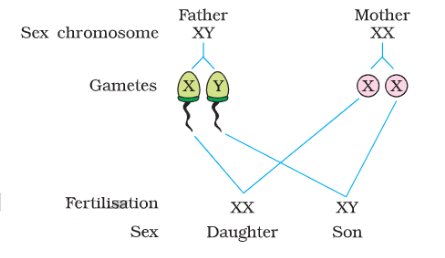
How is the sex of the child determined in human beings?
View full question & answer
Question 43 Marks
How do Mendel's experiments show that traits are inherited independently?
Answer
Mendel performed dihybrid experiment on pea plants.
A tall plant with round seeds was crossed with a short plant with wrinkled seeds. F1 progeny plants were all tall with round seeds. F1 progeny are used to generate F2 progeny by self-pollination. Along with parental combinations, F2 progeny showed new combinations too. Some of them were tall with wrinkled seeds while some others were short with round seeds.
It means factors (genes) controlling for seed shape and height of plant recombine to form new combinations in F2 offsprings. Thus, tall/short trait and the round seed/wrinkled seeds trait are inherited independently.
View full question & answer
Question 53 Marks
When pea plants showing pair of two different characteristics are bred with each other.
 Characters Different characteristics
1.Height of Plant1.Tall and short
2.Shape of seed2.Round and wrinkled
 Answer the following questions :
(1) What do the progeny of cross made between tall plant with round seeds and a short plant with wrinkled seeds look - like?
(2) Which traits are dominant?
(3) What happens when F1 progeny are used to generate F2 progeny by self-pollination?
Answer
(1) All progeny are tall and have round seeds.
(2) Tallness and round seeds are dominant traits.
(3) A Mendelian experiment shows that in F2 progeny some were tall plants with round seeds and some were short plants with wrinkled seeds.
     However, there would be some F2 progeny that showed new combinations such as tall with wrinkled seeds and short with round seeds.
View full question & answer
Question 63 Marks
Why there are two versions for each trait in each child? What trait will be seen in the child from these two versions?
Answer
The rules for inheritance of traits in human beings are related to the fact that both the father and the mother contribute practically equal amounts of genetic material to the child. This means that each trait can be influenced by both paternal and maternal DNA. So, we can say, that for each trait there will be two versions in each child.
The dominant trait is expressed in the child.
Example: Child may have genes for both free and attached earlobes inherited from mother and father, but only free earlobe trait is seen in child. This is because attached earlobe is recessive trait.
View full question & answer
Question 73 Marks
State the basic features of inheritance of traits.
Answer
The basic features of inheritance of traits are as follows :
$\rightarrow$ Traits have two or more alternative forms.
$\rightarrow$ Specific factor (gene) controls specific trait.
$\rightarrow$ One trait may be dominant over the other. e.g., character of free earlobe is dominant over the attached earlobe.
$\rightarrow$ Traits may remain unexpressed i.e., recessive but they can be expressed in future generation without any change.
$\rightarrow$ One alternative (allele) of a trait may express more often than the other.
$\rightarrow$ For sexually reproducing organisms, both male and female parents contribute equal amount of genetic material to the offsprings. This means that each trait can be influenced by both paternal and maternal DNA.
View full question & answer
Question 83 Marks
How does the creation of variations in a species promote survival?
Answer
The creation of variations in a species is either due to inaccuracies in DNA copying or during sexual reproduction.
$\rightarrow$ Depending on the nature of variations, different individuals have different kinds of advantages.
$\rightarrow$ The individuals with useful variations can adapt to the prevailing environment and show better survival.
$\rightarrow$ The individuals with useful variations then increase in numbers.
View full question & answer
Question 93 Marks
Explain how sexual reproduction gives rise to more visible variations than asexual reproduction. How does this affect the evolution of those organisms that reproduce sexually?
Answer
(1) Sexual reproduction gives rise to more visible variations than asexual reproduction because in sexual reproduction, each new generation is the combination of the DNA copies from two pre-existing individuals.
(2) Even during gamete formation new combination of genes occurs during meiosis.
From more visible variations during sexual reproduction, certain favourable variation can be selected by natural selection.
Whereas in asexual reproduction generally offsprings are exact copies of their single parent.
View full question & answer
Question 103 Marks
How does reproduction link to variation?
Answer
Every organism produces offsprings either through asexual or through sexual reproduction.
$\rightarrow$ The offsprings produced through these reproductive processes are similar, but subtly different.
$\rightarrow$ In asexual reproduction, although all the offsprings resemble each other and to their single parent, yet minor variation arise in them.
$\rightarrow$ Very little differences among the individual plants can be seen in a field of sugar cane.
$\rightarrow$ In most of sexually reproducing animals including human beings, quite distinct variations are visible among offsprings.
View full question & answer
Question 113 Marks
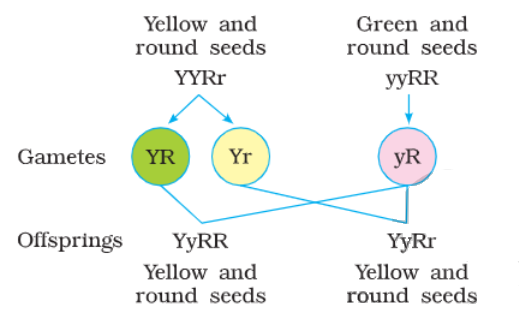
You are supplied with two sets of seeds of pea plants. One set is yellow and round seeds with gene constitution YYRr and other set is green and round seeds with gene constitution yyRR. From both sets of seeds plants are cultivated. Pea plant is self-pollinated but arrange artificial cross between two given plants cultivated from seeds. Which offsprings do you expect? show with chart.
View full question & answer
Question 123 Marks
Define:
Sex determination
Answer
The phenomenon of determining the sex of an individual of a species is called sex determination.
• There are different strategies e.g., temperature, chromosomes, genes, hormones, etc. responsible for determining the sex in certain animals.
• In certain animals, the sex determination is not genetically determined. e.g., the Snails can change their sex.
• In human beings in each cell there are 22 pairs of autosomes and 1 pair of sex chromosomes. The 23rd pair is either XX as in females or XY as in males.
View full question & answer
Question 133 Marks
The character of inflated peapod is dominant (I) and that of the shrunk peapod is recessive (i). Draw a chart to explain the genotype of the offsprings, their character and ratio of the types :
1. $\text {II} \times\ \text {ii}$$\quad$ 2. $\text {li} \times\ \text {ii}$$\quad$ 3. $\text {li} \times\ \text {li}$
View full question & answer
Question 143 Marks
Give scientific reason:
The chances of birth of a male child (son) or a female child (daughter) are equal.
Answer
In human beings, the sex of the child is determined by the father. The father produces two types of sperms. Both the types of sperms are produced equally in number. $50\%$ of the total sperms produced contain X-sex chromosome. While the remaining $50\%$ of sperms produced contain Y-sex chromosome along with autosomes. The chances of each type of sperm to fertilise the ovum are therefore equal.
Hence, the chances of birth of a son or a daughter are equal.
View full question & answer
Question 153 Marks
Give scientific reason:
The sex of the children is determined by father.
Answer
The man produces two types of sperms. $50\%$ of the sperms produced contain X as a sex chromosome, while the remaining $50\%$ of the sperms contain Y as a sex chromosome. The woman produces all the ova of only one type, i.e., containing only one X-chromosome as a sex chromosome.
A child who inherits an X-chromosome from her father will be a girl and one who inherits a Y-chromosome from him will be a boy.
Thus, in human beings, the type of sperm that participates in the process of fertilisation, determines the sex of the child. Hence, the sex of the children is determined by father or by the paternal chromosomes in sperm.
View full question & answer
Question 163 Marks
Give scientific reason:
The characters are under the control of genes.
Answer
A gene is the unit of heredity. It is a segment of DNA of specific length, arranged sequentially along the length of the chromosome.
Each gene is functionally specific and synthesizes a specific type of protein. The enzymes are all proteins and these proteins (as enzymes) induce specific biochemical process. The substances or proteins, formed during these processes, are responsible for the expression of characters. Hence, the characters are under the control of genes.
View full question & answer
Question 173 Marks
Give scientific reason:
The pea plants (Pisum sativum) were selected for Mendel's experiments.
Answer
(1) They are small plants and can be easily grown. (2) They are annual plants. So there are more chances of studyi-ng more number of generations every year. (3) It produces a large number of offsprings. (4) Its flowers are bisexual and generally show self-fertilisation. (5) Artificially cross pollination can be done as and when required. (6) There are varieties of characters. Each character shows atleast two contrasting expressions.
View full question & answer
Question 183 Marks
Give scientific reason:
Sexual reproduction gives rise to variations
Answer
Two parents are involved in sexual reproduction. The offspring inherits the genetic material (DNA) from both the parents through the gametes.
Gametes are produced by meiosis. New combinations and new arrangement of genes are formed as a result of meiosis.
These new combinations of genes on the chromosomes generate one or more variations in the zygote that inherits into an offspring.
Hence sexual reproduction creates more variations.
View full question & answer
Question 193 Marks
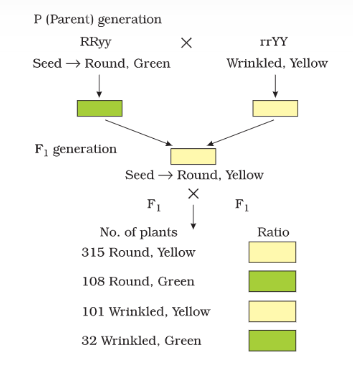
Mendel's experiment to study inheritance in the pea plant (Pisum sativum) is shown in the following diagram. Study the diagram carefully and complete the empty boxes by filling them properly.
Image
View full question & answer
Question 203 Marks
Answer
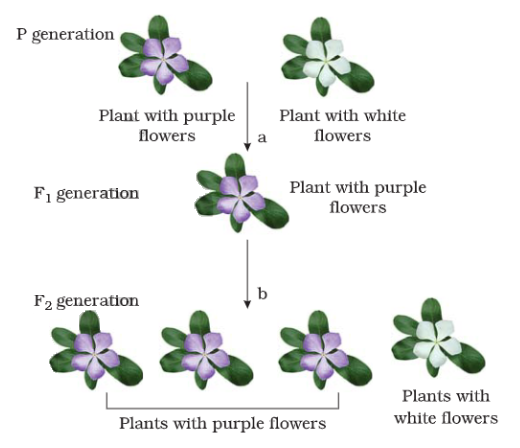
(1) a - Hybridisation, b - Self - fertilisation
(2) Purple colour of flowers is a dominant character and white colour is the recessive character. The hybridisation between the parents yield all plants having purple flowers in F1 generation which shows that it is dominant character.
(3) In F2 generation the ratio of expression of dominant character to the recessive character is $3 : 1.$
View full question & answer
[3 Mark Questions] - Science STD 10 Questions - Vidyadip