Questions · Page 1 of 10

M.C.Q (1 Marks)

🎯

Test yourself on this topic

50 questions · timed · auto-graded

MCQ 11 Mark
Which one of the following is not a criterion for classification of fungi?
  • Mode of nutrition
  • B
    Mode of spore formation
  • C
    Fruiting body
  • D
    Morphology of mycelium
Answer
Correct option: A.
Mode of nutrition
a
The morphology of the mycelium, mode of spore formation and fruiting bodies form the basis for the division of the kingdom fungi into various classes.
View full question & answer
MCQ 21 Mark
Match List $I$ with List $II$

List $I$  List $II$
$A$. Rhizopus $I$. Mushroom
$B$. Ustilago $II$. Smut fungus
$C$. Puccinia $III$. Bread mould
$D$. Agaricus $IV$. Rust fungus

Choose the correct answer from the options given below:

  • A
    $A-I, B-III, C-II, D-IV$
  • B
    $A-III, B-II, C-I, D-IV$
  • C
    $A-IV, B-III, C-II, D-I$
  • $A-III, B-II, C-IV, D-I$
Answer
Correct option: D.
$A-III, B-II, C-IV, D-I$
d
Rhizopus is a bread mould fungus. Ustilago is a smut fungi. Puccinia is known as rust fungi. Agaricus is commonly called mushroom.

$A-III, B-II, C-IV, D-I$

View full question & answer
MCQ 31 Mark
Which of the following is a correct statement?
  • A
    Bacteria are exclusively heterotrophic organisms.
  • B
    Slime moulds are saprophytic organisms classified under Kingdom Monera.
  • C
    Mycoplasma have DNA, Ribosome and cell wall
  • Cyanobacteria are a group of autotrophic organisms classified under Kingdom Monera.
Answer
Correct option: D.
Cyanobacteria are a group of autotrophic organisms classified under Kingdom Monera.
d
View full question & answer
MCQ 41 Mark
Which of the following statements is correct?
  • A
    Fusion of two cells is called Karyogamy.
  • Fusion of protoplasms between two motile on non-motile gametes is called plasmogamy.
  • C
    Organisms that depend on living plants are called saprophytes.
  • D
    Some of the organisms can fix atmospheric nitrogen in specialized cells called sheath cells.
Answer
Correct option: B.
Fusion of protoplasms between two motile on non-motile gametes is called plasmogamy.
b
View full question & answer
MCQ 51 Mark
Which of the following is correct about viroids$?$
  • A
    They have free $DNA$ without protein coat.
  • B
    They have $RNA$ with protein coat.
  • They have free $RNA$ without protein coat.
  • D
    They have $DNA$ with protein coat.
Answer
Correct option: C.
They have free $RNA$ without protein coat.
c
They have free $RNA$ without protein coat.
View full question & answer
MCQ 61 Mark
Which of the following is incorrect about Cynobacteria?
  • A
    They have chiorophyll "a' similar to green plants
  • B
    They are photoautotrophs
  • They lack heterocysts
  • D
    They often form blooms in polluted water bodies
Answer
Correct option: C.
They lack heterocysts
c
Cynobacteria have heterocyst that fixes atmospheric nitrogen to ammenia.
View full question & answer
MCQ 71 Mark
Mad cow disease in catttle is caused by an organism which has
  • A
    inert crystalline structure
  • abnormally folded protein
  • C
    free $RNA$ without protein coat
  • D
    free $DNA$ without protein coat
Answer
Correct option: B.
abnormally folded protein
b
View full question & answer
MCQ 81 Mark
Which of the following statements is correct ?
  • Lichens do not grow in polluted areas.
  • B
    Algal component of lichens is called mycobiont
  • C
    Fungal component of lichens is called phycobiont
  • D
    Lichens are not good pollution indicators
Answer
Correct option: A.
Lichens do not grow in polluted areas.
a
View full question & answer
MCQ 91 Mark
Which of the following statements is incorrect?
  • A
     VIrolds lack a protein coat
  • B
    Viruses are obligate parasites
  •  Infective constituent in viruses is the protein coat
  • D
    Prions consist of abnormally folded proteins
Answer
Correct option: C.
 Infective constituent in viruses is the protein coat
c
View full question & answer
MCQ 101 Mark
Which of the following statements is incorrect?
  • A
    Morels and truffles are edible delicacies.
  • B
    Clatioeps is a source of many alkaloids and $LSD.$
  • C
    Conidia are producell exogenously and ascospores endogenously.
  • Yeasts have fllamentous bodies with long threadlike hyphae.
Answer
Correct option: D.
Yeasts have fllamentous bodies with long threadlike hyphae.
d
View full question & answer
MCQ 111 Mark
Match the organisms in Column$-I$ with habitats in Column$-II$

Column$-I$ Column$-II$
$(a)$ Halophiles $(i)$ Hot springs
$(b)$ Thermoacidophiles $(ii)$ Aquatic environment
$(c)$ Methanogens $(iii)$ Guts of ruminants
$(d)$ Cyanobacteria $(iv)$ Salty area

Select the correct answer from the options given below

  • $(a)-(iv), (b)-(i), (c)-(iii), (d)-(ii)$
  • B
    $(a)-(i), (b)-(ii), (c)-(iii), (d)-(iv)$
  • C
    $(a)-(iii), (b)-(iv), (c)-(ii), (d)-(i)$
  • D
    $(a)-(ii), (b)-(iv), (c)-(iii), (d)-(i)$
Answer
Correct option: A.
$(a)-(iv), (b)-(i), (c)-(iii), (d)-(ii)$
a
View full question & answer
MCQ 121 Mark
After karyogamy followed by meiosis, spores are produced exogenously in
  • A
    Saccharomyces
  • B
    Neurospora
  • C
    Alternaria
  • Agaricus
Answer
Correct option: D.
Agaricus
d
View full question & answer
MCQ 131 Mark
Which of the following organisms are known as chief producers in the oceans?
  • A
    Euglenoids
  • B
    Dinoflagellates
  • Diatoms
  • D
     Cyanobacteria
Answer
Correct option: C.
Diatoms
c
View full question & answer
MCQ 141 Mark
Ciliates differ from all other protozoans in
  • A
    Using flagella for locomotion
  • Having two types of nuclei
  • C
    Using pseudopodia for capturing prey
  • D
    Having a contractile vacuole for removing excess water
Answer
Correct option: B.
Having two types of nuclei
b
View full question & answer
MCQ 151 Mark
Which among the following is $not$ a prokaryote?
  • A
    Oscillatoria
  • Saccharomyces
  • C
    Nostoc
  • D
    Mycobacterium
Answer
Correct option: B.
Saccharomyces
b
An organism that does not possess a true nucleus (nucleus with nuclear membrane) and double membrane-bounded organelles are called as prokaryotes.

Phylum Monera is the prokaryotes i.e., bacteria (Mycobacterium), cyanobacteria (Nostoc and Oscillatoria).

Whereas, Saccharomyces belong to phylum Fungi which possess a true nucleus and double membrane-bounded organelles i.e., eukaryotic.

View full question & answer
MCQ 161 Mark
Viroids differ from viruses in having
  • A
    $DNA$ molecules without protein coat
  • B
    $RNA$ molecules with protein coat
  • $RNA$ molecules without protein coat
  • D
    $DNA$ molecules with protein coat.
Answer
Correct option: C.
$RNA$ molecules without protein coat
c
(c) : Viroids are free $RNA$ particles that lack protein coat. They are infectious agents smaller than viruses.
View full question & answer
MCQ 171 Mark
Which among the following are the smallest living cells, known without a definite cell wall, pathogenic to plants as well as animals and can survive without oxygen?
  • A
    Pseudomonas
  • Mycoplasma
  • C
    Nostoc
  • D
    Bacillus
Answer
Correct option: B.
Mycoplasma
b
(b) : Mycoplasmas are the smallest living cells, known without a definite cell wall. They are pathogenic to both plants and animals and can survive without oxygen.
View full question & answer
MCQ 181 Mark
Which of the following are found in extreme saline conditions?
  • A
    Eubacteria
  • B
    Cyanobacteria
  • C
    Mycobacteria
  • Archaebacteria
Answer
Correct option: D.
Archaebacteria
d
(d) : Halophiles, a type of archaebacteria, usually occur in extreme saline conditions like salt pans, salt beds and salt marshes.
View full question & answer
MCQ 191 Mark
Which one of the following statements is wrong?
  • Eubacteria are also called false bacteria.
  • B
    Phycomycetes are also called algal fungi.
  • C
    Cyanobacteria are also called blue­green algae.
  • D
    Golden algae are also called desmids.
Answer
Correct option: A.
Eubacteria are also called false bacteria.
a
(a) : Eubacteria are also called true bacteria.
View full question & answer
MCQ 201 Mark
Which of the following statements is wrong for viroids?
  • A
    They cause infections.
  • Their $RNA$ is of high molecular weight.
  • C
    They lack a protein coat.
  • D
    They are smaller than viruses.
Answer
Correct option: B.
Their $RNA$ is of high molecular weight.
b
(b) : $RNA$ of viroid has low molecular weight.
View full question & answer
MCQ 211 Mark
One of the major components of cell wall of most fungi is
  • A
    cellulose
  • B
    hemicellulose
  • chitin
  • D
    peptidoglycan.
Answer
Correct option: C.
chitin
c
(c) : Fungal cell wall contains chitin or fungal cellulose along with other olysaccharides, proteins, lipids and a number of other substances.
View full question & answer
MCQ 221 Mark
Which one of the following is wrong for fungi?
  • A
    They are eukaryotic.
  • All fungi possess a purely cellulosic cell wall.
  • C
    They are heterotrophic.
  • D
    They are both unicellular and multicellular.
Answer
Correct option: B.
All fungi possess a purely cellulosic cell wall.
b
(b) : Cell wall in fungi is composed of chitin, a polysaccharide comprising $N$­-acetyl­$D$-­ glucosamine (a derivative of glucose).
View full question & answer
MCQ 231 Mark
Chrysophytes, Euglenoids, Dinoflagellates and Slime moulds are included in the Kingdom
  • A
    Fungi
  • B
    Animalia
  • C
    Monera
  • Protista.
Answer
Correct option: D.
Protista.
d
(d) : Protista is a kingdom of unicellular eukaryotic organisms. It includes hotosynthetic protists (dinoflagellates, chrysophytes and euglenoids), consumer­decomposer protists (slime moulds) and protozoan protists.
View full question & answer
MCQ 241 Mark
The primitive prokaryotes responsible for the production of biogas from the dung of ruminant animals, include the
  • methanogens
  • B
    eubacteria
  • C
    halophiles
  • D
    thermoacidophiles.
Answer
Correct option: A.
methanogens
a
(a) : Methanogens belong to archaebacteria. They include methane producing genera such as Methanobacillus and Methanothrix. Methanogens are obligate anaerobes found in oxygendeficient environments, such as marshes, swamps, sludge (formed during sewage treatment), and the digestive systems of ruminants. Mostly they obtain their energy by reducing carbon dioxide and oxidising hydrogen, with the production of methane.
View full question & answer
MCQ 251 Mark
Methanogens belong to
  • A
    eubacteria
  • archaebacteria
  • C
    dinoflagellates
  • D
    slime moulds.
Answer
Correct option: B.
archaebacteria
b
(b) : Methanogens belong to archaebacteria. They include methane producing genera such as Methanobacillus and Methanothrix. Methanogens are obligate anaerobes found in oxygen­deficient environments, such as marshes, swamps, sludge (formed during sewage treatment), and the digestive systems of ruminants. Mostly they obtain their energy by reducing carbon dioxide and oxidising hydrogen, with the production of methane.
View full question & answer
MCQ 261 Mark
Pick up the wrong statement.
  • A
    Some fungi are edible.
  • Nuclear membrane is present in Monera.
  • C
    Cell wall is absent in Animalia.
  • D
    Protistshavephotosyntheticand heterotrophic modes of nutrition.
Answer
Correct option: B.
Nuclear membrane is present in Monera.
b
(b) : Kingdom Monera consists of prokaryotic organisms, characterised by absence of nuclear envelope around nucleus and absence of membrane­-bound cell organelles.
View full question & answer
MCQ 271 Mark
Which one is a wrong statement?
  • A
    Haploid endosperm is typical feature of Gymnosperms.
  • B
    Brown algae have chlorophyll $a$ and $c$ and fucoxanthin.
  • C
    Archegonia are found in Bryophyta, Pteridophyta and Gymnosperms.
  • Mucor has biflagellate zoospores.
Answer
Correct option: D.
Mucor has biflagellate zoospores.
d
(d) : Mucor is a member of Zygomycetes (the conjugation fungi) in which motile cells $e.g.$ zoospores, planogametes, etc. are absent. Asexual reproduction takes place by the formation of non­ motile mitospores called sporangiospores. Sexual reproduction takes place by the formation of non­ motile zygospores.
View full question & answer
MCQ 281 Mark
Select the wrong statement.
  • A
    The term ‘contagium vivum fluidum’ was coined by M. W. Beijerinck.
  • B
    Mosaic disease in tobacco and $AIDS$ in human being are caused by viruses.
  • The viroids were discovered by D.J. Ivanowsky.
  • D
    W.M. Stanley showed that viruses could be crystallised.
Answer
Correct option: C.
The viroids were discovered by D.J. Ivanowsky.
c
(c) : Viroids are infectious $RNA$ particles which were discovered by T.O. Diener $(1971)$. These are devoid of protein coat and cause diseases in plants only, e.g., potato spindle tuber, chrysanthemum stunt etc.
View full question & answer
MCQ 291 Mark
Which one of the following matches is correct ?

Mucor Reproduction by Conjugation Ascomycetes
Agaricus Parasitic fungus Basidiomycetes
Phytophthora Aseptate mycelium Basidiomycetes
Alternaria Sexual reproduction absent Deuteromycetes


  • A
    Mucor Reproduction Ascomycetes by Conjugation
  • B
    Agaricus Parasitic fungus Basidiomycetes
  • C
    Phytophthora Aseptate Basidiomycetes mycelium
  • Alternaria Sexual Deuteromycetes reproduction absent
Answer
Correct option: D.
Alternaria Sexual Deuteromycetes reproduction absent
d
(d) : Alternaria is a Deuteromycetes member which are also known as fungi imperfecti. Their perfect stages (sexually reproducing stages) are either absent or not known.
View full question & answer
MCQ 301 Mark
Choose the wrong statement.
  • Morels and truffles are poisonous mushrooms.
  • B
    Yeast is unicellular and useful in fermenta­ tion.
  • C
    Penicillium is multicellular and produces antibiotics.
  • D
    Neurospora is used in the study of bio­ chemical genetics.
Answer
Correct option: A.
Morels and truffles are poisonous mushrooms.
a
(a) : Morels are Ascomycetes with edible ascocarps that have fleshy sponge­like conical cap or pileus and a stalk like stipe, $e.g.$, Morchella esculenta. Truffles are also edible members of Ascomycetes with tuber­like subterranean ascocarps that are often dug out with the help of trained dogs and pigs, $e.g.$, Tuber aestivum.
View full question & answer
MCQ 311 Mark
The imperfect fungi which are decomposers of litter and help in mineral cycling belong to
  • A
    Phycomycetes
  • B
    Ascomycetes
  • Deuteromycetes
  • D
    Basidiomycetes.
Answer
Correct option: C.
Deuteromycetes
c
(c) : Deuteromycetes are the imperfect fungi which include all those fungi in which sexual stage is either absent or not known. Some members are saprophytes or parasites while a large number of them are decomposers of litter and help in mineral cycling. $E.g.$, Colletotrichum, Helminthosporium etc.
View full question & answer
MCQ 321 Mark
Viruses have
  • $DNA $ enclosed in a protein coat
  • B
    prokaryotic nucleus
  • C
    single chromosome
  • D
    both $DNA$ and $RNA.$
Answer
Correct option: A.
$DNA $ enclosed in a protein coat
a
(a) : Viruses are nucleoprotein entities which are able to utilize synthetic machinery of a living cell of the host organism for its multiplication which does not involve growth and division. They have either $RNA$ or $DNA$ as genetic material and a protein coat.
View full question & answer
MCQ 331 Mark
Archaebacteria differ from eubacteria in.
  • cell membrane structure
  • B
    mode of nutrition
  • C
    cell shape
  • D
    mode of reproduction.
Answer
Correct option: A.
cell membrane structure
a
(a) : The archaebacteria are the ‘ancient’ bacteria that include extremophiles like methanogens, halophiles and thermophiles. They represent some of the most ancient of life forms that persist today.They have both eubacterial and eukaryotic characters besides the features unique to them. Their mode of reproduction, nutrition and cell shape and size resembles a typical eubacteria. Their cell walls are made of a variety of polymers, but do not contain peptidoglycan unlike eubacteria. Lipids of their cytoplasmic membranes are ether linked unlike eubacteria which contain glycerol ester lipids in their cell membrane.
View full question & answer
MCQ 341 Mark
Five kingdom system of classification sug­gested by R.H. Whittaker is not based on
  • A
    presence or absence of a well defined nucleus
  • mode of reproduction
  • C
    mode of nutrition
  • D
    complexity of body organisation.
Answer
Correct option: B.
mode of reproduction
b
(b) : R.H. Whittaker considered complexity of cell structure and structural (body) organisation, mode of nutrition, ecological life style and phylogenetic relationships for the five kingdom system of classification.
View full question & answer
MCQ 351 Mark
Which one of the following is true for fungi?
  • A
    They lack a rigid cell wall.
  • They are heterotrophs.
  • C
    They lack nuclear membrane.
  • D
    They are phagotrophs.
Answer
Correct option: B.
They are heterotrophs.
b
(b) : Fungi are achlorophyllous, heterotrophic, spore forming, non­vascular, eukaryotic organisms which often contain chitin or fungal cellulose in their walls. Hence, their cell wall is rigid.
View full question & answer
MCQ 361 Mark
Which of the following are likely to be present in deep sea water?
  • A
    Blue­green algae
  • B
    Saprophytic fungi
  • Archaebacteria
  • D
    Eubacteria
Answer
Correct option: C.
Archaebacteria
c
(c) : Archaebacteria belong to a group of prokaryotic organisms called Monera. These include the methanogens, which produce methane? the thermoacidophilic bacteria, which live in extremely hot and acidic environments (such as hot springs)? and the halophilic bacteria, which can only function at high salt concentrations and are abundant in the world’s oceans.
View full question & answer
MCQ 371 Mark
Select the incorrect statement.
  • A
    Cuscuta is a parasitic plant
  • B
     Bladderwort and Venus fly trap are examples of insectivorous plants.
  • C
    Plantae includes algae, bryophytes, pteridophytes, gymnosperms and angiosperms
  • The mode of nutrition in plants is holozoic
Answer
Correct option: D.
The mode of nutrition in plants is holozoic
d
Cuscuta (Amarbael) is parasitic plant

Bladderwort and Venus fly trap are insectivorous plants

Mode of nutrition in plants is autotrophic.

View full question & answer
MCQ 381 Mark
Consider the following statements with respect to characteristic features of the kingdom.

$(i)$ In animalia, the mode of nutrition is autotrophic.

$(ii)$ In monera, the nuclear membrane is present.

$(iii)$ In protista, the cell type is prokaryotic.

$(iv)$ In plantae, all organisms have cell wall. Of the above statements, which one is correct?

  • A
    $(i)$ only
  • B
    $(ii)$ only
  • C
    $(iii)$ only
  • $(iv)$ only
Answer
Correct option: D.
$(iv)$ only
d
Kingdom animalia includes all heterotrophic, multicellular complex eukaryotes.Kingdom monera includes prokaryotic organisms lacking membrane bound nucleus.Protista organism cell type is eukaryotic.
View full question & answer
MCQ 391 Mark
Which of the following pairs is not correctly matched?
  • A
    Anabaena - Cyanobacteria
  • B
    Amoeba - Protozoa
  • C
    Gonyaulax - Dinoflagellates
  • Albugo - Chrysophytes
Answer
Correct option: D.
Albugo - Chrysophytes
d
Albugo is the parasitic fungi which is found on mustard. It is the member of phycomycetes that are found in aquatic habitats and on decaying wood in moist and damp places.
View full question & answer
MCQ 401 Mark
Match column-$I$ (Characters/feature) with column-$II$ (examples) and choose the correct option.

Column-$I$ (Characters/features)

Column-$II$ (Examples)
$A$. Red dinoflagellates $I$. Rhizopus
$B$. Unicellular fungi $II$. Gonyaulax
$C$. Source of antibiotics

$III$. Yeast

$D$. Bread mould $IV$. Penicillium
  • A
    $A - III , B - II , C - I , D - IV$
  • B
    $A - II , B - III , C - I , D - IV$
  • $A - II , B - III , C - IV , D -I$
  • D
    $A - II , B - IV , C - III , D -I$
Answer
Correct option: C.
$A - II , B - III , C - IV , D -I$
c
Rhizopus is a genus of common saprophytic fungi on plants and specialized parasites on animals. They are found on a wide variety of organic substrates, including "mature fruits and vegetables", jellies, syrups, leather, bread, peanuts and tobacco. Rhizopus stolonifer is more commonly known as black bread mold. Gonyaulax is one of the dinoflagellates responsible for the advent of red tides. Yeast is a unicellular fungus, used to make bread and beer. Penicillium is a genus of ascomycetous fungi of major importance in the natural environment as well as food and drug production. Some members of the genus produce penicillin, a molecule that is used as an antibiotic.
View full question & answer
MCQ 411 Mark
Match column $I$ (containing fungus name) with column $II$ (common name) and choose the correct options.
Column-$I$ (Fungus name) Column-$II$ (Commonly called)
$A$. Puccinia $I$. Yeast
$B$. Ustilago $II$. Mushroom
$C$. Agaricus $III$. Smut fungus
$D$. Saccharomyces $IV$. Rust fungus
  • A
    $A-I, B-II, C-III, D-I V$
  • B
    $A-I I, B-I I I, C-I V, D-I$
  • C
    $A-I I I, B-I V, C-I, D-II$
  • $A-I V, B-I I I, C-I I, D-I$
Answer
Correct option: D.
$A-I V, B-I I I, C-I I, D-I$
d
Puccinia, Ustilago, Agaricus and Saccharomyces are commonly called as rust fungi, smut fungi, mushroom and yeast respectively.
View full question & answer
MCQ 421 Mark
Match the scientists given in column $I$ with their discovery given in column $II$ and choose the correct option.

Column-$I$ (Scientists) Column-$II$ (Discovery)

$A$. Ernst Mayr

$I$. Discovered Viroids

$B$. Whittaker $II$. Gave the name virus
$C$. Ivanowsky $III$. Proposed five kingdom classification
$D$. Diener $IV$. Evolutionary biology
  • $A -IV ,B - III , C - II , D - I$
  • B
    $A -III , B - IV , C -II, D -I$
  • C
    $A - II , B - III , C - IV , D -I$
  • D
    $A - I , B - II , C - III , D - IV$
Answer
Correct option: A.
$A -IV ,B - III , C - II , D - I$
a
View full question & answer
MCQ 431 Mark
Match column $I$ (Kingdom) with column $II$ (Class) and select the correct options
Column-$I$ (Kingdom) Column-$II$ (Class)
$A.$ Plantae $I$. Archaebacteria
$B$. Fungi $II$. Euglenoids
$C$. Protista $III$. Phycomycetes
$D$. Monera $IV$. Algae
  • $A - IV , B - III , C - II , D - I$
  • B
    $A - I , B - II , C - III , D - IV$
  • C
    $A - III , B - IV , C - II , D -I$
  • D
    $A - IV , B - II , C - III , D - I$
Answer
Correct option: A.
$A - IV , B - III , C - II , D - I$
a
Archaebacteria, euglenoids, phycomycetes and algae are classes of monera, protista, fungi and plantae respectively.
View full question & answer
MCQ 441 Mark
Column-$I$ (Terms) Column-$ll$ (Examples)
$A$. Ascus $I$. Spirulina
$B$. Basidium $II$. Penicillium
$C$. Protista $III$. Agaricus
$D$. Cyanobacteria $IV$. Euglena
$E$. Animalia $V$. Sponges

Match the terms given in column-$I$ with their examples given in column-$II$ and choose the correct option

  • A
    $A-I I, B-III, C-I V, D-V, E-I$
  • B
    $A-I, B-II, C-I I I, D-V, E-I V$
  • C
    $A-II, B-V, C-I I I, D-I, E-I V$
  • $A-II, B-I I I, C-I V, D-I, E-V$
Answer
Correct option: D.
$A-II, B-I I I, C-I V, D-I, E-V$
d
Ascus is a sac, typically cylindrical in shape, in which the spores of ascomycetes fungi develop.eg Penicillinium,Aspergillus

Basidium is a microscopic club-shaped spore-bearing structure produced by club fungi.egAgaricus( Mushroom)

Euglena, Spirulina and sponges are the examples of protista, cyanobacteria and animalia respectively.

View full question & answer
MCQ 451 Mark
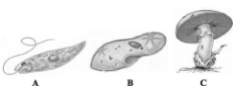
Identify the figures $A$, $B$ and $C$ given below.
  • $A$- Euglena, $B$ - Paramecium, $C$ - Agaricus
  • B
    $A$ - Trypanosoma, $B$ - Planaria, $C$ - Agaricus
  • C
    $A$ - Leishmania, $B$ - Vorticella, $C$ - Agaricus
  • D
    $A$ - Euglena, $B$ - Leishmania, $C$ - Aspergillus
Answer
Correct option: A.
$A$- Euglena, $B$ - Paramecium, $C$ - Agaricus
a
Euglenoids include flagellates like Euglana which have plant like characteristics (chlorophyll) in addition to some animal characteristics. Paramoecium is a ciliated protozoan, aquatic and actively moving organisms because of the presence of thousands of cilia. Agaricus (mushroom) belongs to class basidiomycetes of kingdom Fungi.
View full question & answer
MCQ 461 Mark
Bacteria and yeast are similar in all the following features except that
  • A
    both are unicellular.
  • both are prokaryotes.
  • C
    both are capable of causing fermentation.
  • D
    both produce spores.
Answer
Correct option: B.
both are prokaryotes.
b
 Bacteria and Yeast are unicellular organism that show anaerobic respiration /fermentation and reproduce by forming spores. But, yeast is not prokaryotic;Bacteria are prokaryotes .Yeast belongs to the kingdom Fungi, they are multicellular eukaryotes.
View full question & answer
MCQ 471 Mark
Which of the following organisms is lare correctly assigned its/their taxonomic group
  • A
    Paramecium and Plasmodium belong to the same kingdom as that of Penicillium.
  • B
    Lichen is a composite organism formed from the symbiotic association of an alga and a protozoan.
  • Yeast is a fungus that is used in making bread and beer
  • D
    Nostoc and Anabaena are examples of protista.
Answer
Correct option: C.
Yeast is a fungus that is used in making bread and beer
c
Saccharomyces cervisiae is a yeast used in making bread (Baker's yeast) and commercial production of ethanol.

Paramecium and Plasmodium are both Protozoan Protists while Penicillium is a fungi.

Lichen is composite organism formed from the symbiotic association of an alga and a fungus.

Nostoc and Anabaena are nitrogen fixing cyanobateria (kingdom monera).

View full question & answer
MCQ 481 Mark
Select the $wrong$ statement:
  • A
    Mitochondria are the powerhouse of the cell in all kingdoms except Monera
  • B
    Cell wall is present in members of Fungi and Plantae
  • C
    Mushrooms belong to Basidiomycetes
  • Pseudopodia are locomotory and feeding structures in Sporozoans.
Answer
Correct option: D.
Pseudopodia are locomotory and feeding structures in Sporozoans.
d
View full question & answer
MCQ 501 Mark
How many organisms in the list given below show autrophic nutrition method? Lactobacillus, Nostoc, Chara, wolffia, Nistrosomonas, Nitrobacter, porphyra Streptococus, Saccharomyces, Trypanosoma,
  • A
    Four
  • B
    Five
  • Six
  • D
    Three
Answer
Correct option: C.
Six
c
Autotrophic bacteria synthesize their cell constituents using carbon dioxide as the carbon

source.

From the list, autotrophic bacteria include a total of six as Chara, Nostoc, Porphyra, Wolfia, Nitrosomonas, Nitrobacter. Of these Chara, Nostoc, Porphyra, Wolfia is photoautotrophs while Nitrosomonas, Nitrobacter are chemoautotrophs. The other four (Lactobacillus, Streptomyces, Saccharomyces, Trypanosoma) are heterotrophs meaning they utilize organic compounds as a source of food.

Thus, the correct answer is option C.

View full question & answer