Questions

3 Marks Question

🎯

Test yourself on this topic

7 questions · timed · auto-graded

Question 13 Marks
The reactant which is entirely consumed in reaction is known as limiting reagent. In the reaction $2 A+4 B \rightarrow 3 C+4 D$  , when 5 moles of A react with 6 moles of $B$, then
i. Which is the limiting reagent?
ii. Calculate the amount of C formed?
Answer
The given equation is : $2 A+4 B \rightarrow 3 C +4 D$
i. It is clear from the above equation that: 2 moles of ' $A$ ' requires 4 moles of ' $B$ ' for the reaction i.e. ratio of moles of $A$ to $B$ is 2: 4 or $1: 2$. Hence, for 5 moles of ' $A$ ', the moles of ' $B$ ' required $=5 mole$ of $A \times \frac{4 mol \text { of } B}{2 mol \text { of } A}=10 mol$ of $B$. But we have only 6 moles of ' $B$ ', hence, ' $B$ ' is the limiting reagent.
ii. Since 4 moles of ' $B$ ' gives 3 moles of ' $C$ '. Hence, 6 moles of ' $B$ ' will produce $\frac{3}{4} \times 6=4.5$ mole of $C$.
View full question & answer
Question 23 Marks
The electronic configuration of some elements are given below:
a. $1 s^2, 2 s^2, 2 p^6, 3 s^2$
b. $1 s^2, 2 s^2, 2 p^6$
c. $1 s^2, 2 s^2, 2 p ^2$
d. $1 s^2, 2 s^2, 2 p ^6, 3 s^1$
e. $1 s^2, 2 s^2, 2 p^5$
Answer the following questions:
i. Name the elements.
ii. Which of these have the lowest Ionization enthalpy?
iii. Which is a halogen?
iv. Which is an alkali metal?
v. Which is an inert gas?
Answer
i. (a) Magnesium, (b) Neon (c) Carbon (d) Sodium (e) Flourine
ii. $1 s^2, 2 s^2, 2 p ^6, 3 s^1$ (Sodium)
iii. $1 s^2, 2 s^2, 2 p ^5$ (Flourine)
iv. $1 s^2, 2 s^2, 2 p^6, 3 s^1$ (Sodium)
v. $1 s^2, 2 s^2, 2 p^6($ Neon $)$
View full question & answer
Question 33 Marks
What transition in a hydrogen spectrum would have the same wavelength Balmer transition $n =4$ to $n =2$ of $\overline{ v }=\frac{1}{\lambda}= R _{ H } Z^2\left(\frac{1}{ n _1^2}-\frac{1}{ n _2^2}\right)$ spectrum?
Answer
For an atom, $\overline{ v }=\frac{1}{\lambda}= R _{ H } Z^2\left(\frac{1}{ n _1^2}-\frac{1}{ n _2^2}\right)$
For $He ^{+}$spectrum $Z =4, n _2=4, n _1=2$
$\therefore$ For hydrogen spectrum: $\overline{ v }=\frac{3 R _{ H }}{4}$ and $Z =1$
$\therefore \overline{ v }=\frac{1}{\lambda}= R _{ H } \times 1\left(\frac{1}{ n _1^2}-\frac{1}{ n _2^2}\right)$
or $R_H\left(\frac{1}{n_1^2}-\frac{1}{m_2^2}\right)=\frac{3 R_H}{4}$ or $\frac{1}{n_1^2}-\frac{1}{n_2^2}=\frac{3}{4}$
This corresponding to $n _1=1, n _2=2$ and means that the transition has taken Lyman series from $n =2$ to $n =1$.
Thus, the transition is from $n _2$ to $n _1$ in case of hydrogen spectrum.
View full question & answer
Question 43 Marks
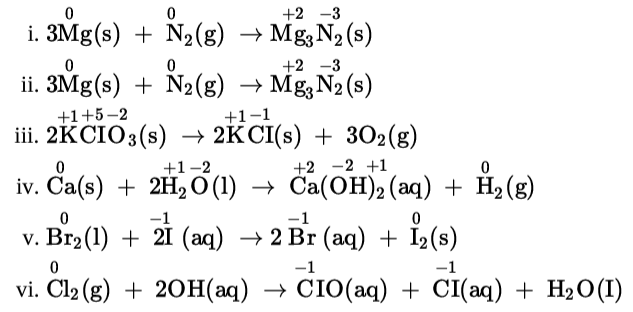
Identify the type of redox reaction taking place in the following.
Image
Answer
i. Combination reaction
ii. Displacement reaction
iii. Decomposition reaction
iv. Metal displacement reaction
v. Non-metal displacement reaction
vi. Disproportionation reaction
View full question & answer
Question 53 Marks
100 mL of a liquid is contained in an insulated container at a pressure of 1 bar. The pressure is steeply increased to 100 bar. The volume of the liquid is decreased by 1 mL at this constant pressure. Find $\Delta H$ and $\Delta U$.
Answer
According to the question, $p_1=1$ bar, $p_2=100 bar , V_1=100 mL, V_2=99 mL$.
We know that, $\Delta U=q+W$
For the adiabatic process, $q =0$
So, $\Delta U=W$
Now, $W=-p \Delta V=-100(99-100)=100$ bar ml
We know that, $\Delta H=\Delta U+\Delta p V$
$
\begin{aligned}
& =100+p_2 V_2-p_1 V_1 \\
& =100+(100 \times 99)-(1 \times 100) \\
& =100+9900-100 \\
& =9900 \text { bar } mL
\end{aligned}
$
View full question & answer
Question 63 Marks
1. Give the mathematical expression of enthalpy.
2. Neither q nor W is a state function but $q + W$ is a state function. Explain why?
3. The standard heat of formation of $Fe _2 O _3$ (s) is $824.2 kJ mol ^{-1}$ Calculate heat change for the reaction.
$
4 Fe(s)+3 O_2(g) \rightarrow 2 Fe_2 O_3(s)
$
Answer
1. Mathematical expression of enthalpy is $H = U + pv$, where U is internal energy.
2. q and W are not state functions. But as we know that, $q + W =\Delta U$, which is a state function.
Hence, $q + W$ is a state function.
3. According to the question, the standard heat of formation of $Fe _2 O _3$ (s) is $824.2 kJ mol ^{-1}$.
The standard heat of formation of Fe and $O _2$ is zero because they are in their basic standard states.
Reaction:
$
4 Fe(s)+3 O_2(g) \rightarrow 2 Fe_2 O_3(s)
$
We know that, $\Delta H^{\circ}=\sum \Delta H_f^{\circ}$ (products $)-\sum \Delta H_f^0$ (reactants)
$
\begin{aligned}
& =\left[2 \times \Delta H_{f}^0 Fe_2 O_3(s)\right]-\left[4 \Delta H_{f}^0 Fe(s)+3 \Delta H_{f}^0 O_2(g)\right] \\
& =2(-824.2)-[4 \times 0+3 \times 0] \\
& =-1648.4 kJ
\end{aligned}
$
View full question & answer
Question 73 Marks
Describe the change in hybridisation (if any) of the Al atom in the following reaction.
$
AlCl_3+Cl^{-} \rightarrow AlCl_4^{-}
$
Answer
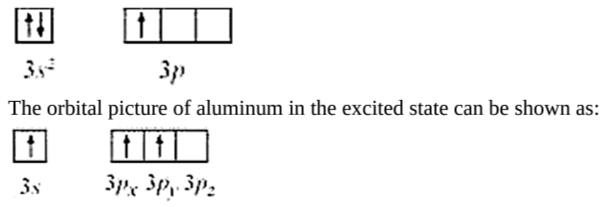
The valence orbital picture of aluminum in the ground state can be shown as:
Image
Hence, it undergoes $sp ^2$ hybridization to give a trigonal planar arrangement (in $AlCl _3$ ). To form $AlCl _4^{-}$, the empty 3 pz orbital also gets involved and the hybridization changes from $sp ^2$ to $sp ^3$. As a result, the shape becomes tetrahedral.
View full question & answer
3 Marks Question - Chemistry STD 11 Science Questions - Vidyadip