Question types

Model Paper 1 question types

36 questions across 6 question groups — pick any mix to generate a Chemistry paper with step-by-step answer keys.

36
Questions
6
Question groups
5
Question types
Sample Questions

Model Paper 1 questions

One sample from each question group in this chapter. Select any group above to see the full set with answer keys.

In a closed system, which of the following take place?
  • A
    The boundaries permit the flow of matter into it but not vice versa.
  • B
    The boundaries permit the flow of matter into or out of it.
  • The boundaries prevent the flow of matter into or out of it.
  • D
    The boundaries prevent the flow of matter out of it but not vice versa.

Answer: C.

View full solution
The ionic radii of $N ^{3-}, O ^{2-}$ and $F ^{-}$are respectively given by:
  • A
    1.36, 1.71, 1.40
  • B
    1.36, 1.40, 1.71
  • 1.71, 1.40, 1.36
  • D
    1.71, 1.36, 1.40

Answer: C.

View full solution
To which the terms stationary phase and mobile phase are associated?
  • Chromatography
  • B
    Spectroscopy
  • C
    Differential Extraction
  • D
    Distillation under reduced pressure

Answer: A.

View full solution
Assertion (A): Both 32 g of $SO _2$ and 8 g of $CH _4$ contain the same number of molecules.
Reason (R): Equal moles of two compounds contain the same number of molecules.
  • Both A and R are true and R is the correct explanation of A.
  • B
    Both A and R are true but R is not the correct explanation of A.
  • C
    A is true but R is false.
  • D
    A is false but R is true.

Answer: A.

View full solution
Assertion: A spectral line will be seen for a $2 p_x \rightarrow 2 p_y$ transition.
Reason: Energy is released in the form of waves of light when the electron drops from $2 p_{ v }$ to 2 p orbital.
  • A
    If both Assertion & Reason are true and the reason is the correct explanation of the assertion.
  • B
    If both Assertion & Reason are true but the reason is not the correct explanation of the assertion.
  • C
    If Assertion is true statement but Reason is false.
  • If both Assertion and Reason are false statements.

Answer: D.

View full solution
Assertion (A): $C _6 H _5 F$ gives large amount of nitration products than all the other halides
Reason (R): $F$ is most electronegative.
  • A
    Both A and R are true and R is the correct explanation of A.
  • B
    Both A and R are true but R is not the correct explanation of A.
  • C
    A is true but R is false.
  • A is false but R is true.

Answer: D.

View full solution
Assertion (A): The term tautomerism was introduced by Maxwell in order to explain the chemical reactivity of a substance according to two possible structures.
Reason (R): Metamers can also be chain isomers or position isomers.
  • A
    Both A and R are true and R is the correct explanation of A.
  • B
    Both A and R are true but R is not the correct explanation of A.
  • A is true but R is false.
  • D
    A is false but R is true.

Answer: C.

View full solution
Write hydrocarbon radicals that can be formed as intermediates during monochlorination of 2-methylpropane. Which of them is more stable? Give reasons.
View full solution
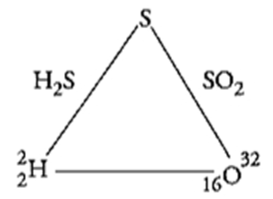
The element H and O combine separately with the third element S to form $H _2 S$ and $SO _2$ respectively, then show that they combine directly with each other to from $H _2 O$.
Image
View full solution
The electron gain enthalpy of bromine is 3.36 eV . How much energy in kcal is released when 8 g of bromine is completely converted to $Br ^{-}$ions in the gaseous state?
$
\left(1 eV=23.06 kcal mol^{-1}\right)
$
View full solution
Q 153 Marks Question3 Marks
A sugar syrup of weight 214.2 g contains 34.2 g of sugar $\left( C _{12} H _{22} O _{11}\right)$. Calculate
i. molal concentration, and
ii. mole fraction of sugar in the syrup
View full solution
Q 173 Marks Question3 Marks
Similar to electron diffraction, neutron diffraction microscope is also used for the determination of the structure of molecules. If the wavelength used here is 800 pm . Calculate the characteristic velocity associated with the neutron.
View full solution
Q 183 Marks Question3 Marks
PbO and $PbO _2$ react with HCl according to the following chemical equations:
$
\begin{aligned}
& 2 PbO+4 HCl \rightarrow 2 PbCl_2+2 H_2 O \\
& PbO_2+4 HCl \rightarrow PbCl_2+Cl_2+2 H_2 O
\end{aligned}
$
Why do these compounds differ in their reactivity?
View full solution
Q 193 Marks Question3 Marks
Assuming the water vapor to be a perfect gas, calculate the internal energy change when 1 mol of water at $100^{\circ} C$ and 1 bar pressure is converted to the ice at $0^{\circ} C$. Given the enthalpy of fusion of ice is 6.00 kJ mol 1 heat capacity of water is $4.2 J / g ^{\circ} C$.
View full solution
In order to explain the characteristic geometrical shapes of polyatomic molecules, Pauling introduced the concept of hybridisation. The orbitals undergoing hybridisation should have nearly the same energy. There are various type of hybridisations involving s, p and d-type of orbitals. The type of hybridisation gives the characteristic shape of the molecule or ion.

1. Why all the orbitals in a set of hybridised orbitals have the same shape and energy?
2. Out of $XeF _2$ and $SF _2$ which molecule has the same shape as $NO _2^{+}$ion?
3. Out of $XeF _4$ and $XeF _2$ which molecule doesn't have the same type of hybridisation as P (Phosphorus) has in $PF _5$ ?
OR
Unsaturated compounds undergo additional reactions. Why?
View full solution
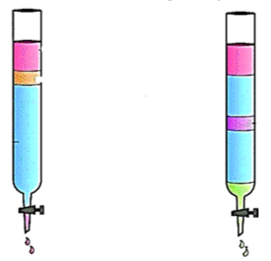
Chromatography is an important technique extensively used to separate mixtures into their components, purify compounds and also test the purity of compounds. Based on the principle involved, chromatography is classified into different categories. Two of these are Adsorption chromatography and Partition chromatography. Two main types of chromatographic techniques are based on the principle of differential adsorption column chromatography, and thin-layer chromatography. Adsorption chromatography is based on the fact that different compounds are adsorbed on an adsorbent to different degrees. Column chromatography involves the separation of a mixture over a column of adsorbent (stationary phase) packed in a glass tube. Thin-layer chromatography (TLC) is another type of adsorption chromatography, which involves the separation of substances of a mixture over a thin layer of an adsorbent coated on a glass plate. Partition chromatography is based on the continuous differential partitioning of components of a mixture between stationary and mobile phases.

1. Which adsorbent is used in adsorption chromatography?
2. How do you visualize colourless compounds after separation in Paper Chromatography?
3. Why paper chromatography is a type of partition chromatography?
OR
Which chromatography is shown in following image?
Image
View full solution
1. Explain hyperconjugation effect. How does hyperconjugation effect explain the stability of alkenes?
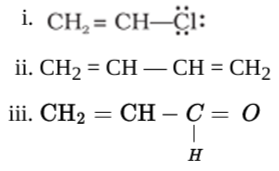
2. Draw the resonance structures of the following compounds:
Image
View full solution
1. What is the general molecular formula of saturated monohydric alcohols?
2. Write structural formulae for compounds named as-
a. 1-Bromoheptane
b. 5-Bromoheptanoic acid
View full solution
A sample of pure $PCl _5$ was introduced into an evacuated vessel at 473 K . After equilibrium was attained, concentration of $PCl _5$ was found to be $0.5 \times 10^{-1} mol L ^{-1}$. If value of $K _{ C }$ is $8.3 \times 10^{-3}$, what are the concentrations of $PCl _3$ and $Cl _2$ at equilibrium?
$
PCl_5(g) \rightleftharpoons PCl_3(g)+Cl_2(g)
$
View full solution
The pH of milk, black coffee, tomato juice, lemon juice, and egg white are $6.8,5.0,4.2,2.2$ and 7.8 respectively. Calculate corresponding hydrogen ion concentration in each.
View full solution
Attempt any five of the following:
1. Convert methane into ethane.
2. Write IUPAC name of the following: $CH _3\left( CH _2\right)_4 CH \left( CH _2\right)_3 CH _3 CH _2- CH \left( CH _3\right)_2$
3. To which category of compounds does cyclohexane belong?
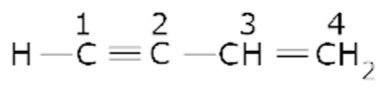
4. Name the type of hybridization in C (2) and C (3) in the following molecule
Image

5. What are Arenes?
6. n-propylmagnesium bromide on hydrolysis gives propane. Is there any other Grignard reagent which also gives propane? If so, give its name, structure and equation for the reaction.
7. How will you distinguish between acetylene and ethylene?
View full solution

Generate a Model Paper 1 paper free

Pick question groups from the list above, set marks and difficulty, and export a branded PDF with step-by-step answer keys. First 3 chapters free — no signup.

Download App