Sample QuestionsJEE Main 28-Jan-2025 Paper - Shift 2 questions
One sample from each question group in this chapter. Select any group above to see the full set with answer keys.
Let $f: \mathbf{R}-\{0\} \rightarrow(-\infty, 1)$ be a polynomial of degree 2, satisfying $f(\mathrm{x}) f\left(\frac{1}{\mathrm{x}}\right)=f(\mathrm{x})+f\left(\frac{1}{\mathrm{x}}\right)$. If $f(\mathrm{~K})=-2 \mathrm{~K}$, then the sum of squares of all possible values of K is :
View full solution →If $A$ and $B$ are the points of intersection of the circle $x^{2}+y^{2}-8 x=0$ and the hyperbola $\frac{x^{2}}{9}-\frac{y^{2}}{4}=1$ and a point $P$ moves on the line $2 x-3 y+4=0$, then the centroid of $\triangle P A B$ lies on the line :
- A
$4 x-9 y=12$
- B
$x+9 y=36$
- C
$9 x-9 y=32$
- D
$6 x-9 y=20$
View full solution →Let the coefficients of three consecutive terms $T_{r}$, $T_{r+1}$ and $T_{r+2}$ in the binomial expansion of $(a+b)^{12}$ be in a G.P. and let p be the number of all possible values of $r$. Let $q$ be the sum of all rational terms in the binomial expansion of $(\sqrt[4]{3}+\sqrt[3]{4})^{12}$. Then $\mathrm{p}+\mathrm{q}$ is equal to :
View full solution →Two equal sides of an isosceles triangle are along $-x+2 y=4$ and $x+y=4$. If $m$ is the slope of its third side, then the sum, of all possible distinct values of $m$, is :
View full solution →If $\sum_{r=1}^{13}\left\{\frac{1}{\sin \left(\frac{\pi}{4}+(r-1) \frac{\pi}{6}\right) \sin\left(\frac{\pi}{4}+\frac{r \pi}{6}\right)}\right\}=a \sqrt{3}+b$,$a, b \in \mathbf{Z}$, then $a^{2}+b^{2}$ is equal to :
View full solution →If $y=y(x)$ is the solution of the differential equation,$\sqrt{4-x^{2}} \frac{d y}{d x}=\left(\left(\sin ^{-1}\left(\frac{x}{2}\right)\right)^{2}-y\right) \sin ^{-1}\left(\frac{x}{2}\right)$,$-2 \leq x \leq 2, y(2)=\left(\frac{\pi^{2}-8}{4}\right)$, then $\mathrm{y}^{2}(0)$ is equal to _______________ .
View full solution →Let A and B be the two points of intersection of the line $y+5=0$ and the mirror image of the parabola $y^{2}=4 x$ with respect to the line $x+y+4=0$. If $d$ denotes the distance between A and B , and a denotes the area of $\triangle \mathrm{SAB}$, where S is the focus of the parabola $y^{2}=4 x$, then the vlaue of $(a+d)$ is _______________ .
View full solution →The interior angles of a polygon with n sides, are in an A.P. with common difference $6^{\circ}$. If the largest interior angle of the polygon is $219^{\circ}$, then n is equal to _______________ .
View full solution →Let $f(\mathrm{x})=\lim _{\mathrm{n} \rightarrow \infty} \sum_{\mathrm{r}=0}^{\mathrm{n}}\left(\frac{\tan \left(\mathrm{x} / 2^{\mathrm{r}+1}\right)+\tan ^{3}\left(\mathrm{x} / 2^{\mathrm{r}+1}\right)}{1-\tan ^{2}\left(\mathrm{x} / 2^{\mathrm{r}+1}\right)}\right)$. Then $\lim _{x \rightarrow 0} \frac{\mathrm{e}^{\mathrm{x}}-\mathrm{e}^{f(\mathrm{x})}}{(\mathrm{x}-f(\mathrm{x}))}$ is equal to _______________ .
View full solution →The number of natural numbers, between 212 and 999 , such that the sum of their digits is 15 , is _______________ .
A balloon and its content having mass $M$ is moving up with an acceleration 'a'. The mass that must be released from the content so that the balloon starts moving up with an acceleration ' $3 \mathrm{a}^{\prime}$ will be : (Take ' g ' as acceleration due to gravity)
- A
$\frac{3 \mathrm{Ma}}{2 \mathrm{a}-\mathrm{g}}$
- B
$\frac{3 \mathrm{Ma}}{2 \mathrm{a}+\mathrm{g}}$
- C
$\frac{2 \mathrm{Ma}}{3 \mathrm{a}+\mathrm{g}}$
- D
$\frac{2 \mathrm{Ma}}{3 \mathrm{a}-\mathrm{g}}$
View full solution →The magnetic field of an E.M. wave is given by $\vec{B}=\left(\frac{\sqrt{3}}{2} \hat{i}+\frac{1}{2} \hat{j}\right) 30 \sin \left[\omega\left(t-\frac{z}{c}\right)\right]$ (S.I. Units) The corresponding electric field in S.I. units is :
- A
$\overrightarrow{\mathrm{E}}=\left(\frac{1}{2} \hat{\mathrm{i}}-\frac{\sqrt{3}}{2} \hat{\mathrm{j}}\right) 30 \operatorname{cosin}\left[\omega\left(\mathrm{t}-\frac{\mathrm{z}}{\mathrm{c}}\right)\right]$
- B
$\overrightarrow{\mathrm{E}}=\left(\frac{3}{4} \hat{\mathrm{i}}+\frac{1}{4} \hat{\mathrm{j}}\right) 30 \mathrm{c} \cos \left[\omega\left(\mathrm{t}-\frac{\mathrm{z}}{\mathrm{c}}\right)\right]$
- C
$\overrightarrow{\mathrm{E}}=\left(\frac{1}{2} \hat{\mathrm{i}}+\frac{\sqrt{3}}{2} \hat{\mathrm{j}}\right) 30 \mathrm{c} \sin \left[\omega\left(\mathrm{t}+\frac{\mathrm{z}}{\mathrm{c}}\right)\right]$
- D
$\overrightarrow{\mathrm{E}}=\left(\frac{\sqrt{3}}{2} \hat{\mathrm{i}}-\frac{1}{2} \hat{\mathrm{j}}\right) 30 \mathrm{c} \sin \left[\omega\left(\mathrm{t}+\frac{\mathrm{z}}{\mathrm{c}}\right)\right]$
View full solution →a 400 g solid cube having an edge of length 10 cm floats in water. How much volume of the cube is outside the water?
(Given : density of water $=1000 \mathrm{~kg} \mathrm{~m}^{-3}$ )
- A
$1400 \mathrm{~cm}^{3}$
- B
$4000 \mathrm{~cm}^{3}$
- C
$400 \mathrm{~cm}^{3}$
- D
$600 \mathrm{~cm}^{3}$
View full solution →A uniform rod of mass 250 g having length 100 cm is balanced on a sharp edge at 40 cm mark. A mass of 400 g is suspended at 10 cm mark. To maintain the balance of the rod, the mass to be suspended at 90 cm mark, is
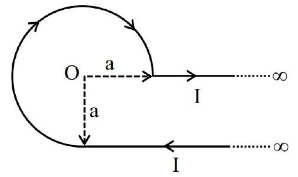
An infinite wire has a circular bend of radius a, and carrying a current I as shown in figure. The magnitude of magnetic field at the origin O of the arc is given by :
- A
$\frac{\mu_{0}}{4 \pi} \frac{I}{a}\left[\frac{\pi}{2}+1\right]$
- B
$\frac{\mu_{0}}{4 \pi} \frac{I}{a}\left[\frac{3 \pi}{2}+1\right]$
- C
$\frac{\mu_{0}}{2 \pi} \frac{I}{a}\left[\frac{\pi}{2}+2\right]$
- D
$\frac{\mu_{0}}{4 \pi} \frac{I}{\mathrm{a}}\left[\frac{3 \pi}{2}+2\right]$
View full solution →A thin transparent film with refractive index 1.4 , is held on circular ring of radius 1.8 cm . The fluid in the film evaporates such that transmission through the film at wavelength 560 nm goes to a minimum every 12 seconds. Assuming that the film is flat on its two sides, the rate of evaporation is _______________ $\pi \times 10^{-13} \mathrm{~m}^{3} / \mathrm{s}$.
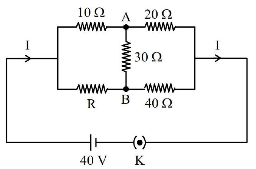
View full solution →The value of current $I$ in the electrical circuit as given below, when potential at A is equal to the potential at $B$, will be _______________ A.
View full solution →The volume contraction of a solid copper cube of edge length 10 cm , when subjected to a hydraulic pressure of $7 \times 10^{6} \mathrm{~Pa}$, would be _______________ $\mathrm{mm}^{3}$.
(Given bulk modulus of copper $=1.4 \times 10^{11} \mathrm{Nm}^{-2}$ )
View full solution →An electric dipole of dipole moment $6 \times 10^{-6} \mathrm{Cm}$ is placed in uniform electric field of magnitude $10^{6} \mathrm{~V} / \mathrm{m}$. Initially, the dipole moment is parallel to electric field. The work that needs to be done on the dipole to make its dipole moment opposite to the field, will be _______________ J.
View full solution →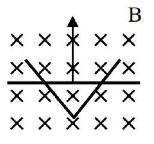
A conducting bar moves on two conducting rails as shown in the figure. A constant magnetic field B exists into the page. The bar starts to move from the vertex at time $t=0$ with a constant velocity. If the induced $E M F$ is $E \propto t^{n}$, then value of $n$ is _______________ .Identify the inorganic sulphides that are yellow in colour :
(A) $\left(\mathrm{NH}_{4}\right)_{2} \mathrm{~S}$
(B) PbS
(C) CuS
(D) $\mathrm{As}_{2} \mathrm{~S}_{3}$
(E) $\mathrm{As}_{2} \mathrm{~S}_{5}$
Choose the correct answer from the options given below:
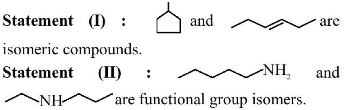
View full solution →- A
Both Statement I and Statement II are false
- B
Both Statement I and Statement II are true
- C
Statement I is true but Statement II is false
- D
Statement I is false but Statement II is true
View full solution →Identify correct statements :
(A) Primary amines do not give diazonium salts when treated with $\mathrm{NaNO}_{2}$ in acidc condition.
(B) Aliphatic and aromatic primary amines on heating wth $\mathrm{CHCl}_{3}$ and ethanolic KOH form carbylamines.
(C) Secondary and tertiary amines also give carbylamine test.
(D) Benzenesulfonyl chloride is known as Hinsberg's reagent.
(E) Tertiary amines reacts with benzenesulfonyl chloride very easily.
Choose the correct answer from the options given below :
View full solution →Assume a living cell with $0.9 \%(\omega / \omega)$ of glucose solution (aqueous). This cell is immersed in another solution having equal mole fraction of glucose and water.
(Consider the data upto first decimal place only)The cell will :
- A
shrink since soluton is $0.5 \%(\omega / \omega)$
- B
shrink since solution is $0.45 \%(\omega / \omega)$ as a result of association of glucose molecules (due to hydrogen bonding)
- C
swell up since solution is $1 \%(\omega / \omega)$
- D
Show no change in volume since solution is $0.9 \%(\omega / \omega)$
View full solution →Which of the following is/are not correct with respect to energy of atomic orbitals of hydrogen atom?
(A) 1 s $<2$ p $<3$ d $<4$ s
(B) $1 \mathrm{~s}<2 \mathrm{~s}=2 \mathrm{p}<3 \mathrm{~s}=3 \mathrm{p}$
(C) 1 s $<2$ s $<2$ p $<3$ s $<3$ p
(D) 1 s $<2$ s $<4$ s $<3\mathrm{~d}$
Choose the correct answer from the options given below:
View full solution →Total number of molecules/species from following which will be paramagnetic is _______________ .
$\mathrm{O}_{2}, \mathrm{O}_{2}^{+}, \mathrm{O}_{2}^{-}, \mathrm{NO}, \mathrm{NO}_{2}, \mathrm{CO}, \mathrm{K}_{2}\left[\mathrm{NiCl}_{4}\right]$,
$\left[\mathrm{Co}\left(\mathrm{NH}_{3}\right)_{6}\right] \mathrm{Cl}_{3}, \mathrm{~K}_{2}\left[\mathrm{Ni}(\mathrm{CN})_{4}\right]$
View full solution →A group 15 element forms $\mathrm{d} \pi-\mathrm{d} \pi$ bond with transition metals. It also forms hydride, which is a strongest base among the hydrides of other group members that form $\mathrm{d} \pi-\mathrm{d} \pi$ bond. The atomic number of the element is _______________ .
View full solution →Electrolysis of 600 mL aqueous solution of NaCl for 5 min changes the pH of the solution to 12 .
The current in Amperes used for the given electrolysis is _______________ . (Nearest integer).
Consider the following data :
Heat of formation of $\mathrm{CO}_{2}(\mathrm{~g})=-393.5 \mathrm{~kJ} \mathrm{~mol}^{-1}$
Heat of formation of $\mathrm{H}_{2} \mathrm{O}(\mathrm{l})=-286.0 \mathrm{~kJ} \mathrm{~mol}^{-1}$
Heat of combustion of benzene $=-3267.0 \mathrm{~kJ} \mathrm{~mol}^{-1}$
The heat of formation of benzene is _______________ $\mathrm{kJ} \mathrm{mol}^{-1}$.
(Nearest integer)
View full solution →The spin only magnetic moment ( $\mu$ ) value (B.M.) of the compound with strongest oxidising power among $\mathrm{Mn}_{2} \mathrm{O}_{3}$, TiO and VO is _______________ B.M.
(Nearest integer).
View full solution →