Questions

SECTION - B [MATHS - NUMERIC]

🎯

Test yourself on this topic

5 questions · timed · auto-graded

Question 14 Marks
Let $m$ and $n$ be the number of points at which the function $f(\mathrm{x})=\max \left\{\mathrm{x}, \mathrm{x}^{3}, \mathrm{x}^{5}, \ldots \ldots, \mathrm{x}^{21}\right\}, \mathrm{x} \in \mathbb{R}$, is not differentiable and not continuous, respectively. Then $\mathrm{m}+\mathrm{n}$ is equal to _____________.
Answer
$f(x)=\left\{\begin{array}{cc}x, & x<-1 \\ x^{21}, & -1 \leq x<0 \\ x, & 0 \leq x<1 \\ x^{21}, & x \geq 1\end{array}\right.$
$f(x)$ is continuous everywhere.
$\therefore \mathrm{n}=0$
$f^{\prime}(x)=\left\{\begin{array}{cc}1, & x < -1 \\ 21 x^{20}, & -1 \leq x < 0 \\ 1, & 0 < x < 1 \\ 21 x^{20}, & x \geq 1\end{array}\right.$
$\therefore \mathrm{f}(\mathrm{x})$ is non-differentiable at $\mathrm{x}=-1,0,1$
$\therefore \mathrm{m}=3$
$\mathrm{m}+\mathrm{n}=3$
View full question & answer
Question 24 Marks
Let $C$ be the circle $x^{2}+(y-1)^{2}=2, E_{1}$ and $E_{2}$ be two ellipses whose centres lie at the origin and major axes lie on $x$-axis and $y$-axis respectively. Let the straight line $\mathrm{x}+\mathrm{y}=3$ touch the curves $C,$ $E_{1}$ and $E_{2}$ at $P\left(x_{1}, y_{1}\right), Q\left(x_{2}, y_{2}\right)$ and $R\left(x_{3}, y_{3}\right)$ respectively. Given that P is the mid-point of the line segment $\text{QR}$ and $\mathrm{PQ}=\frac{2 \sqrt{2}}{3}$, the value of $9\left(x_{1} y_{1}+x_{2} y_{2}+x_{3} y_{3}\right)$ is equal to _____________.
View full question & answer
Question 34 Marks
Let $\mathrm{A}=\{\mathrm{z} \in \mathrm{C}:|\mathrm{z}-2-\mathrm{i}|=3\}$, $B=\{z \in C: \operatorname{Re}(z-i z)=2\}$ and $S=A \cap B$. Then $\sum_{z \in S}|z|^{2}$ is equal to _____________.
Answer
Let $\mathrm{z}=\mathrm{x}+\mathrm{iy}$
$A:|z-2-i|=3$
$|(x-2)+(y-1) i|=3$
$(x-2)^2+(y-1)^2=9\qquad\dots(1)$
$B=\operatorname{Re}(z-i z)=2$
$\operatorname{Re}((x+y)+i(y-x))=2$
$x+y=2\qquad\ldots(2)$
On solving (1) and (2) we get
$\mathrm{x}=\frac{3 \pm \sqrt{17}}{2}, \mathrm{y}=\frac{1 \mp \sqrt{17}}{2}$
$\sum_{z \in \mathrm{~S}}|z|^{2}=\frac{1}{4}[2 \times 26+2 \times 18]$
$\Rightarrow \frac{88}{4}=22$
View full question & answer
Question 44 Marks
Let $A=\left[\begin{array}{ccc}\cos \theta & 0 & -\sin \theta \\ 0 & 1 & 0 \\ \sin \theta & 0 & \cos \theta\end{array}\right].$ If for some $\theta \in(0, \pi),$ $A^{2}=A^{T},$ then the sum of the diagonal elements of the matrix $(\mathrm{A}+\mathrm{I})^{3}+(\mathrm{A}-\mathrm{I})^{3}-6 \mathrm{~A}$ is equal to _____________.
Answer
$\because \mathrm{A}$ is orthogonal matrix
$\therefore \mathrm{A}^{\mathrm{T}}=\mathrm{A}^{-1}$
$\Rightarrow A^{2}=A^{-1} \quad\left(\because A^{2}=A^{T}\right)$
$\Rightarrow A^{3}=I$
let $\mathrm{B}=(\mathrm{A}+\mathrm{I})^{3}+(\mathrm{A}-\mathrm{I})^{3}-6 \mathrm{A}$
$=2\left(\mathrm{A}^{3}+3 \mathrm{~A}\right)-6 \mathrm{A}$
$=2 \mathrm{~A}^{3}$
$B=2 I=\left[\begin{array}{lll}2 & 0 & 0 \\ 0 & 2 & 0 \\ 0 & 0 & 2\end{array}\right]$
Now sum of diagonal elements $=2+2+2=6$
View full question & answer
Question 54 Marks
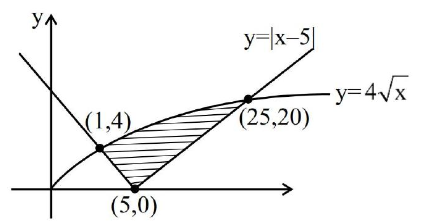
If the area of the region $\{(x, y):|x-5| \leq y \leq 4 \sqrt{x}\}$ is A , then 3A is equal to _____________.
Answer

Image
$A=\int_{1}^{25} 4 \sqrt{x}~ d x-\frac{1}{2} \times 4 \times 4-\frac{1}{2} \times 20 \times 20$
$A=\left[\frac{4 x^{3 / 2}}{\frac{3}{2}}\right]^{25}-8-200$
$A=\frac{8}{3}(125-1)-208$
$A=\frac{368}{3} \Rightarrow 3 A=368$
View full question & answer
SECTION - B [MATHS - NUMERIC] - JEE STD 11 Science Questions - Vidyadip