Questions · Page 1 of 6

(Each question 1 marks)

🎯

Test yourself on this topic

50 questions · timed · auto-graded

Question 11 Mark
Using properties of sets, show that: $A \cap (A \cup B) = A$
Answer
We know that if $A \subset B$then
$A \cap B = A$
Also$A \subset A \cup B$
$\therefore A \cap (A \cup B) = A$
View full question & answer
Question 21 Mark
Using properties of set, show that:$A \cup (A \cap B) = A$
Answer
We know that if $A \subset B$then
$A \cap B = B$
Also $A \cap B \subset A$
$\therefore A \cup (A \cap B) = A$
View full question & answer
Question 31 Mark
Show that for any sets A and B, A = ( A $\cap$B ) $\cup$( A – B ) and A $\cup$( B – A ) = ( A $\cup$B )
Answer
We have to prove: $A=(A \cap B) \cup(A-B)$
Proof: Let $x \in A$
Now, we need to show that $x \in(A \cap B) \cup(A-B)$
In Case I,
$x \in(A \cap B)$
$\Rightarrow X \in(A \cap B) \subset(A \cup B) \cup(A-B)$
In Case II,
$X \notin A \cap B$
$\Rightarrow x \notin B \ or \ x \notin A$
$\Rightarrow X \notin B(X \notin A)$
$\Rightarrow X \notin A-B \subset(A \cup B) \cup(A-B)$
$\therefore A \subset(A \cap B) \cup(A-B)(i)$
It can be concluded that, $A \cap B \subset A \ and \ (A-B) \subset A$
Therefore, (A $\cap$B) $\cap$(A - B) $\subset $A (ii)
Equating (i) and (ii),we get
$A=(A \cap B) \cup(A-B)$
Now, we need to show, $A \cup(B-A) \subset A \cup B$
Suppose that,
$X \in A \cup(B-A)$
$X \in A \ or \ X \in(B-A)$
$\Rightarrow X \in A \ or \ (X \in B \text { and } X \notin A)$
$\Rightarrow(X \in A \text { or } X \in B) \ and \ (X \in A \text { and } X \notin A)$
$\Rightarrow X \in(B \cup A)$
$\therefore A \cup(B-A) \subset(A \cup B)$(iii)
Now, to prove: $(A \cup B) \subset A \cup(B-A)$
Let y $\in A\cup B$
$\mathrm{y} \in \mathrm{A}\ or \ \mathrm{y} \in \mathrm{B}$
$(y \in A \text { or } y \in B)\ and \ (X \in A \text { and } X \notin A)$
$\Rightarrow y \in A \ or \ (y \in B \text { and } y \notin A)$
$\Rightarrow y \in A \cup(B-A)$
Therefore,$A \cup B \subset A \cup(B-A)$(iv)
$\therefore$ Using (iii) and (iv), we obtain
$A \cup(B-A)=A \cup B$
View full question & answer
Question 41 Mark
Is it true that for any sets A and B,$P(A) \cup P(B) = P(A \cup B)?$Justify your answer.
Answer
No, it is not true.
Take A = {1, 2} ad B = {2, 3}
Then$A \cup B = \{ 1,2,3\} $
$P(A) = \{ \phi ,\{ 1\} ,\{ 2\} ,\{ 1,2\} \}$
$P(B) = \{ \phi ,\{ 2\} ,\{ 3\} ,\{ 2,3\} \}$
$\therefore P(A) \cup P(B) = \{ \phi ,\{ 1\} ,\{ 2\} ,\{ 3\} ,\{ 1,2\} ,\{ 2,3\} \} $. . (i)
$A \cup B = \{ 1,2,3\}$

$P(A \cup B) = \{ \phi \}$,{1}, {2}, {3}, {1, 2}, {2, 3}, {1, 3}, {1, 2, 3}} . . . (ii)
From (i) and (ii), we have
$P(A \cup B) \ne P(A) \cup P(B)$

View full question & answer
Question 51 Mark
Assume that P(A) = P(B) show that A = B.
Answer
Let$X \in A \Rightarrow \{ x\} \in P(A)$
$\Rightarrow \{ x\} \in P(B)\,[\because P(A) = P(B)]$
$\Rightarrow X \notin B$
$\therefore A \subset B$. . . (i)
Let $X \in B \Rightarrow \{ x\} \in P(B)$
$\Rightarrow \{ X\} \in P(A)\,[\because \,P(A) = P(B)]$
$ \Rightarrow X \in A$. . . (ii)
$\therefore B \subset A$
From (i) and (ii) we have A = B
View full question & answer
Question 61 Mark
Show that if $A \subset B$then$C - B \subset C - A.$
Answer
Let$x \in C - B \Rightarrow x \in C$and $x \notin B$
$\Rightarrow x \in C$and$x \notin A$$[\because A \subset B]$
$\Rightarrow x \in C - A$Hence$C - B \subset C - A.$
View full question & answer
Question 71 Mark
Let A, B and C be the sets such that $A \cup B = A \cup C$ and $A \cap B = A \cap C$ Show that B = C.
Answer
We know that$A = A \cap (A \cup B)$and$A = A \cup (A \cap B)$
Now $A \cap B = A \cap C$and$A \cup B = A \cup C$
$\therefore B = B \cup (B \cap A) = B \cup (A \cap B) = B \cup (A \cap C)$$[\because \,A \cap B = A \cap C]$
$ = (B \cup A) \cap (B \cup C)$(By distributive law)
$ = (A \cup C) \cap (B \cup C)$
$ = (A \cup C) \cap (B \cup C)$$[\because \,A \cup B = A \cup C]$
$ = (C \cup A) \cap (C \cup B)$
$= C \cup (A \cap B)$(by distributive law)
$ = C \cup (A \cap C)$$[\because \,A \cap B = A \cap C]$
$ = C \cup (C \cap A) = C$
Hence B = C.
View full question & answer
Question 81 Mark
If A $\subset$ B and x $\notin$ B, then x $\notin$A.If it is true, prove it. If it is false, give an example.
Answer
It is given in the question that,
$A \subset B$
Andx $\notin$ B
Let us suppose, $\mathrm{x} \in \mathrm{A}$ then we have:
$\mathbf{x} \in \mathbf{B}$
But it is given in the question that, $x \notin B$
$\therefore \ x \notin A$
Hence, the given statement is true.
View full question & answer
Question 91 Mark
If x $\in$ A and A $\not \subset$B , then x $\in$B.If it is true, prove it. If it is false, give an example.
Answer
It is given in the question that,
x $\in$ A
And, A$\not \subset$B
Let us now assume, A = {3, 5, 7}
And, B = {3, 4, 6}
As, 5$\in$ A
And,A$\not \subset$B
$\therefore$5$\notin$B
Hence, the given statement is false
View full question & answer
Question 101 Mark
If $A \not \subset B$ and $B \not \subset C$ , then $A \not \subset C$.If it is true, prove it. If it is false, give an example.
Answer
It is given in the question that,
$A \not \subset B$
And$B \not \subset C$
Let us now assume, A = {1, 2}
B = {0, 6, 8}
And, C = {0, 1, 2, 6, 9}
$\therefore $A $\subset$ C
Hence, the given statement is false
View full question & answer
Question 111 Mark
If A $\subset$ B and B $\subset$C , then A $\subset$C.If it is true, prove it. If it is false, give an example.
Answer
It is given in the question that, $A \subset B \ and \ B \subset C$
Let us assume, $x \in A$
So, $x \in B$
And $x \in C$
$\therefore$ A $\subset$ C
Hence, the given statement is True
View full question & answer
Question 121 Mark
If A $\subset$ B and B $\in$ C , then A $\in$C.If it is true, prove it. If it is false, give an example.
Answer
Let us assume, A {2}
B = {0, 2}
And, C = {1, {0, 2}, 3}
It is given in the question that,
$A \subset B$
$\therefore \ B \in C$
But, $A \notin C$
Hence, the given statement is false
View full question & answer
Question 131 Mark
If x $\in$A and A $\in$B , then x $\in$B.If it is true, prove it. If it is false, give an example.
Answer
Let us assume A = {1, 2}
And, B = {1, {1, 2},{3}}
So, 2$\in$ {1, 2}
And,{1, 2}$\in${{3}, 1, {1, 2}}
$\therefore$ A $\in$B
But, 2 $\notin${{3}, 1, {1,2}}
Hence, the given statement is false
View full question & answer
Question 141 Mark
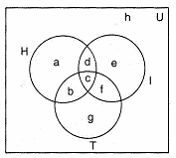
In a survey of 60 people, it was found that 25 people read newspaper H, 26 read newspaper T, 26 read newspaper I, 9 read both H and I, 11 read both H and T, 8 read both T and I, 3 read all three newspapers.
Find the number of people who read exactly one newspaper.
Answer
Here
n(U) = a + b + c + d + e + f + g + h = 60 ....(i)
n(H) = a + b + c +d = 25 ....(ii)
n(T) = b + c + f + g = 26 .....(iii)
n(I) = c + d + e + f = 26 ....(iv)
$n(H \cap I) $ = c + d = 9 ....(v)
$n(H \cap T) $= b + c = 11 .....(vi)
$n(T \cap I) $ = c + f = 8 .....(vii)
$n(H \cap T \cap I) $ = c = 3 ....(viii)

Putting value of c in (vii),
3 + f = 8 $\Rightarrow$ f = 5
Putting value of c in (vi),
3 + b = 11 $\Rightarrow$ b = 8
Putting values of c in (v),
3 + d = 9 $\Rightarrow$ d = 6
Putting value of c, d, f in (iv),
3 + 6 + e + 5 = 26 $\Rightarrow$ e = 26 - 14= 12
Putting value of b, c, f in (iii),
8 + 3 + 5 + g = 26 $\Rightarrow$ g = 26 - 16= 10
Putting value of b, c, d in (ii)
a + 8 + 3 + 6 = 25 $\Rightarrow$ a = 25 - 17 = 8
Number of people who read exactly one newspapers
= a + e + g
= 8 + 12 + 10 = 30
View full question & answer
Question 151 Mark
In a survey of 60 people, it was found that 25 people read newspaper H, 26 read newspaper T, 26 read newspaper I, 9 read both H and I, 11 read both H and T, 8 read both T and I, 3 read all three newspapers.
Find the number of people who read at least one of the newspaper.
Answer
Here
n(U) = a + b + c + d + e + f + g + h = 60....(i)
n (H) = a + b + c +d = 25....(ii)
n(T) = b + c + f + g = 26 .....(iii)
n(I) = c + d + e + f = 26....(iv)
$n(H \cap I) $ = c + d = 9 .....(v)
$n(H \cap T) $ = b + c = 11 .....(vi)
$n(T \cap I) $= c + f = 8 ....(vii)
$n(H \cap T \cap I) $= c = 3 ....(viii)

Putting value of c in (vii),
3 + f = 8 $\Rightarrow$f = 5
Putting value of c in (vi),
3 + b = 11$\Rightarrow$b = 8
Putting values of c in (v),
3 + d = 9$\Rightarrow$d = 6
Putting value of c, d, f in (iv),
3 + 6 + e + 5 = 26$\Rightarrow$ e = 26 - 14= 12
Putting value of b, c, f in (iii),
8 + 3 + 5 + g = 26 $\Rightarrow$g = 26 - 16= 10
Putting value of b, c, d in (ii)
a + 8 + 3 + 6 = 25 $\Rightarrow$a = 25 - 17 = 8
Number of people who read at least one of the three newspapers
= a + b + c + d + e + f + g
= 8 + 8 + 3 + 6 + 12 + 5 + 10 = 52
View full question & answer
Question 161 Mark
In a group of students, 100 students know Hindi, 50 know English and 25 know both. Each of the students knows either Hindi or English. How many students are there in the group?
Answer
Let H be the set of students who know Hindi and E be the set of students who know English.
Here n(H) = 100, n(E) = 50 and$n(H \cap E) = 25$
We know that$n(H \cup E) = n(H) + n(E) - n(H \cap E)$
= 100 + 50 - 25 = 125.
View full question & answer
Question 171 Mark
In a survey of 600 students in a school, 150 students were found to be taking tea and 225 taking coffee, 100 were taking both tea and coffee. Find how many students were taking neither tea nor coffee.
Answer
Let T be the set of students who like tea and C be the set of students who like coffee.
Here n(T) = 150, m (C) = 225 and$n(C \cap T) = 100$
We know that$n(C \cup T) = n(C) + n(T) - n(C \cap T)$
= 150 + 225 - 100 = 275
$\therefore$Number of students taking either tea or coffee += 275
$\therefore$Number of students taking neither tea nor coffee = 600 - 275 = 325
View full question & answer
Question 181 Mark
If $A \not \subset B$ and $B \not \subset C$ , then $A \not \subset C$.If it is true, prove it. If it is false, give an example.
Answer
It is given in the question that,
$A \not \subset B$
And$B \not \subset C$
Let us now assume, A = {1, 2}
B = {0, 6, 8}
And, C = {0, 1, 2, 6, 9}
$\therefore $A $\subset$ C
Hence, the given statement is false
View full question & answer
Question 191 Mark
Find sets A, B and C such that$A \cap B,B \cap C$and $A \cap C$are non-empty sets and$A \cap B \cap C = \phi $
Answer
Take A = {1, 2} B = {1, 4} and C = {2, 4}
Now$A \cap B = \{ 1\} \ne \phi$
$B \cap C = \{ 4\} \ne \phi$
$A \cap C = \{ 2\} \ne \phi$
But$A \cap B \cap C = \phi$
View full question & answer
Question 201 Mark
Show that $A \cap B = A \cap C$need not imply B = C.
Answer
Let A = {1, 2, 3, 4} , B = {2, 3, 4, 5, 6}, C = {2, 3, 4, 9, 10}
$\therefore A \cap B$= {1, 2, 3, 4} $ \cap ${2, 3, 4, 5, 6}
= {2,3, 4}
$A \cap C$= {1, 2, 3, 4}, B = {2, 3, 4, 5, 6}, C = {2, 3, 4, 9, 10}
= {2, 3, 4}
$A \cap C$= {1, 2, 3, 4} $ \cap ${2, 3, 4, 9, 10}
= {2, 3, 4}
Now we have$A \cap B = A \cap C$
But$B \ne C$
View full question & answer
Question 211 Mark
In a committee, 50 people speak French, 20 speak Spanish and 10 speak both Spanish and French. How many speak at least one of these two languages?
Answer
Let F be the set of people who speak French and 'S' be the set of people who speak Spanish.
Here n(F) = 50, n(S) = 20 and $n(F \cap S) = 10$
We know that$n(F \cup S) = n(F) + n(S) - n(F \cap S)$
$\therefore n(F \cup S) = 50 + 20 - 10 = 60$
Number of people who speak at least one of these two languages = 60
View full question & answer
Question 221 Mark
In a group of 65 people, 40 like cricket, 10 like both cricket and tennis. How many like tennis only and not cricket? How many like tennis?
Answer
Let C be the set of people who like cricket and T be the set of people who like tennis.
Here n(C) = 40,$n(C \cap T) = 10$and $n(C \cup T) = 65$
We know that$n(C \cup T) = n(C) + n(T) - n(C \cap T)$
$\therefore$65 = 40 + n(T) - 10
$\therefore$n(T) = 65 - 30= 35
Number of people who like tennis = 35
Now number of people who like tennis only and not cricket
= n(T - C)

$ = n(T) - n(C \cap T)$
= 35 - 10 = 25

View full question & answer
Question 231 Mark
In a group of 70 people, 37 like coffee, 52 like tea and each person likes at least one of the two drinks. How many people like both coffee and tea?
Answer
Let C be the set of persons who like coffee and T be the set of persons who like tea.
$\therefore $n(C) = 30,n(T) = 52 and$n(C \cup T) $ = 70
We know that$n(C \cup T) = n(C) + n(T) - n(C \cap T)$
$\therefore$ 70 = 37 + 52 - n(C$ \cap$ T)
$\therefore n(C \cap T) $ = 89 - 70 = 19
View full question & answer
Question 241 Mark
If X and Y are two sets such that X has 40 elements$X \cup Y$has 60 elements and$X \cap Y$has 10 elements, how many elements does Y have?
Answer
Here n(X) = 40,$n(X \cup Y) = 60$and$n(X \cap Y) = 10$
We know that$n(X \cup Y) = n(X) + n(Y) - n(X \cap Y)$
60 = 40 + n(Y) - 10
$\therefore n(Y) = 60 - 30 = 30.$
View full question & answer
Question 251 Mark
If S and T are two sets such that S has 21 elements T has 32 elements and$S \cap T$has 11 elements, how many elements does$S \cup T$have?
Answer
Here n(S) = 21, n(T) = 32 and$n(S \cap T) = 11$

We know that$n(S \cup T) = n(S) + n(T) - n(S \cap T)$

$\therefore n(S \cup T) = 21 + 32 - 11 = 42.$

View full question & answer
Question 261 Mark
In a group of 400 people, 250 can speak Hindi and 200 can speak English. How many people can speak both Hindi and English.
Answer
Let H be the set of people speaking Hindi and E be the set of people speaking English.
$\therefore$n(H) = 250, n(E) = 200 and $n(H \cup E) = 400$
We have to find $n(H \cap E)$
We know that$n(H \cap E) = n(H) + n(E) - n(H \cap E)$
$\therefore 400 = 250 + 200 - n(H \cap E)$
$\therefore n(H \cap E) = 450 - 400 = 50$
View full question & answer
Question 271 Mark
If X and Y are two sets such that X $\cup$Y has 18 elements, X has 8 elements and Y has 15 elements ; how many elements does X $\cap$Y have?
Answer
Here,
n(X) = 8, n(Y) = 15, and n(X$\cup$ Y) = 18
We know that-
n(X$\cup$ Y) = n(X) + n(Y) -n(X$\cap$ Y)
$\Rightarrow$18 = 8 + 15-n(X$\cap$ Y)
$\Rightarrow$18 = 23-n(X$\cap$ Y)
$\Rightarrow$n(X$\cap$ Y) = 23 - 18

Therefore,
$$ n(X$\cap$ Y) = 5

View full question & answer
Question 281 Mark
If X andY are two sets such that n(X) = 17, n(Y) = 23 and n ( X $\cup$ Y) = 38, find n(X $\cap$ Y).
Answer
We know that,
$n ( X \cup Y ) = n ( X ) + n ( Y ) - n ( X \cap Y )$
$\Rightarrow 38 = 17 + 23 - n ( X \cap Y )$
$\Rightarrow n ( X \cap Y )$ = 40 - 38 = 2
View full question & answer
Question 331 Mark
Let U be the set of all triangles in a plane. If A is the set of all triangles with at least one angle different from 60° what is ${A'}$?
Answer
Here U = {x : x is a triangle}
A = {x : x is a triangle and has at least one angle different from 60°}
$\therefore A' = U - A = ${x : x is a triangle} - {x : x is a triangle and has atleast one angle different from 60°}
= {x : x is a triangle and has all angles equal to 60°}
= Set of all equilateral triangles.
View full question & answer
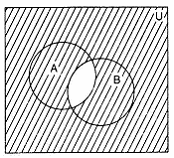
Question 341 Mark
Draw appropriate Venn diagram for: A'$\cup$ B'
Answer
The Venn diagram for A'$\cup$ B' The shaded portion represents A'$\cup$ B'

View full question & answer
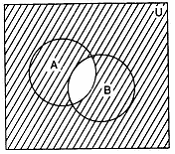
Question 351 Mark
Draw appropriate Venn diagram for: $(A \cap B)'$
Answer
The Venn diagram for$(A \cap B)'$The shaded portion represents$(A \cap B)'$

View full question & answer
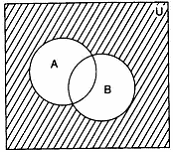
Question 361 Mark
Draw appropriate Venn diagram for: A' $\cap$B'
Answer
The Venn diagram forA' $\cap$B' The shaded portion representsA' $\cap$B'

View full question & answer
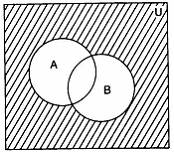
Question 371 Mark
Draw appropriate Venn diagram for:$(A \cup B)'$
Answer
The Venn diagram for$(A \cup B)'$The shaded portion represents $(A \cup B)'$

View full question & answer
Question 381 Mark
If U = {1, 2, 3, 4, 5, 6, 7, 8, 9}, A = {2, 4, 6, 8} and B= {2, 3, 5, 7}, verify that: (A $\cap$ B)' = A' $\cup$ B'.
Answer
Here U = {1, 2, 3, 4, 5, 6, 7, 8, 9}
A = {2, 4, 6, 8} and B = {2, 3, 5, 7}
$A \cap B $ = {2, 4, 6, 8} $\cap$ {2, 3, 5, 7}
= {2}
$(A \cap B)' = U - (A \cap B) $ = {1, 2, 3, 4, 5, 6, 7, 8, 9} - {2}
= {1, 3, 4, 5, 6, 7, 8, 9} . . . (i)
A' = U - A = {1, 2, 3, 4, 5, 6, 7, 8, 9} - {2, 4, 6, 8}
= {1, 3, 5, 7, 8}
B' = U - B = {1, 2, 3, 4, 5, 6, 7, 8, 9} - {2, 3, 5, 7}
= {1, 4, 6, 8, 9}
$A' \cup B'$ = {1, 3, 5, 7, 9} $\cup$ {1, 4, 6, 8, 9}
= {1, 3, 4, 5, 6, 7, 8, 9} . . . (ii)
From (i) and (ii) we have
$(A \cap B)' = A' \cup B'$
View full question & answer
Question 391 Mark
If U = {1, 2, 3, 4, 5, 6, 7, 8, 9}, A = {2, 4, 6, 8} and B= {2, 3, 5, 7}, verify that: (A $\cup$ B)' = A' $\cap$ B'
Answer
Here U = {1, 2, 3, 4, 5, 6, 7, 8, 9}
A = {2, 4, 6, 8} and B = {2, 3, 5, 7}
$A \cup B $ = {2, 4, 6, 8} $\cup$ {2, 3, 5, 7}
= {2, 3, 4, 5, 6, 7,8}
$\therefore (A \cup B)' = U - (A \cup B)$= {1,2, 3, 4, 5, 6, 7, 8, 9} - {2, 3, 4, 5, 6, 7, 8}
= {1, 9} . . . (i)
A' = U - A = {1, 2, 3, 4, 5, 6, 7, 8, 9} - {2, 4, 6, 8}
= {1, 3, 5, 7, 9}
B' = U - B = {1, 2, 3, 4, 5, 6, 7, 8, 9} - {2, 3, 5, 7}
= {1, 4, 6, 8, 9}
$A' \cap B' $ = {1, 3, 5, 7, 9} $\cap$ {1, 4, 6, 8, 9} = {1, 9} ....(ii)
From (i) and (ii), we have
$(A \cup B)' = A' \cap B'$
View full question & answer
Question 401 Mark
Taking the set of natural numbers as the universal set, write down the complement of the set: {x : 2x + 5 = 9}
Answer
Here $U = \{ x:x \in N\}$
Let A = {x : 2x + 5 = 9{ = {2}
$A' = U - A = \{ x:x \in N\} - \{ 2\}$
$= \{ x:x \in N,x \ne 2\}$
View full question & answer
Question 411 Mark
Taking the set of natural numbers as the universal set, write down the complement of the set: {x : x + 5 = 8}
Answer
Here $U = \{ x:x \in N\}$
Let A = {x : x + 5 = 8} = {3}
$A' = U - A = \{ x:x \in N\} -$
$= \{ x:x \in N,x \ne 3\}$
View full question & answer
Question 421 Mark
Taking the set of natural numbesrs as the universal set, write down the complement of the set: {x : x is a perfect cube}
Answer
Here $U = \{ x:x \in N\}$
Let A = {x : x is a perfect cube}
$A' = U - A = \{ x:x \in N\} -${x : x is a perfect cube}
= {x : x $ \in $N , x is not a perfect cube}
View full question & answer
Question 431 Mark
Taking the set of natural numbers as the universal set, write down the complement of the set: {x : x is a perfect square}
Answer
Here $U = \{ x:x \in N\}$
Let A = {x : x is a perfect square}
$A' = U - A = \{ x:x \in N\} -${x : x is a perfect square}
= {$x:x \in N$, x is not a perfect square}
View full question & answer
Question 441 Mark
Taking the set of natural numbers as the universal set, write down the complement of the set: {x : x is a natural number divisible by 3 and 5}
Answer
Here $U = \{ x:x \in N\}$
Let A = {x : x is a natural number divisible by 3 and 5}
$A' = U - A = \{ x:x \in N\} -${x : x is a natural number divisible by 3 and 5}
= {$x:x \in N$} - {x : x is a natural number divisible by 15}
= { $x:x \in N$, x is not divisible by 15}
View full question & answer
Question 451 Mark
Taking the set of natural numbers as the universal set, write down the complement of the set: {x : x is a prime number}
Answer
Here $U = \{ x:x \in N\}$
Let A = {x : x is a prime number}
$A' = U - A = \{ x:x \in N\} -${x : x is a prime number}
= { $x:x \in N$, x is not a prime number}
or {x : x is positive composite number and x = 1}
View full question & answer
Question 461 Mark
Taking the set of natural numbers as the universal set, write down the complement of the set: {x : x is a positive multiple of 3}
Answer
Here $U = \{ x:x \in N\}$
Let A = {x : x is a positive multiple of 3}
$\therefore A' = U - A = \{ x:x \in N\} -${x :x is a positive multiple of 3}
= { $x:x \in N$, x is not a multiple of 3}
View full question & answer
Question 471 Mark
Taking the set of natural numbers as the universal set, write down the complement of the set:{x : x is an odd natural number}
Answer
Here$U = \{ x:x \in N\}$

Let A = {x : x is an odd natural number}
$A' = U - A = \{ x:x \in N\} -${x : x is an odd natural number}
= {x : x is an even natural number}

View full question & answer
Question 481 Mark
Taking the set of natural numbers as the universal set, write down the complement of the set:$\{ x:x \in N\,\,and\,\,2x + 1 > 10\}$
Answer
Here $U = \{ x:x \in N\}$
Let A = {$x:x \in N$and 2x + 1 > 10} = {5, 6, 7, 8 , . . . }
$A' = U - A = \{ x:x \in N\} - \{ 5,6,7,8,.....\}$
= {1, 2, 3, 4}
View full question & answer
Question 491 Mark
Taking the set of natural numbers as the universal set, write down the complement of the set: $\{ x:x \ge 7\}$
Answer
Here $U = \{ x:x \in N\}$
Let$A = \{ x:x \geqslant 7\} = \{ 7,8,9,10,......\}$
$A' = U - A = \{ x:x \in N\} - \{ 7,8,9,10,.....\}$
= {1, 2, 3, 4, 5, 6}
= {$x:x \in N$and x < 7}
View full question & answer
Question 501 Mark
Taking the set of natural numbers as the universal set, write down the complement of the set:{x : x is an even natural number}
Answer
Here$U = \{ x:x \in N\}$
Let A = {x : x is an even natural number}
$A' = U - A = \{ x:x \in N\} -${x : x is an even natural number}
= {x : x is an odd natural number}
View full question & answer
(Each question 1 marks) - MATHS STD 11 Science Questions - Vidyadip