Questions · Page 3 of 4

MCQ

MCQ 1011 Mark
If a line has slope 3 and pass through point (1, 2) then the equation of line is:
  • A
    x = 3y - 1
  • B
    x = 3y + 1
  • C
    y = 3x + 1
  • y = 3x - 1
Answer
Correct option: D.
y = 3x - 1
Let general equation of line be y = m × x + c.
Given m = 3
⇒ y = 3x + c
Substituting the point (1, 2) in above equation we get 2 = 3 × 1 + c
⇒ c = -1
So, equation of line will be y = 3x - 1.
View full question & answer
MCQ 1031 Mark
The equation of the line through the points (1, 5) and (2, 3) is:
  • A
    2x - y - 7 = 0
  • B
    2x + y + 7 = 0
  • 2x + y - 7 = 0
  • D
    x + 2y - 7 = 0
Answer
Correct option: C.
2x + y - 7 = 0
  1. 2x + y - 7 = 0
View full question & answer
MCQ 1041 Mark
The centroid of the triangle with vertices (2, 6), (-5, 6) and (9, 3) is:
  • A
    (2, -3)
  • (2, 5)
  • C
    (-2, 3)
  • D
    (-2, -3)
Answer
Correct option: B.
(2, 5)
$\text{G} =\Big(\frac{ {\text{x}_{1}+\text{x}_{2}+\text{x}_{3}}}{3},\frac{ {\text{y}_{1}+\text{y}_{2}+\text{y}_{3}}}{3}\Big)$
$=\Big(\frac {2-5+9}{3}, \frac{6+6+6}{3}\Big) = (2.5)$
View full question & answer
MCQ 1051 Mark
If the lines x + q = 0, y - 2 = 0 and 3x + 2y + 5 = 0 are concurrent, then the value of q will be:
  • A
    1
  • B
    2
  • 3
  • D
    5
Answer
Correct option: C.
3
The lines x + q = 0, y - 2 = 0 and 3x + 2y + 5 = 0 are concurrent.
$\therefore\begin{vmatrix}1&0&\text{q}\\0&1&-2\\3&2&5 \end{vmatrix}=0$
$\Rightarrow1(5+4)-0+\text{q}(0-3)=0$
$\Rightarrow3\text{q}=9$
$\Rightarrow\text{q}=3$
View full question & answer
MCQ 1061 Mark
The distance of the point ($x_1​, y_1$​) from the origin:
  • A
    $\text{x}\frac{2}{1}+\text{y}\frac{2}{1}$
  • $\sqrt{\text{x}\frac{2}{1}+\text{y}\frac{2}{1}}$
  • C
    $\frac{1}{\sqrt{\text{x}\frac{2}{1}+\text{y}\frac{2}{1}}}$
  • D
    $\frac{1}{\text{x}\frac{2}{1}+\text{y}\frac{2}{1}}$
Answer
Correct option: B.
$\sqrt{\text{x}\frac{2}{1}+\text{y}\frac{2}{1}}$
  1. $\sqrt{\text{x}\frac{2}{1}+\text{y}\frac{2}{1}}$
Solution:
We can use the distance formula to find the length of the line.
Distance between points $\sqrt{(\text{x}_{2}-\text{x}_{1}+(\text{y}_{2}-\text{y}_{1})}$
But given that one of the co-ordinates is (0, 0)
Distance from (0, 0) is $=\sqrt{(\text{x}_{1})^{2}+(\text{y}_{1})^{2}}$
View full question & answer
MCQ 1071 Mark
A point equidistant from the line 4x + 3y + 10 = 0, 5x - 12y + 26 = 0 and 7x + 24y - 50 = 0 is:
  • A
    (1, -1)
  • B
    (1, 1)
  • (0, 0)
  • D
    (0, 1)
Answer
Correct option: C.
(0, 0)
Let the coordiantes of the point be (a, b)
Now, the distance of the point (a, b) from 4x + 3y + 10 = 0 is given by
$\Bigg|\frac{4\text{a}+3\text{b}+10}{\sqrt{4^2+3^2}}\Bigg|$
$=\Bigg|\frac{4\text{a}+3\text{b}+10}{5}\Bigg|$
Again, the distance of the point (a, b) from 5x - 12y + 26 = 0 is given by
$\Bigg|\frac{5\text{a}-12\text{b}+26}{\sqrt{5^2+(-12)^2}}\Bigg|$
$=\Bigg|\frac{5\text{a}-12\text{b}+26}{13}\Bigg|$
Again, the distance of the point (a, b) from 7x + 24y - 50 = 0 is is given by
$\Bigg|\frac{7\text{a}+24\text{b}-50}{\sqrt{7^2+(24)^2}}\Bigg|$
$=\Bigg|\frac{7\text{a}+24\text{b}-50}{25}\Bigg|$
Now,
$\Bigg|\frac{4\text{a}+3\text{b}+10}{5}\Bigg|=\Bigg|\frac{5\text{a}-12\text{b}+26}{13}\Bigg|=\Bigg|\frac{7\text{a}+24\text{b}-50}{25}\Bigg|$
Only a = 0 and b = 0 is satisfying the above equation
Hence, the correct answer is option (c).
View full question & answer
MCQ 1081 Mark
Equation of the line passing through (0, 0) and slope m is:
  • A
    y = mx + c
  • B
    x = my + c
  • y = mx
  • D
    x = my
Answer
Correct option: C.
y = mx
  1. y = mx
View full question & answer
MCQ 1091 Mark
Area of the triangle formed by the points ((a + 3)(a + 4), a + 3), ((a + 2)(a + 3), (a + 2)) and ((a + 1)(a + 2), (a + 1)) is:
  • A
    $25 a^2$
  • B
    $5 \mathrm{a}^2$
  • C
    $24 a^2$
  • None of these.
Answer
Correct option: D.
None of these.
  1. None of these.
Solution:
The given points are {(a + 3)(a + 4), a + 3), ((a + 2)(a + 3), (a + 2)) and ((a + 1)(a + 2), (a + 1)}
Let A be the area of the triangle formed by these points.
Then, $\text{A}=\frac{1}{2}[\text{x}_1(\text{y}_2-\text{y}_3)+\text{x}_2(\text{y}_3-\text{y}_1)+\text{x}_3(\text{y}_1-\text{y}_2)]$
$\Rightarrow\text{A}=\frac{1}{2}[(\text{a}+3)(\text{a}+4)(\text{a}+2-\text{a}-1)+(\text{a}+2)(\text{a}+3)\$\text{a}+1-\text{a}-3)+(\text{a}+1)(\text{a}+2)(\text{a}+3-\text{a}-2)]$
$\Rightarrow\text{A}=\frac{1}{2}[(\text{a}+3)(\text{a}+4)-2(\text{a}+2)(\text{a}+3)+(\text{a}+1)(\text{a}+2)]$
$\Rightarrow\text{A}=\frac{1}{2}[\text{a}^2+7\text{a}+12-2\text{a}^2-10\text{a}-12+\text{a}^2+3\text{a}+2]$
$\Rightarrow\text{A}=1$
View full question & answer
MCQ 1101 Mark
If slope of a line is negative then its inclination is:
  • A
    Right angle
  • B
    Acute angle
  • Obtuse angle
  • D
    Zero
Answer
Correct option: C.
Obtuse angle
If inclination is α slope is given by $\tan\alpha$ Given that slope of line is negative which means $\tan\alpha$ is negative. We know, $\tan\alpha$ is negative in 2nd quadrant i.e. $\alpha$ should be obtuse angle
View full question & answer
MCQ 1111 Mark
Choose the correct answer. The ratio in which the line 3x + 4y + 2 = 0 divides the distance between the lines 3x + 4y + 5 = 0 and 3x + 4y - 5 = 0 is:
  • A
    1 : 2
  • 3 : 7
  • C
    2 : 3
  • D
    2 : 5
Answer
Correct option: B.
3 : 7
Given lines are:
3x + 4y + 5 = 0 .....(i)
3x + 4y - 5 = 0 .....(ii)
The third line is: 3x + 4y + 2 = 0
Distance between the line (i) and (iii) $=\frac{|5-2|}{\sqrt{9+16}}=\frac{3}{5}$
Distance between the lines (ii) and (iii) $=\frac{|-5-2|}{\sqrt{9+16}}=\frac{7}{5}$
Hence, the required ratio is $\frac{3}{5}:\frac{7}{5}$ or 3 : 7.
View full question & answer
MCQ 1121 Mark
The area of the triangle formed by the points (a, b + c), (b, c + a) and (c, a + b) is:
  • A
    1
  • B
    a + b + c
  • C
    abc
  • 0
Answer
Correct option: D.
0
Area $=\frac{1}{2}[\text{a}(\text{c + a - a - b})+\text{b }(\text{a + b - b - c})+\text{c }(\text{b + c - c - a})]=0$
View full question & answer
MCQ 1131 Mark
If two vertices of a triangle are (3, -2) and (-2, 3) and its orthocenter is (-6, 1) then its third vertex is:
  • A
    (5, 3)
  • B
    (-5, 3)
  • C
    (5, -3)
  • (-5, -3)
Answer
Correct option: D.
(-5, -3)
  1. (-5, -3)
View full question & answer
MCQ 1141 Mark
The equation of the line with slope $-\frac{3}{2}$ and which is concurrent with the lines 4x + 3y - 7 = 0 and 8x + 5y - 1 = 0 is:
  • A
    3x + 2y - 63 = 0
  • 3x + 2y - 2 = 0
  • C
    2y - 3x - 2 = 0
  • D
    None of these.
Answer
Correct option: B.
3x + 2y - 2 = 0
Given:
4x + 3y - 7 = 0 ...(1)
8x + 5y - 1 = 0 ...(2)
The equation of the line with slope $-\frac{3}{2}$ is given below:
$\text{y}=-\frac{3}{2}\text{x}+\text{c}$
$\Rightarrow\frac{3}{2}\text{x}+\text{y}-\text{C}=0 \ ...(3)$
The lines (1), (2) and (3) are concurrent.
$\therefore\begin{vmatrix}4&3&-7\\8&5&-1\\\frac{3}{2}&1&\text{-c} \end{vmatrix}=0$
$\Rightarrow4(-5\text{c}+1)-3\Big(-8\text{c}+\frac{3}{2}\Big)-7\Big(8-\frac{15}{2}\Big)=0$
$\Rightarrow-20\text{c}+4+24\text{c}-\frac{9}{2}-56+\frac{105}{2}=0$
$\Rightarrow\frac{-40\text{c}+8+48\text{c}-9-112+105}{2}=0$
$\Rightarrow8\text{c}=8$
$\Rightarrow\text{c}=1$
On substituting c = 1 in $\text{y}=-\frac{3}{2}\text{x}+\text{c},$ we get:
$\text{y}=-\frac{3}{2}\text{x}+1,$
$\Rightarrow3\text{x}+2\text{y}-2=0$
View full question & answer
MCQ 1151 Mark
Choose the correct answer. The point (4, 1) undergoes the following two successive transformations:
  1. Reflection about the line y = x.
  2. Translation through a distance 2 units along the positive x-axis.
Then the final coordinates of the point are:
  • A
    (4, 3)
  • (3, 4)
  • C
    (1, 4)
  • D
    $\frac{7}{2},\frac{7}{2}$
Answer
Correct option: B.
(3, 4)
Reflection of A(4, 1) in y = x is 5(1, 4).
Now translation of point B through a distance '2' units along the positive x-axis shifts B to C(1 + 2, 4) or C(3, 4).
View full question & answer
MCQ 1161 Mark
Choose the correct answer. The distance of the point of intersection of the lines 2x - 3y + 5 = 0 and 3x + 4y = 0 from the line 5x - 2y = 0 is:
  • $\frac{130}{17\sqrt{29}}$
  • B
    $\frac{13}{7\sqrt{29}}$
  • C
    $\frac{130}{7}$
  • D
    None of these.
Answer
Correct option: A.
$\frac{130}{17\sqrt{29}}$
Given lines are:
2x - 3y + 5 = 0 .....(i)
and 3x + 4y = 0 .....(ii)
Solving these lines, we get point of intersection as $\Big(\frac{-20}{17},\frac{15}{17}\Big).$
$\therefore$ Distance of this point from the line '5x - 2y = 0'
$=\frac{\Big|5\times\Big(-\frac{20}{17}\Big)-2\Big(\frac{15}{17}\Big)\Big|}{\sqrt{25+4}}=\frac{\Big|\frac{-100}{17}-\frac{30}{17}\Big|}{\sqrt{25}}$
$=\frac{130}{17\sqrt{29}}$
View full question & answer
MCQ 1171 Mark
If line joining (1, 2) and (5, 7) is parallel to line joining (3, 4) and (11, x):
  • A
    10
  • B
    11
  • C
    12
  • 14
Answer
Correct option: D.
14
  1. 14
Solution:
We know, slope of line joining two points $(x_1, y_1)$ and $(x_2,y_2)$ is given by $\frac{(\text{y}_{2}- \text{y}_{1})}{(\text{x}_{2}-\text{x}_{1})}$
Lines are parallel means slope is equal
$\Rightarrow\frac{(\text{x}-4)}{(11-3)} = \frac{(7-2)}{(5-1)}$
$\Rightarrow \text{x}-4 = \frac{5\times8}{4} = 10$
⇒ x = 14
View full question & answer
MCQ 1181 Mark
The distance between (6, 5) and (-3, 4) is:
  • $\sqrt{82}$
  • B
    $\sqrt{83}$
  • C
    $\sqrt{84}$
  • D
    None
Answer
Correct option: A.
$\sqrt{82}$
The given points are (6, 5) and (-3, 4)
The distance is given as $=\sqrt {(\text{x}_2-\text{x}_1)^2+(\text{y}_2-\text{y}_1)^2}$
$=\sqrt {(6+3)^2+(4-5)^2}$
$=\sqrt {9^2+1^2}$
$=\sqrt {81+1}=\sqrt {82}$
View full question & answer
MCQ 1191 Mark
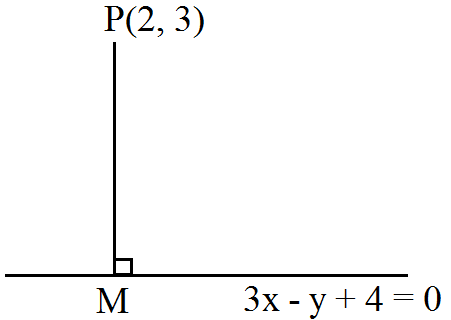
Choose the correct answer. The coordinates of the foot of perpendiculars from the point (2, 3) on the line y = 3x + 4 is given by
  • A
    $\frac{37}{10},\frac{-1}{10}$
  • $\frac{-1}{10},\frac{37}{10}$
  • C
    $\frac{10}{37},-10$
  • D
    $\frac{2}{3},-\frac{1}{3}$
Answer
Correct option: B.
$\frac{-1}{10},\frac{37}{10}$
Let the foot of perpendicular from the point P(2, 3) on the line 3x - y + 4 = 0 be M(h, k).

M(h, k) lies on the given line,
$\therefore$ 3h - k + 4 = 0 .....(i)
Also, slopw of the given line is 3.
$\therefore$ Slope of $\text{PM}=-\frac{1}{3}=\frac{\text{k}-3}{\text{h}-2}$ or h + 3k - 11 = 0 .....(ii)
Solving (1) and (ii), we get $(\text{h},\text{k})\equiv\Big(-\frac{1}{10},\frac{37}{10}\Big)$
View full question & answer
MCQ 1201 Mark
If the coordinates of the middle point of the portion of a line intercepted between the coordinate axes is (3, 2) then the equation of the line will be:
  • 2x + 3y = 12
  • B
    3x + 2y = 12
  • C
    4x - 3y = 6
  • D
    5x - 2y = 10
Answer
Correct option: A.
2x + 3y = 12
  1. 2x + 3y = 12
View full question & answer
MCQ 1211 Mark
The tangent of angle between the lines whose intercepts on the axes are a, -b and b, -a respectively, is:
  • A
    $\frac{\text{a}^2-\text{b}^2}{\text{ab}}$
  • B
    $\frac{\text{b}^2-\text{a}^2}{\text{ab}}$
  • $\frac{\text{b}^2-\text{a}^2}{\text{2ab}}$
  • D
    None of these
Answer
Correct option: C.
$\frac{\text{b}^2-\text{a}^2}{\text{2ab}}$
  1. $\frac{\text{b}^2-\text{a}^2}{\text{2ab}}$
View full question & answer
MCQ 1221 Mark
Line through the points (-2, 6) and (4, 8) is perpendicular to the line through the points (8, 12) and (x, 24). Find the value of x:
  • A
    2
  • B
    3
  • 4
  • D
    5
Answer
Correct option: C.
4
  1. 4
View full question & answer
MCQ 1231 Mark
Find the distance between the following pair of points. (5, 7) and the origin:
  • $\sqrt{74}$
  • B
    $\sqrt{64}$
  • C
    $\sqrt{34}$
  • D
    None of these
Answer
Correct option: A.
$\sqrt{74}$
  1. $\sqrt{74}$
Solution:
Take points A (5, 7) and B (0, 0)
To find the distance between two point A $(x_1​, y_1​)$ and B $(x_2​, y_2​)$, distance formula is used which is given by:
$\text{AB} =\sqrt{ (\text{x}_{1}-\text{x}_{2})^2+(\text{y}_{1}-\text{y}_{2})^2}$
so, $\text{AB} =\sqrt{ (5-0)^{2}+(7-0)^{2}} = \sqrt{(25+49)} = \sqrt{(74)}$
View full question & answer
MCQ 1241 Mark
If $p_1$ and $p_2$ are the lengths of the perpendiculars from the origin upon the lines $\text{x} \sec \theta + \text{y} \text{cosec}\theta = \text{a}$ and $\text{x} \cos \theta - \text{y} \sin \theta = \text{a} \cos 2 \theta$ respectively, then:
  • $4\text{p}_1^2 + \text{p}_2^2 = \text{a}^2$
  • B
    $\text{p}_1^2 + 4\text{p}_2^2 = \text{a}^2$
  • C
    $\text{p}_1^2 + 4\text{p}_2^2 = \text{a}^2$
  • D
    None of these.
Answer
Correct option: A.
$4\text{p}_1^2 + \text{p}_2^2 = \text{a}^2$
  1. $4\text{p}_1^2 + \text{p}_2^2 = \text{a}^2$
Solution:
The given lines are
$\text{x} \sec \theta + \text{y} \text{cosec}\theta = \text{a} \ ...(1)$
$\text{x} \cos \theta - \text{y} \sin \theta = \text{a} \cos 2 \theta \ ...(2)$
$p_1$ and $p_2$ are the perpendiculars from the origin upon the lines (1) and (2), respectively.
$\text{p}_1=\Big|\frac{-\text{a}}{\sqrt{\sec^2\theta+\text{cosec}^2}\theta}\Big|$ and $\text{p}_2=\Big|\frac{-\text{a}\cos2\theta}{\sqrt{\cos^2\theta+\sin^2}\theta}\Big|$
$\Rightarrow\text{p}_1=\Big|\frac{-\text{a}\sin\theta\cos\theta}{\sqrt{\sin^2\theta+\cos^2}\theta}\Big|$ and $\text{p}_2=\big|-\text{a}\cos2\theta\big|$
$\Rightarrow\text{p}_1=\frac{1}{2}\big|-\text{a}\times2\sin\theta\cos\theta\big|$ and $\text{p}_2=\big|-\text{a}\cos2\theta\big|$
$\Rightarrow\text{p}_1=\frac{1}{2}\big|-\text{a}\times\sin2\theta\big|$ and $\text{p}_2=\big|-\text{a}\cos2\theta\big|$
$\Rightarrow4\text{p}_1^2+\text{p}_2^2=\text{a}^2(\sin^22\theta+\cos^22\theta)$
$=\text{a}^2$
View full question & answer
MCQ 1251 Mark
If slope of a line is positive then its inclination is:
  • A
    Right angle
  • Acute angle
  • C
    Obtuse angle
  • D
    Zero
Answer
Correct option: B.
Acute angle
If inclination is $\alpha$ slope is given by $\tan\alpha$ Given that slope of line is positive which means $\tan\alpha$ is positive. We know, $\tan\alpha$ is positive in 1st quadrant i.e. $\alpha$ should be acute angle
View full question & answer
MCQ 1261 Mark
If equation of line is x + y = 2 then find the perpendicular distance of line from origin:
  • $\sqrt{2}$
  • B
    $\sqrt{3}$
  • C
    $\frac{1}{\sqrt2}$
  • D
    $\frac{1}{\sqrt3}$
Answer
Correct option: A.
$\sqrt{2}$
Given, equation is x + y = 2. Reducing the above equation to normal form
$\frac{(\text{x + y})}{\sqrt2} =\sqrt{2}$
$\text{x} \cos⁡45^\circ + \text{y} \sin 45^\circ = \sqrt{2}$
Perpendicular distance from origin is $\sqrt{2}$
View full question & answer
MCQ 1271 Mark
Two lines are perpendicular if the product of their slopes is:
  • A
    0
  • B
    1
  • -1
  • D
    None of these
Answer
Correct option: C.
-1
  1. -1
View full question & answer
MCQ 1281 Mark
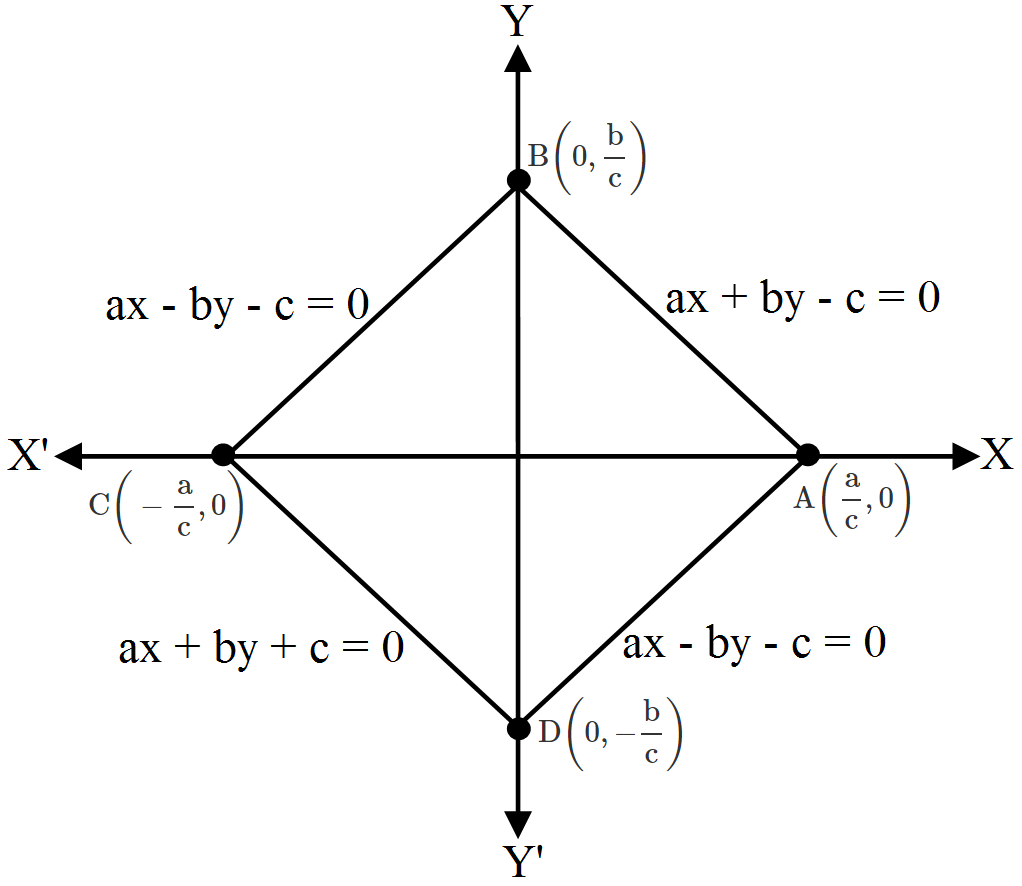
The figure formed by the lines $\text{ax} \pm \text{by} \pm \text{c} = 0 $ is:
  • A
    a rectangle.
  • B
    a square.
  • a rhombus.
  • D
    None of these.
Answer
Correct option: C.
a rhombus.
The given lines can be written separately in the following manner:
ax + by + c = 0 ...(1)
ax + by - c = 0 ...(2)
ax - by - c = 0 ...(3)
ax - by - c = 0 ...(4)
Graph of the given lines is given below:

Clearly, $\text{AB}=\text{BC}=\text{CD}=\text{DA}=\sqrt{\frac{\text{a}^2}{\text{c}^2}+\frac{\text{b}^2}{\text{c}^2}}=\frac{\sqrt{\text{a}^2+\text{b}^2}}{|\text{c}|}$
Thus, the region formed by the given lines is ABCD, which is a rhombus.
View full question & answer
MCQ 1291 Mark
The line segment joining the points (1, 2) and (-2, 1) is divided by the line 3x + 4y = 7 in the ratio:
  • A
    3 : 4
  • B
    4 : 3
  • C
    9 : 4
  • 4 : 9
Answer
Correct option: D.
4 : 9
Let the line segment joining the points (1, 2) and (−2, 1) be divided by the line 3x + 4y = 7 in the ratio m:n.
Then, the coordinates of this point will be $\Big(\frac{-2\text{m}+\text{n}}{\text{m}+\text{n}},\frac{\text{m}+2\text{n}}{\text{m}+\text{n}}\Big)$ that lie on the line.
$3\text{x}+4\text{y}=7$
$3\times\frac{-2\text{m}+\text{n}}{\text{m}+\text{n}}+4\times\frac{\text{m}+2\text{n}}{\text{m}+\text{n}}=7$
$\Rightarrow-2\text{m}+11\text{n}=7\text{m}+7\text{n}$
$\Rightarrow-9\text{m}=-4\text{n}$
$\Rightarrow\text{m}:\text{n}=4:9$
View full question & answer
MCQ 1301 Mark
Equation of horizontal line above x-axis at 5 units from x-axis is:
  • A
    x = 5
  • B
    x = -5
  • y = 5
  • D
    y = -5
Answer
Correct option: C.
y = 5
Equation of x-axis is y = 0. Horizontal line is parallel to x-axis and above it by 5 units so, equation of line is y = 5
View full question & answer
MCQ 1311 Mark
The line x + y = 4 divides the line joining the points (-1, 1) and (5, 7) in the ratio:
  • A
    2 : 1
  • 1 : 2 internally
  • C
    1 : 2 externally
  • D
    None of these
Answer
Correct option: B.
1 : 2 internally
  1. 1 : 2 internally
View full question & answer
MCQ 1321 Mark
The perpendicular distance of a line 4x + 3y + 5 = 0 from the point (-1, 2) is:
  • A
    5
  • B
    4
  • 2
  • D
    1
Answer
Correct option: C.
2
  1. 2
View full question & answer
MCQ 1331 Mark
A line passes through the point (2, 2) and is perpendicular to the line 3x + y = 3. Its y-intercept is:
  • A
    $\frac{1}{3}$
  • B
    $\frac{2}{3}$
  • C
    1
  • $\frac{4}{3}$
Answer
Correct option: D.
$\frac{4}{3}$
The equation of the line perpendicular to 3x + y = 3 is given below:
$\text{x}-3\text{y}+\lambda=0$
This line passes through (2, 2).
$2-6+\lambda=0$
$\Rightarrow\lambda=4$
So, the equation of the line will be
x - 3y + 4 = 0
$\Rightarrow\text{y}=\frac{1}{3}\text{x}+\frac{4}{3}$
Hence, the y-intercept is $\frac{4}{3}.$
View full question & answer
MCQ 1341 Mark
If slope of a line is 4 and y-intercept made by the line is 2 then the equation of line will be:
  • A
    y = 4x - 2
  • y = 4x + 2
  • C
    y = 2x + 4
  • D
    y = 2x - 4
Answer
Correct option: B.
y = 4x + 2
Let general equation of line be y = m × x + c.
Given, m = 4 and c = 2
View full question & answer
MCQ 1351 Mark
Which of the following points are 10 units from the origin:
  • A
    (6, 4)
  • (-6, 8)
  • C
    (6, -8)
  • D
    (-6, -8)
Answer
Correct option: B.
(-6, 8)
$\text{A} =\sqrt{ (6-0)^{2}+(4-0)^{2}} = \sqrt{52}$
$\text{B} =\sqrt{ (6-0)^{2}+(8-0)^{2}} =10$
$\text{C} =\sqrt{ (6-0)^{2}+(-8-0)^{2}} =10$
$\text{D} =\sqrt{ (-6-0)^{2}+(-8-0)^{2}} =10$
View full question & answer
MCQ 1361 Mark
If equation of a line is 3x + 2y - 6 = 0 then x-intercept is and y-intercept is:
  • A
    3, 2
  • 2, 3
  • C
    2, 6
  • D
    3, 6
Answer
Correct option: B.
2, 3
Reducing the above equation to intercept form $\frac{\text{x}}{\text{a}} +\frac{\text{y}}{\text{b}} =1,$
we get $\frac{\text{x}}{2} +\frac{\text{y}}{3} =1$
a = 2 which is x-intercept and b = 3 which is y-intercept.
View full question & answer
MCQ 1371 Mark
What is the slope of a line which is parallel to y-axis?
  • A
    -1.
  • B
    0.
  • C
    1.
  • Not defined.
Answer
Correct option: D.
Not defined.
If a line is parallel to y-axis then angle formed by it with x-axis is zero. So, its inclination is 90°. $\text{slope} = \tan 90^\circ$ which is not defined.
View full question & answer
MCQ 1381 Mark
If line joining (1, 2) and (7, 6) is perpendicular to line joining (3, 4) and (11, x):
  • A
    12
  • B
    16
  • -16
  • D
    -12
Answer
Correct option: C.
-16
  1. -16
Solution:
We know, slope of line joining two points $(x_1, y_1)$ and $(x_2, y_2)$ is given by $\frac{(\text{y}_{2}-\text{y}_{1})}{(\text{x}_{2}-\text{x}_{1})}$
Lines are perpendicular means $m_1\times m_2 = -1$
$\Rightarrow\big(\frac{\text{x}-4}{11-3}\big), \big(\frac{6-2}{7-1}\big) = -1$
⇒ (x - 4) (4) = (-1) (8) (6)
⇒ x - 4 = -12
⇒ x = -16.
View full question & answer
MCQ 1391 Mark
Equation of vertical line to the left of y-axis at 5 units from y-axis is:
  • A
    x = 5
  • x = -5
  • C
    y = 5
  • D
    y = -5
Answer
Correct option: B.
x = -5
Equation of y-axis is x = 0. Vertical line is parallel to y-axis and to the left by 5 units so, equation of line is x = -5
View full question & answer
MCQ 1401 Mark
What is the distance of (5, 12) from the origin?
  • A
    5 units
  • B
    8 units
  • C
    12 units
  • 13 units
Answer
Correct option: D.
13 units
  1. 13 units
Solution:
Let the points be A (0, 0) and B (5, 12).
A (0, 0) = $(x_1, y_1)$
B (5, 12) = $(x_2, y_2)$
The distance between two points, $\text{AB} = [(\text{x}_{2}-\text{x}_{1})^2+(\text{y}_{2}-\text{y}_{1})^2]$
$\text{AB} = [(5-0)^{2}+(12-0)^2]$
$\text{AB}=\sqrt{(25+144)}$
$\text{AB}=\sqrt{(169)}$
$\text{AB}=13$
The distance of (5, 12) from the origin is 13 units.
View full question & answer
MCQ 1411 Mark
If p be the length of the perpendicular from the origin on the straight line x + 2by = 2p, then what is the value of b:
  • A
    $\frac{1}{\text{p}}$
  • B
    $\text{p}$
  • C
    $\frac{1}{2}$
  • $\frac{3}{2}$
Answer
Correct option: D.
$\frac{3}{2}$
  1. $\frac{3}{2}$
View full question & answer
MCQ 1421 Mark
If the lines ax + 12y + 1 = 0, bx + 13y + 1 = 0 and cx + 14y + 1 = 0 are concurrent, then a, b, c are in:
  • A
    H.P.
  • B
    G.P.
  • A.P.
  • D
    None of these.
Answer
Correct option: C.
A.P.
The given lines are
ax + 12y + 1 = 0 ...(1)
bx + 13y + 1 = 0 ...(2)
cx + 14y + 1 = 0 ...(3)
It is given that (1), (2) and (3) are concurrent.
$\begin{vmatrix} \text{a}&12&1\\\text{b}&13&1\\\text{c}&14&1\end{vmatrix}=0$
$\Rightarrow\text{a}(13-14)-12(\text{b}-\text{c})+14\text{b}-13\text{c}=0$
$\Rightarrow-\text{a}-12\text{b}+12\text{c}+14\text{b}-13\text{c}=0$
$\Rightarrow-\text{a}+2\text{b}-\text{c}=0$
$\Rightarrow2\text{b}=\text{a}+\text{c}$
Hence, a, b and c are in AP.
View full question & answer
MCQ 1431 Mark
The relation between a, b, a’ and b’ such that the two lines ax + by = c and a’x + b’y = c’ are perpendicular is:
  • A
    aa¢ – bb¢ = 0
  • aa¢ + bb¢ = 0
  • C
    ab + a¢b¢ = 0
  • D
    ab - a¢b¢ = 0
Answer
Correct option: B.
aa¢ + bb¢ = 0
  1. aa¢ + bb¢ = 0
View full question & answer
MCQ 1441 Mark
Choose the correct answer. The equations of the lines which pass through the point (3, -2) and are inclined at 60° to the line $\sqrt{3} \text{x} + \text{y} = 1$ is:
  • $\sqrt{3}\text{x}+\text{y}-\sqrt{3}=0,\sqrt{3}\text{x}-\text{y}-\sqrt{3}=0$
  • B
    $\sqrt{3}\text{x}+\text{y}+\sqrt{3}=0,\sqrt{3}\text{x}-\text{y}+\sqrt{3}=0$
  • C
    $\text{x}+\sqrt{3}\text{y}-\sqrt{3}=0,\text{x}-\sqrt{3}\text{y}-\sqrt{3}=0$
  • D
    None of these.
Answer
Correct option: A.
$\sqrt{3}\text{x}+\text{y}-\sqrt{3}=0,\sqrt{3}\text{x}-\text{y}-\sqrt{3}=0$
Slope of the given line $\sqrt{3}\text{x}+\text{y}=1$ is, $\text{m}=-\sqrt{3}.$
Let the slope of the required line which makes an angle of 60° with the above line is m.
$\therefore \tan 60^\circ=\bigg|\frac{-\sqrt{3}-\text{m}}{1-\sqrt{3}\text{m}}\bigg|$
$\Rightarrow \bigg|\frac{-\sqrt{3}-\text{m}}{1-\sqrt{3}\text{m}}\bigg|=\sqrt{3}$
$\Rightarrow -\sqrt{3}-\text{m}=\sqrt{3}-3\text{m}$ or $-\sqrt{3}-\text{m}=-\sqrt{3}+3\text{m}$
$\Rightarrow \text{m}=\sqrt{3}$ or m = 0
Line is passing throught the point (3, -2).
Thus, the equation of the required line is: $\text{y}+2=\sqrt{3}(\text{x}-3)$ or y + 2 = 0
$\Rightarrow \sqrt{3}\text{x}-\text{y}-2-3\sqrt{3}=0$ and y + 2 = 0
View full question & answer
MCQ 1451 Mark
The lines x + 2y - 5 = 0, 2x - 3y + 4 = 0, 6x + 4y - 13 = 0:
  • A
    Are concurrent
  • Form a right angled triangle
  • C
    Form an isosceles triangle
  • D
    Form an equilateral triangle
Answer
Correct option: B.
Form a right angled triangle
  1. Form a right angled triangle
View full question & answer
MCQ 1461 Mark
The vertices of a triangle are (6, 0), (0, 6) and (6, 6). The distance between its circumcentre and centroid is:
  • A
    $2\sqrt{2}$
  • B
    $2$
  • $\sqrt{2}$
  • D
    $1$
Answer
Correct option: C.
$\sqrt{2}$
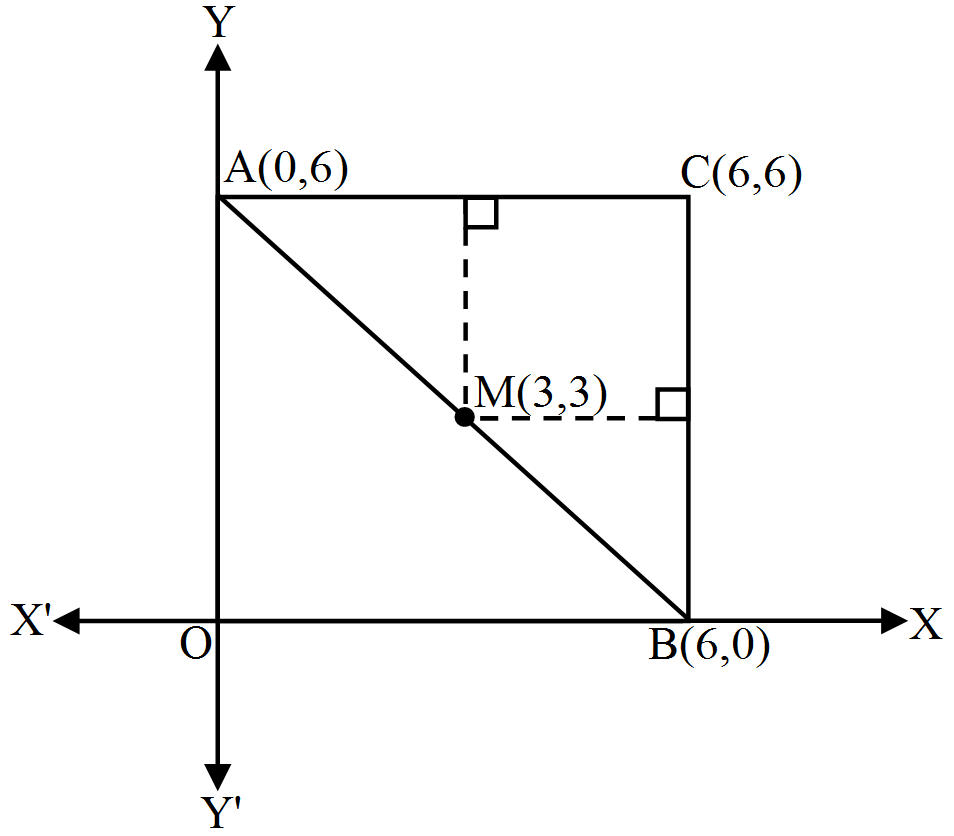
Let A(0, 6), B(6, 0) and C(6, 6) be the vertices of the given triangle.

Centroid of $\triangle\text{ABC}=\Big(\frac{0+6+6}{3},\frac{6+0+6}{3}\Big)$
$=(4,4)$
Coordinates of $\text{N}=\Big(\frac{6+6}{2},\frac{6+0}{2}\Big)$
$=(6,3)$
Coordinates of $\text{P}=\Big(\frac{0+6}{2},\frac{6+6}{2}\Big)$
$=(3,6)$
Equation of MN is y = 3
Equation of MP is x = 3
As, we know that circumcentre of a triangle is the intersection of the perpendicular bisectors of any two sides.
Therefore, coordinates of circumcentre is (3, 3)
Thus, the coordinates of the circumcentre are (3, 3) and the centroid of the triangle is (4, 4).
Let d be the distance between the circumcentre and the centroid.
$\therefore\text{d}\sqrt{(4-3)^2+(4-3)^2}=\sqrt{2}$
View full question & answer
MCQ 1471 Mark
What is the distance between (1, 3) and (5, 6)?
  • A
    3 units.
  • B
    4 units.
  • 5 units.
  • D
    25 units.
Answer
Correct option: C.
5 units.
  1. 5 units.
Solution:
We know, distance between two points ($x_1, y_1$) and ($x_2, y_2​​​​​​​$​​​​​​​) is $\sqrt{(\text{x}_{1}-\text{x}_{2}) ^{2}+{(\text{y}_{1}-\text{y}_{2})} ^{2}}$
So, distance between (1, 3) and (5, 6) is $\sqrt{{(1-5)}^{2}+(3-6)^{2}} = \sqrt{{(4)}^{2}+(3)^{2}} = 5\text{ units}.$
View full question & answer
MCQ 1481 Mark
The equation of the line passing through (1, 5) and perpendicular to the line 3x - 5y + 7 = 0 is:
  • 5x + 3y - 20 = 0
  • B
    3x - 5y + 7 = 0
  • C
    3x - 5y + 6 = 0
  • D
    5x + 3y + 7 = 0
Answer
Correct option: A.
5x + 3y - 20 = 0
A line perpendicular to 3x - 5y + 7 = 0 is given by
$5\text{x}+3\text{y}+\lambda=0$
This line passes through (1, 5)
$5+15+\lambda=0$
$\Rightarrow\lambda=-20$
Therefore, the equation of the required line is 5x + 3y - 20 = 0.
View full question & answer
MCQ 1491 Mark
The reflection of the point (4, -13) about the line 5x + y + 6 = 0 is:
  • (-1, -14)
  • B
    (3, 4)
  • C
    (0, 0)
  • D
    (1, 2)
Answer
Correct option: A.
(-1, -14)
Let the reflection point be A(h, k)
Now, the mid point of line joining (h, k) and (4, -13) will lie on the line 5x + y + 6 = 0
$\therefore5\Big(\frac{\text{h}+4}{2}\Big)+\frac{\text{k}-13}{2}+6=0$
$\Rightarrow5\text{h}+20+\text{k}-13+12=0$
$\Rightarrow5\text{h}+\text{k}+19=0 \ ...(1)$
Now, the slope of the line joining points (h, k) and (4, -13) are perpendicular to the line 5x + y + 6 = 0.
slope of the line = -5
slope of line joining by points (h, k) and (4, -13)
$\frac{\text{k}+13}{\text{h}-4}$
$\therefore\frac{\text{k}+13}{\text{h}-4}(-5)=-1$
$\Rightarrow5\text{k}-\text{h}+60=0 \ ...(2)$
Solving (1) and (2), we get
h = -1 and k = -14
View full question & answer
MCQ 1501 Mark
The equation of the locus of a point equidistant from the point A (1, 3) and B (-2, 1) is:
  • A
    6x - 4y = 5
  • 6x + 4y = 5
  • C
    6x + 4y = 7
  • D
    6x - 4y = 7
Answer
Correct option: B.
6x + 4y = 5
  1. 6x + 4y = 5
View full question & answer