MCQ 11 Mark
A particle moving with uniform speed in a circular path maintains:
- A
- B
Constant velocity but varying acceleration
- ✓
Varying velocity and varying acceleration
- D
AnswerCorrect option: C. Varying velocity and varying acceleration
c
A particle moving with uniform speed in a circular path maintains varying velocity and varying acceleration. It is because direction of both velocity as well as acceleration will change continuously.
View full question & answer→MCQ 21 Mark
A bob is whirled in a horizontal plane by means of a string with an initial speed of $\omega \mathrm{rpm}$. The tension in the string is $T$. If speed becomes $2 \omega$ while keeping the same radius, the tension in the string becomes:
- ✓
$4 T$
- B
$\frac{T}{4}$
- C
$\sqrt{2} T$
- D
$T$
Answera
(image)
$T=m / \omega^2$
(image)
$T^{\prime}=m \ell(2 \omega)^2$
$T^{\prime}=4$

View full question & answer→MCQ 31 Mark
A particle moving with uniform speed in a circular path maintains:
- A
- B
Constant velocity but varying acceleration
- ✓
Varying velocity and varying acceleration
- D
AnswerCorrect option: C. Varying velocity and varying acceleration
c
A particle moving with uniform speed in a circular path maintains varying velocity and varying acceleration. It is because direction of both velocity as well as acceleration will change continuously.
View full question & answer→MCQ 41 Mark
A bob is whirled in a horizontal plane by means of a string with an initial speed of $\omega \mathrm{rpm}$. The tension in the string is $T$. If speed becomes $2 \omega$ while keeping the same radius, the tension in the string becomes:
- ✓
$4 T$
- B
$\frac{T}{4}$
- C
$\sqrt{2} T$
- D
$T$
Answera
(image)
$T=m / \omega^2$
(image)
$T^{\prime}=m \ell(2 \omega)^2$
$T^{\prime}=4$
View full question & answer→MCQ 51 Mark
A bullet is fired from a gun at the speed of $280\,ms ^{-1}$ in the direction $30^{\circ}$ above the horizontal. The maximum height attained by the bullet is $........\,m$ $\left(g=9.8\,ms ^{-2}, \sin 30^{\circ}=0.5\right):-$
- A
$3000$
- B
$2800$
- C
$2000$
- ✓
$1000$
AnswerCorrect option: D. $1000$
d
$H _{\max }=\frac{ u ^2 \sin ^2 \theta}{2 g }$
$=\frac{(280)^2\left(\sin 30^{\circ}\right)^2}{2(9.8)}$
$=1000\,m$
View full question & answer→MCQ 61 Mark
The angular acceleration of a body, moving along the circumference of a circle, is :
- ✓
along the axis of rotation
- B
along the tangent to its position
- C
along the radius towards the centre
- D
along the radius, away from centre
AnswerCorrect option: A. along the axis of rotation
a
Along the axis of rotation

View full question & answer→MCQ 71 Mark
A bullet is fired from a gun at the speed of $280\,ms ^{-1}$ in the direction $30^{\circ}$ above the horizontal. The maximum height attained by the bullet is $........\,m$ $\left(g=9.8\,ms ^{-2}, \sin 30^{\circ}=0.5\right):-$
- A
$3000$
- B
$2800$
- C
$2000$
- ✓
$1000$
AnswerCorrect option: D. $1000$
d
$H _{\max }=\frac{ u ^2 \sin ^2 \theta}{2 g }$
$=\frac{(280)^2\left(\sin 30^{\circ}\right)^2}{2(9.8)}$
$=1000\,m$
View full question & answer→MCQ 81 Mark
The angular acceleration of a body, moving along the circumference of a circle, is :
- ✓
along the axis of rotation
- B
along the tangent to its position
- C
along the radius towards the centre
- D
along the radius, away from centre
AnswerCorrect option: A. along the axis of rotation
a
Along the axis of rotation
View full question & answer→MCQ 91 Mark
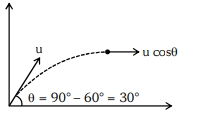
A ball is projected with a velocity, $10 ms ^{-1}$, at an angle of $60^{\circ}$ with the vertical direction. Its speed at the highest point of its trajectory will be$............... ms ^{-1}$
- ✓
$5 \sqrt{3}$
- B
$5$
- C
$10$
- D
AnswerCorrect option: A. $5 \sqrt{3}$
a
At highest point only horizontal component of velocity remains $\Rightarrow u _{ x }= u \cos \theta$
$u _{ x }= u \cos \theta =10 \cos 30^{\circ}$
$=5 \sqrt{3} ms ^{-1}$
View full question & answer→MCQ 101 Mark
A ball is projected with a velocity, $10 ms ^{-1}$, at an angle of $60^{\circ}$ with the vertical direction. Its speed at the highest point of its trajectory will be$............... ms ^{-1}$
- ✓
$5 \sqrt{3}$
- B
$5$
- C
$10$
- D
AnswerCorrect option: A. $5 \sqrt{3}$
a
At highest point only horizontal component of velocity remains $\Rightarrow u _{ x }= u \cos \theta$
$u _{ x }= u \cos \theta =10 \cos 30^{\circ}$
$=5 \sqrt{3} ms ^{-1}$
View full question & answer→MCQ 111 Mark
A cricket ball is thrown by a player at a speed of $20\,m / s$ in a direction $30^{\circ}$ above the horizontal. The maximum height attained by the ball during its motion is $........\,m$ $\left( g =10\,m / s ^2\right)$
Answera
$H =\frac{ u ^2 \sin ^2 \theta}{2 g }=\frac{(20)^2 \sin ^2 30^{\circ}}{2(10)}$
$=5$
View full question & answer→MCQ 121 Mark
A cricket ball is thrown by a player at a speed of $20\,m / s$ in a direction $30^{\circ}$ above the horizontal. The maximum height attained by the ball during its motion is $........\,m$ $\left( g =10\,m / s ^2\right)$
Answera
$H =\frac{ u ^2 \sin ^2 \theta}{2 g }=\frac{(20)^2 \sin ^2 30^{\circ}}{2(10)}$
$=5$
View full question & answer→MCQ 131 Mark
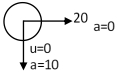
A car starts from rest and accelerates at $5 \,\mathrm{~m} / \mathrm{s}^{2}$. At $t=4 \mathrm{~s}$, a ball is dropped out of a window by a person sitting in the car. What is the velocity and acceleration of the ball at $\mathrm{t}=6\, \mathrm{~s}$ ?
(Take g $\left.=10\, \mathrm{~m} / \mathrm{s}^{2}\right)$
- A
$20\, \mathrm{~m} / \mathrm{s}, 5 \,\mathrm{~m} / \mathrm{s}^{2}$
- B
$20 \,\mathrm{~m} / \mathrm{s}, 0$
- C
$20\, \sqrt{2} \mathrm{~m} / \mathrm{s}, 0$
- ✓
$20 \,\sqrt{2} \mathrm{~m} / \mathrm{s}, 10\, \mathrm{~m} / \mathrm{s}^{2}$
AnswerCorrect option: D. $20 \,\sqrt{2} \mathrm{~m} / \mathrm{s}, 10\, \mathrm{~m} / \mathrm{s}^{2}$
d
$\mathrm{u}=0$
$\mathrm{a}=5$
$\mathrm{t}=4$
$V=u+a t$
$V=0+5 \times 4$
$V=20$
$\mathrm{V}_{\mathrm{x}}=20\, \mathrm{~m} / \mathrm{sec}$
$\mathrm{V}_{\mathrm{y}}=\mathrm{u}+\mathrm{ut}$
$=10 \times 2$
$\mathrm{~V}_{\mathrm{y}}=20\, \mathrm{~m} / \mathrm{sec}$
$\mathrm{V}=20 \sqrt{2}$
and $\mathrm{a}=10\, \mathrm{~m} / \mathrm{sec}^{2}$
View full question & answer→MCQ 141 Mark
A particle moving in a circle of radius $R$ with a uniform speed takes a time $T$ to complete one revolution. If this particle were projected with the same speed at an angle ' $\theta$ ' to the horizontal, the maximum height attained by it equals $4 \mathrm{R}$. The angle of projection, $\theta$, is then given by
- A
$\theta=\cos ^{-1}\left(\frac{g T^{2}}{\pi^{2} R}\right)^{1 / 2}$
- B
$\theta=\cos ^{-1}\left(\frac{\pi^{2} R}{g T^{2}}\right)^{1 / 2}$
- C
$\theta=\sin ^{-1}\left(\frac{\pi^{2} R}{g T^{2}}\right)^{1 / 2}$
- ✓
$\theta=\sin ^{-1}\left(\frac{2 \mathrm{~g} T^{2}}{\pi^{2} R}\right)^{1 / 2}$
AnswerCorrect option: D. $\theta=\sin ^{-1}\left(\frac{2 \mathrm{~g} T^{2}}{\pi^{2} R}\right)^{1 / 2}$
d
$T=\frac{2 \pi R}{V}$
$V=\frac{2 \pi R}{T}$
$H=\frac{u^{2} \sin ^{2} \theta}{2 g}$
$4 R=\frac{4 \pi^{2} R^{2} \sin ^{2} \theta}{T^{2} 2 g}$
$\sin ^{2} \theta=\frac{8 R T^{2} g}{4 \pi^{2} R^{2}}$
$\sin \theta=\sqrt{\frac{2 T^{2} g}{\pi^{2} R}}$
$\theta=\sin ^{-1}\left(\frac{2 T^{2} g}{\pi^{2} R}\right)^{1 / 2}$
View full question & answer→MCQ 151 Mark
A car starts from rest and accelerates at $5 \,\mathrm{~m} / \mathrm{s}^{2}$. At $t=4 \mathrm{~s}$, a ball is dropped out of a window by a person sitting in the car. What is the velocity and acceleration of the ball at $\mathrm{t}=6\, \mathrm{~s}$ ?
(Take g $\left.=10\, \mathrm{~m} / \mathrm{s}^{2}\right)$
- A
$20\, \mathrm{~m} / \mathrm{s}, 5 \,\mathrm{~m} / \mathrm{s}^{2}$
- B
$20 \,\mathrm{~m} / \mathrm{s}, 0$
- C
$20\, \sqrt{2} \mathrm{~m} / \mathrm{s}, 0$
- ✓
$20 \,\sqrt{2} \mathrm{~m} / \mathrm{s}, 10\, \mathrm{~m} / \mathrm{s}^{2}$
AnswerCorrect option: D. $20 \,\sqrt{2} \mathrm{~m} / \mathrm{s}, 10\, \mathrm{~m} / \mathrm{s}^{2}$
d
$\mathrm{u}=0$
$\mathrm{a}=5$
$\mathrm{t}=4$
$V=u+a t$
$V=0+5 \times 4$
$V=20$
$\mathrm{V}_{\mathrm{x}}=20\, \mathrm{~m} / \mathrm{sec}$
$\mathrm{V}_{\mathrm{y}}=\mathrm{u}+\mathrm{ut}$
$=10 \times 2$
$\mathrm{~V}_{\mathrm{y}}=20\, \mathrm{~m} / \mathrm{sec}$
$\mathrm{V}=20 \sqrt{2}$
and $\mathrm{a}=10\, \mathrm{~m} / \mathrm{sec}^{2}$
View full question & answer→MCQ 161 Mark
A particle moving in a circle of radius $R$ with a uniform speed takes a time $T$ to complete one revolution. If this particle were projected with the same speed at an angle ' $\theta$ ' to the horizontal, the maximum height attained by it equals $4 \mathrm{R}$. The angle of projection, $\theta$, is then given by
- A
$\theta=\cos ^{-1}\left(\frac{g T^{2}}{\pi^{2} R}\right)^{1 / 2}$
- B
$\theta=\cos ^{-1}\left(\frac{\pi^{2} R}{g T^{2}}\right)^{1 / 2}$
- C
$\theta=\sin ^{-1}\left(\frac{\pi^{2} R}{g T^{2}}\right)^{1 / 2}$
- ✓
$\theta=\sin ^{-1}\left(\frac{2 \mathrm{~g} T^{2}}{\pi^{2} R}\right)^{1 / 2}$
AnswerCorrect option: D. $\theta=\sin ^{-1}\left(\frac{2 \mathrm{~g} T^{2}}{\pi^{2} R}\right)^{1 / 2}$
d
$T=\frac{2 \pi R}{V}$
$V=\frac{2 \pi R}{T}$
$H=\frac{u^{2} \sin ^{2} \theta}{2 g}$
$4 R=\frac{4 \pi^{2} R^{2} \sin ^{2} \theta}{T^{2} 2 g}$
$\sin ^{2} \theta=\frac{8 R T^{2} g}{4 \pi^{2} R^{2}}$
$\sin \theta=\sqrt{\frac{2 T^{2} g}{\pi^{2} R}}$
$\theta=\sin ^{-1}\left(\frac{2 T^{2} g}{\pi^{2} R}\right)^{1 / 2}$
View full question & answer→MCQ 171 Mark
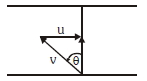
The speed of a swimmer in still water is $20 \;\mathrm{m} / \mathrm{s}$. The speed of river water is $10\; \mathrm{m} / \mathrm{s}$ and is flowing due east. If he is standing on the south bank and wishes to cross the river along the shortest path, the angle at which he should make his strokes w.r.t. north is given by ......$^o$ west
Answera
$\mathrm{v}=20 \mathrm{m} / \mathrm{s}$
$\mathrm{u}=10 \mathrm{m} / \mathrm{s}$
$\sin \theta=\frac{u}{v}=\frac{10}{20}=\frac{1}{2}$
$\Rightarrow \theta=30^{\circ}$ west
View full question & answer→MCQ 181 Mark
Two bullets are fired horizontally and simultaneously towards each other from roof tops of two buldings $100 \;\mathrm{m}$ apart and of same helght of $200 \;\mathrm{m}$ with the same velocity of $25\; \mathrm{m} / \mathrm{s}$. When and where will the two bullets collide. $\left(g=10 \;\mathrm{m} / \mathrm{s}^{2}\right)$
- ✓
after $2\; s$ at a helght $180\; \mathrm{m}$
- B
after $2\; s$ at a helght of $20\; \mathrm{m}$
- C
after $4\;s$ at a height of $120\; \mathrm{m}$
- D
AnswerCorrect option: A. after $2\; s$ at a helght $180\; \mathrm{m}$
a
$\mathrm{t}=\frac{\mathrm{d}}{\mathrm{v}_{\mathrm{rel}}}=\frac{100}{50}=2$
$\mathrm{s}_{\mathrm{y}}=-\frac{1}{2} \mathrm{gt}^{2}=-\frac{1}{2} \times 10 \times 4=-20$
Height $=180 \mathrm{m}$
View full question & answer→MCQ 191 Mark
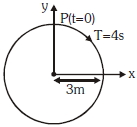
The radius of circle the period of revolution initial position and sense of revolution are indicated in the figure.
$y-$projection of the radius vector of rotating particle $\mathrm{P}$ is
- A
$y(t)=-3 \cos 2 \pi t,$ where $y$ in $m$
- B
$y(t)=4 \sin \left(\frac{\pi t}{2}\right),$ where $y$ in $m$
- C
$y(t)=3 \cos \left(\frac{3 \pi t}{2}\right),$ where $y$ in $m$
- ✓
$y(t)=3 \cos \left(\frac{\pi t}{2}\right),$ where $y$ in $m$
AnswerCorrect option: D. $y(t)=3 \cos \left(\frac{\pi t}{2}\right),$ where $y$ in $m$
d
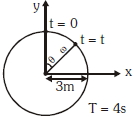
$\omega=\frac{2 \pi}{4}=\frac{\pi}{2}$
For $y-$projection,
$y=A \cos \omega t$
$\Rightarrow y=3 \cos \left(\frac{\pi t}{2}\right)$
View full question & answer→MCQ 201 Mark
Two particles $A$ and $B$ are moving in uniform circular motion in concentric cirdes of radius $r_{A}$ and $r_{B}$ with speed $v_A$ and $v_B$ respectively. The time period of rotation is the same. The ratio of angular speed of $A$ to that of $B$ will be
AnswerCorrect option: D. $1: 1$
d
$\mathrm{T}_{\mathrm{A}}=\mathrm{T}_{\mathrm{B}}$
$\Rightarrow \frac{2 \pi}{\omega_{A}}=\frac{2 \pi}{\omega_{B}}$
$\Rightarrow \frac{\omega_{A}}{\omega_{B}}=1: 1$
View full question & answer→MCQ 211 Mark
When an object is shot from the bottom of a long smooth inclined plane kept at an angle $60^{\circ}$ with horizontal. it can travel a distance $\mathrm{x}_{1}$ along the plane. But when the inclination is decreased to $30^{\circ}$ and the same object the shot with the same velocity, it can travel $x_{2}$ distance. Then $x_{1}: x_{2}$ will be
- A
$1: \sqrt{2}$
- B
$\sqrt{2}: 1$
- ✓
$1: \sqrt{3}$
- D
$1: 2 \sqrt{3}$
AnswerCorrect option: C. $1: \sqrt{3}$
c
$v^{2}=u^{2}-2 a s$
$\Rightarrow \mathrm{s}=\frac{\mathrm{u}^{2}}{2 \mathrm{a}}=\frac{\mathrm{u}^{2}}{2 \mathrm{gsin} \theta}$
$\frac{\mathrm{x}_{1}}{\mathrm{x}_{2}}=\frac{\sin \theta_{2}}{\sin \theta_{1}}=\frac{\sin 30^{\circ}}{\sin 60^{\circ}}=\frac{1 / 2}{\sqrt{3} / 2}$
$\Rightarrow \frac{x_{1}}{x_{2}}=\frac{1}{\sqrt{3}}$
View full question & answer→MCQ 221 Mark
A particle starting from rest, moves in a circle of radius $r$. It attains a velocity of $\mathrm{V}_{0} \;\mathrm{m} / \mathrm{s}$ in the $\mathrm{n}^{\text {th }}$ round. Its angular acceleration will be
- A
$\frac{\mathrm{V}_{0}}{\mathrm{n}}\; \mathrm{rad} / \mathrm{s}^{2}$
- B
$\frac{\mathrm{V}_{0}^{2}}{2 \pi \mathrm{nr}^{2}} \; \mathrm{rad} / \mathrm{s}^{2}$
- ✓
$\frac{\mathrm{V}_{0}^{2}}{4 \pi \mathrm{nr}^{2}}\; \mathrm{rad} / \mathrm{s}^{2}$
- D
$\frac{V_{0}^{2}}{4 \pi n r}\; \mathrm{rad} / \mathrm{s}^{2}$
AnswerCorrect option: C. $\frac{\mathrm{V}_{0}^{2}}{4 \pi \mathrm{nr}^{2}}\; \mathrm{rad} / \mathrm{s}^{2}$
c
$\theta=(2 \pi n), \omega_{0}=0, \omega=V_{0} / r$
$\alpha=\frac{\omega^{2}-\omega_{0}^{2}}{2 \theta}=\frac{\left(\mathrm{V}_{0} / \mathrm{r}\right)^{2}-0}{2(2 \pi \mathrm{n})}$$=\frac{\mathrm{V}_{0}^{2}}{4 \pi \mathrm{nr}^{2}}$
View full question & answer→MCQ 231 Mark
The speed of a swimmer in still water is $20 \;\mathrm{m} / \mathrm{s}$. The speed of river water is $10\; \mathrm{m} / \mathrm{s}$ and is flowing due east. If he is standing on the south bank and wishes to cross the river along the shortest path, the angle at which he should make his strokes w.r.t. north is given by ......$^o$ west
Answera
$\mathrm{v}=20 \mathrm{m} / \mathrm{s}$
$\mathrm{u}=10 \mathrm{m} / \mathrm{s}$
$\sin \theta=\frac{u}{v}=\frac{10}{20}=\frac{1}{2}$
$\Rightarrow \theta=30^{\circ}$ west
View full question & answer→MCQ 241 Mark
Two bullets are fired horizontally and simultaneously towards each other from roof tops of two buldings $100 \;\mathrm{m}$ apart and of same helght of $200 \;\mathrm{m}$ with the same velocity of $25\; \mathrm{m} / \mathrm{s}$. When and where will the two bullets collide. $\left(g=10 \;\mathrm{m} / \mathrm{s}^{2}\right)$
- ✓
after $2\; s$ at a helght $180\; \mathrm{m}$
- B
after $2\; s$ at a helght of $20\; \mathrm{m}$
- C
after $4\;s$ at a height of $120\; \mathrm{m}$
- D
AnswerCorrect option: A. after $2\; s$ at a helght $180\; \mathrm{m}$
a
$\mathrm{t}=\frac{\mathrm{d}}{\mathrm{v}_{\mathrm{rel}}}=\frac{100}{50}=2$
$\mathrm{s}_{\mathrm{y}}=-\frac{1}{2} \mathrm{gt}^{2}=-\frac{1}{2} \times 10 \times 4=-20$
Height $=180 \mathrm{m}$
View full question & answer→MCQ 251 Mark
The radius of circle the period of revolution initial position and sense of revolution are indicated in the figure.
$y-$projection of the radius vector of rotating particle $\mathrm{P}$ is
- A
$y(t)=-3 \cos 2 \pi t,$ where $y$ in $m$
- B
$y(t)=4 \sin \left(\frac{\pi t}{2}\right),$ where $y$ in $m$
- C
$y(t)=3 \cos \left(\frac{3 \pi t}{2}\right),$ where $y$ in $m$
- ✓
$y(t)=3 \cos \left(\frac{\pi t}{2}\right),$ where $y$ in $m$
AnswerCorrect option: D. $y(t)=3 \cos \left(\frac{\pi t}{2}\right),$ where $y$ in $m$
d
$\omega=\frac{2 \pi}{4}=\frac{\pi}{2}$
For $y-$projection,
$y=A \cos \omega t$
$\Rightarrow y=3 \cos \left(\frac{\pi t}{2}\right)$
View full question & answer→MCQ 261 Mark
Two particles $A$ and $B$ are moving in uniform circular motion in concentric cirdes of radius $r_{A}$ and $r_{B}$ with speed $v_A$ and $v_B$ respectively. The time period of rotation is the same. The ratio of angular speed of $A$ to that of $B$ will be
AnswerCorrect option: D. $1: 1$
d
$\mathrm{T}_{\mathrm{A}}=\mathrm{T}_{\mathrm{B}}$
$\Rightarrow \frac{2 \pi}{\omega_{A}}=\frac{2 \pi}{\omega_{B}}$
$\Rightarrow \frac{\omega_{A}}{\omega_{B}}=1: 1$
View full question & answer→MCQ 271 Mark
When an object is shot from the bottom of a long smooth inclined plane kept at an angle $60^{\circ}$ with horizontal. it can travel a distance $\mathrm{x}_{1}$ along the plane. But when the inclination is decreased to $30^{\circ}$ and the same object the shot with the same velocity, it can travel $x_{2}$ distance. Then $x_{1}: x_{2}$ will be
- A
$1: \sqrt{2}$
- B
$\sqrt{2}: 1$
- ✓
$1: \sqrt{3}$
- D
$1: 2 \sqrt{3}$
AnswerCorrect option: C. $1: \sqrt{3}$
c
$v^{2}=u^{2}-2 a s$
$\Rightarrow \mathrm{s}=\frac{\mathrm{u}^{2}}{2 \mathrm{a}}=\frac{\mathrm{u}^{2}}{2 \mathrm{gsin} \theta}$
$\frac{\mathrm{x}_{1}}{\mathrm{x}_{2}}=\frac{\sin \theta_{2}}{\sin \theta_{1}}=\frac{\sin 30^{\circ}}{\sin 60^{\circ}}=\frac{1 / 2}{\sqrt{3} / 2}$
$\Rightarrow \frac{x_{1}}{x_{2}}=\frac{1}{\sqrt{3}}$
View full question & answer→MCQ 281 Mark
A particle starting from rest, moves in a circle of radius $r$. It attains a velocity of $\mathrm{V}_{0} \;\mathrm{m} / \mathrm{s}$ in the $\mathrm{n}^{\text {th }}$ round. Its angular acceleration will be
- A
$\frac{\mathrm{V}_{0}}{\mathrm{n}}\; \mathrm{rad} / \mathrm{s}^{2}$
- B
$\frac{\mathrm{V}_{0}^{2}}{2 \pi \mathrm{nr}^{2}} \; \mathrm{rad} / \mathrm{s}^{2}$
- ✓
$\frac{\mathrm{V}_{0}^{2}}{4 \pi \mathrm{nr}^{2}}\; \mathrm{rad} / \mathrm{s}^{2}$
- D
$\frac{V_{0}^{2}}{4 \pi n r}\; \mathrm{rad} / \mathrm{s}^{2}$
AnswerCorrect option: C. $\frac{\mathrm{V}_{0}^{2}}{4 \pi \mathrm{nr}^{2}}\; \mathrm{rad} / \mathrm{s}^{2}$
c
$\theta=(2 \pi n), \omega_{0}=0, \omega=V_{0} / r$
$\alpha=\frac{\omega^{2}-\omega_{0}^{2}}{2 \theta}=\frac{\left(\mathrm{V}_{0} / \mathrm{r}\right)^{2}-0}{2(2 \pi \mathrm{n})}$$=\frac{\mathrm{V}_{0}^{2}}{4 \pi \mathrm{nr}^{2}}$
View full question & answer→MCQ 291 Mark
The $x$ and $y$ coordinates of the particle at any time are $x = 5t - 2t^2$ and $y = 10t$ respectively, where $x$ and $y$ are in metres and $t$ in seconds. The acceleration of the particle at $t = 2\, s$ is......$m/sec^2$
Answera
$\begin{array}{l}
\,\,\,\,\,\,\,x = 5t - 2{t^2},y = 10t\\
\frac{{dx}}{{dt}} = 5 - 4t,\frac{{dy}}{{dt}} = 10\,\,\,\,\,\,\therefore {v_x} = 5 - 4t,{v_y} = 10\\
\frac{{d{v_x}}}{{dt}} = - 4,\frac{{d{v_y}}}{{dt}} = 0\,\,\,\,\,\,\,\,\,\,\therefore {a_x} = - 4,{a_y} = 0\\
Acceleration,\,\vec a = {a_x}\hat i + {a_y}\hat j = 4\hat i\\
\therefore \,The\,acceleration\,of\,the\,particle\,at\,t = 2\,s\\
is\, - 4\,m\,{s^{ - 2}}
\end{array}$
View full question & answer→MCQ 301 Mark
A ball of mass $1 \;kg$ is thrown vertically upwards and returns to the ground after $3\; seconds$. Another ball, thrown at $60^{\circ}$ with vertical also stays in air for the same time before it touches the ground. The ratio of the two heights are
Answerb
$T _{1}=\frac{2 u _{1}}{ g }$
$T _{2}=\frac{2 u _{2} \sin \theta}{ g }$
$T _{1}= T _{2}$
$\Rightarrow \frac{2}{ g } u _{1}=\frac{2 u _{2} \sin \theta}{ g } \Rightarrow u _{1}= u _{2} \sin \theta$
$\text { Height }=\frac{ u ^{2} \sin ^{2} \theta}{2 g } \Rightarrow \frac{ H _{1}}{ H _{2}}=\frac{u_{1}^{2}}{u_{2}^{2} \sin ^{2} \theta}$
$\Rightarrow \frac{ H _{1}}{ H _{2}}=1$
View full question & answer→MCQ 311 Mark
The $x$ and $y$ coordinates of the particle at any time are $x = 5t - 2t^2$ and $y = 10t$ respectively, where $x$ and $y$ are in metres and $t$ in seconds. The acceleration of the particle at $t = 2\, s$ is......$m/sec^2$
Answera
$\begin{array}{l}
\,\,\,\,\,\,\,x = 5t - 2{t^2},y = 10t\\
\frac{{dx}}{{dt}} = 5 - 4t,\frac{{dy}}{{dt}} = 10\,\,\,\,\,\,\therefore {v_x} = 5 - 4t,{v_y} = 10\\
\frac{{d{v_x}}}{{dt}} = - 4,\frac{{d{v_y}}}{{dt}} = 0\,\,\,\,\,\,\,\,\,\,\therefore {a_x} = - 4,{a_y} = 0\\
Acceleration,\,\vec a = {a_x}\hat i + {a_y}\hat j = 4\hat i\\
\therefore \,The\,acceleration\,of\,the\,particle\,at\,t = 2\,s\\
is\, - 4\,m\,{s^{ - 2}}
\end{array}$
View full question & answer→MCQ 321 Mark
A ball of mass $1 \;kg$ is thrown vertically upwards and returns to the ground after $3\; seconds$. Another ball, thrown at $60^{\circ}$ with vertical also stays in air for the same time before it touches the ground. The ratio of the two heights are
Answerb
$T _{1}=\frac{2 u _{1}}{ g }$
$T _{2}=\frac{2 u _{2} \sin \theta}{ g }$
$T _{1}= T _{2}$
$\Rightarrow \frac{2}{ g } u _{1}=\frac{2 u _{2} \sin \theta}{ g } \Rightarrow u _{1}= u _{2} \sin \theta$
$\text { Height }=\frac{ u ^{2} \sin ^{2} \theta}{2 g } \Rightarrow \frac{ H _{1}}{ H _{2}}=\frac{u_{1}^{2}}{u_{2}^{2} \sin ^{2} \theta}$
$\Rightarrow \frac{ H _{1}}{ H _{2}}=1$
View full question & answer→MCQ 331 Mark
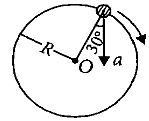
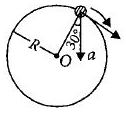
In the given figure, $a = 15 \,m s^{- 2}$ represents the total acceleration of a particle moving in the clockwise direction in a circle of radius $R = 2.5\, m$ at a given instant of time. The speed of the particle is ........ $m/s$
Answera
$\begin{gathered}
\,\,\,\,\,Here,a = 15\,m{s^{ - 2}} \hfill \\
\,\,\,\,\,R = 2.5\,m \hfill \\
From\,figure, \hfill \\
{a_c} = a\,\cos \,{30^ \circ } = 15 \times \frac{{\sqrt 3 }}{2}\,m{s^{ - 2}} \hfill \\
As\,we\,know,\,{a_c} = \frac{{{v^2}}}{R} \Rightarrow v = \sqrt {{a_c}R} \hfill \\
\therefore \,\,\,\,\,v = \sqrt {15 \times \frac{{\sqrt 3 }}{2} \times 2.5} = 5.69 = 5.7m\,{s^{ - 1}} \hfill \\
\end{gathered} $
View full question & answer→MCQ 341 Mark
A particle moves so that its position vector is given by $\overrightarrow {\;r} = cos\omega t\,\hat x + sin\omega t\,\hat y$ , where $\omega$ is a constant. Which of the following is true?
- A
Velocity and acceleration both are parallel to $\overrightarrow {\;r} $
- ✓
Velocity is perpendicular to $\overrightarrow {\;r} \;$ and acceleration is directed towards the origin.
- C
Velocity is perpendicular to $\vec r$ and acceleration is directed away from the origin.
- D
Velocity and acceleration both are perpendicular to $\vec r$
AnswerCorrect option: B. Velocity is perpendicular to $\overrightarrow {\;r} \;$ and acceleration is directed towards the origin.
b
$\begin{array}{l} \,\,\,\,\,\,\,\,\,\,\,\,\,Give,\,\vec r = \cos \omega t\,\hat x + \sin \,\omega t\,\hat y\\ \therefore \,\,\,\,\vec v = \frac{{d\vec r}}{{dt}} = - \omega \,\sin \,\omega t\,\hat x + \omega \,\cos \omega t\,\hat y\\ \,\,\,\,\,\,\mathord{\buildrel{\lower3pt\hbox{$\scriptscriptstyle\rightharpoonup$}} \over a} = \frac{{d\vec v}}{{dt}} = - {\omega ^2}\,\cos \,\omega t\,\hat x - {\omega ^2}\,\sin \,\omega t\,\hat y = - {\omega ^2}\vec r\\ {\rm{Since}}\,position\,vector\,\left( {\bar r} \right)\,is\,directed\,away\\ from\,the\,origin,\,so,\,acceleration\,\left( { - {\omega ^2}\bar r} \right)\\ is\,directed\,towards\,the\,origin.\\ Also,\\ \vec r \cdot \vec v = \left( {\cos \omega t\,\hat x + \sin \,\omega t\,\hat y} \right) \cdot \left( { - \omega \sin \omega t\,\hat x + \omega \cos \omega t\,\hat y} \right)\\ = - \omega \sin \omega t\cos \omega t + \omega \sin \omega t\cos \omega t = 0\\ \,\,\,\,\,\,\,\,\,\,\,\, \Rightarrow \bar r\, \bot \bar v \end{array}$
View full question & answer→MCQ 351 Mark
In the given figure, $a = 15 \,m s^{- 2}$ represents the total acceleration of a particle moving in the clockwise direction in a circle of radius $R = 2.5\, m$ at a given instant of time. The speed of the particle is ........ $m/s$
Answera
$\begin{gathered}
\,\,\,\,\,Here,a = 15\,m{s^{ - 2}} \hfill \\
\,\,\,\,\,R = 2.5\,m \hfill \\
From\,figure, \hfill \\
{a_c} = a\,\cos \,{30^ \circ } = 15 \times \frac{{\sqrt 3 }}{2}\,m{s^{ - 2}} \hfill \\
As\,we\,know,\,{a_c} = \frac{{{v^2}}}{R} \Rightarrow v = \sqrt {{a_c}R} \hfill \\
\therefore \,\,\,\,\,v = \sqrt {15 \times \frac{{\sqrt 3 }}{2} \times 2.5} = 5.69 = 5.7m\,{s^{ - 1}} \hfill \\
\end{gathered} $
View full question & answer→MCQ 361 Mark
A particle moves so that its position vector is given by $\overrightarrow {\;r} = cos\omega t\,\hat x + sin\omega t\,\hat y$ , where $\omega$ is a constant. Which of the following is true?
- A
Velocity and acceleration both are parallel to $\overrightarrow {\;r} $
- ✓
Velocity is perpendicular to $\overrightarrow {\;r} \;$ and acceleration is directed towards the origin.
- C
Velocity is perpendicular to $\vec r$ and acceleration is directed away from the origin.
- D
Velocity and acceleration both are perpendicular to $\vec r$
AnswerCorrect option: B. Velocity is perpendicular to $\overrightarrow {\;r} \;$ and acceleration is directed towards the origin.
b
$\begin{array}{l} \,\,\,\,\,\,\,\,\,\,\,\,\,Give,\,\vec r = \cos \omega t\,\hat x + \sin \,\omega t\,\hat y\\ \therefore \,\,\,\,\vec v = \frac{{d\vec r}}{{dt}} = - \omega \,\sin \,\omega t\,\hat x + \omega \,\cos \omega t\,\hat y\\ \,\,\,\,\,\,\mathord{\buildrel{\lower3pt\hbox{$\scriptscriptstyle\rightharpoonup$}} \over a} = \frac{{d\vec v}}{{dt}} = - {\omega ^2}\,\cos \,\omega t\,\hat x - {\omega ^2}\,\sin \,\omega t\,\hat y = - {\omega ^2}\vec r\\ {\rm{Since}}\,position\,vector\,\left( {\bar r} \right)\,is\,directed\,away\\ from\,the\,origin,\,so,\,acceleration\,\left( { - {\omega ^2}\bar r} \right)\\ is\,directed\,towards\,the\,origin.\\ Also,\\ \vec r \cdot \vec v = \left( {\cos \omega t\,\hat x + \sin \,\omega t\,\hat y} \right) \cdot \left( { - \omega \sin \omega t\,\hat x + \omega \cos \omega t\,\hat y} \right)\\ = - \omega \sin \omega t\cos \omega t + \omega \sin \omega t\cos \omega t = 0\\ \,\,\,\,\,\,\,\,\,\,\,\, \Rightarrow \bar r\, \bot \bar v \end{array}$
View full question & answer→MCQ 371 Mark
The length of second's hand in watch is $1 \,cm.$ The change in velocity of its tip in $15$ seconds is
- A
- B
$\frac{\pi }{{30\sqrt 2 }}\,\,cm/\sec $
- C
$\frac{\pi }{{30}}\,\,cm/\sec $
- ✓
$\frac{{\pi \sqrt 2 }}{{30}}\,\,cm/\sec $
AnswerCorrect option: D. $\frac{{\pi \sqrt 2 }}{{30}}\,\,cm/\sec $
d
(d) $\Delta v = 2v\sin \left( {\frac{{90^\circ }}{2}} \right) = 2v\sin 45^\circ $
$ = 2v \times \frac{1}{{\sqrt 2 }} = \sqrt 2 v$
$ = \sqrt 2 \times r\omega = \sqrt 2 \times 1 \times \frac{{2\pi }}{{60}} = \frac{{\sqrt 2 \pi }}{{`30}}\;cm/s$
View full question & answer→MCQ 381 Mark
The coordinates of a moving particle at any time are given by $x = a{t^2}$ and $y = b{t^2}$. The speed of the particle at any moment is
- A
$2t(a + b)$
- B
$2t\sqrt {({a^2} - {b^2})} $
- C
$t\,\sqrt {{a^2} + {b^2}} $
- ✓
$2t\sqrt {({a^2} + {b^2})} $
AnswerCorrect option: D. $2t\sqrt {({a^2} + {b^2})} $
d
(d) Velocity along $X-$axis ${v_x} = \frac{{dx}}{{dt}} = 2at$
Velocity along $Y-$axis ${v_y} = \frac{{dy}}{{dt}} = 2bt$
Magnitude of velocity of the particle,
$v = \sqrt {v_x^2 + v_y^2} = 2t\sqrt {{a^2} + {b^2}} $
View full question & answer→MCQ 391 Mark
The position of a particle moving in the $xy-$plane at any time $t$ is given by $x = (3{t^2} - 6t)$ metres, $y = ({t^2} - 2t)$ metres. Select the correct statement about the moving particle from the following
- A
The acceleration of the particle is zero at $t = 0$ second
- B
The velocity of the particle is zero at $t = 0$ second
- ✓
The velocity of the particle is zero at $t = 1$ second
- D
The velocity and acceleration of the particle are never zero
AnswerCorrect option: C. The velocity of the particle is zero at $t = 1$ second
c
(c) ${v_x} = \frac{{dx}}{{dt}} = \frac{d}{{dt}}(3{t^2} - 6t) = 6t - 6$.
At $t = 1,\;{v_x} = 0$
${v_y} = \frac{{dy}}{{dt}} = \frac{d}{{dt}}({t^2} - 2t) = 2t - 2$.
At $t = 1,\;{v_y} = 0$
Hence $v = \sqrt {v_x^2 + v_y^2} = 0$
View full question & answer→MCQ 401 Mark
The height $y$ and the distance $x$ along the horizontal plane of a projectile on a certain planet (with no surrounding atmosphere) are given by $y = (8t - 5{t^2})$ meter and $x = 6t\, meter$, where $t$ is in second. the angle with the horizontal at which the projectile was projected is
- A
${\tan ^{ - 1}}(3/4$)
- ✓
${\tan ^{ - 1}}(4/3)$
- C
${\sin ^{ - 1}}(3/4$)
- D
Not obtainable from the given data
AnswerCorrect option: B. ${\tan ^{ - 1}}(4/3)$
b
${v_y} = \frac{{dy}}{{dt}} = 8 - 10t$, ${v_x} = \frac{{dx}}{{dt}} = 6$
at the time of projection i.e. ${v_y} = \frac{{dy}}{{dt}} = 8$and ${v_x} = 6$
The angle of projection is given by $\theta = {\tan ^{ - 1}}\left( {\frac{{{v_y}}}{{{v_x}}}} \right) $
$= {\tan ^{ - 1}}\left( {\frac{4}{3}} \right)$
View full question & answer→MCQ 411 Mark
The height $y$ and the distance $x$ along the horizontal plane of a projectile on a certain planet (with no surrounding atmosphere) are given by $y = (8t - 5{t^2})$ meter and $x = 6t\, meter$, where $t$ is in second., the acceleration due to gravity is given by ......... $m/{\sec ^2}$
Answera
(a) ${a_x} = \frac{d}{{dt}}({v_x}) = 0$,
${a_y} = \frac{d}{{dt}}({v_y}) = - 10\;m/{s^2}$
Net acceleration $a = \sqrt {a_x^2 + a_y^2} $=$\sqrt {{0^2} + {{10}^2}} =10m/s^2$
View full question & answer→MCQ 421 Mark
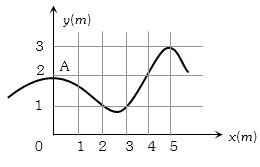
The trajectory of a particle moving in vast maidan is as shown in the figure. The coordinates of a position A are $(0,2)$. The coordinates of another point at which the instantaneous velocity is same as the average velocity between the points are
- A
$(1, 4)$
- ✓
$(5, 3)$
- C
$(3, 4)$
- D
$(4, 1)$
AnswerCorrect option: B. $(5, 3)$
b
The coordinates of position $A$ ar $(0,2)$ is same as the average velocity between the points are $(5,3)$ in graph of a moving particle as shown in fig.Because both have same slope.
View full question & answer→MCQ 431 Mark
A body starts from rest from the origin with an acceleration of $6 \;m / s^2$ along the $x$-axis and $8\; m / s^2$ along the $y$-axis. Its distance from the origin after $4\; seconds$ will be
Answerc
$x = {u_x}t + \frac{1}{2}{a_x}{t^2} = \frac{1}{2} \times 6 \times {(4)^2} = 48\,m$
$y = {u_y}t + \frac{1}{2}{a_y}{t^2} = \frac{1}{2} \times 8 \times {(4)^2} = 64\,m$
$d = \sqrt {{x^2} + {y^2}} = \sqrt {{{(48)}^2} + {{(64)}^2}} = 80\,m$
View full question & answer→MCQ 441 Mark
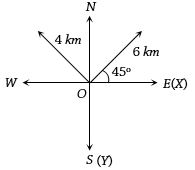
A car travels $6 \,km$ towards north at an angle of $45^o $ to the east and then travels distance of $4 \,km$ towards north at an angle of $135^o $ to the east. How far is the point from the starting point. What angle does the straight line joining its initial and final position makes with the east
- A
$\sqrt {50} \,km$ and ${\tan ^{ - 1}}(5)$
- B
$10 \,km$ and ${\tan ^{ - 1}}(\sqrt 5 )$
- ✓
$\sqrt {52} \,km$ and ${\tan ^{ - 1}}(5)$
- D
$\sqrt {52} \,km$ and ${\tan ^{ - 1}}(\sqrt 5 )$
AnswerCorrect option: C. $\sqrt {52} \,km$ and ${\tan ^{ - 1}}(5)$
c
(c) Net movement along $x-$direction $Sx = (6 -4) cos 45^o $ $\hat i$
$ = 2 \times \frac{1}{{\sqrt 2 }}\, = \,\sqrt 2 \,km$
Net movement along y-direction $Sy = (6 + 4) sin 45^o $$\hat j$ $ = 10 \times \frac{1}{{\sqrt 2 }} = 5\sqrt 2 \,km$
Net movement from starting point
$|\overrightarrow S |\, = \sqrt {{S_x}^2 + {S_y}^2} $$ = \sqrt {{{\left( {\sqrt 2 } \right)}^2} + {{\left( {5\sqrt 2 } \right)}^2}} $=$\sqrt {52} \,\,km$
Angle which makes with the east direction
$\tan \theta = \frac{{{\rm{Y}} - {\rm{component}}}}{{{\rm{X}} - \,{\rm{component}}}}$ $ = \frac{{5\sqrt 2 }}{{\sqrt 2 }}$ $\therefore \theta = {\tan ^{ - 1}}(5)$
View full question & answer→MCQ 451 Mark
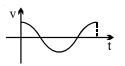
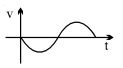
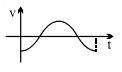
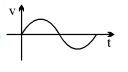
If position time graph of a particle is sine curve as shown, what will be its velocity-time graph.
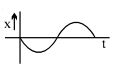
Answerc
Given curve has the equation
$\sin (t)$ Slope at $t=0$ is $- ve.$
Hence, options $(A),$ $(B)$ and $(D)$ are not possible.
View full question & answer→MCQ 461 Mark
It takes one minute for a passenger standing on an escalator to reach the top. If the escalator does not move it takes him $3$ minute to walk up . ....... $\sec$ long will it take for the passenger to arrive at the top if he walks up the moving escalator ?
Answerb
$V_{e s c l a \rightarrow r}=\frac{x}{1} \Rightarrow V_{e s c l a \rightarrow r x}, v_{m a n}=\frac{x}{3}$
$t=\frac{x}{v_{e s c l a \rightarrow r}+v_{\operatorname{man}}} \Rightarrow t=\frac{x}{x+\frac{x}{3}}$
$\Rightarrow t=\frac{3}{4} \min \Rightarrow t=45 \mathrm{sec}$
View full question & answer→MCQ 471 Mark
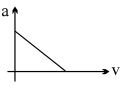
Acceleration versus velocity graph of a particle moving in a straight line starting from rest is as shown in figure. The corresponding velocity-time graph would be
Answerd
The given graph is of the form $y=m x$
So, here $a=m v$ [where $m$ is negative] $\Rightarrow \frac{d v}{d t}=m v$
$\Rightarrow \frac{d v}{v}=m d t$
$\Rightarrow v=e^{m t}$
as $m$ is negative. So, $v=e^{-k t}$
Required graph will be Option$'D’$
View full question & answer→MCQ 481 Mark
The velocity- time graph of a body falling from rest under gravity and rebounding from a solid surface is represented by which of the following graphs?
Answera
Initially velocity increases downwards (negative) and after rebound it becomes positive and then speed us decreasing due to acceleration of gravoty $(\downarrow)$
View full question & answer→MCQ 491 Mark
A man moves in $x-y$ plane along the path shown. At what point is his average velocity vector in the same direction as his instantaneous velocity vector. The man starts from point $P$.
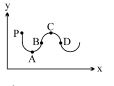
Answerc
The average velocity will be zero for the region below the line.
Now, The average velocity of the region from point $P$ till the line will be nullified by the vertical component of velocity of region $BCD.$
Thus, the average velocity will only be in the right direction. Thus, direction of average velocity will be same as instantaneous velocity of point $\mathrm{C}$.
View full question & answer→MCQ 501 Mark
The figure shows a velocity-time graph of a particle moving along a straight line Identify the region in which the rate of change of velocity $\left| {\frac{{\Delta \vec v}}{{\Delta t}}} \right|$ of the particle is maximum
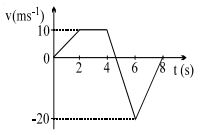
- A
$0$ to $2\,\,s$
- B
$2$ $4\,\,s$
- ✓
$4$ to $6 \,\,s$
- D
$6$ to $8\,\, s$
AnswerCorrect option: C. $4$ to $6 \,\,s$
c
$\left[\frac{\Delta \vec{v}}{\Delta t}\right]_{\max }=$ where slope is max.
Which is max. in region $4$ to $6 s$
View full question & answer→