MCQ 11 Mark
The mass of a planet is $\frac{1}{10}^{\text {th }}$ that of the earth and its diameter is half that of the earth. The acceleration due to gravity on that planet is:
- A
$9.8 \mathrm{~m} \mathrm{~s}^{-2}$
- B
$4.9 \mathrm{~m} \mathrm{~s}^{-2}$
- ✓
$3.92 \mathrm{~m} \mathrm{~s}^{-2}$
- D
$19.6 \mathrm{~m} \mathrm{~s}^{-2}$
AnswerCorrect option: C. $3.92 \mathrm{~m} \mathrm{~s}^{-2}$
c
$g^{\prime}=\frac{G M^{\prime}}{R^{\prime 2}}=\frac{G M}{10\left(\frac{R}{2}\right)^2}$
$=\frac{4}{10} \frac{G M}{R^2}=0.4 \times 9.8$
$=3.92 \mathrm{~m} \mathrm{~s}^{-2}$
View full question & answer→MCQ 21 Mark
The minimum energy required to launch a satellite of mass $m$ from the surface of earth of mass $M$ and radius $R$ in a circular orbit at an altitude of $2 R$ from the surface of the earth is:
- A
$\frac{2 G m M}{3 R}$
- B
$\frac{G m M}{2 R}$
- C
$\frac{G m M}{3 R}$
- ✓
$\frac{5 G m M}{6 R}$
AnswerCorrect option: D. $\frac{5 G m M}{6 R}$
d
Apply energy conservation,
$U_I+K_I=U_f+K_f$
$\Rightarrow \quad-\frac{G M m}{R}+K_I=-\frac{G M m}{3 R}+\frac{1}{2} m v^2$
$\Rightarrow \quad-\frac{G M m}{R}+K_I=-\frac{G M m}{3 R}+\frac{1}{2} \times m \times \frac{G M}{3 R}$
$\Rightarrow \quad K_I=-\frac{1}{6} \frac{G M m}{R}+\frac{G M m}{R}$
$K_I=\frac{5}{6} \frac{G M m}{R}$
View full question & answer→MCQ 31 Mark
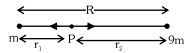
Two bodies of mass $m$ and $9 m$ are placed at a distance $R$. The gravitational potential on the line joining the bodies where the gravitational field equals zero, will be ( $G=$ gravitational constant) :
- A
$-\frac{20 G m}{R}$
- B
$-\frac{8 G m}{R}$
- C
$-\frac{12 G m}{R}$
- ✓
$-\frac{16 G m}{R}$
AnswerCorrect option: D. $-\frac{16 G m}{R}$
d
Position of Neutral point (Zero Gravitational Field)
$r_1=\frac{\sqrt{m_1} R}{\sqrt{m_1}+\sqrt{m_2}}=\frac{\sqrt{m} R}{\sqrt{m}+\sqrt{9 m}}=\frac{R}{4}$
$r_2=R-R / 4=3 R / 4$
Now Gravitational potential at point $P$
$V_p=-\frac{G M}{R / 4}-\frac{9(G M)}{3 R / 4}$
$=\frac{-16 G M}{R}$
View full question & answer→MCQ 41 Mark
A satellite is orbiting just above the surface of the earth with period $T$. If $d$ is the density of the earth and $G$ is the universal constant of gravitation, the quantity $\frac{3 \pi}{G d}$ represents :
- A
$\sqrt{T}$
- B
$T$
- ✓
$T^2$
- D
$T^3$
Answerc
$T=\frac{2 \pi}{\sqrt{G M}} r^{3 / 2} \Rightarrow T^2=\frac{4 \pi^2 R^3}{G\left(\frac{4}{3} \pi R^3 d\right)} \quad( r = R )$
$T ^2=\frac{3 \pi}{ Gd }$
View full question & answer→MCQ 51 Mark
In a gravitational field, the gravitational potential is given by, $V =-\frac{ K }{ x }( J / kg )$. The gravitational field intensity at point $(2,0,3)\,m$ is
- A
$+\frac{ K }{2}$
- B
$-\frac{ K }{2}$
- ✓
$-\frac{K}{4}$
- D
$+\frac{K}{4}$
AnswerCorrect option: C. $-\frac{K}{4}$
c
$V=-\frac{K}{x}$
$E_x =-\frac{d V}{d x}=K \frac{d\left(x^{-1}\right)}{d x}$
$=\frac{-K}{x^2}=\frac{-K}{2^2}=-\frac{K}{4}$
View full question & answer→MCQ 61 Mark
Match List$-I$ With List$-II$
| $(a)$ Gravitational constant $(G)$ |
$(i)$ $\left[ L ^{2} T ^{-2}\right]$ |
| $(b)$ Gravitational potential energy |
$(ii)$ $\left[ M ^{-1} L ^{3} T ^{-2}\right]$ |
| $(c)$ Gravitational potential |
$(iii)$ $\left[ LT ^{-2}\right]$ |
| $(d)$ Gravitational intensity |
$(iv)$ $\left[ ML ^{2} T ^{-2}\right]$ |
Choose the correct answer from the options given below:
- ✓
$(a) - (ii), (b) - (iv), (c) - (i), (d) - (iii)$
- B
$(a) - (ii), (b) - (iv), (c) -(iii), (d) - (i)$
- C
$(a) - (iv), (b) -(ii), (c) -(i), (d) -(iii)$
- D
$( a )-( ii ),( b )-( i ),( c )-( iv ),( d )-(iii)$
AnswerCorrect option: A. $(a) - (ii), (b) - (iv), (c) - (i), (d) - (iii)$
a
Gravitational constant $=\left[ M ^{-1} L ^{3} T ^{-2}\right]$
Gravitational potential energy $=\left[ ML ^{2} T ^{-2}\right]$
Gravitational potential $=\left[ L ^{2} T ^{-2}\right]$
Gravitational intensity $=\left[ LT ^{-2}\right]$
View full question & answer→MCQ 71 Mark
A body of mass $60 g$ experiences a gravitational force of $3.0 N$, when placed at a particular point. The magnitude of the gravitational field intensity at that point is ..... $N/ kg$
Answera
$I_{g}=\frac{F}{m}$
$=\frac{3}{60 \times 10^{-3}}=50\,N / kg$
View full question & answer→MCQ 81 Mark
The escape velocity from the Earth's surface is $v .$ The escape velocity from the surface of another planet having a radius, four times that of Earth and same mass density is :
Answerd
$v_{e}=\sqrt{\frac{2 G M}{R}}=\sqrt{\frac{2 G}{R} \times \frac{4}{3} \pi R^{3} \rho}$
$=\sqrt{\frac{8 \pi \mathrm{G} \rho}{3} R^{3}}$
$\Rightarrow v_{e} \propto R$
$\Rightarrow \frac{v_{e}}{v}=\frac{4 R}{R} \Rightarrow v_{e}=4\, v$
View full question & answer→MCQ 91 Mark
A particle of mass $'\mathrm{m}'$ is projected with a velocity $v=\mathrm{kV}_{\mathrm{e}}(\mathrm{k}\,<\,1)$ from the surface of the earth.
$\left(\mathrm{V}_{\mathrm{e}}=\right.\text { escape velocity) }$
The maximum height above the surface reached by the particle is :
- A
$\mathrm{R}\left(\frac{\mathrm{k}}{1-\mathrm{k}}\right)^{2}$
- B
$\mathrm{R}\left(\frac{\mathrm{k}}{1+\mathrm{k}}\right)^{2}$
- C
$\frac{\mathrm{R}^{2} \mathrm{k}}{1+\mathrm{k}}$
- ✓
$\frac{\mathrm{Rk}^{2}}{1-\mathrm{k}^{2}}$
AnswerCorrect option: D. $\frac{\mathrm{Rk}^{2}}{1-\mathrm{k}^{2}}$
d
$-\frac{G M m}{R}+\frac{1}{2} m k^{2} v_{e}^{2}=-\frac{G M m}{r}$
$-\frac{G M m}{R}+\frac{1}{2} m k^{2} \frac{2 G M}{R}=-\frac{G M m}{r}$
$-\frac{1}{R}+\frac{k^{2}}{R}=-\frac{1}{r}$
$\frac{1}{r}=\frac{1}{R}-\frac{k^{2}}{R}$
$\frac{1}{r}=\frac{1-k^{2}}{R}$
$r=\frac{R}{1-k^{2}}$
$R+h=\frac{R}{1-k^{2}}$
$h=\frac{R}{1-k^{2}}-R=\frac{k^{2}}{1-k^{2}} R$
View full question & answer→MCQ 101 Mark
What is the depth at which the value of acceleration due to gravity becomes $\frac{1}{n}$ times the value that at the surface of earth? (radius of earth $=R$ )
- A
$\frac{R}{n}$
- B
$\frac{R}{n^{2}}$
- ✓
$\frac{R(n-1)}{n}$
- D
$\frac{R n}{(n-1)}$
AnswerCorrect option: C. $\frac{R(n-1)}{n}$
c
Value of acceleration due to gravity at depth d,
$g^{\prime}=g\left(1-\frac{d}{R}\right)$
$\frac{g}{n}=g\left(1-\frac{d}{R}\right)$
$1-\frac{d}{R}=\frac{1}{n}$
$\frac{d}{R}=1-\frac{1}{n}=\left(\frac{n-1}{n}\right)$
$d =R\left(\frac{ n -1}{ n }\right)$
View full question & answer→MCQ 111 Mark
A body welghs $200 \;\mathrm{N}$ on the surface of the earth. ......$N$ will it weigh half way down to the centre of the earth?
- A
$150 $
- B
$200$
- C
$250$
- ✓
$100$
Answerd
$g^{\prime}=g\left(1-\frac{d}{R}\right)$
$\mathrm{g}^{\prime}=\mathrm{g}\left(1-\frac{\mathrm{R} / 2}{\mathrm{R}}\right)$
$\mathrm{mg}^{\prime}=\mathrm{mg}\left(\frac{1}{2}\right)$
$\mathrm{W'}=200\left(\frac{1}{2}\right)=100 \mathrm{N}$
View full question & answer→MCQ 121 Mark
A mass falls from a helght $h$ and its time of fall $t$ is recorded in terms of time period $T$ of a simple pendulum. On the surface of earth it is found that $t =2 T$. The entre setup is taken on the surface of another planet whose mass is half of that of earth and radius the same. Same experiment is repeated and corresponding times noted as $t'$ and $T'$.
- A
$\mathrm{t}^{\prime}=\sqrt{2} \mathrm{T}^{\prime}$
- B
$\mathrm{t}^{\prime} > 2 \mathrm{T}^{\prime}$
- C
$\mathrm{t}^{\prime} < 2 \mathrm{T}^{\prime}$
- ✓
$\mathrm{t}^{\prime}=2 \mathrm{T}^{\prime}$
AnswerCorrect option: D. $\mathrm{t}^{\prime}=2 \mathrm{T}^{\prime}$
d
Time of flight $=\sqrt{\frac{2 h}{g}} \propto \frac{1}{\sqrt{g}}$
Time perlod of pendulum $=2 \pi \sqrt{\frac{l}{g}} \propto \frac{1}{\sqrt{g}}$
Ratio of time of fillght and time period of pendulum is independent of $g$. Hence $t'=2 T'$
View full question & answer→MCQ 131 Mark
The work done to raise a mass $\mathrm{m}$ from the surface of the earth to a height $\mathrm{h}$, which is equal to the radius of the earth, is
AnswerCorrect option: C. $\frac{1}{2} \mathrm{mgR}$
c
$\mathrm{W}=\frac{\mathrm{mgh}}{1+\mathrm{h} / \mathrm{R}}$
at $\mathrm{h}=\mathrm{R}, \mathrm{W}=\frac{\mathrm{mgR}}{2}$
View full question & answer→MCQ 141 Mark
Assuming that the gravitational potential energy of an object at inflinity is zero, the change in potential energy (final-initial) of an object of mass $\mathrm{m}$, when to a height $h$ from the surface of earth (of radius $\mathrm{R}$ ), is given
- A
$-\frac{\mathrm{GMm}}{\mathrm{R}+\mathrm{h}}$
- ✓
$\frac{\mathrm{GMmh}}{\mathrm{R}(\mathrm{R}+\mathrm{h})}$
- C
$mgh$
- D
$\frac{\mathrm{GMm}}{\mathrm{R}+\mathrm{h}}$
AnswerCorrect option: B. $\frac{\mathrm{GMmh}}{\mathrm{R}(\mathrm{R}+\mathrm{h})}$
b
$\Delta \mathrm{U}=-\mathrm{GMm}\left[\frac{1}{\mathrm{r}_{\mathrm{f}}}-\frac{1}{\mathrm{r}_{\mathrm{i}}}\right]$$=-\mathrm{GMm}\left[\frac{1}{\mathrm{R}+\mathrm{h}}-\frac{1}{\mathrm{R}}\right]$$=\frac{\mathrm{GMmh}}{\mathrm{R}(\mathrm{R}+\mathrm{h})}$
View full question & answer→MCQ 151 Mark
The time period of a geostationary satellite is $24\; \mathrm{h}$, at a helght $6 \mathrm{R}_{\mathrm{E}}( \mathrm{R}_{\mathrm{E}}$ is radius of earth) from surface of earth. The time period of another satellite whose helght is $2.5 \mathrm{R}_{\mathrm{E}}$ from surface will be
AnswerCorrect option: A. $6 \sqrt{2} \mathrm{h}$
a
Kepler's Third Law :
$T\propto r^{3 / 2}$
$\frac{\mathrm{T}_{2}}{\mathrm{T}_{1}}=\left(\frac{\mathrm{r}_{2}}{\mathrm{r}_{1}}\right)^{3 / 2}=\left(\frac{\mathrm{R}+2.5 \mathrm{R}}{\mathrm{R}+6 \mathrm{R}}\right)^{3 / 2}=\frac{1}{2 \sqrt{2}} $
$\Rightarrow \mathrm{T}_{2}=\frac{24}{2 \sqrt{2}}=6 \sqrt{2} \mathrm{hours}$
View full question & answer→MCQ 161 Mark
If the mass of the Sun were ten times smaller and the universal gravitational constant were ten times larger in magnitude, which of the following is not correct?
AnswerCorrect option: C. $‘g’ $ on the Earth will not change.
c
If universal Gravitational constant becomes ten times, then $G' = 10\ G.$
So, acceleration due to gravity increases.
View full question & answer→MCQ 171 Mark
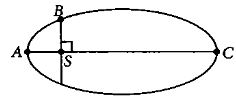
The kinetic energies of a planet in an elliptical orbit about the Sun, at positions $A, B$ and $C$ are $K_A, K_B$ and $K_C$, respectively. $AC$ is the major axis and $SB$ is perpendicular to $AC$ at the position of the Sun $S$ as shown in the figure. Then
- A
$K_A < K_B < K_C$
- ✓
$K_A>K_B>K_C$
- C
$K_B>K_A>K_C$
- D
$K_B < K_A < K_C$
AnswerCorrect option: B. $K_A>K_B>K_C$
b
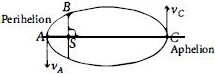
point $A$ is perihelion and $C$ is aphelion.
So, ${v_A} > {v_B} > {v_C}$
As kinetic energy $k = 1/2\,m{v^2}\,or\,k\, \propto {v^2}$
$So,\,{K_A} > {K_B} > {K_C}$
View full question & answer→MCQ 181 Mark
Imagine earth to be a solid sphece of mass $M$ and radius $R$. If the value of acceleration due to gravity at a depth d below earth's surface is same as its value at a height $h$ above its surface and equal to $\frac{g}{4}$ (where $g$ is the value of acceleration due to gravity on the surface of earth), the ratio of $\frac{h}{d}$ will be
- ✓
$\frac{4}{3}$
- B
$\;\frac{3}{2}$
- C
$\;\frac{2}{3}$
- D
$1$
AnswerCorrect option: A. $\frac{4}{3}$
a
$\Rightarrow g(h)=\frac{g}{\left(1+\frac{h}{R}\right)^2}$
$\therefore \frac{g}{4}=\frac{g}{\left(1+\frac{h}{R}\right)^2}$
$\therefore 4=\left(1+\frac{h}{R}\right)^2$
$\therefore 2=1+\frac{h}{R}$
$\therefore \frac{h}{R}=1 \quad \ldots(1)$
$\Rightarrow g(d)=g\left(1-\frac{d}{R}\right)^2$
$\therefore \frac{g}{4}=g\left(1-\frac{d}{R}\right)^2$
$\therefore \frac{1}{4}=1-\frac{d}{R}$
$\therefore \frac{d}{R}=1-\frac{1}{4}$
$\therefore \frac{d}{R}=\frac{3}{4} \quad \ldots(2)$
$\therefore$ Taking ratio of equ.$(1)$ and $(2)$
$\frac{h}{d}=\frac{4}{3}$
View full question & answer→MCQ 191 Mark
The acceleration due to gravity at a height $1\, km$ above the earth is the same as at a depth $d$ below the surface of earth. Then $d\,=$ ......... $km$
- A
$\frac{4}{3}$
- B
$\;\frac{3}{2}$
- C
$\;\frac{2}{3}$
- ✓
$2$
Answerd
The acceleration due to gravity at a height $h$ is given as
${g_h} = g\left( {1 - \frac{{2h}}{{{R_e}}}} \right)$
Where $R_e$ is radius of earth.
The acceleration due to gravity at a depth $d$ is given as
${g_d} = g\left( {1 - \frac{d}{{{R_e}}}} \right)$
Given, ${g_h} = {g_d}$
$g\left( {1 - \frac{{2h}}{{{R_e}}}} \right) = g\left( {1 - \frac{d}{{{R_e}}}} \right)$
$d = 2h = 2 \times 1 = 2km\left( {h = 1\,km} \right)$
View full question & answer→MCQ 201 Mark
A satellite of mass $m$ is in circular orbit of radius $3 R_E$ about earth (mass of earth $M_{E}$, radius of earth $R_{E}$). How much additional energy is required to transfer the satellite to an orbit of radius $9 R_{E}$?
- A
$\frac{{G{M_E}m}}{{18{R_E}}}$
- B
$\;\frac{{3G{M_E}m}}{{2{R_E}}}$
- ✓
$\;\frac{{G{M_E}m}}{{9{R_E}}}$
- D
$\;\frac{{G{M_E}m}}{{3{R_E}}}$
AnswerCorrect option: C. $\;\frac{{G{M_E}m}}{{9{R_E}}}$
c
Initial total energy of the satellite is
$E_{i}-\frac{G M_{E} m}{6 R_{E}}$
Final total energy of the satellite is
$E_{f}=-\frac{G M_{E} m}{18 R_{E}}$
The change in the total energy is
$\Delta E=E_{f}-E_{i}$
$\Delta E=-\frac{G M_{E} m}{18 R_{E}}-\left(-\frac{G M_{E} m}{6 R_{E}}\right)$
$=-\frac{G M_{E} m}{18 R_{E}}+\frac{G M_{E} m}{6 R_{E}}=\frac{G M_{E} m}{9 R_{E}}$
Thus, the energy required to transfer the satellite to the desired orbit $=\frac{G M_{E} m}{9 R_{E}}$
View full question & answer→MCQ 211 Mark
Two astronauts are floating in gravitational free space after having lost contact with their spaceship. The two will
- A
move away from each other.
- B
- C
keep floating at the same distance between them.
- ✓
Answerd
Since two astronauts are floating in gravitational free space. The only force acting on the two astronauts is the gravitational pull of their masses,$F = \frac{{G{m_1}{m_2}}}{{{r^2}}},$
which is attractive in nature.
Hence they move towards each other.
View full question & answer→MCQ 221 Mark
At ..... $km$ height from the surface of earth the gravitation potential and the value of $g$ are $-5.4 \times 10^7\, J kg^{-1}$ and $6.0\,m s^{-2}$ respectively . Take the radius of earth as $6400\, km$.
- A
$1600$
- B
$1400$
- C
$2000$
- ✓
$2600$
AnswerCorrect option: D. $2600$
d
Gravitation potential at a height $h$ from the surface of earth, ${V_h} = - 5.4 \times {10^7}\,J\,k{g^{ - 1}}$
At the same point acceleration due to gravity,
${g_h}$ $= 6\,ms^{-2}$
$R=6400\, km=6.4\times10^6\,m$
We know, ${V_h} = - \frac{{GM}}{{\left( {R + h} \right)}}$
${g_h} = \frac{{GM}}{{{{\left( {R + h} \right)}^2}}} = - \frac{{{V_h}}}{{R + h}} \Rightarrow R + h = - \frac{{{V_h}}}{{{g_h}}}$
$\therefore \,\,h = - \frac{{{V_h}}}{{{g_h}}} - R = \frac{{\left( { - 5.4 \times {{10}^7}} \right)}}{6} - 6.4 \times {10^6}$
$ = 9 \times {10^6} - 6.4 \times {10^6} = 2600\,Km$
View full question & answer→MCQ 231 Mark
The ratio of escape velocity at earth $(v_e)$ to the escape velocity at a planet $(v_p)$ whose radius and mean density are twice as that of earth is
- ✓
$1:2$$\sqrt 2 $
- B
$1:4$
- C
$1:$$\sqrt 2 $
- D
$1:2$
AnswerCorrect option: A. $1:2$$\sqrt 2 $
a
As escape velocity, $v = \sqrt {\frac{{2GM}}{R}} $
$ = \sqrt {\frac{{2G}}{R}\frac{{4\pi {R^3}}}{3}\rho } = - R\sqrt {\frac{{8\pi G}}{3}\rho } $
$\therefore \frac{{{v_e}}}{{{v_p}}} = \frac{{{R_e}}}{{{R_p}}} \times \sqrt {\frac{{{\rho _e}}}{{{\rho _p}}}} = \frac{1}{2} \times \sqrt {\frac{1}{2}} = \frac{1}{{\underline {2\sqrt 2 } }}$
$\left( {{R_p} = 2{R_e}and\,{\rho _p} = 2{\rho _e}} \right)$
View full question & answer→MCQ 241 Mark
A satellite of mass $m$ is orbiting the earth $($of radius $R)$ at a height $h$ from its surface. The total energy of the satellite in terms of $g_0$, the value of acceleration due to gravity at the earth's surface, is
- A
$\frac{{2m{g_0}{R^2}}}{{R + h}}$
- B
$-$$\;\frac{{2m{g_0}{R^2}}}{{R + h}}$
- C
$\;\frac{{{mg_0}{R^2}}}{{2\left( {R + h} \right)}}$
- ✓
$-$$\;\frac{{{mg_0}{R^2}}}{{2\left( {R + h} \right)}}$
AnswerCorrect option: D. $-$$\;\frac{{{mg_0}{R^2}}}{{2\left( {R + h} \right)}}$
d
Total energy of satellite at height $h$ from the earth surface,
$E=PE+KE$
$ = - \frac{{GMm}}{{\left( {R + h} \right)}} + \frac{1}{2}m{v^2}\,\,\,\,\,\,\,\,\,\,\,\,\,\,\,\,...\left( i \right)$
Also, $\frac{{m{v^2}}}{{\left( {R + h} \right)}} = \frac{{GMm}}{{\left( {R + {h^2}} \right)}}$
or, ${v^2} = \frac{{GM}}{{R + h}}\,\,\,\,\,\,\,\,\,\,\,\,\,\,\,\,\,\,\,\,\,\,\,\,\,\,\,\,\,\,...\left( {ii} \right)$
From eqns, $(i)$ and $(ii)$,
$E = - \frac{{GMm}}{{\left( {R + h} \right)}} + \frac{1}{2}\frac{{GMm}}{{\left( {R + h} \right)}} = - \frac{1}{2}\frac{{GMm}}{{\left( {R + h} \right)}}$
$ = - \frac{1}{2}\frac{{GM}}{{{R^2}}} \times \frac{{m{R^2}}}{{\left( {R + h} \right)}}$
$ = - \frac{{m{g_0}{R^2}}}{{2\left( {R + h} \right)}}\,\,\,\,\,\,\,\,\,\,\,\,\left( {{g_0} = \frac{{GM}}{{{R^2}}}} \right)$
View full question & answer→MCQ 251 Mark
Mass $M$ is divided into two parts $xM$ and $(1 - x)\,M$. For a given separation, the value of $x$ for which the gravitational attraction between the two pieces becomes maximum is
- ✓
$0.5$
- B
$\frac{3}{5}$
- C
$1$
- D
$2$
Answera
(a) $F \propto xm \times (1 - x)m = x{m^2}(1 - x)$
For maximum force $\frac{{dF}}{{dx}} = 0$
$⇒$ $\frac{{dF}}{{dx}} = {m^2} - 2x{m^2} = 0\, \Rightarrow x = 1/2$
View full question & answer→MCQ 261 Mark
Two identical solid copper spheres of radius $R$ placed in contact with each other. The gravitational attracton between them is proportional to
- A
$R^2$
- B
$R^{-2}$
- ✓
$R^4$
- D
$R^{-4}$
Answerc
(c) $F = \frac{{G \times m \times m}}{{{{(2R)}^2}}}$=$\frac{{G \times {{\left( {\frac{4}{3}\pi {R^3}\rho } \right)}^2}}}{{4{R^2}}}$$ = \frac{4}{9}{\pi ^2}{\rho ^2}{R^4}$
$F \propto {R^4}$
View full question & answer→MCQ 271 Mark
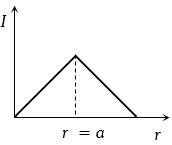
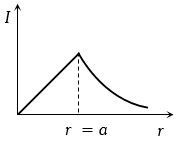
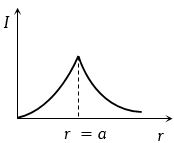
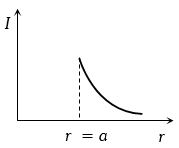
Which one of the following graphs represents correctly the variation of the gravitational field $(F) $ with the distance $(r)$ from the centre of a spherical shell of mass $M$ and radius $a$
Answerd
(d) Intensity will be zero inside the spherical shell.
$I = 0$ upto $r = a$ and $I \propto \frac{1}{{{r^2}}}$ when $r > a$
View full question & answer→MCQ 281 Mark
A man of mass $m$ starts falling towards a planet of mass $M$ and radius $R.$ As he reaches near to the surface, he realizes that he will pass through a small hole in the planet. As he enters the hole, he sees that the planet is really made of two pieces a spherical shell of negligible thickness of mass $\frac{2M}{3}$ and a point mass $\frac{M}{3}$ at the centre. Change in the force of gravity experienced by the man is
- ✓
$\frac{2}{3}\,\frac{{GMm}}{{{R^2}}}$
- B
$0$
- C
$\frac{1}{3}\,\frac{{GMm}}{{{R^2}}}$
- D
$\frac{4}{3}\,\frac{{GMm}}{{{R^2}}}$
AnswerCorrect option: A. $\frac{2}{3}\,\frac{{GMm}}{{{R^2}}}$
a
Gravitational field inside the shell is zero, but the force on the man due to the point mass at the centre is
$F_{\text {new }}=\frac{G M m}{3 R^{2}}, F_{\text {old }}=\frac{G M m}{R^{2}}$
Change in force $=\frac{2 G M m}{3 R^{2}}$ Itbr.
View full question & answer→MCQ 291 Mark
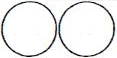
Gravitational force between two identical uniform solid gold spheres of radius r reach in contact is proportional to
- ✓
$r^4$
- B
$r^2$
- C
$\frac{1}{{{r^2}}}$
- D
$\frac{1}{{{r^3}}}$
Answera
$\mathrm{F}=\mathrm{Gm}^{2}$
$(2 \mathrm{r})^{2}$
$\mathrm{m}=\rho \times \frac{4}{3} \pi \mathrm{r}^{3}$
$\mathrm{F}=\mathrm{G} \rho^{2} \times \frac{16 \pi^{2}}{9} \times \frac{\mathrm{r}^{6}}{4 \mathrm{r}^{2}} \propto \mathrm{r}^{4}$
View full question & answer→MCQ 301 Mark
Two small, equal masses are attached by a light weight rod. This object orbits a planet ; the length of the rod is smaller than the radius of the orbit, but not negligible. The rod rotates about its axis in such a way that it remains vertical with respect to the planet. (Assume in each case perturbation maintains the rate of rotation, so that in the co-rotating frame the rod is still stationary but at an angle to the vertical.)
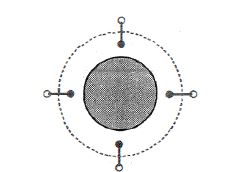
- A
There is no force in the rod; the equilibrium is neutral with respect to a small perturbation in the angle of the rod
- ✓
The rod is in tension; the equilibrium is stable with respect to a small perturbation in the angle of the rod
- C
The rod is in compression; the equilibrium is stable with respect, to a small perturbation in the angle of the rod
- D
The rod is in tension; the equilibrium is unstable with respect to a small perturbation in the angle of the rod
AnswerCorrect option: B. The rod is in tension; the equilibrium is stable with respect to a small perturbation in the angle of the rod
View full question & answer→MCQ 311 Mark
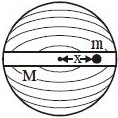
A tunnel is dug along the diameter of earth of mass $'M'$ and then a mass $'m'$ is released a distance $'X'$ from centre so that the time period of oscillation is $T$ . If mass $'4m'$ is released from same point then time period of oscillation will be
- A
$\frac{T}{{\sqrt 2 }}$
- B
$\frac {T}{2}$
- C
$T\sqrt 2 $
- ✓
$T$
Answerd
Time period is independent of mass in this case
$\because \quad \mathrm{T}=2 \pi \sqrt{\frac{\mathrm{R}^{3}}{\mathrm{GM}}}$
View full question & answer→MCQ 321 Mark
If the mass of the planet is $10\%$ less than that of the earth and radius is $20\%$ greater than that of earth, the acceleration due to gravity on the planet will be
- ✓
$\frac {5}{8}$ times that on the surface of earth
- B
$\frac {3}{4}$ times that on the surface of earth
- C
$\frac {1}{2}$ times that on the surface of earth
- D
$\frac {9}{10}$times that on the surface of earth
AnswerCorrect option: A. $\frac {5}{8}$ times that on the surface of earth
a
$\mathrm{g}^{\prime}=\frac{\mathrm{G}\left(\frac{9}{10} \mathrm{M}\right)}{\left(\frac{12}{10} \mathrm{R}\right)^{2}}$
$=\frac{5}{8} \frac{\mathrm{GM}}{\mathrm{R}^{2}}$
$=\frac{5}{8} g$
View full question & answer→MCQ 331 Mark
If the acceleration due to gravity at earth is $'g'$ and mass of earth is $80\,times$ that of moon and radius of earth is $4\,times$ that of moon, the value of acceleration due to gravity at the surface of moon will be
Answerc
$\mathrm{G}_{\mathrm{moon}}=\frac{\mathrm{GMm}}{\mathrm{R}_{\mathrm{M}}^{2}}=\frac{\mathrm{G}(\mathrm{Me} / 80)}{(\mathrm{Re} / 4)^{2}}$
$=\frac{1}{5} \frac{\mathrm{GMe}}{\mathrm{Re}^{2}}=\frac{\mathrm{g}}{5}$
View full question & answer→MCQ 341 Mark
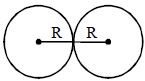
Two masses (spheres) as in fig are placed. If mass density of each sphere is $'\rho '$. Find force between than
- A
$\frac{4}{9}{\pi ^2}G\rho {R^3}$
- ✓
$\frac{4}{9}{\pi ^2}{\rho ^2}{R^4}G$
- C
$\frac{4}{9}{\pi ^2}{\rho ^2}{R^2}G$
- D
${\pi ^2}{\rho ^2}{R^2}G$
AnswerCorrect option: B. $\frac{4}{9}{\pi ^2}{\rho ^2}{R^4}G$
b
$F=\frac{\left(\frac{4}{3} \pi R^{3} \rho\right)\left(\frac{4}{3} \pi R^{3} \rho\right) G}{4 R^{2}}$
$\Rightarrow \mathrm{F}=\frac{4}{3} \pi^{2} \rho^{2} \mathrm{R}^{4} \mathrm{G}$
View full question & answer→MCQ 351 Mark
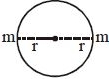
Two particles of equal mass $m$ each move in a circle of radius $r$ under the action of their mutual gravitational attraction. Time period of each particle is
- A
$\frac{{2\pi {r^{3/2}}}}{{\sqrt {Gm} }}$
- ✓
$\frac{{4\pi {r^{3/2}}}}{{\sqrt {Gm} }}$
- C
$\frac{{4{\pi ^2}{r^{3/2}}}}{{\sqrt {Gm} }}$
- D
AnswerCorrect option: B. $\frac{{4\pi {r^{3/2}}}}{{\sqrt {Gm} }}$
b
$\frac{\mathrm{mv}^{2}}{\mathrm{r}}=\frac{\mathrm{Gmm}}{(2 \mathrm{r})^{2}} \quad \mathrm{v}=\frac{1}{2} \sqrt{\frac{\mathrm{Gm}}{\mathrm{r}}}$
$\mathrm{T}=\frac{2 \pi \mathrm{r}}{\mathrm{v}} \quad \Rightarrow \frac{4 \pi^{r^{3 / 2}}}{\sqrt{\mathrm{Gm}}}$
View full question & answer→MCQ 361 Mark
Two particles of equal mass $(m)$ each move in a circle of radius $(r)$ under the action of their mutual gravitational attraction. Find the speed of each particle

- A
$\frac{{Gm}}{{2r}}$
- B
$\frac{{{G^2}{m^2}}}{{{r^2}}}$
- C
$\sqrt {\frac{{Gm}}{r}} $
- ✓
$\frac{1}{2}\,\sqrt {\frac{{Gm}}{r}} $
AnswerCorrect option: D. $\frac{1}{2}\,\sqrt {\frac{{Gm}}{r}} $
d
$\frac{m v^{2}}{r}=\frac{G m m}{(2 r)^{2}} \quad v^{2}=\frac{G m}{4 r}$
$\mathrm{v}=\frac{1}{2} \sqrt{\frac{\mathrm{Gm}}{\mathrm{r}}}$
View full question & answer→MCQ 371 Mark
If radius of earth contracted by $0.1 \%$, its mass remaining same, then weight of the body at earth's surface will increase by ..............$\%$
- A
$0.1 \%$
- ✓
$0.2 \%$
- C
$0.3 \%$
- D
AnswerCorrect option: B. $0.2 \%$
b
(b)
If radius is decreased by $0.1 \%$
$r ^{\prime}= r -0.001 r =0.999\, r$
$W ^{\prime}=\frac{ GMm }{(0.999\, r )^2}=\frac{ GMm }{(0.999)^2\, r ^2}$
$=\frac{ W }{0.999^2}$
$=1.002\, W$
$\Delta W = W ^{\prime}- W =0.002$
$0.002 \times 100=0.2\, \% \text { increase. }$
View full question & answer→MCQ 381 Mark
Two point objects of mass $2 x$ and $3 x$ are separated by a distance $r$. Keeping the distance fixed, how much mass should be transferred from $3 x$ to $2 x$, so that gravitational force between them becomes maximum?
- A
$\frac{x}{4}$
- B
$\frac{x}{3}$
- ✓
$\frac{x}{2}$
- D
$\frac{2 x}{3}$
AnswerCorrect option: C. $\frac{x}{2}$
c
(c)
Let $y$ amount of mass should be transferred. Then:
$F^{\prime}=\frac{G(M-y)(m+y)}{r^2}$
$=\frac{G(3 x-y)(2 x+y)}{r^2}$
$\text { For this to be maximum, } \frac{d F^{\prime}}{d y}=0$
$\frac{d F^{\prime}}{d y}=\frac{d\left[6 x^2+3 x y-2 x y-y^2\right]}{d y}$
$=3 x-2 x-2 y=0$
$x-2 y=0$
$y=\frac{x}{2}$
View full question & answer→MCQ 391 Mark
Two point masses $m$ and $4 m$ are separated by a distance $d$ on a line. A third point mass $m_0$ is to be placed at a point on the line such that the net gravitational force on it is zero. The distance of that point from the $m$ mass is ..............

- A
$\frac{d}{2}$
- B
$\frac{d}{4}$
- ✓
$\frac{d}{3}$
- D
$\frac{d}{5}$
AnswerCorrect option: C. $\frac{d}{3}$
c
(c)
Force of gravitation on $m_0$ due to $m=\frac{G m m_0}{r^2}=F_1$
Force of gravitation on $m_0$ due to $4 m=\frac{G 4 m m_0}{(d-r)^2}=F_2$
Net force $=0$
$\Rightarrow F_1=F_2$
$\frac{G m m_0}{r^2}=\frac{4 G m m_0}{(d-r)^2}$
$\Rightarrow (d-r)^2=(2 r)^2$
$\Rightarrow d-r=2 r$
$\Rightarrow d=3 r$
Thus, $r=\frac{d}{3}$
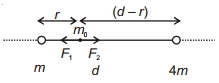
View full question & answer→MCQ 401 Mark
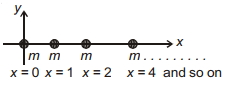
A large number of identical point masses $m$ are placed along $x$-axis, at $x=0,1,2,4$, The magnitude of gravitational force on mass at origin $(x=0)$, will be ............
- A
$G m^2$
- ✓
$\frac{4}{3} G m^2$
- C
$\frac{2}{3} G m^2$
- D
$\frac{5}{4} G m^2$
AnswerCorrect option: B. $\frac{4}{3} G m^2$
b
(b)
Let, $F_1, F_2, F_4, F_8 \ldots \ldots$ be the forces of gravitation due masses ' $m$ ' at $x=1,2,4,8 \ldots$ respectively.
$\Rightarrow F_1=\frac{G m^2}{1^2}$
$F_2=\frac{G m^2}{2^2}$
$F_4=\frac{G m^2}{4^2}$
$F_8 =\frac{G m^2}{8^2}$
$F_1+F_2+F_4+F_8 \ldots=G m^2\left(\frac{1}{1}+\frac{1}{4}+\frac{1}{16}+\frac{1}{64} \ldots\right)$
infinite $G.P$. with common ratio $=\frac{1}{4}$
For an infinite $G.P$, sum $=\left(\frac{a}{1-r}\right)$
$a$ is the first term
$r$ is the common ratio
$\Rightarrow \text { Sum }=\frac{1}{1-\frac{1}{4}}=\left(\frac{4}{3}\right)$
$\Rightarrow F_1+F_2+F_4+F_8 \ldots \ldots=\frac{4}{3} G m^2$
View full question & answer→MCQ 411 Mark
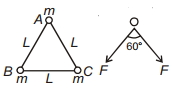
Three particles $A, B$ and $C$ each of mass $m$ are lying at the corners of an equilateral triangle of side $L$. If the particle $A$ is released keeping the particles $B$ and $C$ fixed, the magnitude of instantaneous acceleration of $A$ is ........

- A
$\sqrt{3} \frac{G m^2}{L^2}$
- B
$\sqrt{2} \frac{G m^2}{L^2}$
- C
$\sqrt{2} \frac{G m}{L^2}$
- ✓
$\sqrt{3} \frac{G m}{L^2}$
AnswerCorrect option: D. $\sqrt{3} \frac{G m}{L^2}$
d
(d)
At this moment,
Forces acting on particle at $A$ can be shown,
where, $F=\frac{G m^2}{L^2}$
$\Rightarrow$ Net force will be resultant of both,
$F_{\text {resultant }}=\sqrt{F^2+F^2+2 F^2 \cos 60^{\circ}}=\sqrt{3} F$
$\Rightarrow F_{\text {resultant }}=\frac{\sqrt{3} G m^2}{L^2}$
$a=\frac{F}{m}=\frac{\sqrt{3} G m}{L^2}$
View full question & answer→MCQ 421 Mark
A man of mass $m$ starts falling towards a planet of mass $M$ and radius $R$. As he reaches near to the surface, he realizes that he will pass through a small hole in the planet. As he enters the hole, he sees that the planet is really made of two pieces a spherical shell of negligible thickness of mass $2 M / 3$ and a point mass $M / 3$ at the centre. Change in the force of gravity experienced by the man is
- ✓
$\frac{2}{3} \frac{ GMm }{ R ^2}$
- B
$0$
- C
$\frac{1}{3} \frac{ GMm }{ R ^2}$
- D
$\frac{4}{3} \frac{ GMm }{ R ^2}$
AnswerCorrect option: A. $\frac{2}{3} \frac{ GMm }{ R ^2}$
a
(a)
Change in force of gravity
$=\frac{ GMm }{ R ^2}-\frac{ G \frac{ M }{3} m }{ R ^2}$
(only due to mass $M / 3$ due to shell gravitational field is zero (inside the shell))
$=\frac{2 GMm }{3 R ^2}$
View full question & answer→MCQ 431 Mark
A body weighs $700 \,gm$ wt on the surface of the earth. How much will it weigh on the surface of a planet whose mass is $\frac{1}{7}$ and radius is half that of the earth ........ $gm\, wt$
Answerb
(b) We know that $g = \frac{{GM}}{{{R^2}}}$
On the planet ${g_p} = \frac{{GM/7}}{{{R^2}/4}} = \frac{{4g}}{7} = \frac{4}{7}g$
Hence weight on the planet $ = 700 \times \frac{4}{7} = 400\,\,gm\,wt$
View full question & answer→MCQ 441 Mark
The mass and diameter of a planet have twice the value of the corresponding parameters of earth. Acceleration due to gravity on the surface of the planet is ........ $m/{\sec ^2}$.
- A
$9.8$
- ✓
$4.9$
- C
$980$
- D
$19.6$
Answerb
(b) $\frac{{g'}}{g} = \frac{{M'}}{M}{\left( {\frac{R}{{R'}}} \right)^2} = \left( {\frac{{2M}}{M}} \right)\;{\left( {\frac{R}{{2R}}} \right)^2} = \frac{1}{2}$
$⇒$ $g' = \frac{g}{2} = \frac{{9.8}}{2} = 4.9\;m/{s^2}$
View full question & answer→MCQ 451 Mark
The radius of the earth is $6400\, km$ and $g = 10\,m/{\sec ^2}$. In order that a body of $5 \,kg$ weighs zero at the equator, the angular speed of the earth is
- A
$1/80\, radian/sec$
- B
$1/400 \,radian/sec$
- ✓
$1/800\, radian/sec$
- D
$1/1600\, radian/sec$
AnswerCorrect option: C. $1/800\, radian/sec$
c
(c) For the condition of weightlessness at equator $\omega = \sqrt {\frac{g}{R}} $
$\omega = \sqrt {\frac{1}{{640 \times {{10}^3}}}} = \frac{1}{{800}} \,rad/s$
View full question & answer→MCQ 461 Mark
If $R$ is the radius of the earth and $g$ the acceleration due to gravity on the earth's surface, the mean density of the earth is
- A
$4\pi G/3gR$
- B
$3\pi R/4gG$
- ✓
$3g/4\pi RG$
- D
$\pi RG/12G$
AnswerCorrect option: C. $3g/4\pi RG$
c
(c) $g = \frac{{GM}}{{{R^2}}}$ and $M = \frac{4}{3}\pi {R^3} \times D $
$\therefore \,\,g = \frac{4}{3}\frac{{\pi {R^3} \times GD}}{{{R^2}}}\, \Rightarrow \,D = \frac{{3g.}}{{4\pi RG}}$
View full question & answer→MCQ 471 Mark
The mass of the earth is $81$ times that of the moon and the radius of the earth is $3.5$ times that of the moon. The ratio of the acceleration due to gravity at the surface of the moon to that at the surface of the earth is
AnswerCorrect option: A. $0.15$
a
(a) $g = \frac{{GM}}{{{R^2}}}$ (Given ${M_e} = 81{M_m},\,\,\,{R_e} = 3.5{R_m})$
Substituting the above values, $\frac{{{g_m}}}{{{g_e}}} = 0.15$
View full question & answer→MCQ 481 Mark
The value of g on the earth's surface is $980\,cm/{\sec ^2}$. Its value at a height of $64 \,km$ from the earth's surface is ........ $cm/{\sec ^2}$
(Radius of the earth $R = 6400$ kilometers)
- ✓
$960.40$
- B
$984.90$
- C
$982.45$
- D
$977.55$
AnswerCorrect option: A. $960.40$
a
(a)$\frac{{g'}}{g} = {\left( {\frac{R}{{R + h}}} \right)^2} = {\left( {\frac{{6400}}{{6400 + 64}}} \right)^2}$$ \Rightarrow $$g' = 960.40\;cm/{s^2}$
View full question & answer→MCQ 491 Mark
The moon's radius is $1/4$ that of the earth and its mass is $1/80$ times that of the earth. If $g$ represents the acceleration due to gravity on the surface of the earth, that on the surface of the moon is
Answerb
(b)Using $g = \frac{{GM}}{{{R^2}}}$ we get ${g_m} = g/5$
View full question & answer→MCQ 501 Mark
$R$ is the radius of the earth and $\omega $ is its angular velocity and ${g_p}$ is the value of $g$ at the poles. The effective value of $g$ at the latitude $\lambda = 60^\circ $ will be equal to
- ✓
${g_p} - \frac{1}{4}R{\omega ^2}$
- B
${g_p} - \frac{3}{4}R{\omega ^2}$
- C
${g_p} - R{\omega ^2}$
- D
${g_p} + \frac{1}{4}R{\omega ^2}$
AnswerCorrect option: A. ${g_p} - \frac{1}{4}R{\omega ^2}$
a
(a) $g = {g_p} - R{\omega ^2}{\cos ^2}\lambda $ = ${g_p} - {\omega ^2}R{\cos ^2}60^\circ $ = ${g_p} - \frac{1}{4}R{\omega ^2}$
View full question & answer→