MCQ 11 Mark
The venturi-meter works on :
- A
The principle of perpendicular axes
- B
- ✓
- D
The principle of parallel axes
Answerc
Venturimeter works an Bernoulli's principle
View full question & answer→MCQ 21 Mark
Two copper vessels $A$ and $B$ have the same base area but of different shapes. $A$ takes twice the volume of water as that $B$ requires to fill upto a particular common height. Then the correct statement among the following is
- ✓
Pressure on the base area of vessels $A$ and $B$ is same.
- B
Pressure on the base area of vessels $A$ and $B$ is not same.
- C
Both vessels $A$ and $B$ weigh the same.
- D
Vessel $B$ weighs twice that of $A$.
AnswerCorrect option: A. Pressure on the base area of vessels $A$ and $B$ is same.
a
Pressure depends on height above base only which is same for two vessels.
View full question & answer→MCQ 31 Mark
A spherical ball is dropped in a long column of a highly viscous liquid. The curve in the graph shown, which represents the speed of the ball $(v)$ as a function of time $(t)$ is
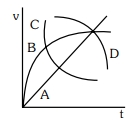
Answera
Initially speed is zero, then increases \& after some time it becomes constant.
Acceleration (slope of $v / t$ curve) of ball first decreases and after some time it becomes zero.
View full question & answer→MCQ 41 Mark
The terminal velocity of a copper ball of radius $5\,mm$ falling through a tank of oil at room temperature is $10\,cm\,s ^{-1}$. If the viscosity of oil at room temperature is $0.9\,kg\,m ^{-1} s ^{-1}$, the viscous drag force is :
- ✓
$8.48 \times 10^{-3}\,N$
- B
$8.48 \times 10^{-5}\,N$
- C
$4.23 \times 10^{-3}\,N$
- D
$4.23 \times 10^{-6}\,N$
AnswerCorrect option: A. $8.48 \times 10^{-3}\,N$
a
$F\,=6 \pi \eta rv$
$\quad =6 \times 3.14 \times 0.9 \times 5 \times 10^{-3} \times 10 \times 10^{-2}$
$\quad=847.8 \times 10^{-5}\,N$
$\quad=8.48 \times 10^{-3}\,N$
View full question & answer→MCQ 51 Mark
The velocity of a small ball of mass $\mathrm{M}$ and density $d,$ when dropped in a container filled with glycerine becomes constant after some time. If the density of glycerine is $\frac{\mathrm{d}}{2}$, then the viscous force acting on the ball will be :
AnswerCorrect option: A. $\frac{\mathrm{Mg}}{2}$
a
$w=M g=v d y$
$F_{B}=M^{\prime} g=v \frac{d}{2} y=\frac{M g}{2}$
$F_{v}+F_{B}=F_{g}$
$F_{v}=m g-\frac{m g}{2}=\frac{m g}{2}$
View full question & answer→MCQ 61 Mark
A barometer is constructed using a liquid (density $\left.=760 \;kg / m ^{3}\right) .$ What would be the height (In $m$) of the liquid column, when a mercury barometer reads $76 \;cm ?$ (density of mercury $\left.=13600 \;kg / m ^{3}\right)$
- A
$0.76$
- B
$1.36$
- ✓
$13.6$
- D
$136$
AnswerCorrect option: C. $13.6$
c
Pressure, $P=h d g$
Reading of mercury barometer, $h=76 cm$
Reading of liquid barometer $= h ^{\prime}$
$h ^{\prime} d _{i} g = h d _{ hg } g$
$h ^{\prime}=\frac{76 \times 13600}{760}=1360 cm$
$=13.6 m$
View full question & answer→MCQ 71 Mark
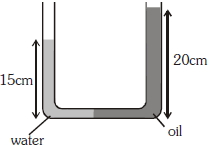
In a $U-$tube as shown in figure, water and oil are in the left side and right side of the tube respectively. The helghts from the bottom for water and oil columns are $15\; \mathrm{cm}$ and $20\; \mathrm{cm}$ respectively. The density of the oil is......$kg/{m}^{3}$
[take $\rho_{water} \left.=1000 \;\mathrm{kg} / \mathrm{m}^{3}\right]$
- A
$1200$
- ✓
$750$
- C
$1000$
- D
$1333$
Answerb
$\rho_{oil} \mathrm{h}_{\text {oil }}={ \rho_{water} } \mathrm{h}_{\text {water }} $
$\Rightarrow \rho_{oil} =\frac{1000(15)}{20}=750 \mathrm{kg} \mathrm{m}^{-3}$
View full question & answer→MCQ 81 Mark
A small hole of area of cross-section $2\; \mathrm{mm}^{2}$ is present near the bottom of a fully filled open tank of height $2\; \mathrm{m} .$ Taking $\mathrm{g}=10 \;\mathrm{m} / \mathrm{s}^{2},$ the rate of flow of water through the open hole would be nearly ......... $\times 10^{-6} \;m^{3} /s$
- ✓
$12.6$
- B
$8.9$
- C
$2.23$
- D
$6.4$
AnswerCorrect option: A. $12.6$
a
velocity of efflux $v=\sqrt{2 g h}$
volume flow rate $=\mathrm{Av}=\mathrm{A} \sqrt{2 \mathrm{gh}}$
${=\left(2 \times 10^{-6}\right)(2 \times 10 \times 2)^{1 / 2}}$
${=4 \sqrt{10} \times 10^{-6} \mathrm{m}^{3} / \mathrm{s}}$
${\cong 12.6 \times 10^{-6} \mathrm{m}^{3} / \mathrm{s}}$
View full question & answer→MCQ 91 Mark
Two small spherical metal balls, having equal masses, are made from materials of densities $\rho_{1}$ and $\rho_{2}\left(\rho_{1}=8 \rho_{2}\right)$ and have radii of $1\; \mathrm{mm}$ and $2\; \mathrm{mm}$, respectively. They are made to fall vertically (from rest) in a viscous medum whose coefficient of viscosity equals $\eta$ and whose denstry is $0.1 \mathrm{\rho}_{2} .$ The ratio of their terminal velocitites would be
- A
$\frac{79}{72}$
- B
$\frac{19}{36}$
- C
$\frac{39}{72}$
- ✓
$\frac{79}{36}$
AnswerCorrect option: D. $\frac{79}{36}$
d
$v_{T}=\frac{2 r^{2}(\sigma-\rho) g}{9 \eta}$
$\frac{v_{1}}{v_{2}}=\left(\frac{r_{1}}{r_{2}}\right)^{2} \frac{\left(\sigma_{1}-\rho\right)}{\left(\sigma_{2}-\rho\right)}$$=\left(\frac{1}{2}\right)^{2}\left(\frac{8 \rho_{2}-0.1 \rho_{2}}{\rho_{2}-0.1 \rho_{2}}\right)$$=\frac{79}{36}$
View full question & answer→MCQ 101 Mark
A small sphere of radius $r$ falls from rest in a viscous liquid. As a result, heat is produced due to viscous force. The rate of production of heat when the sphere attains its terminal velocity, is proportional to
- A
$r^3$
- B
$\;$$r^2$
- C
$r^4$
- ✓
$\;$$r^5$
AnswerCorrect option: D. $\;$$r^5$
d
The viscous drag force, $F = 6\pi \eta rv;$
$where\,v = terminal\,velocity$
$\therefore \,The\,rate\,of\,production\,of\,heat = power$
$ = force \times terminal\,velocity$
$ \Rightarrow power = 6\pi \eta rv \cdot v = 6\pi \eta r{v^2}\,\,\,\,\,\,\,\,...\left( i \right)$
$Terminal\,velocity\,v = \frac{{2{r^2}\left( {\rho - \sigma } \right)}}{{9\eta }};\,\,\,\therefore v \propto {r^2}$
$Now,\,power = 6\pi \eta r\left[ {\frac{{4{r^2}{{\left( {\rho - \sigma } \right)}^2}}}{{81{\eta ^2}}}{g^2}} \right]or\,power \propto {r^5}.$
View full question & answer→MCQ 111 Mark
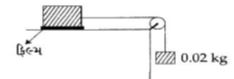
A metal block of base area $0.2\; m ^{2}$ is connected to a $0.02\; kg$ mass via a string that passes over an ideal pulley as shown in figure. A liquid film of thickness $0.6\; mm$ is placed between the block and the table. When released the block moves to the right with a constant speed of $0.17\; m / s$. The co-efficient of viscosity of the liquid is
- A
$3.45 \times 10^{-2} Pa{-s}$
- ✓
$3.45 \times 10^{-3} Pa{-s}$
- C
$3.45 \times 10^{2} Pa{-s}$
- D
$3.45 \times 10^{3} Pa{-s}$
AnswerCorrect option: B. $3.45 \times 10^{-3} Pa{-s}$
b
Shear force, $F=T=m g=0.01\; kg \times 10\; m s ^{-2}=0.1\; N$
Shear stress on the fluid $=\frac{F}{A}=\frac{0.1\; N }{0.1 \;m ^{2}}$
Strain rate $=\frac{v}{l}=\frac{0.085 \;m {s}^{-1}}{0.3 \times 10^{-3}\; m }$
Coefficient of viscosity, $\eta=\frac{\text { Shear stress }}{\text { Strain rate }}$
$=\left(\frac{0.1\; N }{0.1 \;m ^{2}}\right) \times \frac{\left(0.3 \times 10^{-3}\; m \right)}{0.085\; ms ^{-1}}$
$=3.5 \times 10^{-3} Pa\cdot s$
View full question & answer→MCQ 121 Mark
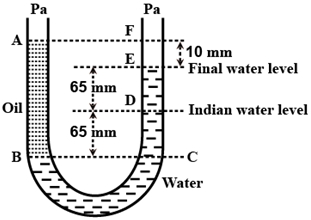
A $U$ tube with both ends open to the atmosphere, is partially filled with water. Oil, which is immiscible with water, is poured into one side until it stands at a distance of $10\,\, mm$ above the water level on the other side. Meanwhile the water rises by $65\,\, mm$ from its original level (see diagram). The density of the oil is ......... $kg/m^3$
- A
$800$
- B
$425 $
- ✓
$928$
- D
$650$
Answerc
Pressure at point $C$,
${p_C} = {p_a} + {\rho _{water}}g{h_{water'}}$
$where\,{h_{water}} = CE = \left( {65 + 65} \right)mm = 130\,mm$
$pressure\,at\,point\,B,{P_B} = {P_u} + {\rho _{oil}}g{h_{oil}}$
$where\,{h_{oil}} = AB = \left( {65 + 65 + 10} \right)\,mm = 140\,mm$
In liquid, Pressure is same at same liquid level,
${p_B} = {p_c} \Rightarrow {\rho _{oil}}g{h_{oil}} = {\rho _{water}}g\,{h_{water}}$
${\rho _{oil}} = \frac{{130 \times {{10}^3}}}{{140}} = \frac{{13}}{{14}} \times {10^3} = 928.57\,kg\,{m^{ - 3}}$
View full question & answer→MCQ 131 Mark
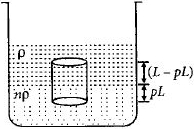
Two non-mixing liquids of densities $\rho $ and $n \rho \,(n > 1)$ are put in a container. The height of each liquid is $h.$ A solid cylinder of length $L$ and density $d$ is put in this container. The cylinder floats with its axis vertical and length $\rho L (\rho < 1)$ in the denser liquid. The density $d$ is equal to
- A
$[2+(n+1)P]\rho $
- B
$[2+(n-1)P]\rho $
- ✓
$[1+(n-1)P]\rho $
- D
$[1+(n+1)P]\rho $
AnswerCorrect option: C. $[1+(n-1)P]\rho $
c
$d = density\,of\,cylinder$
$A = area\,of\,cross - section\,of\,cylinder$
Using law of floatation,
$Weight\,of\,cylinder = Upthrust\,by\,two\,liquids$
$L \times A \times d \times g = n\rho \times \left( {pL \times A} \right)g + \rho \left( {L - pL} \right)Ag$
$d = np\rho + \rho \left( {1 - p} \right) = \left( {np + 1 - p} \right)\rho $
$d = \left\{ {1 + \left( {n - 1} \right)p} \right\}\rho $
View full question & answer→MCQ 141 Mark
$10,000 $ small balls, each weighing $1\, gm$, strike one square cm of area per second with a velocity $100 \,m/s$ in a normal direction and rebound with the same velocity. The value of pressure on the surface will be
- A
$2 \times {10^3}\,N/{m^2}$
- B
$2 \times {10^5}\,N/{m^2}$
- C
${10^7}\,N/{m^2}$
- ✓
$2 \times {10^7}\,N/{m^2}$
AnswerCorrect option: D. $2 \times {10^7}\,N/{m^2}$
d
(d) $P = \frac{F}{A} = \frac{{n[mv - ( - mv)]}}{A} = \frac{{2mnv}}{A}$
$ = \frac{{2 \times {{10}^{ - 3}} \times {{10}^4} \times {{10}^2}}}{{{{10}^{ - 4}}}}$
$ = 2 \times {10^7}N/{m^2}$
View full question & answer→MCQ 151 Mark
Density of ice is $\rho $ and that of water is $\sigma $. What will be the decrease in volume when a mass $M$ of ice melts
- A
$\frac{M}{{\sigma - \rho }}$
- B
$\frac{{\sigma - \rho }}{M}$
- ✓
$M\,\left[ {\frac{1}{\rho } - \frac{1}{\sigma }} \right]$
- D
$\frac{1}{M}\left[ {\frac{1}{\rho } - \frac{1}{\sigma }} \right]$
AnswerCorrect option: C. $M\,\left[ {\frac{1}{\rho } - \frac{1}{\sigma }} \right]$
c
(c)Volume of ice $ = \frac{M}{\rho }$, volume of water $ = \frac{M}{\sigma }$ .
$>$ Change in volume $ = \frac{M}{\rho } - \frac{M}{\sigma } = M\,\left( {\frac{1}{\rho } - \frac{1}{\sigma }} \right)$
View full question & answer→MCQ 161 Mark
Equal masses of water and a liquid of density $ 2$ are mixed together, then the mixture has a density of ........ $ g / cm^3$
Answerb
(b)If two liquid of equal masses and different densities are mixed together then density of mixture
$\rho = \frac{{2{\rho _1}{\rho _2}}}{{{\rho _1} + {\rho _2}}} = \frac{{2 \times 1 \times 2}}{{1 + 2}} = \frac{4}{3}$
View full question & answer→MCQ 171 Mark
A body of density ${d_1}$ is counterpoised by $Mg$ of weights of density ${d_2}$ in air of density $d$. Then the true mass of the body is
- A
$M$
- B
$M\,\left( {1 - \frac{d}{{{d_2}}}} \right)$
- C
$M\left( {1 - \frac{d}{{{d_1}}}} \right)$
- ✓
$\frac{{M(1 - d/{d_2})}}{{(1 - d/{d_1})}}$
AnswerCorrect option: D. $\frac{{M(1 - d/{d_2})}}{{(1 - d/{d_1})}}$
d
(d)Let ${M_0} = $mass of body in vacuum.
Apparent weight of the body in air = Apparent weight of standard weights in air
$ \Rightarrow $ Actual weight -upthrust due to displaced air
= Actual weight -upthrust due to displaced air
$ \Rightarrow $${M_0}g - \left( {\frac{{{M_0}}}{{{d_1}}}} \right)\,dg = Mg - \left( {\frac{M}{{{d_2}}}} \right)\,dg$$ \Rightarrow {M_0} = \frac{{M\left[ {1 - \frac{d}{{{d_2}}}} \right]}}{{\left[ {1 - \frac{d}{{{d_1}}}} \right]}}$
View full question & answer→MCQ 181 Mark
The volume of an air bubble becomes three times as it rises from the bottom of a lake to its surface. Assuming atmospheric pressure to be $75 cm$ of $Hg $ and the density of water to be $1/10$ of the density of mercury, the depth of the lake is ....... $m$
Answerc
(c) ${P_1}{V_1} = {P_2}{V_2}$==> $({P_0} + h\rho g)V$=${P_0} \times 3V$
==> $h\rho g = 2{P_0}$==> $h = \frac{{2 \times 75 \times 13.6 \times g}}{{\frac{{13.6}}{{10}} \times g}}$ $= 15 m$
View full question & answer→MCQ 191 Mark
If two liquids of same masses but densities ${\rho _1}$ and ${\rho _2}$ respectively are mixed, then density of mixture is given by
- A
$\rho = \frac{{{\rho _1} + {\rho _2}}}{2}$
- B
$\rho = \frac{{{\rho _1} + {\rho _2}}}{{2{\rho _1}{\rho _2}}}$
- ✓
$\rho = \frac{{2{\rho _1}{\rho _2}}}{{{\rho _1} + {\rho _2}}}$
- D
$\rho = \frac{{{\rho _1}{\rho _2}}}{{{\rho _1} + {\rho _2}}}$
AnswerCorrect option: C. $\rho = \frac{{2{\rho _1}{\rho _2}}}{{{\rho _1} + {\rho _2}}}$
c
(c)$\rho = \frac{{{\rm{Total mass}}}}{{{\rm{Total volume }}}} = \frac{{2m}}{{{V_1} + {V_2}}} = \frac{{2m}}{{m\,\left( {\frac{1}{{{\rho _1}}} + \frac{1}{{{\rho _2}}}} \right)}}$
$>$ $\rho = \frac{{2{\rho _1}{\rho _2}}}{{{\rho _1} + {\rho _2}}}$
View full question & answer→MCQ 201 Mark
If two liquids of same volume but different densities ${\rho _1}$ and ${\rho _2}$ are mixed, then density of mixture is given by
- ✓
$\rho = \frac{{{\rho _1} + {\rho _2}}}{2}$
- B
$\rho = \frac{{{\rho _1} + {\rho _2}}}{{2{\rho _1}{\rho _2}}}$
- C
$\rho = \frac{{2{\rho _1}{\rho _2}}}{{{\rho _1} + {\rho _2}}}$
- D
$\rho = \frac{{{\rho _1}{\rho _2}}}{{{\rho _1} + {\rho _2}}}$
AnswerCorrect option: A. $\rho = \frac{{{\rho _1} + {\rho _2}}}{2}$
a
(a) $\rho = \frac{{{\rm{Total mass}}}}{{{\rm{Total volume }}}} = \frac{{{m_1} + {m_2}}}{{2V}} = \frac{{V\left( {{\rho _1} + {\rho _2}} \right)}}{{2V}}$$ = \frac{{{\rho _1} + {\rho _2}}}{2}$
View full question & answer→MCQ 211 Mark
With rise in temperature, density of a given body changes according to one of the following relations
- A
$\rho = {\rho _0}[1 + \gamma \,d\theta ]$
- ✓
$\rho = {\rho _0}[1 - \gamma \,d\theta ]$
- C
$\rho = {\rho _0}\gamma d\theta $
- D
$\rho = {\rho _0}/\gamma d\theta $
AnswerCorrect option: B. $\rho = {\rho _0}[1 - \gamma \,d\theta ]$
b
(b)Since, with increase in temperature, volume of given body increases, while mass remains constant so that density will decrease.
i.e. $\frac{\rho }{{{\rho _0}}} = \frac{{m/V}}{{m/{V_0}}} = \frac{{{V_0}}}{V} = \frac{{{V_0}}}{{{V_0}(1 + r\Delta \theta )}} = (1 - \gamma \Delta \theta )$
$\rho = {\rho _0}(1 - \gamma \Delta \theta )$
View full question & answer→MCQ 221 Mark
Three liquids of densities $d,\,2d$ and $3d$ are mixed in equal volumes. Then the density of the mixture is
Answerb
(b) ${\rho _{mixture}}$= $\frac{{{m_1} + {m_2} + {m_3}}}{{3V}} = \frac{{V(d + 2d + 3d)}}{{3V}}$ $= 2d.$
View full question & answer→MCQ 231 Mark
Three liquids of densities $d,\,2d$ and $3d$ are mixed in equal proportions of weights. The relative density of the mixture is
- A
$\frac{{11d}}{7}$
- ✓
$\frac{{18d}}{{11}}$
- C
$\frac{{13d}}{9}$
- D
$\frac{{23d}}{{18}}$
AnswerCorrect option: B. $\frac{{18d}}{{11}}$
b
(b) ${\rho _{mix}}$= $\frac{{3m}}{{{V_1} + {V_2} + {V_3}}} = \frac{{3m}}{{\frac{m}{d} + \frac{m}{{2d}} + \frac{m}{{3d}}}}$= $\frac{{3 \times 6}}{{11}}d = \frac{{18}}{{11}}d$
View full question & answer→MCQ 241 Mark
In making an alloy, a substance of specific gravity ${s_1}$ and mass ${m_1}$ is mixed with another substance of specific gravity ${s_2}$ and mass ${m_2}$; then the specific gravity of the alloy is
- A
$\left( {\frac{{{m_1} + {m_2}}}{{{s_1} + {s_2}}}} \right)$
- B
$\left( {\frac{{{s_1}{s_2}}}{{{m_1} + {m_2}}}} \right)$
- ✓
$\frac{{{m_1} + {m_2}}}{{\left( {\frac{{{m_1}}}{{{s_1}}} + \frac{{{m_2}}}{{{s_2}}}} \right)}}$
- D
$\frac{{\left( {\frac{{{m_1}}}{{{s_1}}} + \frac{{{m_2}}}{{{s_2}}}} \right)}}{{{m_1} + {m_2}}}$
AnswerCorrect option: C. $\frac{{{m_1} + {m_2}}}{{\left( {\frac{{{m_1}}}{{{s_1}}} + \frac{{{m_2}}}{{{s_2}}}} \right)}}$
c
(c)Specific gravity of alloy $ = \frac{{{\rm{Mass of alloy }}}}{{{\rm{Volume of alloy}} \times {\rm{density of water }}}}$
$ = \frac{{{m_1} + {m_2}}}{{\left( {\frac{{{m_1}}}{{{\rho _1}}} + \frac{{{m_2}}}{{{\rho _2}}}} \right) \times {\rho _w}}}$$ = \frac{{{m_1} + {m_2}}}{{\frac{{{m_1}}}{{{\rho _1}/{\rho _w}}} + \frac{{{m_2}}}{{{\rho _2}/{\rho _w}}}}} = \frac{{{m_1} + {m_2}}}{{\frac{{{m_1}}}{{{s_1}}} + \frac{{{m_2}}}{{{s_2}}}}}$ $\left[ {{\rm{As\, specific \,gravity \,of\,substance }} = \frac{{{\rm{density \,of\, substance }}}}{{{\rm{density\, of \,water}}}}} \right]$
View full question & answer→MCQ 251 Mark
A tank $5 \,m$ high is half filled with water and then is filled to the top with oil of density $0.85 \,g/cm^3$. The pressure at the bottom of the tank, due to these liquids is ........ $g/cm^2$
- A
$1.85$
- B
$89.25$
- ✓
$462.5$
- D
$500$
AnswerCorrect option: C. $462.5$
c
(c) Pressure at the bottom $P = ({h_1}{d_1} + {h_2}{d_2})\frac{g}{{c{m^2}}}$
$ = [250 \times 1 + 250 \times 0.85] = 250\;[1.85]\frac{g}{{c{m^2}}}$
$ = 462.5\frac{g}{{c{m^2}}}$
View full question & answer→MCQ 261 Mark
Two substances of densities ${\rho _1}$ and ${\rho _2}$ are mixed in equal volume and the relative density of mixture is $4$. When they are mixed in equal masses, the relative density of the mixture is $3$. The values of ${\rho _1}$ and ${\rho _2}$ are
- ✓
${\rho _1} = 6$ and ${\rho _2} = 2$
- B
${\rho _1} = 3$ and ${\rho _2} = 5$
- C
${\rho _1} = 12$ and ${\rho _2} = 4$
- D
AnswerCorrect option: A. ${\rho _1} = 6$ and ${\rho _2} = 2$
a
(a) When substances are mixed in equal volume then density $ = \frac{{{\rho _1} + {\rho _2}}}{2} = 4$ ==>${\rho _1} + {\rho _2} = 8$ .......$(i)$
When substances are mixed in equal masses then density $ = \frac{{2{\rho _1}{\rho _2}}}{{{\rho _1} + {\rho _2}}} = 3$
==> $2{\rho _1}{\rho _2} = 3({\rho _1} + {\rho _2})$ .......$(ii)$
By solving $(i)$ and $(ii)$ we get ${\rho _1} = 6$ and ${\rho _2} = 2$.
View full question & answer→MCQ 271 Mark
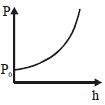
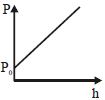
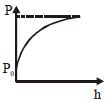
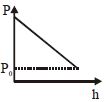
At shallow depth $h$, the pressure in the ocean is simply given by $P = P_0 + \rho gh$, in which $\rho$ is the density of water and $P_0$ is the air pressure. As we go deeper, the high pressure causes the water to compress and become denser. Which of the following sketches illustrates the correct dependence of the pressure on the depth $h$ ?
Answera
As depth increases, density of water increases so rate of increase of pressure with depth will be positive.
View full question & answer→MCQ 281 Mark
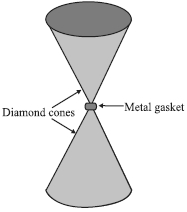
Anvils made of single crystals of diamond, with the shape as shown in Figure, are used to investigate behaviour of materials under very high pressures. Flat faces at the narrow end of the anvil have a diameter of $0.50\; mm$, and the wide ends are subjected to a compressional force of $50,000 \;N$. What is the pressure at the tip of the anvil?
- A
$4.56 \times 10^{10} \;Pa$
- ✓
$2.55 \times 10^{11} \;Pa$
- C
$9.45 \times 10^{12} \;Pa$
- D
$8.62 \times 10^{9} \;Pa$
AnswerCorrect option: B. $2.55 \times 10^{11} \;Pa$
b
Diameter of the cones at the narrow ends, $d=0.50 mm =0.5 \times 10^{-3} m$
Radius, $r=\frac{d}{2}=0.25 \times 10^{-3} m$
Compressional force, $F=50000 N$
Pressure at the tip of the anvil
$p=\frac{\text { Force }}{\text { Arear }}=\frac{F}{\pi r^{2}}$
$=\frac{50000}{\pi\left(0.25 \times 10^{-3}\right)^{2}}$
$=2.55 \times 10^{11} Pa$
Therefore, the pressure at the tip of the anvil is $2.55 \times 10^{11} \;Pa$
View full question & answer→MCQ 291 Mark
A $50 \;kg$ girl wearing high heel shoes balances on a single heel. The heel is circular with a diameter $1.0 \;cm$. What is the pressure exerted by the heel on the horizontal floor ?
- A
$1.95 \times 10^{7} \;N m ^{-2}$
- B
$8.62 \times 10^{5} \;N m ^{-2}$
- C
$2.65 \times 10^{5} \;N m ^{-2}$
- ✓
$6.24 \times 10^{6} \;N m ^{-2}$
AnswerCorrect option: D. $6.24 \times 10^{6} \;N m ^{-2}$
d
Mass of the girl, $m=50 kg$
Diameter of the heel, $d=1 cm =0.01 m$ Radius of the heel, $r=d / 2=0.005 m$
Area of the heel $=\pi r^{2}=\pi(0.005)^{2}=7.85 \times 10^{-5} m ^{2}$
Force exerted by the heel on the floor:
$F=m g=50 \times 9.8=490 N$
Pressure exerted by the heel on the floor:
$P=\frac{\text { Force }}{\text { Area }}=\frac{490}{7.85 \times 10^{-5}}$
$=6.24 \times 10^{6} \;N m ^{-2}$
Therefore, the pressure exerted by the heel on the horizontal floor is $6.24 \times 10^{6} \,Nm ^{-2}$
View full question & answer→MCQ 301 Mark
A tank with a square base of area $1.0\; m ^{2}$ is divided by a vertical partition in the middle. The bottom of the partition has a small-hinged door of area $20\; cm ^{2} .$ The tank is filled with water in one compartment, and an acid (of relative density $1.7$) in the other, both to a height of $4.0 \;m$. compute the force (in $N$) necessary to keep the door
- A
$72.36$
- B
$46.32$
- C
$68.24$
- ✓
$54.88$
AnswerCorrect option: D. $54.88$
d
Base area of the given $\operatorname{tank}, A=1.0 m ^{2}$
Area of the hinged door, $a=20 cm ^{2}=20 \times 10^{-4} m ^{2}$
Density of water, $\rho_{1}=10^{3} kg / m ^{3}$
Density of acid, $\rho_{2}=1.7 \times 10^{3} kg / m ^{3}$
Height of the water column, $h_{1}=4 m$
Height of the acid column, $h_{2}=4 m$
Acceleration due to gravity, $g=9.8$
Pressure due to water is given as:
$P_{1}=h_{1} \rho_{1} g$
$=4 \times 10^{3} \times 9.8$
$=3.92 \times 10^{4} Pa$
Pressure due to acid is given as:
$P_{2}=h_{2} \rho_{2} g$
$=4 \times 1.7 \times 10^{3} \times 9.8$
$=6.664 \times 10^{4} Pa$
Pressure difference between the water and acid columns:
$\Delta P=P_{2}-P_{1}$
$=6.664 \times 10^{4}-3.92 \times 10^{4}$
$=2.744 \times 10^{4} Pa$
Hence, the force exerted on the door $=\Delta P \times a$ $=2.744 \times 10^{4} \times 20 \times 10^{-4}$
$=54.88 N$
Therefore, the force necessary to keep the door closed is $54.88 \;N .$
View full question & answer→MCQ 311 Mark
An ice cube contains a large air bubble. The cube is floating on the horizontal surface of water contained in a trough. What will happen to the water level, when the cube melts?
- ✓
- B
- C
- D
First it will fall and then rise
Answera
(a)
Since density of a hollow ice cube is less than water. Hence it will float and when ice melts, then level of water decreases due to loss in volume.
View full question & answer→MCQ 321 Mark
The reading of a spring balance when a block is suspended from it in air is $60 \,N$. This reading is changed to $40 \,N$ when the block is submerged in water. The specific gravity of the block must be therefore ............
Answera
(a)
Let $m$ be mass ,
$m = Dv ; D =$ density of mass, $v =$ vol.
$d =$ density of water.
$m \times g = Dv \times g =60$
fully submerged in water
$( D - d ) v \times g =40$
dividing both equations
$\frac{ D - d }{ D }=\frac{2}{3}$
solving this :
$\frac{ D }{ d }=3$
View full question & answer→MCQ 331 Mark
A piston of cross-section area $100\, cm^2$ is used in a hydraulic press to exert a force of $107\, dynes$ on the water. The cross-sectional area of the other piston which supports an object having a mass $2000 \,kg$. is
- A
$100 \,cm^2$
- B
$109\,cm^2$
- ✓
$2 × 10^4\,cm^2$
- D
$2 × 10^{10}\,cm^2$
AnswerCorrect option: C. $2 × 10^4\,cm^2$
c
(c) ${P_1} = {P_2} \Rightarrow \frac{{{F_1}}}{{{A_1}}} = \frac{{{F_2}}}{{{A_2}}}$==> $\frac{{{{10}^7}}}{{{{10}^2}}} = \frac{{2000 \times {{10}^3} \times {{10}^3}}}{{{A_2}}}$
$\therefore {A_2} = 2 \times {10^4}c{m^2}$$(g = 980 \approx {10^3}cm/{s^2})$
View full question & answer→MCQ 341 Mark
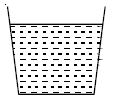
A liquid of mass $1$ $kg$ is filled in a flask as shown in figure. The force exerted by the flask on the liquid is $(g = 10\ m/s^2)$[Neglect atmospheric pressure]:
- ✓
$10$ $ N$
- B
greater than $10\ N$
- C
less than $10\ N$
- D
AnswerCorrect option: A. $10$ $ N$
a
Force applied by liquid on flask $=m g=1 \times 10=10 N$
As there is no atmospheric pressure and liquid is stationary with respect to flask
so force exerted by the liquid on flask $=$ force exerted by flask on liquid $=10 N$
View full question & answer→MCQ 351 Mark
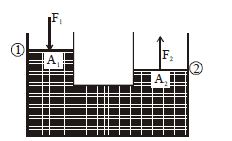
The diagram below shows a hydraulic lift.A force is applied at $side\ 1$ and an output force is generated at $side\ 2$. Which of the following is true?
- A
The force at $side\ 1$ is greater than the force at $side\ 2$
- ✓
The force at $side\ 1$ is less than the force at $side\ 2$
- C
The pressure at $side\ 1$ is greater than the force at $side\ 2$
- D
The pressure at $side\ 1$ is less than the pressure at $side\ 2$
AnswerCorrect option: B. The force at $side\ 1$ is less than the force at $side\ 2$
b
Pascal's law
$\frac{\mathrm{F}_{1}}{\mathrm{A}_{1}}=\frac{\mathrm{F}_{2}}{\mathrm{A}_{2}} \Rightarrow \mathrm{F}_{1} \mathrm{A}_{2}=\mathrm{F}_{2} \mathrm{A}_{1}$
as $\mathrm{A}_{1}<\mathrm{A}_{2}$
So $\mathrm{F}_{1}<\mathrm{F}_{2}$
View full question & answer→MCQ 361 Mark
The diameter of two pistons of a hydraulic press are $0.1\,\, m$ and $0.6\,\, m$ respectively. Advantage of the hydraulic press assuming effort is applied directly on pump plunger
- A
$6$
- ✓
$36$
- C
$\frac {1}{6}$
- D
$\frac {1}{36}$
Answerb
$Mech.$ $adv.$ $(MA)$
$=\frac{\text { Area of bigger piston }}{\text { Area of smaller piston }}$
$=\frac{\pi\left(\frac{\mathrm{d}_{1}}{2}\right)^{2}}{\pi\left(\frac{\mathrm{d}_{2}}{2}\right)^{2}}=\frac{\mathrm{d}_{1}^{2}}{\mathrm{d}_{2}^{2}}=\frac{0.36}{0.01}=36$
View full question & answer→MCQ 371 Mark
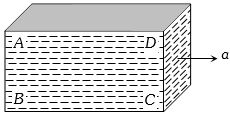
A closed rectangular tank is completely filled with water and is accelerated horizontally with an acceleration a towards right. Pressure is $(i)$ maximum at, and $ (ii) $ minimum at
- ✓
$(i) B (ii) D$
- B
$(i) C (ii) D$
- C
$(i) B (ii) C$
- D
$(i) B (ii) A$
AnswerCorrect option: A. $(i) B (ii) D$
a
(a)Due to acceleration towards right, there will be a pseudo force in a left direction. So the pressure will be more on rear side (Points $A $ and $B$) in comparison with front side (Point $D$ and $C$).
Also due to height of liquid column pressure will be more at the bottom (points $ B $ and $C$) in comparison with top (point $A$ and $D$).
So overall maximum pressure will be at point $B $ and minimum pressure will be at point $D$.
View full question & answer→MCQ 381 Mark
The height to which a cylindrical vessel be filled with a homogeneous liquid, to make the average force with which the liquid presses the side of the vessel equal to the force exerted by the liquid on the bottom of the vessel, is equal to
- A
Half of the radius of the vessel
- ✓
- C
One-fourth of the radius of the vessel
- D
Three-fourth of the radius of the vessel
Answerb
(b) Pressure at the bottom = $h\rho g$
and pressure on the vertical surface = $\frac{1}{2}h\rho g$
Now, according to problem
Force at the bottom = Force on the vertical surface
==> $h\rho g \times \pi {r^2} = \frac{1}{2}h\rho g \times 2\pi rh$ $ ==> h = r$
View full question & answer→MCQ 391 Mark
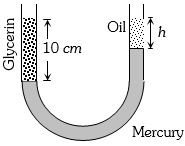
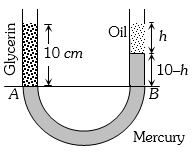
A vertical $U-$ tube of uniform inner cross section contains mercury in both sides of its arms. A glycerin (density = $1.3 g/cm^3$) column of length $10 $ $cm $ is introduced into one of its arms. Oil of density $0.8 gm/cm^3$ is poured into the other arm until the upper surfaces of the oil and glycerin are in the same horizontal level. Find the length of the oil column ........ $cm$. Density of mercury = $13.6 g/cm^3$
- A
$10.4$
- B
$8.2 $
- C
$7.2 $
- ✓
$9.6$
Answerd
(d)At the condition of equilibrium
Pressure at point $A$ = Pressure at point $ B $
${P_A} = {P_B}$==> $10 \times 1.3 \times g = h \times 0.8 \times g + (10 - h) \times 13.6 \times g$
By solving we get $h = 9.7 cm$
View full question & answer→MCQ 401 Mark
A triangular lamina of area $A$ and height h is immersed in a liquid of density $\rho $ in a vertical plane with its base on the surface of the liquid. The thrust on the lamina is
- A
$\frac{1}{2}A\rho gh$
- ✓
$\frac{1}{3}A\rho gh$
- C
$\frac{1}{6}A\rho gh$
- D
$\frac{2}{3}A\rho gh$
AnswerCorrect option: B. $\frac{1}{3}A\rho gh$
b
(b)Thrust on lamina = pressure at centroid $×$ Area
= $\frac{{h\rho g}}{3} \times A$=$\frac{1}{3}A\rho gh.$
View full question & answer→MCQ 411 Mark
Two bodies having volumes $V$ and $2V $ are suspended from the two arms of a common balance and they are found to balance each other. If larger body is immersed in oil (density $d_1 $ $=$ $ 0.9$ $ gm/cm^3$) and the smaller body is immersed in an unknown liquid, then the balance remain in equilibrium. The density of unknown liquid is given by ......... $gm/cm^3$
- A
$2.4$
- ✓
$1.8$
- C
$0.45 $
- D
$2.7$
Answerb
Two bodies are found to balance each other even after these are dipped is liquids of different densities,
which means they have displaced the equal weights of liquids.
Weight of the oil displaced by larger block $=2 V \times 0.9 \times g$ $...(I)$
Weight of the unknown liquid displaced by smaller block $=V \times \rho \times g$ $...(II)$
Equating $(I)$ and $(I I),$ we have
$\rho=1.8 \mathrm{gm} / \mathrm{cm}^{3}$
View full question & answer→MCQ 421 Mark
A jet of water with cross section of $6$ $cm^2$ strikes a wall at an angle of $60^o $ to the normal and rebounds elastically from the wall without losing energy. If the velocity of the water in the jet is $12$ $m/s$, the force acting on the wall is ....... $N$
- A
$0.864$
- ✓
$86.4 $
- C
$72 $
- D
$7.2$
AnswerCorrect option: B. $86.4 $
b
$F=\frac{d P}{d t}$
$=\frac{2 d m V \cos 60^{\circ}}{d t}$
$=\frac{2(\rho A d x) V \cos 60^{\circ}}{d t}$
$=2 \rho A V^{2} \cos 60^{\circ}$
$=10^{3} \times 6 \times 10^{-4} \times 12^{2}$
$=86.4 \;N$
View full question & answer→MCQ 431 Mark
When an air bubble rises from the bottom of a deep lake to a point just below the water surface, the pressure of air inside the bubble
- A
is greater than the pressure outside it
- B
is less than the pressure outside it
- C
decreases as the bubble moves up
- ✓
$B$ and $C$ both
AnswerCorrect option: D. $B$ and $C$ both
d
When bubble is deep down it has atmosphere pressure and water pressure i.e. $P_{o}+h \rho g$ As it rises, water pressure which is proportional to the depth, reduces and becomes $P_{o}$ just below the water surface Hence option $'D'$ is correct and $\mathrm{'C'}$ is incorrect. Pressure inside a bubble is always greater than the outside pressure by the amount of excess pressure. Outside pressure and pressure due to surface tension has to be compensated by the inside pressure for stable shape of the bubble. Hence option$'A'$ is correct and $'B'$ is incorrect.
View full question & answer→MCQ 441 Mark
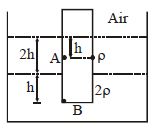
A cylinder stands vertical in two immiscible liquids of densities $\rho$ and $2 \rho$. The height of two liquids are shown. Find the difference in pressure at point $A$ and $B$
- A
$2 \rho gh$
- ✓
$3 \rho gh$
- C
$4 \rho gh$
- D
AnswerCorrect option: B. $3 \rho gh$
b
Difference in pressure at $\mathrm{A}$ and $\mathrm{B}=4 \rho g h-\rho g h=3 \rho g h$
View full question & answer→MCQ 451 Mark
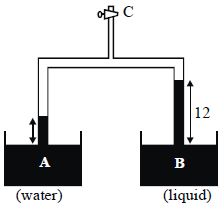
The limbs of a $U$ -tube glass are lowered into vessels $A$ and $B, A$ containing water. Some air is pumped out through the top of the tube $C$. The liquids in the left hand limb $A$ and the right hand limb $B$ rise to heights of $10\, cm$ and $12\, cm$ respectively. The density of liquid $B$ is ........ $g/cm^3$
- A
$0.75$
- ✓
$0.83$
- C
$1.2$
- D
$0.25$
AnswerCorrect option: B. $0.83$
b
Equating pressure at the surface on both vessel
$\rho_{w} g \times \frac{10}{100}=\rho_{B} g \times \frac{12}{100} \Rightarrow \rho_{B}=\frac{10}{12} \rho_{w}$
View full question & answer→MCQ 461 Mark
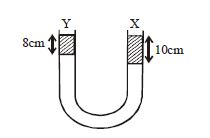
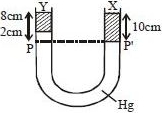
A liquid $X$ of density $3.36\ g/cm^3$ is poured in a $U-$ tube, which contains $Hg$. Another liquid $Y$ is poured in left arm with height $8\ cm$, upper levels of $X$ and $Y$ are same. What is density of $Y$ .......... $g/cc$
Answera
As shown in figure, in the two arms of a tube pressure remains same on surface $pp'.$ Hence,
$8 \times \rho_{y} \times g+2 \times \rho_{H g} \times g=10 \times \rho_{x} \times g$
$\therefore 8 \rho_{y}+2 \times 13.6=10 \times 3.36$
or $\rho_{y}=\frac{33.6-27.2}{8}=0.8 \mathrm{g} / \mathrm{cc}$
View full question & answer→MCQ 471 Mark
A wooden block floats in a liquid with $40\%$ of its volume inside the liquid. When the vessel containing he liquid starts rising upwards with acceleration $a = g/2$, the percentage of volume inside the liquid is ......... $\%$
Answerd
Both weight and upthrust have same fractional change.
View full question & answer→MCQ 481 Mark
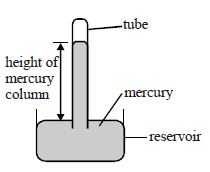
The diagram shows a simple mercury barometer.Which of the following does not cause the height of the mercury column to vary ?
AnswerCorrect option: C. Evaporation of mercury from the barometer reservoir
c
Atmospheric pressure is directly proportion to the height of mercury.
pressure due Weight of mercury in column is equal to atmospheric pressure, if g will vary, height should adjust so as to keep $W$ same.
Leakage of air inside the tube will disturb the vacuum, due to which pressure inside the tube will become equal to atmospheric pressure and height of mercury will become $0.$
Evaporation of mercury does not cause the height to vary, because it doesn't not change the pressure at surface of reservoir.
View full question & answer→MCQ 491 Mark
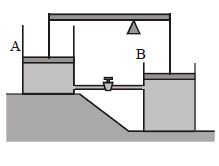
In the arrangement shown both the vessels $A$ and $B$ are identical but amount of water in $B$ is double of that in $A$. The vessels are closed by identical leak proof pistons at the same height. The pistons are connected to the ends of lever arm. There is no friction between the pistons and the container walls. The system is in equilibrium in the situation shown. Now the valve in the horizontal tube connecting both the vessels is opened. In which direction will the water flow through the tube ?
- ✓
From $A$ to $B$
- B
From $B$ to $A$
- C
- D
AnswerCorrect option: A. From $A$ to $B$
View full question & answer→MCQ 501 Mark
If solid will break under pressure greater than $13\ atm$ and that solid has a specific gravity of $4$ , what is the maximum height of a cylinder made from the solid that can be built at the earth's surface ? (Note: $1\ atm$ = $10^5\ Pa$ .) ......... $m$
Answerd
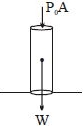
$\mathrm{P}_{0} \mathrm{A}+\mathrm{hA} \rho \mathrm{g}=\mathrm{P}_{1} \mathrm{A}$
$\mathrm{h}=\frac{\mathrm{P}_{1}-\mathrm{P}_{0}}{\rho \mathrm{g}}$
$=\frac{12 \times 10^{5}}{4 \times 10^{3} \times 10}=30 \mathrm{m}$
View full question & answer→