Question 15 Marks
Two particles each of mass m and speed v travel in opposite direction along parallel lines, separated by a distance d. Show that vector angular momentum of the two particles system is same whatever be the point about which angular momentum is taken.
Answer
View full question & answer→Suppose, O be the origin chosen.
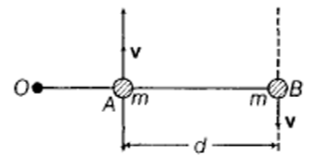
Then, angular momentum of particle at A is
$
\begin{aligned}
& I_1=O A \times p=O A \times m v \\
& =m(O A \times v)
\end{aligned}
$
and angular momentum of particle at $B$ is
$
\begin{aligned}
& I_2=O B \times p=O B \times(-m v) \\
& =-m(O B \times v)
\end{aligned}
$
so, total angular momentum of the system of particles is
$
\begin{aligned}
& L=I_1+I_2 \\
& =m(O A \times v)-m(O B \times v) \\
& =m(O A-O B) \times v \\
& =m(B A) \times v
\end{aligned}
$
$
=m(B A) \times v
$
$\{ As , B A=$ position vector of $A -$ position vector of B $\}$
Above expression is independent of choice of origin.
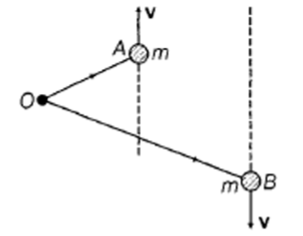
This is true even when particles are not in a straight line.
$
\begin{aligned}
& L_i\left(I_1+I_2=m(O A \times v-O B \times v)\right. \\
& =m(B A) \times v
\end{aligned}
$
Which is the same as a previous result. So, the angular momentum of the system is independent of the choice of origin.
Then, angular momentum of particle at A is
$
\begin{aligned}
& I_1=O A \times p=O A \times m v \\
& =m(O A \times v)
\end{aligned}
$
and angular momentum of particle at $B$ is
$
\begin{aligned}
& I_2=O B \times p=O B \times(-m v) \\
& =-m(O B \times v)
\end{aligned}
$
so, total angular momentum of the system of particles is
$
\begin{aligned}
& L=I_1+I_2 \\
& =m(O A \times v)-m(O B \times v) \\
& =m(O A-O B) \times v \\
& =m(B A) \times v
\end{aligned}
$
$
=m(B A) \times v
$
$\{ As , B A=$ position vector of $A -$ position vector of B $\}$
Above expression is independent of choice of origin.
This is true even when particles are not in a straight line.
$
\begin{aligned}
& L_i\left(I_1+I_2=m(O A \times v-O B \times v)\right. \\
& =m(B A) \times v
\end{aligned}
$
Which is the same as a previous result. So, the angular momentum of the system is independent of the choice of origin.