Question types

Model Paper 5 question types

38 questions across 6 question groups — pick any mix to generate a Physics paper with step-by-step answer keys.

38
Questions
6
Question groups
5
Question types
Sample Questions

Model Paper 5 questions

One sample from each question group in this chapter. Select any group above to see the full set with answer keys.

A chef, on finding his stove out of order, decides to boil the water for his wife's coffee by shaking it in a thermos flask. Suppose that he uses tap water at $15^{\circ} C$ and that the water falls 30 cm each shake, the chef makes 30 shakes each minute. Neglecting any loss of thermal energy by the flask, how long must he shake the flask until the water reaches $100^{\circ} C$ ?
  • A
    $4.00 \times 10^3 \min$
  • B
    $3.97 \times 10^3 min$
  • C
    $5.25 \times 10^3 min$
  • D
    $2.25 \times 10^3 min$
View full solution
A mass is revolving in a circle, which is in the plane of the paper. The direction of angular acceleration if any, is:
  • A
    Upward from the plane of the paper
  • B
    Tangential
  • C
    At right angles to the plane of the paper
  • D
    Towards the radius
View full solution
The ratio of escape velocity at earth $\left( v _{ e }\right)$ to the escape velocity at a planet $\left( u _{ p }\right)$ whose radius and mean density are twice as that of earth is:
  • A
    $1: 2 \sqrt{2}$
  • B
    $1: 4$
  • C
    $1: \sqrt{2}$
  • D
    $1: 2$
View full solution
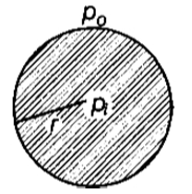
In figure, pressure inside a spherical drop is more than pressure outside. (S = surface tension and r = radius of bubble) 
Image
The extra surface energy if radius of bubble is in creased by $\Delta r$ is
  • A
    $2 \pi r \Delta r S$
  • B
    $4 \pi r \Delta r S$
  • C
    $10 \pi r \Delta r S$
  • D
    $8 \pi r \Delta r S$
View full solution
The phase velocity $\left( v _{ p }\right)$ of a travelling wave is
  • A
    $v_p=\frac{\omega}{k}$
  • B
    $v _{ p }=\frac{c}{v_g}$
  • C
    $v_p=\frac{d \omega}{d k}$
  • D
    $v _{ p }= c$
View full solution
The acceleration due to gravity at the moon's surface is $1.67 ms^{-2}$. If the radius of the moon is $1.74 \times 10^6 m$, then calculate the mass of the moon.
View full solution
A uniform rope of length $L$, resting on a frictionless horizontal surface is pulled at one end by a force $F$. What is the tension in the rope at a distance 1 from the end where the force is applied?
View full solution
The orbital velocity $\nu$ of a satellite may depend on its mass $m$, distance $r$ from the centre of earth and acceleration due to gravity g. Obtain an expression for orbital velocity.
View full solution
Q 113 Marks Question3 Marks
A sphere is dropped under gravity through a fluid of viscosity $\eta$. Taking the average acceleration as half of the initial acceleration, show that the time taken to attain the terminal velocity is independent of the fluid density.
View full solution
Q 133 Marks Question3 Marks
A body of mass 5 kg is acted upon by two perpendicular forces 8 N and 6 N . Give the magnitude and direction of the acceleration of the body.
View full solution
Q 143 Marks Question3 Marks
Specific heat of Argon at constant Pressure is $0.125 cal / g / K$ and at constant volume is $0.075 cal / g / K$. Calculate the density of Argon at N.T.P. Given that $J =4.2$ Joule/cal?
View full solution
Q 153 Marks Question3 Marks
A block of metal of mass 50 g when placed over an inclined plane at an angle of $15^{\circ}$ slides down without acceleration. If the inclination is increased by $15^{\circ}$, what would be the acceleration of the block?
View full solution
Find the components along the $x , y , z$ axes of the angular momentum l of a particle, whose position vector is r with components $x , y , z$ and momentum is p with components $p _{ x }, p _{ y }$ and $p _{ z }$. Show that if the particle moves only in the x y plane the angular momentum has only a z-component.
View full solution
Two cylindrical hollow drums of radii $R$ and $2 R$, and of a common height $h$, are rotating with angular velocities $\omega_1$ (anti-clockwise) and $\omega_2$ (clockwise), respectively. Their axes, fixed are parallel and in a horizontal plane separated by $(3 R+\delta)$. They are now brought in contact $(\delta \rightarrow 0)$.
i. Show the frictional forces just after contact.
ii. Identify forces and torques external to the system just after contact.
iii. What would be the ratio of final angular velocities when friction ceases?
View full solution
A quarterback, standing on his opponents 35-yard line, throws a football directly down field, releasing the ball at a height of 2.00 m above the ground with an initial velocity of $20.0 m / s$, directed $30.0^{\circ}$ above the horizontal.
i. How long does it take for the ball to cross the goal line, 32.0 m from the point of release?
ii. The ball is thrown too hard and so passes over the head of the intended receiver at the goal line. What is the ball's height above the ground as it crosses the goal line?
View full solution
Show that simple harmonic motion may be regarded as the projection of uniform circular motion along the diameter of the circle. Hence derive an expression for the displacement of a particle in S.H.M.
View full solution
View full solution
View full solution
Assertion (A): Generally the path of a projectile from the earth is parabolic but it is elliptical for projectiles going to a very large height.
Reason (R): The path of a projectile is independent of the gravitational force of earth.
  • A
    Both A and R are true and R is the correct explanation of A.
  • B
    Both A and R are true but R is not the correct explanation of A.
  • C
    A is true but R is false.
  • D
    A is false but R is true.
View full solution
Assertion: A person feels weightlessness in an artificial satellite of the earth. However a person on the moon (natural satellite) feels his weight.
Reason: Satellite (natural or artificial) of a planet is a freely falling body.
  • A
    Assertion and reason both are correct statements and reason is correct explanation for assertion.
  • B
    Assertion and reason both are correct statements but reason is not correct explanation for assertion.
  • C
    Assertion is correct statement but reason is wrong statement.
  • D
    Assertion is wrong statement but reason is correct statement.
View full solution
Assertion: When a glass of hot milk is placed in a room and allowed to cool, its entropy decreases.
Reason: Allowing hot object to cool does not violate the second law of thermodynamics.
  • A
    Assertion and reason both are correct statements and reason is correct explanation for assertion.
  • B
    Assertion and reason both are correct statements but reason is not correct explanation for assertion.
  • C
    Assertion is correct statement but reason is wrong statement.
  • D
    Assertion is wrong statement but reason is correct statement.
View full solution
Assertion: Two particles moving in the same direction do not lose all their energy in a completely inelastic collision.
Reason: Principle of conservation of momenturm holds true for all kinds of collisions.
  • A
    Assertion and reason both are correct statements and reason is correct explanation for assertion.
  • B
    Assertion and reason both are correct statements but reason is not correct explanation for assertion.
  • C
    Assertion is correct statement but reason is wrong statement.
  • D
    Assertion is wrong statement but reason is correct statement.
View full solution

Generate a Model Paper 5 paper free

Pick question groups from the list above, set marks and difficulty, and export a branded PDF with step-by-step answer keys. First 3 chapters free — no signup.

Download App