Decomposers. Explanation:
View full question & answer→ Question 2 1 Mark
Secondary producers are:
Herbivores. Producers. Carnivores. None of the above. View full question & answer→ Question 3 1 Mark
The second trophic level in a lake is-
Phytoplankton. Zooplankton. Benthos. Fishes. Answer Zooplankton. Explanation:
Zooplankton are primary consumers in aquatic food chains that feed upon phytoplankton.
Therefore, they are present at the second trophic level in a lake.
View full question & answer→ Question 4 1 Mark
What is the percentage of photosynthetically active radiation (PAR), in the incident solar radiation.
100% 50% 1-5% 2-10% Answer 50% Explanation:
Out of total incident solar radiation, about fifty percent of it forms photosynthetically active radiation (PAR).
View full question & answer→ Question 5 1 Mark
Fill in the blanks.
View full question & answer→ Question 6 1 Mark
Fill in the blanks.
Answer Earthworm, bacteria & fungi of decay and vulture.
View full question & answer→ Question 7 1 Mark
Fill in the blanks.
In aquatic ecosystems, the limiting factor for the productivity is _________.
View full question & answer→ Question 8 1 Mark
Fill in the blanks.
The major reservoir of carbon on earth is ________.
View full question & answer→ Question 9 1 Mark
Fill in the blanks.
View full question & answer→ Question 10 1 Mark
State what does ‘standing crop’ of a trophic level represent?
Answer There is unidirectional movement of energy the higher trophic level and its levels has a certain mass of living material at a particular time called as the standing crop. It represent values for dry blomass (standing crop).
View full question & answer→ Question 11 1 Mark
Write a difference between net primary productivity and gross productivity.
Answer Gross productivity-Rate of production of organic matter during photosynthesis Net primary productivity -Available biomass for the consumption to heterotrophs/GPP-R = NPP.
View full question & answer→ Question 12 1 Mark
How is ‘stratification’ represented in a forest ecosystem?
Answer Trees occupy vertical stratra, shrubs the second layer and herbs/grasses occupy the bottom layers/vertical distribution of species, at different levels.
View full question & answer→ Question 13 1 Mark
What does ecological niche of an organism represent?
Answer The ecological niche (of an organism) signifies the range of conditions it can tolerate, the resources it utilises, and its functional role in the ecological system.
View full question & answer→ Question 14 1 Mark
Write the equation that helps in deriving the net primary productivity of an ecosystem.
Answer Net primary productivity (NPP) is an ecosystem can be derived using the following equation: NPP = GPP-R.
= (Gross – Primary Productivity) - (Respiratory Losses).
View full question & answer→ Question 15 1 Mark
Why is the rate of assimilation of energy at the herbivore level called secondary productivity?
Answer It is because the biomass available to the consumer for consumption is a resultant of the primary productivity from plants.
View full question & answer→ Question 16 1 Mark
How much of carbon is:
Fixed in the biosphere through photosynthesis annually? Dissolved in the ocean? Answer 4 × 10¹³ kg of carbon is fixed annually. 71% of carbon is dissolved in the ocean. View full question & answer→ Question 17 1 Mark
Answer Photosynthetic Active Radiation.
View full question & answer→ Question 18 1 Mark
Write a difference between net primary productivity and gross primary productivity.
OR
How is net primary productivity different from gross primary productivity?
Answer A difference between c and gross primary productivity is: S. No.
gross primary productivity.
net primary productivity
1.
It is the rate of production of biomass/organic matter by producers during photosynthesis.
It refers to the biomass/ organic matter available for the consumption to heterotrophs, left after some respiratory losses.
View full question & answer→ Question 19 1 Mark
How much of productivity is contributed by oceans?
Answer Oceans contribute about 55 billion tons organic matter.
View full question & answer→ Question 20 1 Mark
Is the common edible mushroom an autotroph or a heterotroph?
Answer Heterotroph (as it does not have chlorophyll).
View full question & answer→ Question 21 1 Mark
Arrange the following as you observe in vertical stratification of a forest-Grass, Shrubby plants, Teak, Amaranthus.
Answer Grass, Amaranthus, Shrubby plants, Teak.
View full question & answer→ Question 22 1 Mark
How is stratification represented in forest ecosystem?
Answer Stratification is the way in which different species in an ecosystem are placed or arranged vertically, occupying different levels. It is a way of minimising competition for limited resources vital for survival.
View full question & answer→ Question 23 1 Mark
What is the basic requirement of any ecosystem to function and sustain?
View full question & answer→ Question 24 1 Mark
Define primary production.
Answer It is defined as the amount of biomass or organic matter produced per unit area over a certain time period by plants during photosynthesis.
View full question & answer→ Question 25 1 Mark
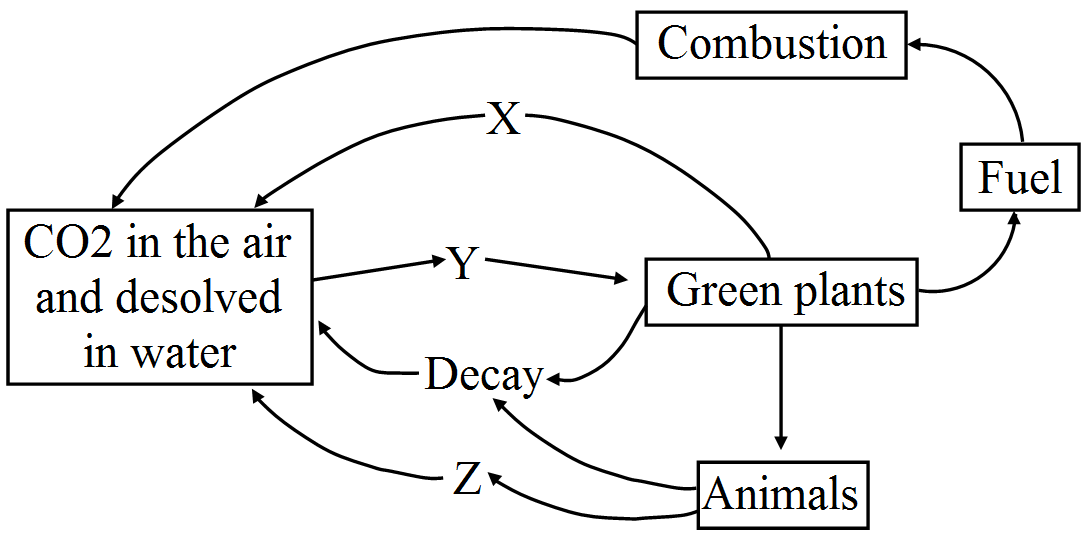
Answer X and Z- Respiration and Y- Photosynthesis.
View full question & answer→ Question 26 1 Mark
What is meant by species composition in an ecosystem?
Answer Species composition refers to all the plant, animal and microbial species present in a given ecosystem.
View full question & answer→ Question 27 1 Mark
Name any two organisms which occupy more than one trophic level in an ecosystem?
View full question & answer→ Question 28 1 Mark
What is the significance of the process of mineralization by microbes?
Answer The inorganic nutrients released from the humus by the microbes are used by plants as nutrients.
View full question & answer→ Question 29 1 Mark
State what does standing crop of a trophic level represent.
Answer Standing crop represents total amount of living matter or organic matter present in an ecosystem in an unit area and at a specific time.
View full question & answer→ Question 30 1 Mark
Name the basic requirement of any ecosystem to function and sustain.
Answer Biotic and abiotic factors.
View full question & answer→ Question 31 1 Mark
Answer the following questions:
Answer Phytoplankton - hydric → Submerged plant stage → Submerged free floating plant stage → Reed swamp stage → Marsh - meadow stage → Scrub stage → Forest stage - Mesic.
View full question & answer→ Question 32 1 Mark
How much of carbon is dissolved in the oceans?
View full question & answer→ Question 33 1 Mark
How much carbon is fixed in the biosphere through photosynthesis annually?
View full question & answer→ Question 34 1 Mark
Answer Food web is formed by interconnecting food chains.
View full question & answer→ Question 35 1 Mark
Answer the following questions:
Answer Pioneer species invade the area first.
View full question & answer→ Question 36 1 Mark
Answer The entire sequence of communities, that successively change in a given area resulting in a climax community, is called a sere.
View full question & answer→ Question 37 1 Mark
Among bryophytes, lichens and fern which one is a pioneer species in a xeric succession?
View full question & answer→ Question 38 1 Mark
Mr. Galgotia eats curd/yoghurt. In this case, which trophic level will he occupy?
View full question & answer→ Question 39 1 Mark
Name two omnivores that occupy positions in both grazing food chain as well as detritus food chain.
View full question & answer→ Question 40 1 Mark
Name the basic requirement of any ecosystem to function and sustain properly.
Answer A constant input of solar energy is the ultimate source of all energy and requirement of any ecosystem to function and sustain properly.
View full question & answer→ Question 41 1 Mark
Cite an example of an inverted ecological pyramid. What kind of pyramid of energy would it have?
Answer The pyramid of biomass in sea is an inverted pyramid. It would have an upright pyramid of energy.
View full question & answer→ Question 42 1 Mark
Justify the pitcher plant as a producer.
Answer Pitcher plant is chlorophyllous and is thus capable of photosynthesis and act as producer.
View full question & answer→ Question 43 1 Mark
What percentage of productivity is contributed by oceans?
Answer Oceans contribute about 55 billion tonnes, which is about 32.5%.
View full question & answer→ Question 44 1 Mark
Mark the odd one in the following group.
View full question & answer→ Question 45 1 Mark
Name the dominant producers in a deep aquatic ecosystem. What other name could you give to a primary consumer?
Answer Phytoplanktons are the dominant producers in aquatic ecosystem. Primary consumers are also known as herbivores.
View full question & answer→ Question 46 1 Mark
What is the starting point of a grazing food chain and detritus food chain, respectively?
Answer The grazing food chain starts with producers while the detritus food chain starts with decomposers.
View full question & answer→ Question 47 1 Mark
Name the two basic categories of an ecosystem.
Answer Natural and artificial ecosystem.
View full question & answer→ Question 48 1 Mark
All primary productivity is not available for herbivores. Give one reason.
Answer Some of the gross primary productivity gets lost in the form of respiration, that is why all primary productivity is not available for herbivores.
View full question & answer→ Question 49 1 Mark
Answer An ecosystem is a functional unit of nature, where biotic components (living organisms) interact among themselves and also with the abiotic environmental or physical factors.
View full question & answer→ Question 50 1 Mark
Why the pyramid of energy is always upright?
Answer Because when energy flows from a particular trophic level to the next trophic level, some energy is always lost as heat at each step.
View full question & answer→
Page 1 of 3 Next →