Questions · Page 2 of 2

3 Marks Question

Question 523 Marks
Where and how does the primary succession occur? Explain.
Answer
Primary succession occurs on newly cooled lava or bare rocks or newly created pond or reservoir.
  1. Primary succession in water:
  • The pioneer species are phytoplanktons.
  • The phytoplanktons are replaced by free-floating angiosperms.
  • Then, rooted angiosperms invade sedges, grasses and finally the trees.
  • At last, a stable climax forest is formed.
  • An aquatic habitat is converted into mesic habitat.
  1. Primary succession on rocks:
  • Lichens are the pioneer species on a bare area.
  • The lichen secretes some acids to dissolve rock and help in weathering and soil formation.
  • Later, some small bryophytes invade and hold the small amount of soil.
  • The bryophytes are succeeded by herbs, shrubs and ultimately big trees.
  • At last, a stable climax forest is formed.
  • The xerophytic habitat gets converted into a mesophytic one.
View full question & answer
Question 533 Marks
What is ecological succession? Where and why would the rate of succession be faster, in a newly created pond or a forest destroyed by a forest fire?
Answer
  1. Ecological succession is the phenomenon in which the structure and composition of communities change in an orderly and sequential manner leading ultimately to the establishment of a climax community.
  2. The ecological succession in a forest destroyed by a forest fire will be faster, because, there is already soil (substratum) and organic matter present; some vegetative propagules may also be present and it is secondary succession.
  3. In a newly created pond, it is primary succession as there is not much of organic matter or any propagules; hence it will take a very long time.
View full question & answer
Question 543 Marks
Give two examples of each:
  1. Terrestrial ecosystem.
  2. Aquatic ecosystem.
  3. Man-made ecosystem.
Answer
  1. Terrestrial ecosystem: Forest, grassland, desert, etc.

  2. Aquatic ecosystem: Pond, lake, river, wetland, estuary, etc.

  3. Man-Made ecosystem: A manmade ecosystem is an artificial biological system that is managed and sustained by people.
View full question & answer
Question 553 Marks
Explain how oxygen and the chemical composition of detritus control decomposition.
Answer
  1. Chemical composition of detritus:
  • Decomposition is faster when detritus is rich in nitrogen and water-soluble substances like sugars.
  • Decomposition is slow when detritus is rich in lignin and chitin.
  1. Oxygen:
  • Decomposition is an oxygen-consuming process.
  • Anaerobic conditions inhibit decomposition.
View full question & answer
Question 563 Marks
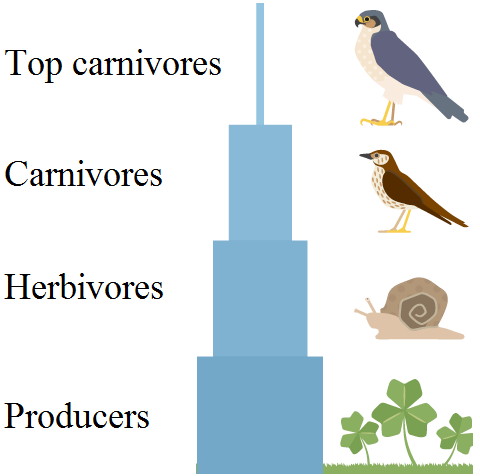
Questions 1-3 are based on the following diagram. Read the questions and fill the blank spaces:

  1. Each level of a pyramid represents a trophic level. With reference to the grazing food web, name an organism at the first trophic level. ______ (a) ______. Two organisms at the second trophic level ______(b)______ Two organisms at the third trophic level ______ (c) ______.
  2. With reference to a pyramid of energy, why is each trophic level reduced in size?
  3. Why is there a limited number of trophic levels?
Answer
  1.  
  1. Trees.
  2. Deer and rabbits.
  3. Snakes and hawks.
  1. As energy flows from one trophic level to the next, approximately 90% of it is lost.
  2. Eventually there is not enough energy to support another level.
View full question & answer
Question 573 Marks
Mention the various seral stages of xero sere.
Answer
  1. Lichen stage.
  2. Moss stage.
  3. Annual grass stage.
  4. Perennial grass stage.
  5. Shrub stage.
  6. Climax community.
View full question & answer
Question 583 Marks
List the four important changes, taking place during biotic succession.
Answer
  1. Small short lived plants (r-selection) to large long lived plants (k-selection).
  2. Unstable biotic community to stable biotic community.
  3. Little diversity to high degree of diversity.
  4. Aquatic or dry conditions to mesic conditions.
View full question & answer
Question 593 Marks
Differentiate between carnivores and consumers.
Answer
Carnivores and consumers:
S.No.
Carnivores
Consumers
1.
A carnivore meaning "meat eater" is an organism that derives its energy and nutrient requirements from a diet consisting mainly or exclusively of animal tissue, whether through predation or scavenging.
Consumers in a food chain are living creatures that eat organisms from a different population. First, it is necessary to understand these two classifications, heterotrophs and autotrophs, consumers and producers respectively.
2.
A carnivore at the top of the food chain, not preyed upon by other animals.
it can also only eat plants (producers) being located in the first level of the food chain above the producers. (primary, secoundary, tertiary).
View full question & answer
Question 603 Marks
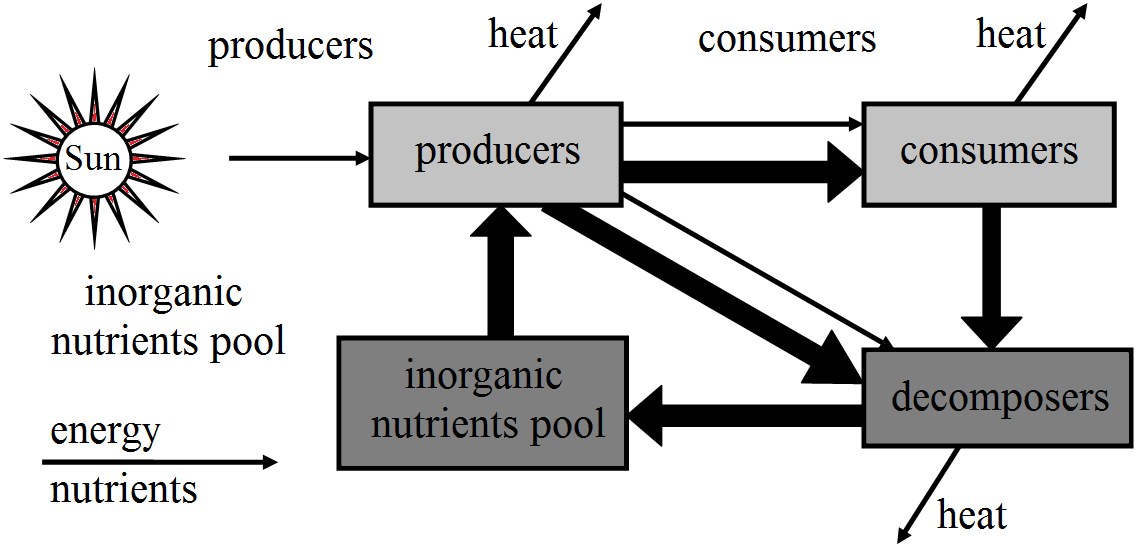
Study the following diagram, and answer these questions:

  1. Why does a wide arrow point from both producers and consumers to decomposers?
  2. Why does a wide arrow point only from inorganic nutrient pool to producers?
  3. Why don't the wavy arrows point from decomposers to producers?
Answer
  1. Both producers and consumers die and decompose.
  2. Only producers use inorganic nutrients to make organic molecules.
  3. Energy does not cycle.
View full question & answer
Question 613 Marks
Autotrophs convert inorganic materials into organic material with the help of solar energy.

  1. Name the process depicted by the given statement.
  2. Name the pigment which traps solar energy and convert light energy to chemical energy.
  3. What do you understand by a photosynthetic unit?

$6\text{CO}_2+12\text{H}_2\text{O}\xrightarrow{\text{Light}}\text{C}_6\text{H}_{12}\text{O}+6\text{H}_2\text{O}+6\text{O}_2$

Answer
  1. The process by which autotrophs convert inorganic materials into organic material with the help of solar energy is called photosynthesis.
  2. The green pigment which traps solar energy and converts light energy into chemical energy is chlorophyll.
  3. The three pigments, i.e. chlorophyll, carotenoids and xenthophylls together form a complex of pigments in the thylakoid membrane. These complexes work for the absorption of light and its transfer to a reaction centre,

These complexes are called photosynthetic unit or photosystem or pigment system.

View full question & answer
Question 623 Marks
Define ecological succession. Give three differences between seral stages and climax community during succession.
Answer
The sequential, gradual and predictable changes in the species composition in an area are called succession or ecological succession.
S. No.
Seral stage
Climax community
(i)
It is the sequential replacement and establishment of species in the process of succession.
It is the community which gets established at the terminal stage of succession.
(ii)
The species composition changes from time to time.
The species are stable and species composition do not change.
(iii)
Simple food chains and food webs are found.
Complex food chains and food webs are found.
View full question & answer
Question 633 Marks
Describe the different classes of consumers.
Answer
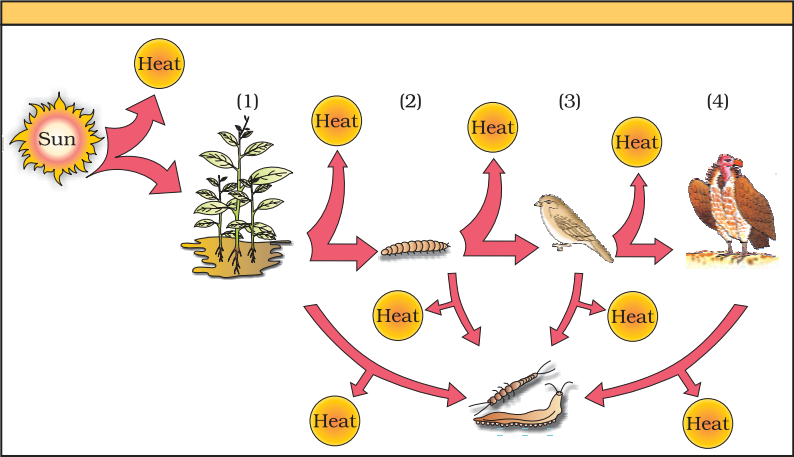
The consumers may be of following types:

  1. Primary consumers: The consumers that feed on plants direcdy, are called primary consumers or herbivores.

  2. Secondary consumers: Those animals, which ear other animals, who ear plants are called secondary consumers. These are also referred ro as primary carnivores.

  3. Tertiary consumers: These are animals who feeds on secondary consumers for their nutrition. These are also referred to as secondary carnivores.

Therefore, due to this interdependence of food/energy between organisms, the chains or webs are formed in the ecosystem.
View full question & answer
Question 653 Marks
Explain pyramid of numbers with the help of an example.
Answer

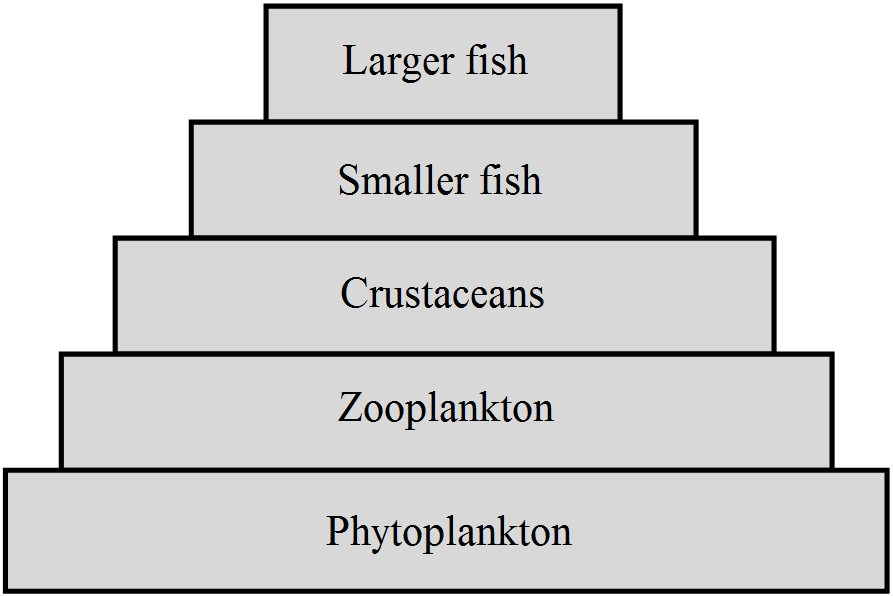
It is a graphic presentation of aquatic food chain in terms of numbers of producers and consumers at each level.
View full question & answer
Question 673 Marks
What are the limitations of ecological pyramids?
Answer
Limitations of ecological pyramids:
  1. It never takes into account the same species belonging to two or more trophic levels.
  2. It assumes a simple food chain, which never exists in nature.
  3. In spite of the vital role played by saprophytes/ decomposers, they are not given any position in ecological pyramids.
View full question & answer
Question 683 Marks
Fill in the missing stages in the given primary hydrarch succession.
Phytoplankton → (a) → (b) → (c) → Submerged free-floating → (d) → Forest plant stage.
What is common between hydrarch and xerarch succession?
Answer
  1. Reed-swamp stage.
  2. Submerged plant stage.
  3. Marsh-meadow stage.
  4. Scrub stage.

Both the hydrarch and xerarch lead to mesic conditions of forest.

View full question & answer
Question 693 Marks
Construct an ideal pyramid of energy, where 1,000,000 joules of sunlight is available. Label all its trophic level.
View full question & answer
Question 703 Marks
What will happen to an ecosystem if:
  1. All producers are removed;
  2. All organisms of herbivore level are eliminated;
  3. All top carnivore population is removed.
Answer
  1. Reduction in primary productivity. No biomass available for consumption by higher trophic levels/ heterotrophs and hence heterotrophs also die of starvation.
  2. Increase in primary productivity and biomass of producers. Carnivore population will subsequently dwindle due to food shortage.
  3. Increase in number of herbivores which leads to over-grazing by herbivores, finally resulting in desertification.
View full question & answer
Question 713 Marks
According to the 10% law given by Lindeman, only 10% of the energy is transferred to the next trophic level.
  1. Name the process by which an organism produces energy.
  2. What is the most common substrate used in this pathway?
  3. Which biomolecule is also known as energy currency of the cell?
Answer
  1. The process of harvesting chemical energy for metabolic activities by oxidising the food molecules is called respiration.
  2. The most common substrate used in the process is glucose.
  3. ATP or Adenosine Triphosphate is also known as energy currency of the cell.
View full question & answer
Question 723 Marks
How does a detritivore differ from a decomposer? Explain with an example each.
Answer
Detritivore
Decomposer
Detritivore is an organism that breaks down the detritus into smaller particles in the process, called fragmentation, e.g. Earthworm.
Decomposer is an organism which by secreting enzymes degrades the detritus into simpler inorganic substances, e.g. Some bacteria and some fungi.
View full question & answer
3 Marks Question - Page 2 - BIOLOGY STD 12 Science Questions - Vidyadip