Questions · Page 1 of 2

3 Marks Question

🎯

Test yourself on this topic

50 questions · timed · auto-graded

Question 13 Marks
Explain antibiotic resistance observed in bacteria in light of Darwinian selection theory.
Answer
Darwinian selection theory states that individuals with favourable variations are better adapted than individuals with less favourable variation. It means that nature selects the individuals with useful variation as these individuals are better evolved to survive in the existing environment. An example of such selection is antibiotic resistance in bacteria. When bacterial population was grown on an agar plate containing antibiotic penicillin, the colonies that were sensitive to penicillin died, where as one or few bacterial colonies that were resistant to penicillin survived. This is because these bacteria had undergone chance mutation, which resulted in the evolution of a gene that made them resistant to penicillin drug. Hence, the resistant bacteria multiplied quickly as compared to non-resistant (sensitive) bacteria, thereby increasing their number. Hence, the advantage of an individual over other helps in the struggle for existence.
View full question & answer
Question 23 Marks
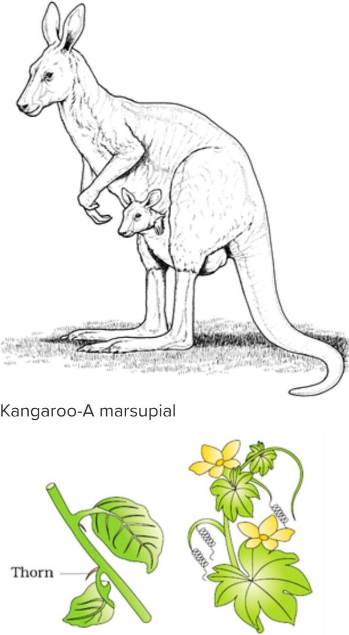
Practise drawing various animals and plants.
Answer

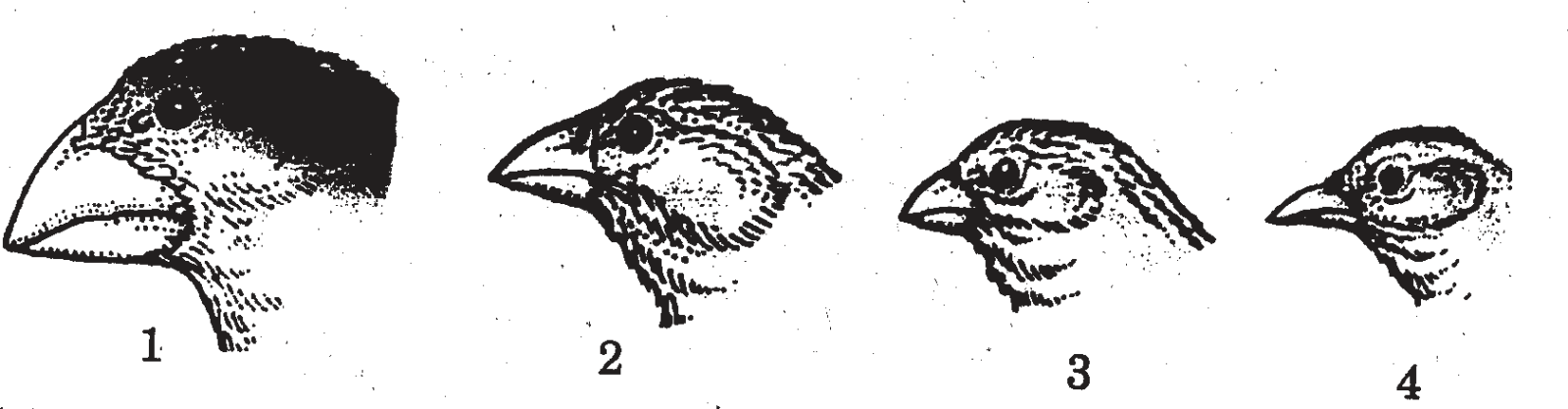
Drawin's finches

Thorns in Bougainvillea and tendrils in Cucurbita- examples of homology.
View full question & answer
Question 33 Marks
Rearrange Ramapithecus, Australopithecus and Homo habilis in the order of their evolution on the Earth. Comment on their evolutionary characteristics.
Answer
Ramapithecus $\rightarrow$ Australopithecu $\rightarrow$ Homo habilis
  • Ramapithecus- hairy/walked like gorilla and chimpanzees/more man like
  • Australopithecus- Hunted with stone weapons/ate fruit.
  • Homo habilis- Brain capacity 650- 800 cc/probably did not eat meat.
View full question & answer
Question 43 Marks
How do homologous organs represent divergent evolution? Explain with the help of a suitable example.
Answer
Organs with similar strucuture/same ancestry/anatomically same/same origin developed along different directions due to adapation/different needs, to perform different functions.

For example the fore limbs of some animals (Vertebrates) like whales, bats, cheetah and human have similar anatomical strucuture (i.e. humerus, radius, ulna, carpals, metacarpals and phalanges) develop differently to meet different needs/to perform different functions.

View full question & answer
Question 53 Marks
  1. Explain adaptive radiation with the help of a suitable example.
  2. Cite an example where more than one adaptive radiation have occurred in an isolated geographical area. Name the type of evolution your example depicts and state why it is so named.
Answer
  1. Darwin finches/black birds (on Galapagos islands), evolved from original seed eating features, into insectivorous & vegetarian features in different habitat/islands.
  2. Australian marsupials and placental mammals. Convergent evolution, more than one adaptive radiation occured in isolated geographical area.
View full question & answer
Question 63 Marks
What is disturbance in Hardy-Weinberg genetic equilibrium indicative of? Explain how it is caused.
Answer
  • Disturbance in Hardy-Weinberg equilibrium is an indicator of change of frequency of alleles in a population, resulting in evolution.
  • It is caused by genetic drift/gene flow or gene migration/mutation/genetic recombination/natural selection.
View full question & answer
Question 73 Marks
Differentiate between divergent and convergent evolution. Give one example of each.
Answer
 
Divergent
Convergent
1.
same structure developed along different direction.
Different structures evolving for the same function.
2.
due to adaptation to different needs.
due to adaptation to meet similar needs. 
3.
Examples:
  • Vertebrates heart & brain
  • thorn of Bougainvillea and tendrils of cucurbita 
  • fore limbs of whales, bat, cheetah, humans.
Examples:
  • Wing of bird & insects
  • Potato & sweet potato
  • Eye of Octopus & mammals
  • Flippers of Penguins & dolphin
View full question & answer
Question 83 Marks
Write the characteristics of Ramapithecus, Dryopithecus and Neanderthal man.
Answer
Ramapithecus  :  hairy/walked like gorillas and chimpanzees, more man like.
Dryopithecus  :  hairy/walked like gorillas and chimpanzees, more ape-like.
Neanderthal man  :  brain size is 1400cc, used hides to protect their body/buried their dead.
View full question & answer
Question 93 Marks
Differentiate between homology and analogy. Give one example of each.
Answer
Homology

Analogy

Organisms having the same structure developed along different directions due to adaptations/different functions.

Different structures having the same function. (in different organisms)

Result of divergent evolution.

Result of convergent evolution.
Indicates common ancestry. Does not indicate common ancestry.
Anatomically same structures. Anatomically different structures.

Example:

Forelimbs of whale - bats - cheetah – human//

Thorns of Bougainvillea - tendrils of cucurbits.

Example:

Wings of butterfly and birds//

Sweet potato and potato.

View full question & answer
Question 103 Marks
What does the following equation represent? Explain.
p2 + 2 pq + q2 = 1
Answer
Hardy Weinberg's Principle/allele frequencies in a population are stable and is constant from generation to generation,/represents stable allelic frequency in a population indicating no evolution occurring, p2 frequency of homozygous dominant/AA, 2 pq frequency of heterozygous/Aa.q2 frequency of homozygous recessive/aa.
View full question & answer
Question 113 Marks
Since the origin of life on the earth, there were five episodes of mass extinction of species.
  1. How is the 'Sixth Extinction', presently in progress, different from the previous episodes?
  2. Who is mainly responsible for the 'Sixth Extinction'?
  3. List any four points that can help to overcome this disaster.
Answer
  1. The rates are faster/accelerated/current species extinction rate are estimated to be 100 - 1000 times faster than in the pre-human times.
  2. Human activities.
  3.  
  1. Preventing habitat loss and fragmentation.
  2. Checking overexploitation.
  3. Preventing alien species invasion.
  4. Preventing co-extinction.
  5. Conservation/Preservation of species.
View full question & answer
Question 123 Marks
Explain the increase in the numbers of melanic (dark winged) moths in the urban areas of post-industrialisation period in England.
Answer
They will grow in areas that are polluted. Hence, moths that were able to comouflag themselves, i.e., hide in the background, Survived. This understanding is supported by the fact that in areas where industrialisation did not occur e.g., in rural areas, the count of melanic moths was low. This showed that in a mixed population, those that can better-adapt, survive and increase in population size. Remember that no variant is completely wiped out.
View full question & answer
Question 133 Marks
How does industrial melanism support Darwin’s theory of Natural Selection? Explain.
Answer
Before industrial revolution-the environment was unpolluted the lichens on the barks of trees-pale, white winged moths could easily camouflage, while the dark winged were spotted out by the birds for food-hence they could not survive, After industrial revolution the lichens became dark (due to soot deposit), This favoured the dark winged months while the white winged were picked by birds, The population of the former increased (naturally selected).
View full question & answer
Question 143 Marks
Branching descent and natural selection are the two key concepts of Darwinian Theory of Evolution. Explain each concept with the help of a suitable example.
Answer
Branching descent: Different species descending from the common ancestor - get adapted in different habitats.
e.g. Darwins finches - varieties of finches arose from grain eaters/Australian marsupials- evolved from common marsupial.
Natural selection: A process in which heritable variations enable better survival of a species to reproduce in large number.
e.g. White moth surviving before the industrial revolution and black moth surviving after industrial revolution/Long necked giraffe survived/DDT resistant mosquito survive.
View full question & answer
Question 153 Marks
How do organisms cope with stressful external environmental conditions which are localised or of short duration?
Answer
Migrate temporarily from the stressful habitat to a hospitable area/suspended activities/Form thick walled spores/Form dormant seeds/Hibernate during winter/Aestivate during summer/Planktons diapause.
View full question & answer
Question 163 Marks
Water is very essential for life. Write any three features both for plants and animals which enable them to survive in water scarce environment.
Answer
Plants: Ephemeral mode (complete life cycle in short period)/Deep tap roots/Deciduous leaves/Waxy cuticle/sunken stomata/Succulence to storewater/C4 Pathway of Photosynthesis.
Animals: No sweating/uricotelic/deposition of fat insub epidermal layer/burrowing nature/thick skin/body covered with scales.
View full question & answer
Question 173 Marks
  1. How does the Hardy - Weinbergís expression (p2 + 2pq+ q2 = 1) explain that genetic equilibrium is maintained in a population.
  2. List any two factors that can disturb the genetic equilibrium.
Answer
  1. Gene frequencies in a population are stable, constant from generation to generation, until some change in frequency happens, due to some factor.
  2. Gene migration/gene flow/gene drift/mutation/genetic recombination/natural selection.
View full question & answer
Question 183 Marks


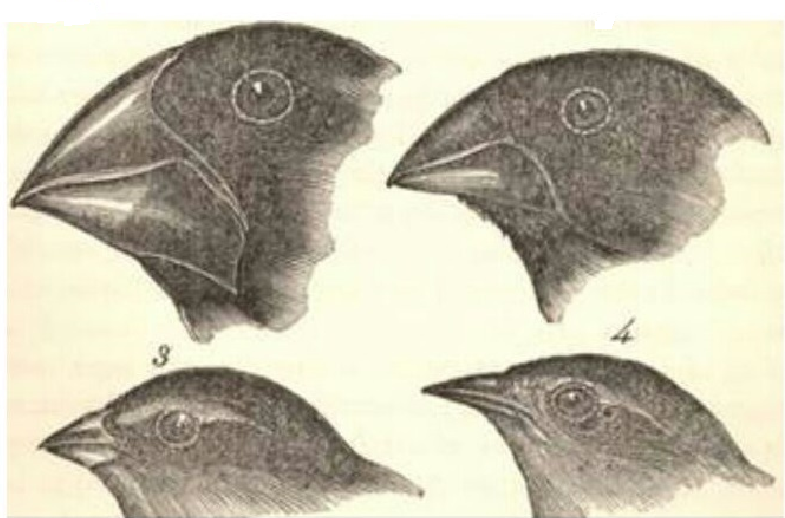
  1. Write your observations on the variations seen in the Darwin’s finches shown above.
  2. How did Darwin explain the existence of different varieties of finches on Galapagos Islands?
Answer
  1. From the original seed eating features, many other forms with altered beaks arose, enabling them to become insectivorous and vegetarian finches.
  2. The process of evolution of different species in a given geographical area starting from one point, and literally radiating to other areas of geography (habitats), is called adaptive radiation.
View full question & answer
Question 193 Marks
How do fossils help us in understanding the evolutionary history?
Answer
  1. Fossils in different sedimentary layers indicate the geological period in which they existed.
  2. They show that life forms varied over time.
  3. New forms of life have arisen at different times in the history of earth.
View full question & answer
Question 203 Marks
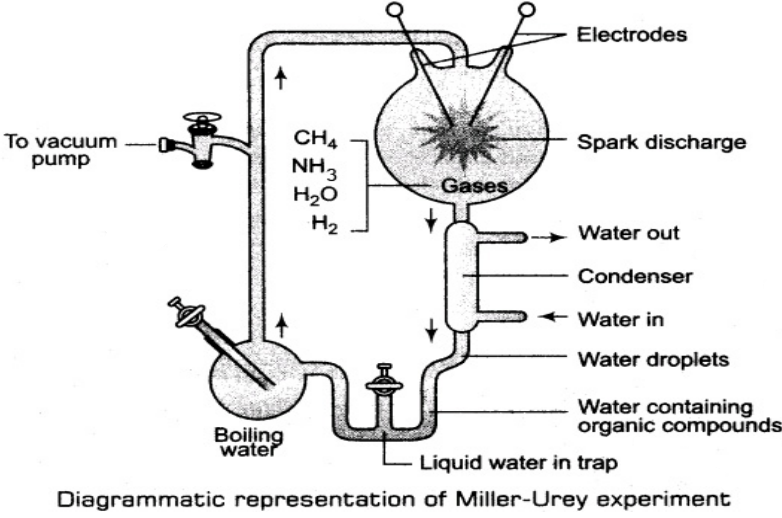
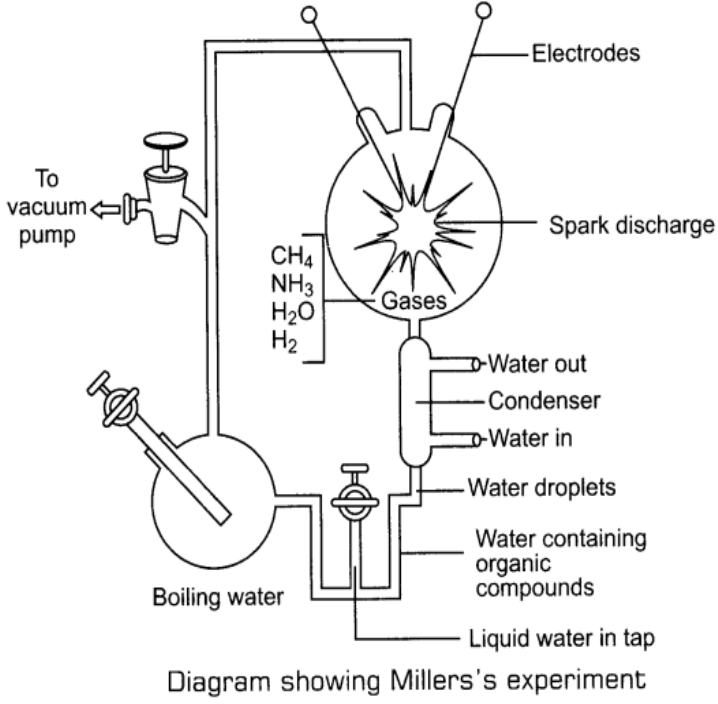
Describe the experiment of S.L. Miller on the origin of life. Write the conclusion drawn at the end of the experiment.
Answer

The set-up created conditions like that of primitive atmosphere, Electrical discharge with electrodes in closed flask, containing CH4 NH3 H2 H2O vapour, - observed formation of amino acids.
Conclusion: The first form of life arose through evolutionary forces from non-living molecules/abiogenesis.
View full question & answer
Question 213 Marks
  1. State Oparin-Haldane’s hypothesis.
  2. How does S.L. Miller’s experiment supports it?
Answer
  1. Life could have come from pre-existing non-living organic molecules, and that formation of life was preceded by chemical evolution.
  2. (S. L. Miller created condition similar to prehistoric earth in the laboratory) He created electric discharge in a closed flask, containing CH4 H2 NHand water vapour, at 8000C observed formation of amino acid (organic molecules)

View full question & answer
Question 223 Marks
State the contribution of Louis Pasteur in understanding the origin of life on earth. Explain the procedure that he followed to arrive at his conclusion.
Answer
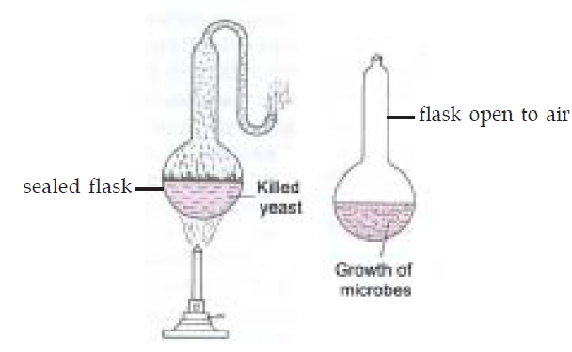
Pasteur in his experiment took a flask containing sugar solution and added yeast to it , then boiled the contents of the flask so that yeast got killed.
In presterlized sealed flask, life did not come from killed yeast.
In open flask (open to air) life comes from pre existing life, new living organisms arose in presence of killed yeast.
View full question & answer
Question 233 Marks
"Post-industrialization, the population of melanised moth increased in England at the expense of white-winged moths." Provide explanations.
Answer
Pre Industrialisation had more white winged moth against grey lichens on tree trunk, industrialisation led to deposition of soot & smoke on tree bark, making bark of trees dark, against the dark background white moth could easily be preyed upon, melanised moth could camouflage against dark bark, increased in number (through reproduction)/natural selection.
View full question & answer
Question 243 Marks
p2 + 2 pq + q2 = 1. Explain this algebraic equation on the basis of Hardy Weinberg’s principle.
Answer
If p represents the frequency of allele A, q represents the allele frequency of a, then frequency of AA = p2, aa = q², Aa = 2pq.

Total genes and their alleles in a population or gene pool remains constant. (called as genetic equilibrium)

Sum total of all the allelic frequencies is: 1/[p + q = 1/(p + q)² = 1]

View full question & answer
Question 253 Marks
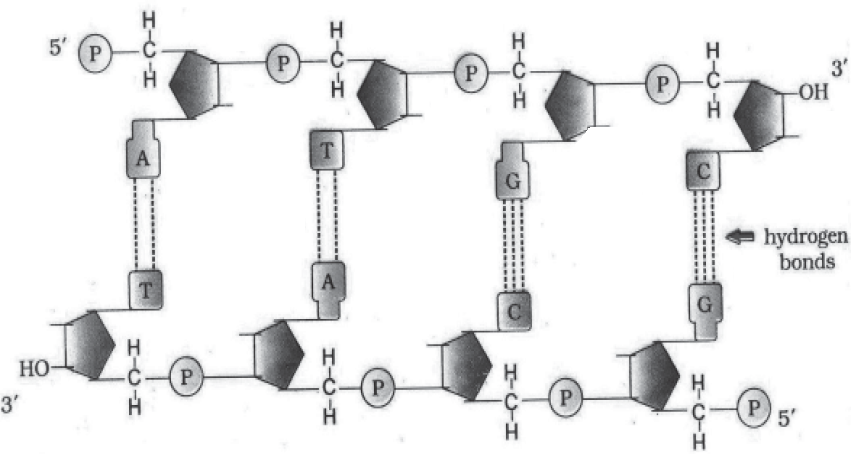
  1. A DNA segment has a total of 2,000 nucleotides, out of which 520 are adenine containing nucleotides. How many purine bases this DNA segment possesses?
  2. Draw a diagrammatic sketch of a portion of DNA segment to support your answer.
Answer
  1. 1000 purines.
  1. Calculation:

$\text{A} = \text{T},\ \ \text{A} = 520\ \ \text{hence}\ \ \text{ T} = 520$

$\text{A + T} = 520 + 520 = 1040$

$\text{so}\ \ \text{G + C} = 2000 - 1040 = 960$

$\text{G = C}, \text{so}\ \ \text{C}=\frac{960}{2}=480$

$\text{so pyrimidines}=\text{C + T}$

$= 480 + 520 = 1000$

  1. Purine A and G always pair with T and C respectively.
  2. $\text{(iii)}\frac{\text{A}}{\text{G}}=\frac{\text{T}}{\text{C}}=1 \ \text{(Chargaff rule)}$
  1.  

Diagram showing polarity:

N- base

H - bond

Deoxyribose sugar.

View full question & answer
Question 263 Marks
Explain the interpretation of Charles Darwin when he observed a variety of small black birds on Galapagos Islands.
Answer
Darwin conjectured that all varieties are evolved on the Galapagos island itself, from original seed eating features, many other forms with altered beaks arose, became insectivorous, and vegetarian finches, adaptive radiation.
View full question & answer
Question 273 Marks
What is adaptive radiation? When can adaptive radiation be referred to as convergent evolution? Give an example.
Answer
Adaptive Radiation - The process of evolution of different species in a given geographical area starting from a point and literally radiating to other geographical areas (habitats),
When more than one adaptive radiation appeared to have occurred in an isolated geographical area (representing different habitats) , then this can referred to as convergent evolution.
Example:
Placental mammals Australian marsupials
Wolf Tasmanian wolf
Mole Marsupial mole
Anteater Numbat (anteater)
Mouse Marsupial mouse
Lemur Spotted cuscus
Flying squirrel Flying phalanger
Bobcat Tasmanian tiger cat
View full question & answer
Question 283 Marks
Describe the experiment that helped Louis Pasteur to dismiss the theory of spontaneous generation of life.
Answer
Two pre-sterilised flasks with killed yeast, one sealed, other open to air, differential growth of life in two flasks/life was found only in open flask.

// the following diagram can be considered in lieu of above explanation.

life comes from pre-existing life (it came from air entering the flask)/proved the theory of biogenesis.

View full question & answer
Question 293 Marks
Explain adaptive radiation with the help of a suitable example.
Answer
Evolution of different species in a given geographical area starting from a point and literally radiating to other geographical areas habitat is called adaptive radiation.
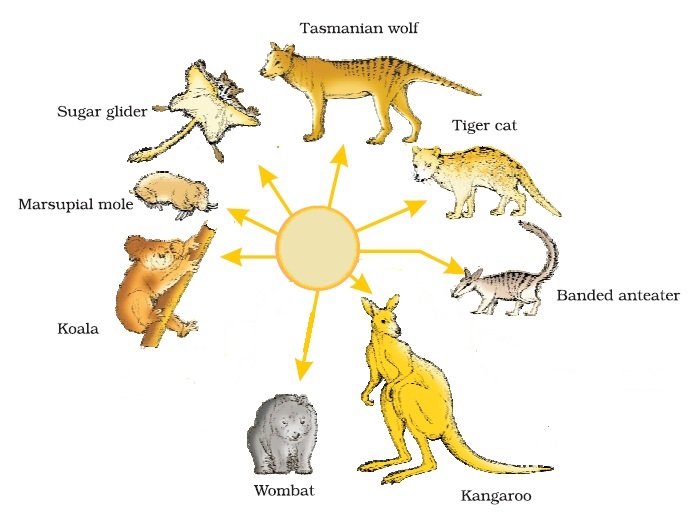
A number of marsupials each different from other/Tasmanian Wolf/Tiger Cat/Banded Anteater/Marsupial Rat/Kangaroo/Wombat/Bandicoot/Koala/Marsupial mole/Sugar Glider, evolved from an ancestral stock, but all within Australian continent.
Darwin's finches, from original seed, eating features many other forms with altered beaks arose, enabling them to become insectivorous/vegetarian finches on the same (Galapagos) islands.
View full question & answer
Question 303 Marks
With the help of any two suitable examples explain the effect of anthropogenic action on organic evolution.
Answer
Anthropogenic activities have caused increased rate of evolution.
  1. The excess use of herbicides and pesticides in the agricultural field by the humans to kill pests and insects has resulted in selections of resistant variety of pests and insects over a short time span the change favored resistance pests and insects which lead to their evolution.
  2. The excess use of antibiotics has caused selection of drug-resistant microbes, the microbes sensitive to antibiotics died but few variants having resistance against it survived. This led to evolution of more fatal microbes.
View full question & answer
Question 313 Marks
State the theory of Biogenesis. How does Miller’s experiment support this theory?
Answer
Biogenesis -A living organism arises from another living organism.
Miller’s experiment -An electric discharge, was created in a closed flask containing CH4 - H2 -NH3, and water vapour at 800°C, which resulted in the formation of amino acids, supports chemical evolution.
//Miller’s experiment does not support Theory of Biogenesis it supports chemical evolution.
View full question & answer
Question 323 Marks
Explain convergent and divergent evolution with the help of one example of each.
Answer
Convergent - Different structures evolving in the same direction in different organisms eg. wings of butterfly and of birds/eye of octopus and of mammals/the flippers of penguins and dolphins/sweet potato and potato.
Divergent - Same structure evolving in different directions in different organisms eg. forelimbs of whales, bats, cheetah and humans/vertebrate hearts or brains/thorns of Bougainvillea and tendrils of cucurbita.
View full question & answer
Question 333 Marks

  1. Mention the specific geographical region where these organisms are found.
  2. Name and explain the phenomenon that has resulted in the evolution of such diverse species in the region.
  3. Explain giving reasons the existence of placental wolf and Tasmanian wolf sharing the same habitat.
Answer
  1. Australia.
  2. Adaptive Radiation The process of evolution of different species in a given geographical area starting from a point and literally radiating to other areas of geography (habitat) is called adaptive radiation.
  3. (Convergent evolution/Adaptive Convergence) Organisms coming from different stock, evolved similar features and adapted to same habitat.
View full question & answer
Question 343 Marks
  1. Differentiate between analogous and homologous structures.
  2. Select and write analogous structures from the list given below:
  1. Wings of butterfly and birds.
  2. Vertebrate hearts.
  3. Tendrils of bougainvillea and cucurbita.
  4. Tubers of sweet potato and potato.
Answer
  1.  
 
Analogous Organs
Homologous Organs
i.
Those organs which are structurally dissimilar but functionally similar are called analogous organs.
Those organs, which are structurally similar but functional dissimilar are called homologous organs.
ii.
They lead to convergent evolution.
They lead to divergent evolution.
iii.
Eg. Wings of birds and insects.
Eg. Forelimbs of terrestrial vertebrates such as frog, lizard, bird, bat, horse, man.
  1. Following are the analogous structure from the given list:
  1. Wings of butterfly and birds.
  2. Tubers of sweet potato and potato.
View full question & answer
Question 353 Marks
  1. Write two differences between Homo erectus and Homo habilis.
  2. Rearrange the following from early to late geologic periods:

Carboniferous, Silurian, Jurassic.

Answer
  1.  
 
Homo habilis
Homo erectus
1
This creature probably lived in East African grassland around two mya
This creature lived about 15 mya and its fossils were discovered in Java in 1891.
2
Brain capacity of this creature was 650–800cc.
Brain capacity was around 900cc.
3
They did not eat meat.
They probably ate meat.
  1. Silurian, Carboniferous, Jurassic.
View full question & answer
Question 363 Marks
What are the periods in Palaeozoic era and name the plant group that appeared in each of them?
Answer
The periods in Palaeozoic era are:
  1. Silurian Zosterophyllum. (Psilophyton, Rhynia type plants).
  2. Devonian Progymnosperms.
  3. Carboniferous seed ferns.
  4. Permian Arborescent lycopods.
View full question & answer
Question 373 Marks
How did Louis Pasteur successfully demolish the popular theory of spontaneous generation? What were his conclusions?
Answer
He used particular type of flasks in his experiment.
His flasks were pre-sterilised and heat-killed yeast culture was kept in them.
  1. One flask was kept closed and the other was left open.
  2. He showed that in the closed pre-sterilised flask, life did not come from the killed yeast; in the other flask that was kept open, life appeared from killed yeast. This dismissed the theory of spontaneous generation.
  3. He concluded that life can come from pre-existing life.
View full question & answer
Question 383 Marks
  1. When and where did Neanderthal man live?
  2. What was his brain capacity?
  3. Mention the advancements he showed over Homo erectus.
Answer
  1. Neanderthal man lived in near east and Central Asia, between 1,00,000-40,000 years before.
  2. His brain capacity was 1400cc.
  3. He used hides to protect the body. He buried the dead. His brain size was more (1400cc) than that of Homo erectus which was 900cc.
View full question & answer
Question 393 Marks
  1. Name the ancestors of progymnosperm.
  2. Name the ancestors of herbaceous and arborescent lycopod.
  3. Name the ancestors of cycads.
Answer
  1. Psilophyton.
  2. Zosterophyllum.
  3. Progymnosperm.
View full question & answer
Question 403 Marks
Enumerate three most characteristic criteria for designating a Mendelian population.
Answer
The three most important criteria for designating a Mendelian population are as follows:
  • Population must be sufficiently large.
  • Free flow of genetic materials is ensured through sexual reproduction.
  • There should be negligible or nil migration in the population.
View full question & answer
Question 413 Marks
How did Louis Pasteur successfully demolish the popular theory of spontaneous generation?
Answer
Pasteur invented the swan-necked flask to create an environment known not to grow microorganisms. After sterilizing a nutrient broth in these flasks, he removed the swan necks of the controls. Microorganisms grew only in the controls, refuting spontaneous generation.
View full question & answer
Question 423 Marks
Whose theory was put to test by Miller and Urey and what was the theory? How did their experiment give due to abiotic origin of life on earth?
Answer
Urey and Miller tested the theory of Oparin and Haldane, which states that life originated on the earth through physiochemical processes of atoms combining to form molecules which in turn react to produce inorganic and organic compounds. Miller and Urey created the similar environment as described by Oparin and Haldane in laboratory using glass apparatus and tubes. They took CH4, NH3, H2O, H2 and water vapour for their experiment and supplied electric discharge using cathode in a closed flask at 800°C. After a week, it was observed that a number of complex organic molecules have originated, e.g., some sugars, nitrogen bases, amino acids and lipids. When the meteorites were analysed, it was observed that presence of similar compounds was confirmed which conclude that similar process is going on elsewhere in the space.
View full question & answer
Question 433 Marks
Would you consider the wings of butterfly and a bat as a homologous or analogous?
Answer
It is an example of analogous organ as the basic structure of the wings of butterfly is different from that of the wings of the bat. Their function is similar and is used for flying.
View full question & answer
Question 443 Marks
What is the study of fossils called? Mention any three points how the fossils throw light on the past.
Answer
Study of fossils is called Paleontology:
  1. The rocks of early era contain less number of fossils than the rocks of later era and fossils of only simple marine invertebrates are in these rocks, which indicate that life originated in sea as simple form.
  2. The distribution of fossils indicates that fossils became more and more complex as we proceeded from earliest to recent rocks.
  3. On the basis of fossil study, it has been shown that the early organisms were very different from their modern forms.
View full question & answer
Question 453 Marks
Define analogous organ. Give one example of analogous organ.
Answer
The organs, which have similar functions but are different in their structural details and origin are called analogous organs. The analogous structures are the result of convergent evolution. Fins of fishes and flippers of whales are analogous organs.
View full question & answer
Question 463 Marks
Give a brief account of origin of earth.
Answer
The origin of life on the earth took place million of years ago and the study of history of life forms on earth is called evolutionary biology. The history of life actually comprises of two events, i.e. firstly origin of life and secondly the mechanism involved in the changes of living organisms through time or evolution of life. The origin of life is considered a unique went in the history of universe.
View full question & answer
Question 473 Marks
What are fossils? Mention any two ways in which the study of fossils support biological evolution of an organism.
Answer
Fossils are the remains or impressions of pre-historic organisms preserved in sedimentary rocks or other media.

Two ways in which study of fossils support biological evolution:

  1. The study of Archaeopteryx reveals that birds have evolved from reptiles. This shows fossils provide evidence for evolution.
  2. Phylogeny can be constructed from fossils.
  3. The habitat and behaviour of extinct organisms can be inferred from well-preserved fossils.
View full question & answer
Question 483 Marks
How can Hardy-Weinberg equilibrium be affected? Explain giving three reasons.
Answer
Any disturbance in Hardy-Weinberg's genetic equilibrium indicates an evolutionary change.

It is caused by one or more of the following:

  1. Gene migration/ Gene flow:
  • When a section of a population migrates to another population in another place, the gene frequencies change in both the populations.
  • When gene migration occurs a number of times, there is gene flow.
  1. Genetic drift: Due to some chance events, the allele frequency becomes so different that they become new species.
  2. Natural selection: It is a process in which heritable variations enabling better survival are made to reproduce and leave more progeny; hence, there is a change in the allele frequency.
  3. Genetic recombination: In sexually reproducing organisms, recombination of maternal and paternal alleles occurs during gametogenesis, it is a major cause of variation in the allele frequency
View full question & answer
Question 493 Marks
What is natural selection? How is artificial selection different from natural selection? Give one example each from plants and animals where artificial selection has operated.
Answer
The nature builds some pressure on the population of a species and as a result few individuals are eliminated and few adapt to adjust with changes and become fit. This biological phenomenon is called natural selection.

S. No Natural selection Artificial selection
(i) It is a natural phenomenon. It is the practice done by man.
(ii) As a result only fit individual increases in a population. As a result commercially high yielding and disease resistance varieties increase.

Artificial selection have been operated in the followings cases:

Plants: Cabbage, wheat.

Animals: High milk yielding varieties of cows.

View full question & answer
Question 503 Marks
What is molecular homology? Cite one example.
Answer
Molecular homology is the similarity among organisms at the molecular level. The amino acid sequence for the protein cytochromic-C is the same in humans and chimpanzee. Molecular homology shows phyllogenetic relationships.
View full question & answer
3 Marks Question - BIOLOGY STD 12 Science Questions - Vidyadip