Questions · Page 1 of 3

2 Marks Questions

🎯

Test yourself on this topic

50 questions · timed · auto-graded

Question 12 Marks
What are the major functions of male accessory ducts and glands?
Answer
Major functions of male-accessory ducts are:

  • Aid in sperm transport.
  • Temporary storage of spermatozoa.

Male accessory glands secretions constitute the seminal plasma. These secretions are rich in fructose, ascorbic acid, citrate, calcium, certain enzymes and prostaglandins. These secretions nourish and activate the spermatozoa to swim.
View full question & answer
Question 22 Marks
Name the hormones involved in regulation of spermatogenesis.
Answer
Follicle-stimulating hormones (FSH) and luteinizing hormones (LH) are secreted by gonadotropin releasing hormones from the hypothalamus. These hormones are involved in the regulation of the process of spermatogenesis.
FSH acts on sertoli cells, whereas LH acts on leydig cells of the testis and stimulates the process of spermatogenesis.
View full question & answer
Question 32 Marks
What are the major components of seminal plasma?
Answer
Semen (produced in males) is composed of sperms and seminal plasma. The major components of the seminal plasma in the male reproductive system are mucus, spermatozoa, and various secretions of accessory glands. The seminal plasma is rich in fructose, calcium, ascorbic acid, and certain enzymes. It provides nourishment and protection to sperms.
View full question & answer
Question 42 Marks
Define spermiogenesis and spermiation.
Answer
Spermiogenesis is the process of transformation of spermatids into mature flagellated spermatozoa (sperms). Spermiation is the process of release of mature spermatozoa. In this spermatozoa are shed into the lumen of seminiferous tubule for transport.
View full question & answer
Question 62 Marks
Write two major functions each of testis and ovary.
Answer
Functions of the Testis:

  • They produce male gametes called spermatozoa by the process of spermatogenesis.
  • The leydig cells of the seminiferous tubules secrete the male sex hormone called testosterone. Testosterone aids the development of secondary sex characteristics in males.

Functions of the ovary:

  • They produce female gametes called ova by the process of oogenesis.
  • The growing Graafian follicles secrete the female sex hormone called estrogen. Estrogen aids the development of secondary sex characteristics in females.
View full question & answer
Question 72 Marks
Where is acrosome present in humans? Write its function.
Answer
On the sperm head, has enzymes to dissolve the follicles of ovum/facilitate entry of sperm nucleus for fertilisation/help the sperm enter into the cytoplasm of the ovum.
View full question & answer
Question 82 Marks
Name the embryonic stage that gets implanted in the uterine wall of a human female.
Answer
Blastocyst/Blastula.
View full question & answer
Question 92 Marks
Where does fertilisation normally take place in a human female?
Answer
Fallopian tubes/ (ampulla of) oviduct.
View full question & answer
Question 102 Marks
Write the location and function of the Sertoli cells in humans.
Answer
In the seminiferous tubules/testes, nourishes sperms/germ cells.
View full question & answer
Question 112 Marks
Name the type of cell division that takes place in the zygote of an organism exhibiting haplontic life cycle.
Answer
Meiosis.
View full question & answer
Question 122 Marks
How does colostrum provide initial protection against diseases to newborn infants? Give one reason.
Answer
Colostrum has abundant antibodies/IgA to develop resistance in newborn babies.
View full question & answer
Question 132 Marks
How many eggs do you think were released by the ovary of a female dog which gave birth to 6 puppies?
Answer
Six eggs were released by the ovary of a female dog which gave birth to six puppies.
View full question & answer
Question 152 Marks
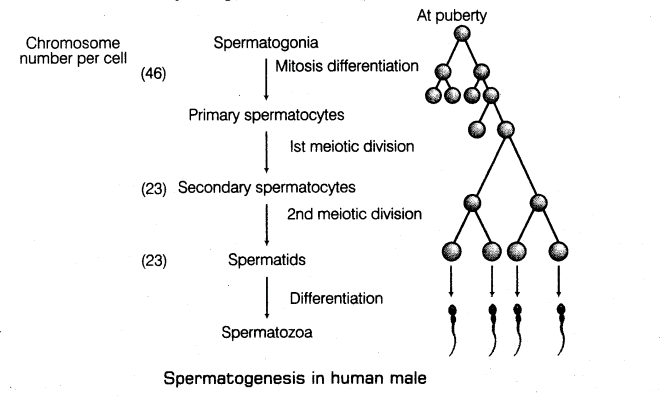
A spermatogonial cell has 30 chromosomes. How many chromosomes will be found in:
  1. The primary spermatocyte.
  2. The spermatid?
Answer
  1. 30
  2. 15
View full question & answer
Question 162 Marks
Match Column I with Column II.
S. No.
Column I
S. No.
Column II
A.
Acrosome
1. 
Motility of sperm towards the egg.
B.
Head
2.
Powerhouse of the sperm; contains a number of mitochondria.
C.
Tail
3.
Contains the genetic material.
D.
Middle piece
4.
Contains enzymes to dissolve egg envelopes.
Answer
S. No.
Column I
S. No.
Column II
A.
Acrosome
4. 
Contains enzymes to dissolve egg envelopes.
B.
Head
3.
Contains the genetic material.
C.
Tail
1.
Motility of sperm towards the egg.
D.
Middle piece
2.
Powerhouse of the sperm; contains a number of mitochondria.
View full question & answer
Question 172 Marks
How is a primary spermatocyte different from a secondary spermatocyte?
Answer
  1. A primary spermatocyte is diploid and has 46 chromosomes; it undergoes meiosis I and forms two secondary spermatocytes.
  2. A secondary spermatocyte is haploid and has 23 chromosomes; it undergoes meiosis II and forms two spermatids.
View full question & answer
Question 182 Marks
Observe the relationship between first two words and suggest suitable word for the fourth one:
  1. Ovary : Mesovarium :: Uterus: A.
  2. Male : Penis :: Female : B.
  3. Male gametes: Sperms:: Female gametes: C.
Answer
  1. A - Pelvic wall.
  2. B - Clitoris.
  3. C - Ova.
View full question & answer
Question 192 Marks
What is the role of cervix of the human female system in reproduction?
Answer
Cervix helps in regulating the passage of sperms into the uterus and forms the birth canal to facilitate parturition.
View full question & answer
Question 212 Marks
Males in whom testes fail to descend to the scrotum are generally infertile. Why?
Answer
If the testes fail to descend to the scrotum, gametogenesis could be inhibited. The process of spermatogenesis requires a marginally lesser ambient temperature than that in the abdominal cavity.
View full question & answer
Question 222 Marks
Name the important mammary gland secretions that help in resistance of the new born baby.
Answer
Colostrum.
View full question & answer
Question 232 Marks
When and where do chorionic villi appear in humans? State their functions.
Answer
Chorionic villi appear after implantation on the trophoblast. It becomes interdigitated with uterine tissue to form the placenta and increases the surface area for exchange of materials between the mother and the embryo.
View full question & answer
Question 242 Marks
State the function of trophoblast in human embryo.
Answer
Trophoblast forms chorionic villi, which become part of the placenta.
View full question & answer
Question 252 Marks
How does the sperm penetrate through the zona pellucida in human ovum?
Answer
The sperm penetrates through zona pellucida with the help of secretions from acrosome.
View full question & answer
Question 262 Marks
What do you mean by foetal ejection reflex?
Answer
These are mild uterine contraction induced by the signals for parturition originated from fully developed foetus and placenta.
View full question & answer
Question 282 Marks
Somatic chromosome number is 40. What shall be the chromosome number in the cells of seminiferous tubules?
Answer
40 chromosomes.
View full question & answer
Question 292 Marks
What is urethral meatus?
Answer
The urethra originates from the urinary bladder and extends through penis to its external opening called urethral meatus.
View full question & answer
Question 302 Marks
What are chorionic villi?
Answer
Chorionic villi are the finger-like projections formed by the trophoblast immediately after implantation; they form the foetal part of the placenta.
View full question & answer
Question 332 Marks
Mark the odd one the following groups.
Fimbriae, Labia minora, Infundibulum, Isthmus.
Answer
Labia minora.
View full question & answer
Question 342 Marks
What is the role of cervix in the human female reproductive system?
Answer
Cervix helps in regulating the passage of sperms into the uterus and forms the birth canal to facilitate parturition.
View full question & answer
Question 352 Marks
Given below are the stages in human reproduction. Write them in correct sequential order.
Insemination, Gametogenesis, Fertilisation, Parturition, Gestation, Implantation
Answer
Gametogenesis, Insemination, Fertilisation, Implantation, Gestation, Parturition.
View full question & answer
Question 362 Marks
Which type of cell division forms spermatids from the secondary spermatocytes?
Answer
Second meiotic division.


View full question & answer
Question 382 Marks
Given below are the events in human reproduction. Write them in correct sequential order.
Insemination, gametogenesis, fertilisation, parturition, gestation, implantation.
Answer
Gametogenesis → Insemination → Fertilisation → Implantation → Gestation → Parturition.
View full question & answer
Question 422 Marks
Where does fertilization take place in human female?
Answer
Ampullary-isthmic junction of the fallopian tube.
View full question & answer
Question 432 Marks
Name the stages when oogenesis and spermatogenesis initiate in human female and male, respectively.
Answer
Oogenesis starts during embryonic developmental stages of the female foetus while, spermatogenesis starts at puberty.
View full question & answer
Question 442 Marks
How is the entry of only one sperm and not many ensured into an ovum during fertilisation in humans?
Answer
During fertilisation a sperm head comes in contact with zona pellucida layer of ovum and induces changes in the membrane that block the entry of additional sperms.
View full question & answer
Question 452 Marks
How is the first sign of growing foetus noticed?
Answer
The first sign of growing foetus is noticed by listening to the heart sounds through a stethoscope.
View full question & answer
Question 462 Marks
Luteal phase of the menstrual cycle is also called the secretory phase. Give reason.
Answer
In this phase, progesterone stimulates the endometrial glands of the uterus to secrete a nutrient fluid for the foetus hence, also called the secretory phase.
View full question & answer
Question 472 Marks
Sperms have a tail, whereas eggs do not. Why?
Answer
Because eggs are non-motile (stationary) and sperms have to travel up to eggs.
View full question & answer
Question 482 Marks
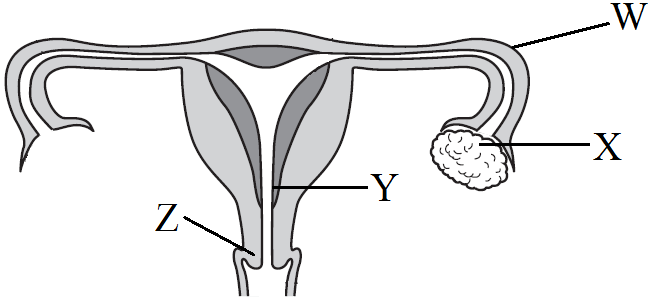
The diagram shows the female reproductive system. Where do fertilisation and implantation occur?

Answer
Fertilisation takes place in Fallopian tube (W) and implantation takes place in uterus (Y).
View full question & answer
Question 492 Marks
Mention the location and the function of Leydig cells in humans.
Answer
Leydig cells are present in the regions called interstitial spaces outside the seminiferous tubules. They synthesise and secrete androgens (testosterone).
View full question & answer
Question 502 Marks
Sperms have a tail whereas egg does not, why?
Answer
Sperms swim by vibrating their tail in the fluid while eggs do not require it.
View full question & answer
2 Marks Questions - BIOLOGY STD 12 Science Questions - Vidyadip