Questions

3 Marks Question

🎯

Test yourself on this topic

9 questions · timed · auto-graded

Question 13 Marks
Discuss: "Different levels of biodiversity".
Answer
→ The most important of them are :
→ (i) Genetic diversity :
→ A single species might show high diversity at the genetic level over its distributional range.
→ The genetic variation shown by the medicinal plant Rauwolfia vomitoria growing in different Himalayan ranges might be in terms of the potency and concentration of the active chemical (reserpine) that the plant produces.
→ India has more than 50,000 genetically different strains of rice, and 1,000 varieties of mango.
→ (ii) Species diversity :
→ The diversity at the species level, for example, the Western Ghats have a greater amphibian species diversity than the Eastern Ghats.
→ (iii) Ecological diversity :
→ At the ecosystem level, India, for instance, with its deserts, rain forests, mangroves, coral reefs, wetlands, estuaries, and alpine meadows has a greater ecosystem diversity than a Scandinavian country like Norway.
View full question & answer
Question 23 Marks
Describe genetically engineered Insulin with diagram.
Answer
→ Insulin is produced by beta cells of pancreas.
→ Insulin plays important role in a sugar or carbohydrate metabolism.
→ Due to lack of insulin diabetes mellitus occurs in humans.
→ Insulin used for diabetes was earlier extracted from pancreas of slaughtered cattle and pigs.
→ Insulin from an animal source, though caused some patients to develop allergy or other types of reactions to the foreign protein.
Image
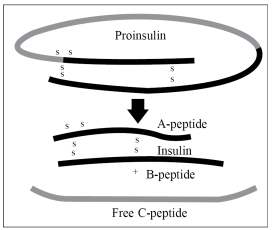
→ Insulin consists of two short polypeptide chains: chain A and chain B.
→ Polypeptide Chain A contains 21 amino acids and chain B contains 30 amino acids that are linked together by disulphide bridges.
→ In mammals, including humans, insulin is synthesised as a pro-hormone (like a pro-enzyme, the pro-hormone also needs to be processed before it becomes a fully mature and functional hormone) which contains an extra stretch called the C peptide.
→ This C peptide is not present in the mature insulin and is removed during maturation into insulin.
→ The main challenge for production of insulin using rDNA techniques was getting insulin assembled into a mature form.
→ In 1983, Eli Lilly an American company prepared two DNA sequences corresponding to A and B, chains of human insulin and introduced them in plasmids of E. coli to produce insulin chains.
→ Chains A and B were produced separately, extracted and combined by creating disulfide bonds to form human insulin.
View full question & answer
Question 33 Marks
Write significance of microbes as Biofertilisers.
Answer
→ Due to our present day life styles, environmental pollution is a major cause of concern.
→ The use of chemical fertilizers to meet the ever-increasing demand of agricultural produce has contributed significantly to this pollution.
→ There are problems associated with the overuse of chemical fertilizers and there is a large pressure to switch to organic farming - the use of biofertilizers.
→ Biofertilizers are organisms that enrich the nutrient quality of the soil,
→ The main sources of biofertilizers are bacteria, fungi and cyanobacteria.
→ The nodules on the roots of leguminous plants are formed by the symbiotic association of Rhizobium.
These bacteria fix atmospheric nitrogen into organic forms, which is used by the plant as nutrient.
→ Other bacteria can fix atmospheric nitrogen while free-living in the soil Azospirillum and Azotobacter, enriching the nitrogen content of the soil.
→ Fungi are also known to form symbiotic associations with plants(mycorrhiza).
→ Many members of the genus Glomus form mycorrhiza.
→ The fungal symbiont in these associations absorbs phosphorus from soil and passes it to the plant.
→ In paddy fields, cyanobacteria serve as an important biofertilizer.
→ Currently, in our country, a number of biofertilizers are available commercially in the market and farmers use these regularly in their fields to replenish soil nutrients and to reduce dependence on chemical fertilizers.
→ In agriculture, there is a method of controlling pests that relies on natural predation rather than introduced chemicals.
→ The use of biocontrol measures will greatly reduce our dependence on toxic chemicals and pesticides.
→ A biological control being developed for use in the treatment of plant disease is the fungus Trichoderma. Trichoderma species are free-living fungi.
Trichoderma is a biocontrol agent of several plant pathogens.
View full question & answer
Question 43 Marks
Describe biological treatment of Sewage. (Figure is not necessary)
Answer
→ Large quantities of waste water are generated everyday in cities and towns. A major component of this waste water is human excreta. This municipal waste water is also called sewage.
→ It contains large amounts of organic matter and microbes, many of which are pathogenic.
→ This cannot be discharged into natural water bodies like rivers and streams directly.
→ Before disposal, hence, sewage is treated in Sewage Treatment Plant (STPs) to make it less polluting.
→ Treatment of waste water is done by heterotrophic microbes naturally present in the sewage.
→ There are two stages of the process:
(1) Primary treatment
(2) Secondary treatment (biological treatment)
→ The following sequential treatment is done in secondary treatment.
→ The primary effluent is passed into large aeration tanks, Where it is constantly agitated mechanically and air is pumped into it.
→ This allows vigorous growth of useful aerabic microbes into flocs (masses of bacterial associated with fungal filaments to form mesh like structures).
→ While growing, these microbes consume the major part of the organic matter in the effluent.
→ This results in significant reduction of the BOD (Biochemical Oxygen Demand) of the effluent.
→ The greater the BOD of waste water, the more is its polluting potential.
→ Once the BOD of sewage or waste water is reduced significantly, the effluent is then passed into a settling tank.
→ Where bacterial 'flocs' are allowed to sediment. This sediment is called activated sludge.
→ A small part of the activated sludge is pumped back into the aeration tank to serve as the inoculum.
→ The remaining major part of the sludge is pumped into large tanks called anaerobic sludge digesters.
→ Here, other kinds of bacteria, which grow anaerobically, digest the bacteria and the fungi in the sludge.
→ During this digestion, bacteria produce a mixture of gases from biogas such as carbon dioxide, methane and hydrogen. These gases from biogas and can be used as source of energy as it is inflammable.
View full question & answer
Question 53 Marks
Explain adaptive radiation. (Figure is not necessary)
Answer
→ The process of development of different species starting from one point of a given geographical area to other geographical habitats is called adaptive radiation.
Darwin finch
→ Darwin Finch is an excellent example of this type of phenomenon.
→ Darwin saw several species of finches across the Galapagos Islands.
→ He speculated that all species had evolved on the island by themselves.
→ Along with other features of the original finches (seed eating), their beaks may have evolved for other forms that made them insectivorous and herbivorous finches.
Australian marsupials
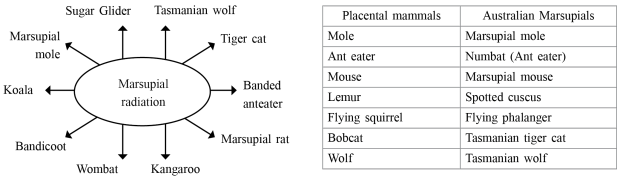
→ Another example is the Australian marsupial.
→ Most marsupials were different from each other.
→ They evolved from a common set of ancestors, but they all evolved on the Australian island continent.
→ When more than one adaptive diffusion occurs in a geographical area (representing different habitats) it is called convergent evolution.
→ Mammals of Australia marsupials (E.g.:- the wolf and the Tasmanian wolf) show a similar evolution.
Image
View full question & answer
Question 63 Marks
Describe Miller's experiment with diagram.
Answer

Image
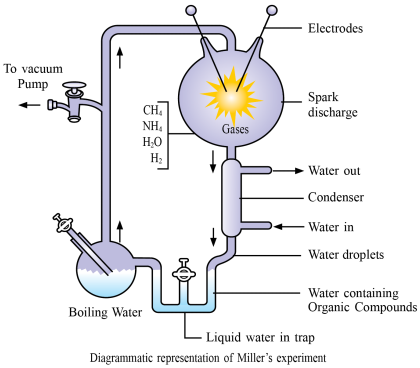
→ In 1953, an American scientist named S. L. Miller created in the laboratory a condition similar to the Earth's primordial atmosphere.
→ He mixed CH4, H2, NH3 and water vapour in a closed flask at a temperature of $800^{\circ} $C and arranged the electrodes and gave electric shocks. Then the mixture was cooled in the condenser and made a liquid.
→ He Collected the liquid in a separate flask,
→ After two weeks of the procedure, the fluid was analyzed by chromatography.
→ He found that amino acids were formed in it. Besides hydroxy acids (scientific name of H2O) and aliphatic acids were also present.
→ Similarly, other scientists have observed in this type of experiment that sugars, nitrogen bases, pigments and fats were produced.
View full question & answer
Question 73 Marks
Explain transforming principle with Griffith's experiment.
Answer
→ Transforming Principle
→ In 1928, Frederick Griffith, in a series of experiments with Streptococcus pneumoniae (bacterium responsible for pneumonia), witnessed a miraculous transformation in the bacteria.
→ During the course of his experiment, a living organism (bacteria) had changed in physical form.
→ When Streptococcus pneumoniae (pneumococcus) bacteria are grown on a culture plate,
(I) Some produce smooth shiny colonies (S) while others produce rough colonies (R).
(II) This is because the S strain bacteria have a mucous (polysaccharide) coat, while R strain does not.
→ Mice infected with the S strain (virulent) die from pneumonia infection but mice infected with the R strain do not develop pneumonia.
Image
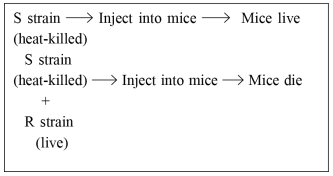
→ Griffith was able to kill bacteria by heating them.
→ He observed that heat-killed S strain bacteria injected into mice did not kill them.
Image
→ When he injected a mixture of heat-killed S and live R bacteria, the mice died. Moreover, he recovered living S bacteria from the dead mice.
→ He concluded that the R strain bacteria had somehow been transformed by the heat-killed S strain bacteria.
→ Some 'transforming principle', transferred from the heat-killed S strain, had enabled the R strain to synthesise a smooth polysaccharide coat and become virulent.
→ This must be due to the transfer of the genetic material. However, the biochemical nature of genetic material was not defined from his experiments,
View full question & answer
Question 83 Marks
Explain various events during a menstrual cycle in detail. (Diagram is not necessary)
Answer
→ (i) Menarche - The first menstruation begins at puberty and is called menarche.
→ (ii) Menopause - In human beings, menstrual cycles ceases around 50 years of age; that is termed as menopause.
→ (iii) Menstrual cycle - In human females, menstruation is repeated at an average interval of about 28/29 days, and the cycle of events starting from one menstruation till the next one is called the menstrual cycle.
→ Menstrual cycle: It is the reproductive cycle of female primates (such as monkeys, apes, and humans).
→ The menstrual cycle is the sequence of events that begins with one menstruation and ends with the next.
→ Menstruation occurs every 28/29 days in human females.
→ Menstruation, the follicular phase, ovulation, and the luteal phase are the four phases of the menstrual cycle.
→ Hormones that regulate the menstrual cycle are: Follicle-stimulating hormone (FSH), Luteinizing hormone (LH), Estrogen and Progesterone.
View full question & answer
Question 93 Marks
Describe double fertilization in flowering plant. (Diagram is not necessary)
Answer

Image
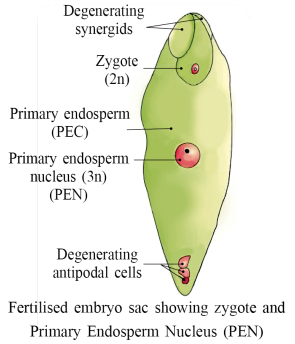
→ After entering one of the synergids, the pollen tube releases the two male gametes into the cytoplasm of the synergid.
→ One of the male gametes moves towards the egg cell and fuses with its nucleus thus completing the syngamy. This results in the formation of a diploid cell, the zygote.
→ The other male gamete moves towards the two polar nuclei located in the central cell and fuses with them to produce a triploid Primary Endosperm Nucleus (PEN).
→ As this involves the fusion of three haploid nuclei it is termed triple fusion.
→ Since two types of fusions, syngamy and triple fusion take place in an embryo sac the phenomenon is termed double fertilisation, an event unique to flowering plants.
→ The central cell, after triple fusion, becomes the Primary Endosperm Cell (PEC) and develops into the endosperm while the zygote develops into an embryo.
View full question & answer
3 Marks Question - BIOLOGY STD 12 Science Questions - Vidyadip