Questions

3 Marks Question

🎯

Test yourself on this topic

9 questions · timed · auto-graded

Question 13 Marks
Explain a typical biogas plant with diagram.
Answer
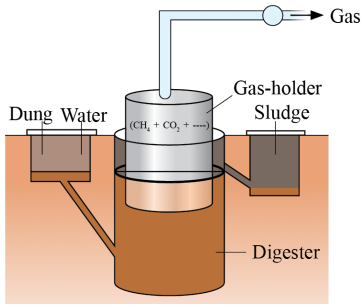
10-15 feet deep concrete tank is prepared for biogas plant.
Image
→ This tank is fed by collected bio-waste and a slurry.
→ A floating cover is placed over the slurry.
→ Due to microbial activity (Methanogens) this slurry keeps rising as the gas is produced.
→ The biogas plant has an outlet.
→ This is connected to a pipe to supply biogas to nearby houses.
→ The spent slurry is removed through another outlet and may be used for as a fertiliser.
→ The biogas plants are more often built in rural areas.
→ The biogas thus produced is used for cooking and lighting.
→ In biogas plant, bacteria produce a mixture of gases from biogas such as carbon dioxide, methane and hydrogen.
→ These bacteria are collectively called as methanobacterium.
View full question & answer
Question 23 Marks
What is gene therapy? Illustrate using the example of adenosine deaminase (ADA) deficiency.
Answer
→ Gene therapy is a collection of methods that allows correction of a gene defect that has been diagnosed in a child/embryo.
→ Here by using DNA medicinal protein is produce which correct or treat the mutated Gene.
→ Here genes are inserted into a person's cells and tissues to treat a disease.
→ Correction of a genetic defect involves delivery of a normal gene in to the individual or embryo to take over the function of and compensate for the non-functional gene.
→Example - Adenosine deaminase deficiency
→ The first clinical gene therapy was given in 1990 to a 4-year old girl with adenosine deaminase (ADA) deficiency.
→ This enzyme is crucial for the immune system to function.
→ The disorder is caused due to the deletion of the gene for adenosine deaminase.
→ In some children ADA deficiency can be cured by bone marrow transplantation.
→ In others it can be treated by enzyme replacement therapy, in which functional ADA is given to the patient by injection.
→ But the problem with both of these approaches that they are not completely curative. As a first step towards gene therapy, lymphocytes from the blood of the patient are grown in a culture outside the body.
→ A functional ADA CDNA (using a retroviral vector) is then introduced into these lymphocytes, which are subsequently returned to the patient.
→ However, as these cells are not immortal, the patient requires periodic infusion of such genetically engineered lymphocytes.
→ However, if the gene isolate from marrow cells producing ADA is introduced into cells at early embryonic stages, it could be a permanent cure.
View full question & answer
Question 33 Marks
Explain - adaptive radiation
Answer
→ The process of development of different species starting from one point of a given geographical area to other geographical habitats is called adaptive radiation.
Darwin finch
→ Darwin Finch is an excellent example of this type of phenomenon.
→ Darwin saw several species of finches across the Galapagos Islands.
→ He speculated that all species had evolved on the island by themselves.
→ Along with other features of the original finches (seed eating), their beaks may have evolved for other forms that made them insectivorous and herbivorous finches.
Australian marsupials
→ Another example is the Australian marsupial.
→ Most marsupials were different from each other.
They evolved from a common set of ancestors, but they all evolved on the Australian island continent.
→ When more than one adaptive diffusion occurs in a geographical area (representing different habitats) it is called convergent evolution.
→ Mammals of Australia marsupials (E.g.:- the wolf and the Tasmanian wolf) show a similar evolution.
View full question & answer
Question 43 Marks
Give the salient features of the genetic code.
Answer
→ During replication and transcription a nucleic acid was copied to form another nucleic acid. Hence, these processes are easy to conceptualise on the basis of complementarity.
→ The process of translation requires transfer of genetic information from a polymer of nucleotides to synthesise a polymer of amino acids.
→ Neither does any complementarity exist between nucleotides and amino acids, nor could any be drawn theoretically.
→ There existed ample evidences, though, to support the notion that change in nucleic acids (genetic material) were responsible for change in amino acids in proteins.
→ This led to the proposition of a genetic code that could direct the sequence of amino acids during synthesis of proteins.
View full question & answer
Question 53 Marks
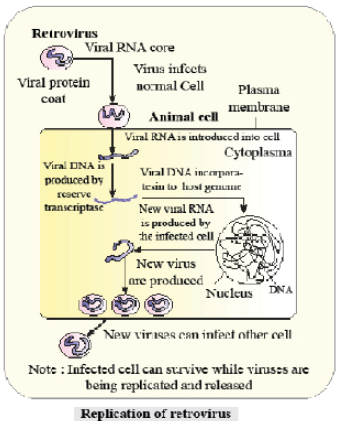
Illustrate the chart of replication of retrovirus.
Answer
→ The word AIDS stands for Acquired Immuno Deficiency Syndrome.
→ This means deficiency of immune system, acquired during the lifetime of an individual indicating that it is not a congenital disease. 'Syndrome' means a group of symptoms,
→ AIDS was first reported in 1981 and in the last twenty-five years or so, it has spread all over the world killing more than 25 million persons.
Image
View full question & answer
Question 63 Marks
What are cry proteins? Name an organism that produces it. How has man exploited this protein to his benefit?
Answer
→ In Bacillus thuringiensis, there is a bacterial gene which produce toxic crystal protein having insecticidal activity. This crystal protein is called Cry protein.
→ Bt toxin is produced by a bacterium called Bacillus thuringiensis.
→ Bt toxin gene has been cloned from the bacteria and been expressed in plants.
→ So plants become resistance to insects without the need for insecticides. This is how a biopesticide is created.
→ Some strains of Bacillus thuringiensis produce proteins that kill certain insects such as lepidopterans (tobacco budworm, armyworm), coleopterans (beetles) and dipterans (flies, mosquitoes).
B. thuringiensis forms protein crystals during a particular phase of their growth.
→ These crystals contain a toxic insecticidal protein.
→ Actually, the Bt toxin protein exist as inactive protoxins.
→ But once an insect ingest the inactive toxin, it is converted into an active form of toxin due to the alkaline pH of the gut which solubilise the crystals.
→ The activated toxin binds to the surface of midgut epithelial cells and create pores.
→ That cause cell swelling and lysis and eventually cause death of the insect.
→ Specific Bt toxin genes were isolated from Bacillus thuringiensis and incorporated into the several crop plants such as cotton.
→The proteins encoded by the genes crylAc and crylIAb control the cotton bollworms.
→ CrylAb controls com borer.
View full question & answer
Question 73 Marks
Explain the internal structure of testis (Figure is not essential).
Answer
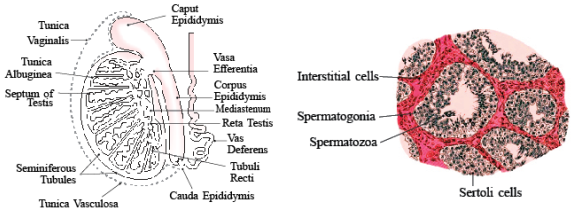
→ Each lobule contains one to three highly coiled "seminiferous tubules" in which sperms are produced.
→ Each seminiferous tubules is lined on its inside by two types of cells.
(i) Male germ cells : It is also called Spermatogonia.
→ It undergo meiotic divisions finally leading to sperm formation.
(ii) Sertoli Cells : Provide nutrition to the germ cells.
→ In a lobule the regions outside the seminiferous tubules are called "interstitial spaces".
→ Interstitial spaces contain : (i) Small blood vessels (ii) Interstitial Cells/Leydig Cells
(iii) Other immunologically competent cells
Leydig Cells Synthesise and secrete testicular hormones called "androgens".
Image
View full question & answer
Question 83 Marks
Define decomposition and describe the processes of decomposition. (Diagram is not required)
Answer
→ Decomposition :
→ Break down complex organic matter into inorganic substances like carbon dioxide, water and nutrients and the process is called decomposition.
→ Dead plant remains such as leaves, bark, flowers and dead remains of animals, including feacal matter, constitute detritus, which is the raw material for decomposition.
→ Important steps for decomposition :
→ The important steps in the process of decomposition are fragmentation, leaching, catabolism, humification and mineralisation.
→ Fragmentation :
→ Detritivores (e.g., earthworm) break down detritus into smaller particles. This process is called fragmentation.
→ Leaching :
→ By the process of leaching, water soluble inorganic nutrients go down into the soil horizon and get precipitated as unavailable salts.
→ Catabolism :
→ Bacterial and fungal enzymes degrade detritus into simpler inorganic substances. This process is called as catabolism.
→ Humification :
→ Humification leads to accumulation of a dark coloured amorphous substance called humus that is highly resistant to microbial action and undergoes decomposition at an extremely slow rate.
→ Being colloidal in nature it serves as a reservoir of nutrients.
→ Mineralisation :
→ The humus is further degraded by some microbes and release of inorganic nutrients occur by the process known as mineralisation.
→ Factors affecting decomposition:
→ Decomposition is largely an oxygen-requiring process.
→ The rate of decomposition is controlled by chemical composition of detritus and climatic factors.
→ In a particular climatic condition, decomposition rate is slower if detritus is rich in lignin and chitin.
→ Decomposition rate is quicker, if detritus is rich in nitrogen and water-soluble substances like sugars.
→ Temperature and soil moisture are the most important climatic factors that regulate decomposition through their effects on the activities of soil microbes.
→ Warm and moist environment favour decomposition, whereas low temperature and anaerobiosis inhibit decomposition resulting in build up of organic materials.
View full question & answer
Question 93 Marks
Explain the Ex-situ conservation.
Answer
→ In this approach, threatened animals and plants are taken out from their natural habitat and placed in special setting where they can be protected and given special care.
→ Zoological parks, botanical gardens and wildlife safari parks serve this purpose. There are many animals that have become extinct in the wild but continue to be maintained in zoological parks.
→ In recent years, ex situ conservation has advanced beyond keeping threatened species in enclosures.
→ Now gametes of threatened species can be preserved in viable and fertile condition for long periods using cryopreservation techniques, eggs can be fertilised in vitro, and plants can be propagated using tissue culture methods.
→ Seeds of different genetic strains of commercially important plants can be kept for long periods in seed banks.
View full question & answer
3 Marks Question - BIOLOGY STD 12 Science Questions - Vidyadip