Questions

2 Marks Questions

🎯

Test yourself on this topic

6 questions · timed · auto-graded

Question 12 Marks
Treatment of wastewater is done in a sewage treatment plant to make it less polluting. Explain the following with reference to this treatment process:
$a.$ Primary sludge
$b.$ Activated sludge
$c.$ Anaerobic sludge digesters
Answer
$a.$ Treatment process in primary Sludge: All the solids that settle down, during the primary treatment of sewage water.
$b.$ Treatment process in Activated Sludge: Produced during the secondary treatment or biological treatment of sewage, primary effluent $+$ aerobic microbes flocs $($bacteria and fungus$) -$ get converted to a sediment whose $ \text{BOD}$ has reduced significantly.
$c.$ Treatment process in Anaerobic sludge digesters: Large tanks where activated sludge is treated with anaerobic bacteria which digest the bacteria and fungi, and produce a mixture of $CH_4, H_2S$ and $CO_2/$ Biogas
View full question & answer
Question 22 Marks
a. A patient had suffered myocardial infarction and clots were found in his blood vessels. Name a clot buster that can be used to dissolve the clots and the micro-organism from which it is obtained.
b. A woman had just undergone a kidney transplant. A bioactive molecular drug is administered to oppose kidney rejection by the body. What is the bioactive molecule? Name the microbe from which this is extracted.
c. What do doctors prescribe to lower the blood cholesterol level in patients with high blood cholesterol? Name the source organism from which this drug can be obtained.
Answer
a. Clot buster - Streptokinase, microorganism - Streptococcus
b. Cyclosporin A, Trichoderma polysporum
c. Statins, Monascus purpureus.
View full question & answer
Question 32 Marks
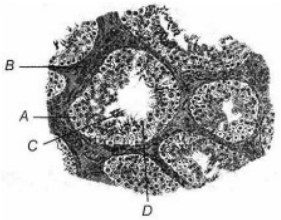
Study the sectional view of human testis showing seminiferous tubules given below.
Image
i. Identify A, B and C.
ii. Write the function of A and D.
Answer
1. A-Spermatogonia,
B-Interstitial cells
C-Spermatozoa.
2. A-Spermatogonia produces a spermatogonium (plural: spermatogonia) is an undifferentiated male germ cell. Spermatogonia undergo spermatogenesis to form mature spermatozoa in the seminiferous tubules of the testes.
D-Sertoli cells provide nutrition to sperms.
View full question & answer
Question 42 Marks
Majority of angiosperms have hermaphrodite flowers, but self-pollination is discouraged by them. Explain any three outbreeding devices that they have developed to achieve this.
Answer
i. Pollen release and stigma receptivity not synchronised, either pollen released before the stigma is receptive or otherwise.
ii. Anther and stigma are placed at different position, stigma cannot come in contact with the pollen of the same flower.
iii. In some plant flowers are unisexual, male flower and female flower born on different plant.
iv. Self incompatibility, it is a genetic mechanism and prevents self pollen from fertilising the ovule by inhibiting pollen germination or pollen tube growth in the pistil.
v. Many angiosperms possess genetic mechanisms that prevent self-pollination through self-incompatibility systems. These systems recognize and reject pollen from the same plant, promoting cross-pollination.
View full question & answer
Question 52 Marks
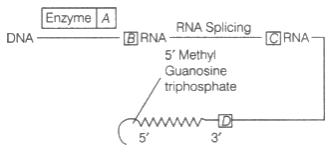
Given below is a sequence of steps of transcription in a eukaryotic cell. Answer the following questions:
Image
i. Fill up the blanks (A, B, C and D) left in the sequence.
ii. Why hnRNA is required to undergo splicing?
Answer
i. A - DNA polymerase, B - hnRNA, C - Spliced RNA, D - mRNA
ii. hnRNA is required to undergo splicing because of the presence of introns in it. These need to be removed and the exons have to be joined in a specific sequence for translation to take place.
View full question & answer
Question 62 Marks
Some of the microbes used as biofertilizers are prokaryotes. Name the taxonomic group they come under. With the help of an example, mention how they act as biofertilizers.
Answer
The following microorganisms are used as biofertilizers:
i. Rhizobium: They form root nodules in leguminous plants and fix the atmospheric nitrogen into an organic form. Rhizobium also has no negative effect on soil quality and improves the quality, nutrient content, and growth of the plant.
ii. Azotobacter: These are free-living nitrogen fixers found in all types of upland crops. These not only fix nitrogen but also provide certain antibiotics and growth substances to the plant.
View full question & answer
2 Marks Questions - BIOLOGY STD 12 Science Questions - Vidyadip