Why is the Human Genome project called a mega project?
Question types
Molecular Basis of Inheritance question types
850 questions across 7 question groups — pick any mix to generate a BIOLOGY paper with step-by-step answer keys.
850
Questions
7
Question groups
5
Question types
01
2 Marks Questions
149 Q→023 Marks Question
116 Q→03Case study (4 Marks)
11 Q→041 Marks Question
222 Q→05M.C.Q (1 Marks)
270 Q→06Assertion (A) & Reason (B) MCQ
20 Q→075 Marks Questions
62 Q→Sample Questions
Molecular Basis of Inheritance questions
One sample from each question group in this chapter. Select any group above to see the full set with answer keys.
View full solution →
Group the following as nitrogenous bases and nucleosides:
Adenine, Cytidine, Thymine, Guanosine, Uracil and Cytosine.
Adenine, Cytidine, Thymine, Guanosine, Uracil and Cytosine.
If a double stranded DNA has 20 per cent of cytosine, calculate the per cent of adenine in the DNA.
List two essential roles of ribosome during translation.
Depending upon the chemical nature of the template (DNA or RNA) and the nature of nucleic acids synthesised from it (DNA or RNA), list the types of nucleic acid polymerases.
Differentiate between the following:
mRNA and tRNA.
What is DNA fingerprinting? Mention its application.
Which property of DNA double helix led Watson and Crick to hypothesise semi-conservative mode of DNA replication? Explain.
How did Hershey and Chase differentiate between DNA and protein in their experiment while proving that DNA is the genetic material?
Differentiate between the following:
Template strand and Coding strand.
Read the following and answer any four questions from (i) to (v) given below: In prokaryotes, DNA is circular and present in the cytoplasm but in eukaryotes, DNA is linear and mainly confined to the nucleus. DNA or deoxyribonucleic acid is a long polymer of nucleotides. In 1953, the first correct double-helical structure of DNA was worked out by Watson and Crick. Based on the X-ray diffraction data produced by Maurice Wilkins and Rosalind Franklin. It is composed of three components, i.e., A phosphate group, a deoxyribose sugar and a nitrogenous base. Different forms of DNA are B-DNA, Z-DNA, A-DNA, C-DNA and D-DNA.
- Name the linkage present between the nitrogen base and pentose sugar in DNA.
- Phosphodiester bond
- Phosphodiester bond
- Hydrogen bond
- None of these
- The double helix structure of DNA was proposed by.
- James Watson and Francis Crick.
- Earwin Chargaff
- Federick Griffith
- Hershey and Chase.
- The double chain of B-DNA is coiled in a helical fashion. The spiral twisting of B-DNA duplex produces.
- Right and left part.
- Major and minor grooves.
- Upper and lower side.
- Linear and circular part.
- Assertion: The two strands of DNA helix have uniform distance between them.
Reason: A large sized purine always paired opposite to a small sized pyrimidine.
- Both assertion and reason are true and reason is the correct explanation of assertion.
- Both assertion and reason are true but reason is not the correct explanation of assertion.
- Assertion is true but reason is false.
- Both assertion and reason are false.
- Which of the following describes the structure of B-DNA?
| S.no | Polynudeotide chains | Polynudeotide chains |
| (a) | Parallel | 5 |
| (b) | Anti-parallel | 10 |
| (c) | Parallel | 15 |
| (d) | Anti-parallel | 20 |
Read the following and answer any four questions from (i) to (v) given below: Mutation explains the relationship between gene and DNA. The effects of large deletions and rearrangement in a segment of DNA results in loss or gain of gene and its function. Insertion or deletion of one or two bases changes the reading frame from the point of insertion or deletion. A classical example of point mutation is a change of single base pair in the gene for beta globin chain that results in change of amino acid residue glutamate to valine and results into a diseased condition called sickle cell anaemia.
The mutation has changed the amino acid.
mRNA codons for these amino acids are Glutamine (Glu) GAA GAG Praline (Pro) CCU CCC Threonine (Thr) ACU ACC Valine (Val) GUA GUG Which transfer RNA molecule is involved in the formation of this part of the sickle cell haemoglobin? 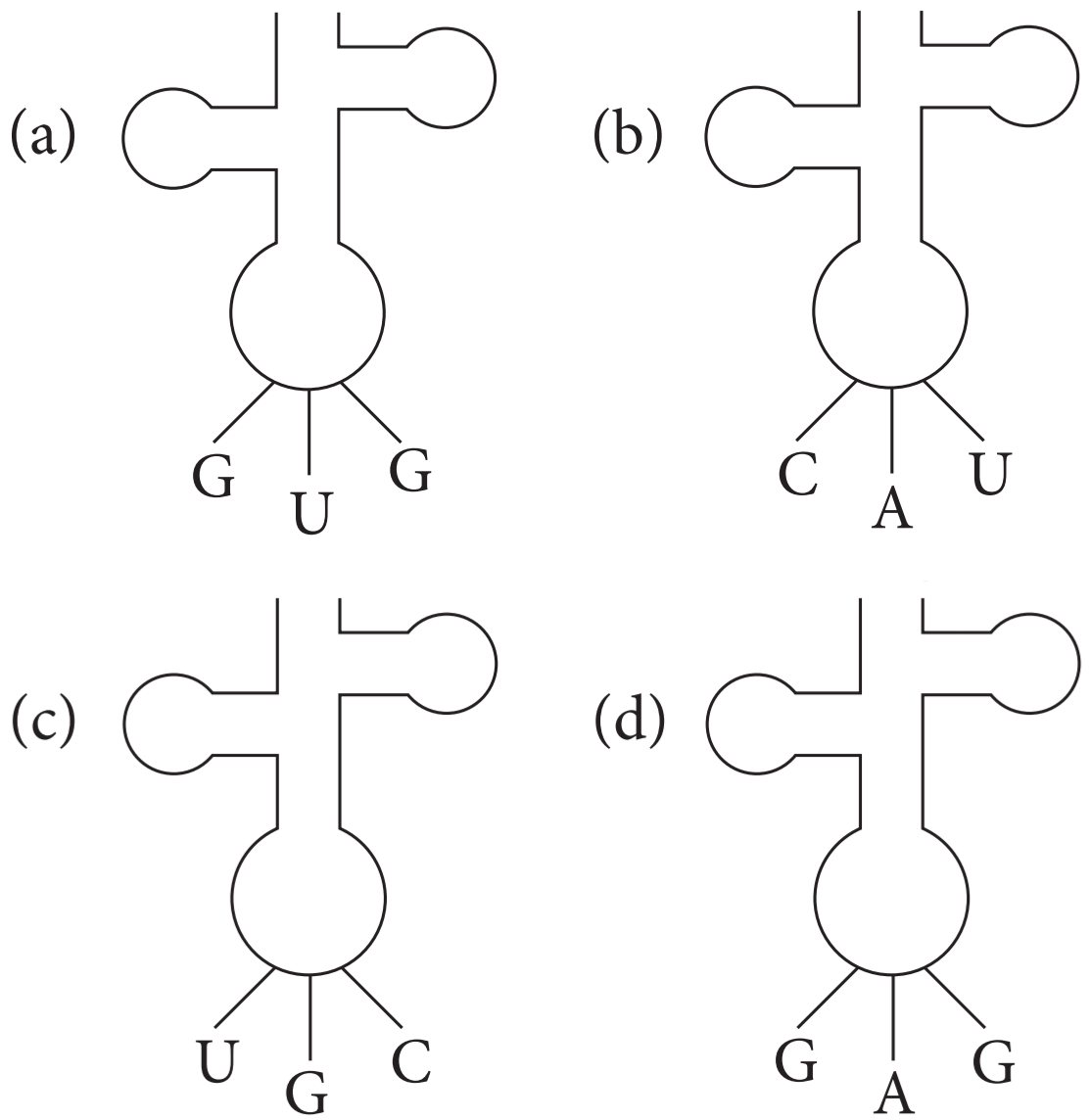
- A mutation is a change produced by an alteration in the genetic mechanism and.
- May arise spontaneously.
- Is always induced by the environment.
- Is never advantageous.
- Is not inherited.
- The DNA code for glutamic acid is CTC or CTT. The code for valine is CAA or CAT. In sickle cell haemoglobin, valine is present instead of glutamic acid.
Assuming a single base pair substitution has occurred, what is the mRNA code in the affected mutant?
- CUU
- GAA
- GAG
- GUA
- A mutation involving the substitution of one nitrogenous base for another has altered the base sequence of a DNA molecule, coding for four amino acids, as shown below.
Normal A-G-C-A-T-G-G-A-T-C-C-T
Mutant A-G-C-A-T-G-C-A-T-C-C-T
The table shows six codons and the corresponding amino acids into which each is translated.| mRNA codon | Amino acid |
| AAG | Lysine |
| CUA | Leucine |
| GGA | Glycine |
| GUA | Valine |
| UAC | Tyrosine |
| UCG | Serine |
- Leucine to valine.
- Lysine to glycine.
- Serine to leucine.
- Tyrosine to lysine.
- Assertion : Insertion or deletion of three or its multiple bases, insert or delete one or multiple codons and so one or multiple amino acids.
Reason: Reading frame remains unaltered with insertion or deletion of three or its multiple bases.
- Both assertion and reason are true, and reason is the correct explanation of assertion.
- Both assertion and reason are true, but reason is not the correct explanation of assertion.
- Assertion is true, but reason is false.
- Both assertion and reason are false.
- Part of the amino acid sequences in normal and sickle cell haemoglobin are shown.
| Normal haemoglobin | Sickle cell haemoglobin |
| Thr-Pro-Glu-Glu | Thr-Pro-Val-Glu |
Read the following and answer any four questions from (i) to (v) given below:
Translation is the process of polymerisation of amino acids to form a polypeptide. The order and sequence of amino acids are defined by the sequence bases in the mRNA. The amino acids are joined by a bond called peptide bond. Ribosome is the site of protein synthesis.
Translation is the process of polymerisation of amino acids to form a polypeptide. The order and sequence of amino acids are defined by the sequence bases in the mRNA. The amino acids are joined by a bond called peptide bond. Ribosome is the site of protein synthesis.
- Which ion is essential for association of both units of ribosome at the time of protein formation?
- Mg2+
- Mn2+
- CI-
- Ca2+
- During translation, how many initiation factors are required in eukaryotes for initiation reactions?
- 3
- 6
- 7
- 9
- Which part of mRNA contains untranslated regions (UTR)?
- 3' end
- 5' end
- Either 3' or 5' end
- Both 5' end and 3' end
- Name the enzyme that helps in combining amino acid to its particular tRNA?
- Activating enzyme
- Amino-acyl tRNA-synthetas
- PeptidyI transferase
- Both (a) and (b)
- From the given list, select the translation machinery.
- mRNA
- Ribosomes
- Amino acids
- tRNAs
- Peptidyl transferase
- Amino acyl tRNA synthetase
- Pyrophosphatase
- (1), (2), (3), (4) and (6)
- (1), (2), (3), (4) and (5)
- (1), (2), (3), (4), (5) and (6)
- (1), (2), (3), (4), (5), (6) and (7)
Read the following and answer any four questions from (i) to (v) given below: The process of translation requires transfer of genetic information from a polymer of nucleotides to synthesise a polymer of amino acids. The relationship between the sequence of amino acids in a polypeptide and nucleotide sequence of DNA or mRNA is called genetic code. George Gamow suggested that in order to code for all the 20 amino acids, code should be made up of three nucleotides.
Which DNA sequence would be needed to produce the following polypeptide sequence? Alanine-Arginine-Lysine-Phenylalanine
View full solution →- What is a codon?
- A length of DNA which codes for a particular protein.
- A part of the tRNA molecule to which a specific amino acid is attached.
- A part of the tRNA molecule which recognises the triplet code on the messenger RNA.
- A part of the messenger RNA molecule that has a sequence of bases coding for an amino acid.
- Three consecutive bases in the DNA molecule provide the code for each amino acid in a protein molecule. What is the maximum number of different triplets that could occurs?
- 16
- 20
- 24
- 64
- Listed below are some amino acids and their corresponding mRNA triplets.
| Amino acid | mRNA triplet |
| Phenylalanine | UUU |
| Lysine | AAG |
| Arginine | CGA |
| Alanine | GCA |
- $\text{CGT}\ \ \ \text{GCT}\ \ \ \text{TTC}\ \ \ \text{AAA}$
- $\text{CGT}\ \ \ \text{GCT}\ \ \ \text{TTC}\ \ \ \text{TTT}$
- $\text{CGU}\ \ \ \text{GCU}\ \ \ \text{UUC}\ \ \ \text{AAA}$
- $\text{CGU}\ \ \ \text{GCU}\ \ \ \text{UUC}\ \ \ \text{TTT}$
- Identify the non-sense codons among the following.
- AUG
- GUG
- UAA
- UGG
- A polypeptide is made using synthetic mRNA molecules as shown.
| Synthetic mRNA used | Polypeptide produced |
| UUUAAAUUUAAA | Phenylalanine-Iysine-phenylalanine-Iysine |
What are the DNA codes for the amino acids phenylalanine and lysine?
| S.no | Phenylalanine | Lysine |
| (a) | AAA | TTT |
| (b) | AAA | UUU |
| (c) | GGG | CCC |
| (d) | TTT | GGG |
Read the following and answer any four questions front (i) to (v) given below:
Gene regulation is the mechanism of switching off and switching on of the genes depending upon the requirement of cells and the state of development. Gene regulation is of two types : negative and positive. In negative generegulation the genes continue expressing their effect till their activity is suppressed. Positive gene regulation is the one in which the genes remain non-expressed unless and until they are induced to do it. Operon model is a co-ordinated group of genes such as structural gene, operator gene, promoter gene, regulator gene which function together and regulate a metabolic pathway as a unit, e.g., lac operon, trp operon, ara operon, etc.
Gene regulation is the mechanism of switching off and switching on of the genes depending upon the requirement of cells and the state of development. Gene regulation is of two types : negative and positive. In negative generegulation the genes continue expressing their effect till their activity is suppressed. Positive gene regulation is the one in which the genes remain non-expressed unless and until they are induced to do it. Operon model is a co-ordinated group of genes such as structural gene, operator gene, promoter gene, regulator gene which function together and regulate a metabolic pathway as a unit, e.g., lac operon, trp operon, ara operon, etc.
- Regulation of gene expression occurs at the level of.
- Transcription
- Processing/splicing
- Translation
- All of these.
- Inducible operon system usually occurs in A pathways. Nutrient molecules serve as B to stimulate production of the enzymes necessary for their breakdown. Genes for inducible operon are usually switched C and the repressor is synthesised in an D form.
| S.no | A | B | C | D |
| (a) | anabolic | corepressor | on | inactive |
| (b) | anabolic | inducer | off | active |
| (c) | catabolic | inducer | off | active |
| (d) | catabolic | corepressor | on | inactive |
- An mRNA molecule transcribed from the lac operon contains nucleotide sequences complementary to.
- Structural genes coding for the enzymes.
- the operator region
- the promotor region
- the repressor gene.
- Which statement correctly describes the control of transcription of the genes involved in the breakdown of lactose in Estherichia coli?
- A repressor protein binds to the operator and the genes are switched on.
- A repressor protein binds to the operator and the genes are switched off.
- A transcription factor binds to the promoter and the genes are switched on.
- A transcription factor binds to the promoter and the genes are switched off.
- Function of catabolic activator protein in lac operon is.
- To form mRNA
- Help to bind RNA polymerase
- Code for repressor
- To activates lac gene when glucose is absent.
If the sequence of the coding strand in a transcription unit is written as follows:
5'-ATGCATGCATGCATGCATGCATGCATGC-3'
Write down the sequence of mRNA.
5'-ATGCATGCATGCATGCATGCATGCATGC-3'
Write down the sequence of mRNA.
Briefly describe the following:
Bioinformatics.
Bioinformatics.
Explain (in one or two lines) the function of the following:
tRNA.
tRNA.
If the sequence of one strand of DNA is written as follows:
5'-ATGCATGCATGCATGCATGCATGCATGC-3'
Write down the sequence of complementary strand in 5' → 3' direction.
5'-ATGCATGCATGCATGCATGCATGCATGC-3'
Write down the sequence of complementary strand in 5' → 3' direction.
Briefly describe the following:
Polymorphism.
Polymorphism.
Which one of the following lacks active site of RNA polymerase?
- A
$\alpha\alpha'\beta2\sigma$
- B
$\alpha\beta\beta'\sigma$
- C
$\alpha\alpha'\beta,\beta'\sigma$
- D
$\alpha_2\beta\beta'$
Sex is determined in human beings:
- ABy ovum.
- BAt the time of fertilization.
- C40 days after fertilization.
- DSeventh to eight week when genitals differentiate in foetus.
Which one of the following codons codes for the same information as UGC?
- AUGU
- BUGA
- CUAG
- DUGG
The experimental system used in studies of the discovery of replication of DNA has been:
- ADrosophila melanogaster
- BPneumococcus
- CEscherichia coli
- DNeurospora crassa
An individual exhibiting both male and female sexual characteristics in the body is known as:
- AHermaphrodite
- BIntersex
- CGynandromorph
- DBisexual
For question, two statements are given-one labelled Assertion and the other labelled Reason. Select the correct answer to these questions from the codes (a), (b), (c) and (d) as given below.
Reason : The specificity of a codon is particularly determined by the first two bases.
- Both assertion and reason are true, and reason is the correct explanation of assertion.
- Both assertion and reason are true, but reason is not the correct explanation of assertion.
- Assertion is true, but reason is false.
- Both assertion and reason are false
Reason : The specificity of a codon is particularly determined by the first two bases.
For question, two statements are given-one labelled Assertion and the other labelled Reason. Select the correct answer to these questions from the codes (a), (b), (c) and (d) as given below.
Reason : for a particular amino acid more than one codons can be used.
- Both assertion and reason are true, and reason is the correct explanation of assertion.
- Both assertion and reason are true, but reason is not the correct explanation of assertion.
- Assertion is true, but reason is false.
- Both assertion and reason are false
Reason : for a particular amino acid more than one codons can be used.
For question, two statements are given-one labelled Assertion and the other labelled Reason. Select the correct answer to these questions from the codes (a), (b), (c) and (d) as given below.
Reason: In the presence of glucose and lactose activity of lac operon is not needed.
- Both assertion and reason are true, and reason is the correct explanation of assertion.
- Both assertion and reason are true, but reason is not the correct explanation of assertion.
- Assertion is true, but reason is false.
- Both assertion and reason are false
Reason: In the presence of glucose and lactose activity of lac operon is not needed.
For question, two statements are given-one labelled Assertion and the other labelled Reason. Select the correct answer to these questions from the codes (a), (b), (c) and (d) as given below.
Reason: R-type of Pneumococcus can be virulent by having transformation with S -type of Pneumococcus.
- Both assertion and reason are true, and reason is the correct explanation of assertion.
- Both assertion and reason are true, but reason is not the correct explanation of assertion.
- Assertion is true, but reason is false.
- Both assertion and reason are false.
Reason: R-type of Pneumococcus can be virulent by having transformation with S -type of Pneumococcus.
For question, two statements are given-one labelled Assertion and the other labelled Reason. Select the correct answer to these questions from the codes (a), (b), (c) and (d) as given below.
Reason: Tryptophan works both as co-repressor and through feedback inhibition.
- Both assertion and reason are true, and reason is the correct explanation of assertion.
- Both assertion and reason are true, but reason is not the correct explanation of assertion.
- Assertion is true, but reason is false.
- Both assertion and reason are false
Reason: Tryptophan works both as co-repressor and through feedback inhibition.
In the medium where E. coli was growing, lactose was added, which induced the lac operon. Then, why does lac operon shut down some time after addition of lactose in the medium?
Differentiate between the genetic codes given below:
- Unambiguous and Universal.
- Degenerate and Initiator.
An organism is able to survive on a culture medium, containing nutrient A, by the enzyme-catalysed reactions.
$\text{A}\xrightarrow{\ \ \ \text{p}\ \ \ }\text{B}\xrightarrow{\ \ \ \text{q}\ \ \ }\text{C}\xrightarrow{\ \ \ \text{r}\ \ \ }\text{D}$
A mutant organism failed to survive on this medium, but grew well when nutrient B was added to it.
View full solution →$\text{A}\xrightarrow{\ \ \ \text{p}\ \ \ }\text{B}\xrightarrow{\ \ \ \text{q}\ \ \ }\text{C}\xrightarrow{\ \ \ \text{r}\ \ \ }\text{D}$
A mutant organism failed to survive on this medium, but grew well when nutrient B was added to it.
- Which gene of this mutant organism is defective?
- What does such a condition indicate of ?
- Mention the major components and their functions in an operon.
- Indicate the value expressed in this sequence of reactions.
The biology teacher asked her students to verify the experiment on transformation principle in bacteria to establish DNA as genetic material. The class was divided into two groups. The teacher asked them to submit the reports. Group 2 did not use mouse and did not repeat Griffith's experiment. The teacher praised them.
- Which experiment did they perform?
- Explain the experiment in brief.
- Who and when performed the transformation principle experiment?
- What values did students of group 2 exhibit?
Draw a labelled schematic structure of a transcription unit. Explain the function of each component in the unit in the process of transcription.
Generate a Molecular Basis of Inheritance paper free
Pick question groups from the list above, set marks and difficulty, and export a branded PDF with step-by-step answer keys. First 3 chapters free — no signup.