Why are vitamin A and vitamin C essential to us? Give their important sources.
Question types
Biomolecules question types
435 questions across 7 question groups — pick any mix to generate a Chemistry paper with step-by-step answer keys.
435
Questions
7
Question groups
5
Question types
01
2 Marks Questions
62 Q→023 Marks Question
44 Q→031 Marks Question
97 Q→04Case study (4 Marks)
8 Q→05M.C.Q (1 Marks)
177 Q→06Assertion (A) & Reason (B) MCQ
31 Q→075 Marks Questions
16 Q→Sample Questions
Biomolecules questions
One sample from each question group in this chapter. Select any group above to see the full set with answer keys.
View full solution →
Enumerate the reactions of D - glucose which cannot be explained by its open chain structure.
What happens when D - glucose is treated with the following reagents?
- HI
- Bromine water
- HNO3
What is the basic structural difference between starch and cellulose?
What are essential and non - essential amino acids? Give two examples of each type.
- Which one of the following is a disaccharide: starch, maltose, fructose, glucose
- What is the difference between acidic amino acid and basic amino acid?
- Write the name of the linkage joining two nucleotides.
Define the following terms:
- Nucleotide.
- Anomers.
- Essential amino acids.
Define the following terms:
- Glycosidic linkage.
- Invert sugar.
- Oligosaccharides.
- Write the structural difference between starch and cellulose.
- What type of linkage is present in Nucleic acids?
- Give one example each for fibrous protein and globular protein.
Define the following terms as related to proteins:
- Peptide linkage.
- Primary structure.
- Denaturation.
What is the difference between a nucleoside and a nucleotide?
What are the common types of secondary structure of proteins?
What type of bonding helps in stabilising the $\alpha$ - helix structure of protins.
View full solution →How do you explain the amphoteric behaviour of amino acids?
The two strands in DNA are not identical but are complementary. Explain.
Read the passage given below and answer the following questions: Glucose is known as dextrose because it occurs in nature as the optically active dextrorotatory isomer. lt is essential constituent of human blood. The blood normally contains 65 to 110mg of glucose per 100mL (hence named Blood sugar). The level may be much higher in diabetic persons. The urine of diabetic persons also contain considerable amount of glucose. ln combined form, it occurs in cane sugar and polysaccharides such as starch and cellulose. Glucose has an aldehyde group (-CHO), one primary alcoholic group (-CH2OH) and four secondary alcoholic groups (-CHOH) in their structure. Due to the presence five hydroxyl groups (-OH). glucose undergoes acetylation. Glucose also undergoes oxidation with mild oxidising agents like bromine water as well as with strong oxidising agents like nitric acid. Since glucose is readily oxidised, it acts as a strong reducing agent and reduces Tollen's reagent and Fehling solution. Glucose exists in two crystalline forms: $\alpha$-D-glucose and $\beta$-D-glucose. If either of the two forms is dissolved in water and allowed to stand, the specific rotation of the solution changes gradually, until a constant value is obtained. This change is called mutarotation. A statement of assertion followed by a statement of reason is given. Choose the correct answer out of the following choices.
View full solution →- Assertion and reason both are correct statements and reason is correct explanation for assertion.
- Assertion and reason both are correct statements but reason is not correct explanation for assertion.
- Assertion is correct statement but reason is wrong statement.
- Assertion is wrong statement but reason is correct statement.
- Assertion: A diabetic person carries a packet of glucose with him always.
Reason: Glucose increases the blood sugar level almost instantaneously.
- Assertion: On oxidation with nitric acid, glucose as well as gluconic acid both yield saccharic acid.
Reason: The pentaacetate of glucose does not react with hydroxylamine indicating the absence of free -CHO group.
- Assertion: Glucose reacts with acetyl chloride to form pentaacetyl glucose.
Reason: The formation of pentaacetyl derivative confirms the presence of five -OH groups in glucose.
- Assertion: A certain compound gives negative test with ninhydrin and positive test with Benedict's solution, the compound is an amino acid.
Reason: Glucose is a monosaccharide.
- Assertion: The rapid interconversion of $\alpha$-D-glucose and $\beta$-D-glucose in solution is known as racemisation.
Reason: Hydrolysis reaction will take place when a mineral acid is treated with sugar.
Read the passage given below and answer the following questions:
When a protein in its native form, is subjected to physical changes like change in temperature or chemical changes like change in pH, the hydrogen bonds are disturbed. Due to this, globules unfold and helix get uncoiled and protein loses its biological activity. This is called denaturation of protein.
The denaturation causes change in secondary and tertiary structures but primary structures remains intact. Examples of denaturation of protein are coagulation of egg white on boiling, curdling of milk, formation of cheese when an acid is added to milk.
The following questions are multiple choice questions. Choose the most appropriate answer:
View full solution →When a protein in its native form, is subjected to physical changes like change in temperature or chemical changes like change in pH, the hydrogen bonds are disturbed. Due to this, globules unfold and helix get uncoiled and protein loses its biological activity. This is called denaturation of protein.
The denaturation causes change in secondary and tertiary structures but primary structures remains intact. Examples of denaturation of protein are coagulation of egg white on boiling, curdling of milk, formation of cheese when an acid is added to milk.
The following questions are multiple choice questions. Choose the most appropriate answer:
- Mark the wrong statement about denaturation of proteins.
- The primary structure of the protein does not change.
- Globular proteins are converted into fibrous proteins.
- Fibrous proteins are converted into globular proteins.
- The biological activity of the protein is destroyed.
- Which structure(s) of proteins remains(s) intact during denaturation process?
- Both secondary and tertiary structures.
- Primary structure only.
- Secondary structure only.
- Tertiary structure only.
- $\alpha$-helix and $\beta$-pleated structures of proteins are classified as:
- Primary structure.
- Secondary structure.
- Tertiary structure.
- Quaternary structure.
- Cheese is a:
- Globular protein.
- Conjugated protein.
- Denatured protein.
- Derived protein.
- Secondary structure of protein refers to:
- Mainly denatured proteins and structure of prosthetic groups.
- Three-dimensional structure, especially the bond between amino acid residues that are distant from each other in the polypeptide chain.
- Linear sequence of amino acid residues in the polypeptide chain.
- Regular folding patterns of continuous portions of the polypeptide chain.
Read the passage given below and answer the following questions: The sequence of bases along the DNA and RNA chain establishes its primary structure which controls the specific properties of the nucleic acid. An RNA molecule is usually a single chain ofribose-containing nucleotide. On the basis of X-ray analysis of DNA, J.D., Watson and EH.C. crick (shared noble prize in 1962) proposed a three dimensional secondary structure for DNA. DNA molecule is a long and highly complex, spirally twisted, double helix, ladder like structure. The two polynucleotide chains or strands are linked up by hydrogen bonding between the nitrogeneous base molecules of their nucleotide monomers. Adenine (purine) always links with thymine (pyrimidine) with the help of two hydrogen bonds and guanine (purine) with cytosine (pyrimidine) with the help of three hydrogen bonds. Hence, the two strands extend in opposite directions, i.e., are antiparallel and complimentary.
- Assertion and reason both are correct statements and reason is correct explanation for assertion.
- Assertion and reason both are correct statements but reason is not correct explanation for assertion.
- Assertion is correct statement but reason is wrong statement.
- Assertion is wrong statement but reason is correct statement.
- Assertion: DNA molecules and RNA molecules are found in the nucleus of a cell.
Reason: There are two types of nitrogenous bases, purines and pyrimidines. Adenine (A) and guanine (G) are substituted purines; cytosine (C), thymine (T) and uracil (U) are substituted pyrimidines.
- Assertion: In both DNA and RNA, heterocyclic base and phosphate ester linkages are at C-1' and C-5' respectively of the sugar molecule.
Reason: Nucleotides and nucleosides mainly differ from each other in presence of phosphate units.
- Assertion: The backbone of RNA molecule is a linear chain consisting of an alternating units of a heterocylic base, D-ribose and a phosphate.
Reason: The segment of DNA which acts as the instruction manual for the synthesis of protein is ribose.
- Assertion: The double helical structure of DNA was proposed by Emil Fischer.
Reason: A nucleoside is an N-glycoside of heterocyclic base.
- Assertion: In DNA, the complementary bases are, adenine and guanine; thymine and cytosine.
Reason: The phenomenon of mutation is chemical change in DNA molecule.
Read the passage given below and answer the following questions: Carbohydrates are polyhydroxy aldehydes and ketones and those compounds which on hydrolysis give such compounds are also carbohydrates. The carbohydrates which are not hydrolysed are called monosaccharides. Monosaccharides with aldehydic group are called aldose and those which free ketonic groups are called ketose. Carbohydrates are optically active. Number of optical isomers = 2n Where n = numberofasymmetric carbons. Carbohydrates are mainlysynthesised by plants during photosynthesis. The monosaccharides give the characteristic reactions of alcohols and carbonyl group (aldehydes and ketones). It has been found that these monosaccharides exist in the form of cyclic structures. In cyctization, the -OH groups (generally C5 or C4 in aldohexoses and C5 or C6 in ketohexoses) combine with the aldehyde or keto group. As a result, cyclic structures of five or six membered rings containing one oxygen atom are formed, e.g., glucose forms a ring structure. Glucose contains one aldehyde group, one IO alcoholic group and four 2° alcoholic groups in its open chain structure. The following questions are multiple choice questions. Choose the most appropriate answer:
- First member of ketos sugar is:
- Ketotriose.
- Ketotetrose.
- Ketopentose.
- Ketohexose.
- In CH2OHCHOHCHOHCHOHCHOHCHO, the number of optical isomers will be:
- 16
- 8
- 32
- 4
- Some statements are given below:
- Glucose is aldohexose.
- Naturally occurring glucose is dextrorotatory.
- Glucose contains three chiral centres.
- Glucose contains one 1° alcoholic group and four 2° alcoholic groups.
Among the above, correct statements are:
- 1 and 2 only
- 3 and 4 only
- 1, 2 and 4 only
- 1, 2, 3 and 4
- Two hexoses fonn the same osazone, find the correct statement about these hexoses.
- Both of them must be aldoses.
- They are epimers at C-3.
- The carbon atoms I and 2 in both have the same configuration.
- The carbon atoms 3, 4 and 5 in both have the same configuration.
- Which of the following reactions of glucose can be explained only by its cyclic structure?
- Glucose forms cyanohydrin with HCN.
- Glucose reacts with hydroxylamine to form an oxime.
- Pentaacetate of glucose does not react with hydroxylamine.
- Glucose is oxidised by nitric acid to gluconic acid.
Read the passage given below and answer the following questions: Proteins are high molecular mass complex biomolecules of amino acids. The important proteins required for our body are enzymes, hormones, antibodies, transport proteins, structural proteins, contractile proteins etc. Except for glycine, all $\alpha$-amino acids have chiral carbon atom and most of them have L-configuration. The amino acids exists as dipolar ion called zwitter ion, in which a proton goes from the carboxyl group to the amino group. A large number of $\alpha$-amino acids are joined by peptide bonds forming polypeptides. The peptides having very large molecular mass (more than 10,000) are called proteins. The structure of proteins is described as primary structure giving sequence of linking of amino acids; secondary structure giving manner in which polypeptide chains are arranged and folded; tertiary structure giving folding, coiling or bonding polypeptide chains producing three dimensional structures and quaternary structure giving arrangement of sub-units in an aggregate protein molecule. A statement of assertion followed by a statement of reason is given. Choose the correct answer out of the following choices.
View full solution →- Assertion and reason both are correct statements and reason is correct explanation for assertion.
- Assertion and reason both are correct statements but reason is not correct explanation for assertion.
- Assertion is correct statement but reason is wrong statement.
- Assertion is wrong statement but reason is correct statement.
- Assertion: Except glycine, all naturally occurring CL-amino acids are optically active.
Reason: All naturally occurring CL-amino acids, except glycine, has at least one asymmetric carbon.
- Assertion: All amino acids are optically active.
Reason: Amino acids contain asymmetric carbon atoms.
- Assertion: In $\alpha$-helix structure, intramolecular H-bonding takes place whereas in $\beta$-pleated structure, intermolecular H-bonding takes place.
Reason: An egg contains a soluble globular protein called albumin which is present in the white part.
- Assertion: Secondary structure of protein refers to regular folding patterns of continuos portions of the polypeptide chain.
Reason: Out of 20 amino acids, only 12 amino acids can be synthesised by human body.
- Assertion: The helical structure of protein is stabilised by intramolecular hydrogen bond between -NH and carbonyl oxygen.
Reason: Sanger's reagent is used for the identification of N-tenninal amino acid of peptide chain.
Starch is a mixture of two components, a water soluble component amylose(15-20%) and a water insoluble component amylopectin (80-85%). The aqueous solution of amylose gives a blue colour with iodine solution due to the formation of:
- AAmylose iodide
- BAmylose iodate
- CInclusion complex
- DAmylose tetraiodide complex
Three cyclic structures of monosaccharides are given below which of these are anomers.
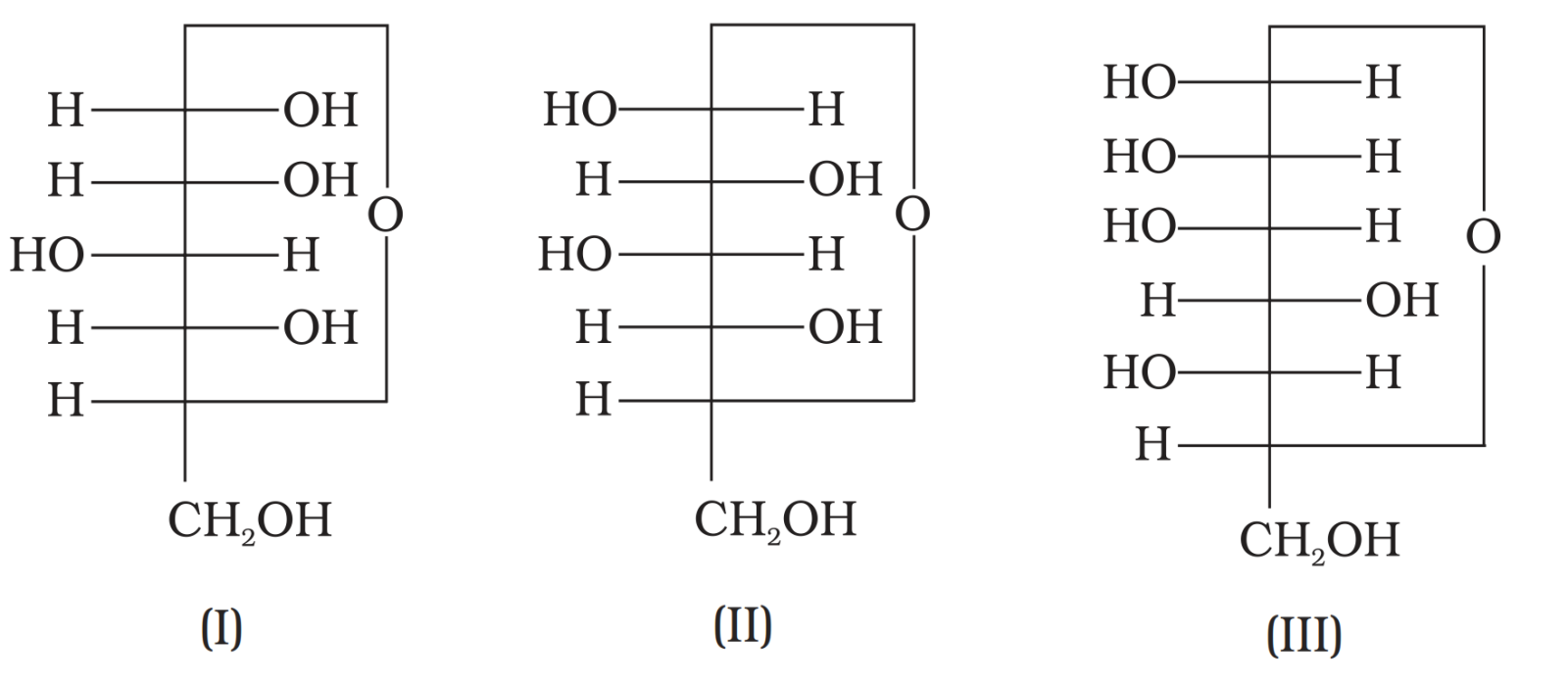
- AI and II
- BII and III
- CI and III
- DIII is anomer of I and II
Which of the following bases is not present in DNA?
- AAdenine
- BThymine
- CCytosine
- DUracil
Example of coenzyme is:
- AZn2+
- BLipase
- CVitamin B
- DLysine
Which among the following are essential chemical components of many coenzymes?
- ANucleic acids
- BCarbohydrates
- CVitamins
- DProteins
Two statements are given- one labelled Assertion (A) and the other labelled Reason (R). Select the correct answer to these questions from the codes (a), (b), (c) and (d) as given below:
Reason (R): Reducing groups of glucose and fructose are involved in glycosidic bond formation.
- Both Assertion (A) and Reason (R) are correct statements, and Reason (R) is the correct explanation of the Assertion (A).
- Both Assertion (A) and Reason (R) are correct statements, but Reason (R) is not the correct explanation of the Assertion (A).
- Assertion (A) is correct, but Reason (R) is incorrect statement.
- Assertion (A) is incorrect, but Reason (R) is correct statement.
Reason (R): Reducing groups of glucose and fructose are involved in glycosidic bond formation.
Two statements are given- one labelled Assertion (A) and the other labelled Reason (R). Select the correct answer to these questions from the codes (a), (b), (c) and (d) as given below:
Reason (R): Sucrose has glycosidic linkage.
- Both Assertion (A) and Reason (R) are correct statements, and Reason (R) is the correct explanation of the Assertion (A).
- Both Assertion (A) and Reason (R) are correct statements, but Reason (R) is not the correct explanation of the Assertion (A).
- Assertion (A) is correct, but Reason (R) is incorrect statement.
- Assertion (A) is incorrect, but Reason (R) is correct statement.
Reason (R): Sucrose has glycosidic linkage.
Note: In the following questions a statement of assertion followed by a statement of reason is given. Choose the correct answer out of the following choices.
- Assertion and reason both are correct statements and reason explains the assertion.
- Both assertion and reason are wrong statements.
- Assertion is correct statement and reason is wrong statement.
- Assertion is wrong statement and reason is correct statement.
- Assertion and reason both are correct statements but reason does not explain assertion.
Assertion: Vitamin D can be stored in our body.
Reason: Vitamin D is fat soluble vitamin.
Reason: Vitamin D is fat soluble vitamin.
Note: In the following questions a statement of assertion followed by a statement of reason is given. Choose the correct answer out of the following choices.
- Assertion and reason both are correct statements and reason explains the assertion.
- Both assertion and reason are wrong statements.
- Assertion is correct statement and reason is wrong statement.
- Assertion is wrong statement and reason is correct statement.
- Assertion and reason both are correct statements but reason does not explain assertion.
Assertion: All naturally occurring α-aminoacids except glycine are optically active.
Reason: Most naturally occurring amino acids have L-configuration.
Reason: Most naturally occurring amino acids have L-configuration.
In these questions, a statement of assertion followed by a statement of reason is given. Choose the correct answer out of the following choices.
Reason: Insulin is a globular protein.
- Assertion and reason both are correct statements and reason is correct explanation for assertion.
- Assertion and reason both are correct statements but reason is not correct explanation for assertion.
- Assertion is correct statement but reason is wrong statement.
- Assertion is wrong statement but reason is correct statement.
Reason: Insulin is a globular protein.
- What are essential and non-essential amino acids? Give two examples of each.
- What are the two types of photosynthesis in green plants? Give the basic equations of photosynthesis.
- Mention the two products of glycolysis.
- Define the following terms:
- Co-enzymes.
- Mutation in biomolecules.
- Nucleotides.
- List four main functions of carbohydrates in organisms.
- Answer the following questions briefly:
- What are any two good sources of vitamin A?
- What are nucleotides?
- Give an example of simple lipids.
- How are carbohydrates classified?
- Answer the following questions briefly:
- What are reducing sugars?
- What is meant by denaturation of a protein?
- How is oxygen replenished in our atmosphere?
- Define enzymes.
After watching a programme on TV about the presence of carcinogens (cancer causing agents) Potassium bromate and Potassium iodate in bread and other bakery products, Veena, a class XII student, decided to make others aware about the adverse effects of these carcinogens in foods. She consulted the school principal and requested him to instruct the canteen contractor to stop selling sandwiches, pizzas, burgers and other bakery products to the students. The principal took an immediate action and instructed the canteen contractor to replace the bakery products with some proteins and vitamins-rich food like fruits, salads, sprouts, etc. The decision was welcomed by the parents and students.
After reading the above passage, answer the following questions:
After reading the above passage, answer the following questions:
- What are the values (at least two) displayed by Veena?
- Which polysaccharide component of carbohydrates is commonly present in bread?
- Write the two types of secondary structures of proteins.
- Give two examples of water soluble vitamins.
Generate a Biomolecules paper free
Pick question groups from the list above, set marks and difficulty, and export a branded PDF with step-by-step answer keys. First 3 chapters free — no signup.