MCQ 11 Mark
[Co(NH3)4Cl2] possesses:
- ASquare planar geometry
- BTetrahedral geometry
- CTetrahedral nature
- DOctahedral geometry
Answer
View full question & answer→- Octahedral geometry
Explanation:

50 questions · timed · auto-graded
Explanation:
Explanation:
Total number of stereo isomers of [Co(acac)2BrCl]− are 3 i.e. cis, trans, optical.
Explanation:
The formula of a coordination complex is written in a different order than its name. The chemical symbol of the metal center is written first.
The ligands are written next, with neutral ligands coming before anionic ligands. If there is more than one anion or neutral ligand, they are written in alphabetical order according to the first letter in their chemical formula.
Explanation:
The secondary valency is equal to the coordination number the secondary valency are non ionizable valencies. These are satisfied by neutral molecules or negative ions.
For example in [Ni(CO)4] the coordination number of Ni metal is four and its secondary valency is also four.
Explanation:
In this case both the central atom as well as ligands are present in the coordination sphere. The legands are named first in alphabetical order before the name of central atom or ion. Names of the anionic ligands end with suffix '-o'. The name of the central metal atom is written at the end along with its oxidation state in Roman numeral, which is (II) for the central metal atom "platinum". Note the "chlorido" is preferred term/ name over chloro for chloride ion as a ligand as per modern trend.
Explanation:
Crystal Field Stabilization Energy(CFSE) is proportional to the frequency of the absorbed light. The emitted colors are red, green and blue. The corresponding absorbed colors are green, red and orange.
So the first complex will be blue, second is red and third is green.
Explanation:
Since 4 amino groups are present, it will be called as tetrammine.
Since copper(II) is the central metal, it will be tetrammine copper(II). Note that we can determine the oxidation number of copper by charge balance.
Now finally since sulphate is the counter ion, it's full name will be tetrammine copper(II) sulphate.
Explanation:
When excess of KCN is added to an aqueous solution of CuSO4 then-
Initially, cupric cyanide is formed, Cu(CN)2.
CuSO4 + 2KCN → K2CO4 + Cu(CN)2
Cupric Cyanide will decompose to produce cuprous cyanide,Cu2(CN)2.
2Cu(CN)2 → 2Cu2(CN)2 + 2(CN)
Cuprous cyanide reacts with an excess of KCN to form a complex, K3[Cu(CN)4], which is a stable complex.
CuCN + 3Ka → K3[Cu(CN)4].
Explanation:
Explanation:
The brown colour complex obtained in the detection of nitrate radical is formulated as [Fe(H2O)5NO]SO4. In this complex, oxidation state of iron is +1. The univalent character of iron in the complex is justified by the presence of a coordinated NO+ group.
Explanation:
cis−[PtCl2NH3)2] known as cis platin is used as an anticancer agent.
Explanation:
Linear combination of two hybridized orbitals, belonging to two atoms and each having one electron leads to formation of sigma bond.
Explanation:
Number of hybrid orbitals formed is equal to number of atomic orbitals involved in hybridisation. $\pi$ bonds will be formed always by pure orbitals (p or d orbitals). Hybrid orbitals arrange around the centre of atom gymmetrically depending on number of bond pairs and lone pairs.
Explanation:
Iodine heptafluoride, also known as iodine(VII) fluoride or iodine fluoride, is an interhalogen compound with the chemical formula IF7. It has an unusual pentagonal bipyramidal structure.
Explanation:
The stability of complexes is represented by the magnitude of its "Stability constant (K)". A higher value of stability constant of certain complex denotes its greater stability. Mathematically, the same hols good for log K values. Among the given log K values of different complexes, it is noted that the log K value for complex at (ii) is maximum (ie = 27.3). Hence it is most stable.
Explanation:
Anti knocking compounds are the chemicals which reduce knocking for improving the quality of gasoline. example:- Tetraethyl lead (TEL).
Explanation:
Carnallite: KCl.MgCl2.6H2O
Alum: K2SO4Al2(SO3)24H2O
Ferrous ammonium sulphate: (NH4)2Fe(SO4)26H2O.
All are double salts.
Only [Co(NH3)6].Cl3 is complex compound.
In each of the given complex, Fe is in +3 oxidation state. As C2O42- is didentate chelating ligand, it forms chelate rings and hence (c) out of complexes given above is the most stable complex.
Explanation:
[Co(en)3]2(SO4)3
Oxidation of en = 0 SO4 = −2 then we get CO = +3 as given.
And tris is used as two numbers are present at that same spot.
where 2 is called "di" and 3 is called "tris".
Explanation:
The developed photography film is due to Ag.
The treatment of the exposed photgraphic film with reducing agent is called developing of the film.
A developer is usually an alkaline solution of hydroquinone or alkaline solution of pyrogallol.
The pairs activated by light are reduced to deposit more of black silver.
Explanation:
The coordination sphere of a coordination compound or complex consists of the central metal atom/ion plus its attached ligands. The coordination sphere is usually enclosed in brackets when written in a formula. The coordination number is the number of donor atoms bonded to the central metal atom/ion.
Most metal complexes or compounds except for alloys. Specific examples include hemoglobin and Ru3(CO)12.
So the total electron should be 18
valence electron of iron is = 8
CO gives = 2e−, NO gives 3e−
18 = 8 + (2 × 2) + (3 × x)
18 - 8 - 4 = 3x
x = 2
Explanation:
The complex [Cr(NH3)3Cl3] is of the type Ma3b3, has two isomers cis and trans or facial and meridional.
Explanation:
Trifluorophosphine is PF3.
The formula should be Li[Ni(PF3)3I].
Explanation:
NO2 and SCN are ambidentate ligands hence, show linkage isomerism.
Explanation:
Complexes in which a metal is bound to more than one kind of donor groups are known as heteroleptic. This condition is satisfied by complexes mentioned at (ii) & (iv) where the donor groups are NH3 & Cl2. Therefore, complexes at (ii) & (iv) are heteroleptic.
Explanation:
Transition elements form complexes readily because
Due to lower size and higher charge, they have high charge density.
They have vacant d orbital in which a ligand can donate its electron and form complex.
Explanation:
Fe3+ = 1s22s22p63s23p63d5
d orbital is half filled.So ferric ion is stable.
Explanation:
The primary and secondary valency of cobalt ion is 3 and 6 respectively.
The charge on cobalt ion is +3 which balances −2 charge on carbonate ion and −1 charge on chloride ion. Hence, the primary valency of cobalt ion is 3.
Cobalt ion is surrounded by four monodentate and one bidentate ligand (4 ammonia and on carbonate) in the coordination sphere. Hence, its coordination number (secondary valency) is 6.
Explanation:
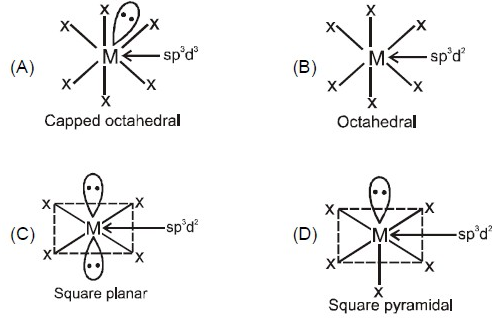
Hybridization is the concept of mixing atomic orbitals to form new hybrid orbitals.
Atomic orbitals with similar energy combine to give degenerated hybrid orbitals.
The number of combining atomic orbitals is equal to the hybridised orbitals.
They involve redistribution of electrons of combined atomic orbital to hybrid orbitals.
Explanation:
Explanation:
Complex formed is Bq2[CO(CN)6] in which oxidation of CO is (2+) and CN of CO is six.
Explanation:
Mn2+ has d5 configuration, since H2O is weak ligand field, so it does not causes pairing of electrons and hence it has 5 unpaired electrons.
Explanation:
[Fe(CN)6]3-
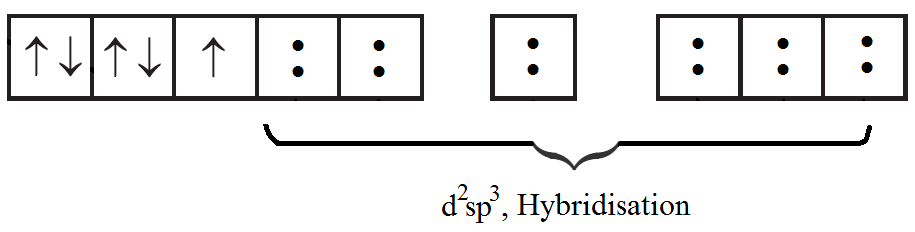
Magnetic nature-paramagnetic.
Explanation:
The complex having Br and Cl out of coordination sphere only gives AgBr(pale yellow ) and AgCl (white ppt.) respectively upon reaction with AgNO3.
Explanation:
The given compounds havfe different number of water molecules inside and outside the coordinate sphere.
Explanation:
It exists as lis trans which is diastereomer and its cis form is optically active and exits as enantiomer also, where as only exists as enantiomers.
Explanation:
1 mole of amino cobalt chloride gives 2 moles of AgCl so number of Cl− ions which satisfies both primary and secondary valency of cobalt in the complex is 1.
Explanation:
Ferric ferrocyanide / Potassium ferrocyanide / Sodium ferrocyanide is prussian blue.
Fe4[Fe(CN)6]3
Explanation:
Exhibits cis trans.
Exhibits optical Isomerism.
Exhibits linkage Isomerism (NO2,−ONO)
Cis-Trans Isomerism.
Explanation:
Ionization energy decreases from top to bottom of each column because the outer shell electrons become farther removed from the nucleus.
Explanation:
The complex compound is [Pt(NH3)2Cl2]. NH3 is a neutral ligand and named as amine. Cl is anion ligand and named as chloride. Di or tri is prefixed to represent the number. So the name of the compound is- Diamminedichloridoplatinum (II).
(II) represent the oxidation state of platinum.
Explanation:
Among the following coordination compounds, the one giving a white precipitate with BaCl2 solution is [Cr(H2O)5Br]SO4.
It dissociates in aqueous solution to give sulphate ions. Sulphate ions react with barium chloride to form a white precipitate of barium sulphate.
Explanation:
The primary valency of Co is 3 and the secondary valency of Co is 6.
The primary valency represents the number of ions in the ionization sphere and the secondary valency represents the number of ligands.
In this example, one chlorine atom serves dual role.
Explanation:
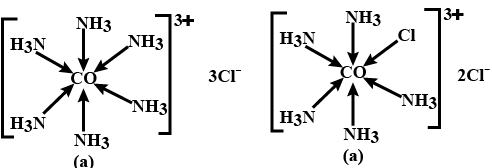
There is one Cl− ion which satisfies both primary and secondary valency in CoCl3.5NH3.
Explanation:
Total 6 isomers are possible.
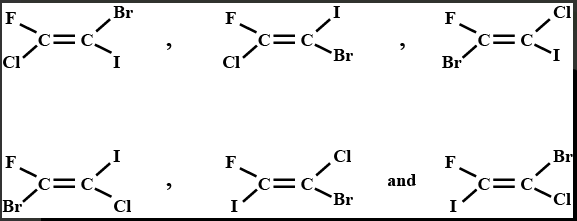
Explanation:
(a, c) [Co(en)3]3+ and cis [Co(en)2Cl2]2+ are optically active compounds because their mirror images are non-superimposable isomer.
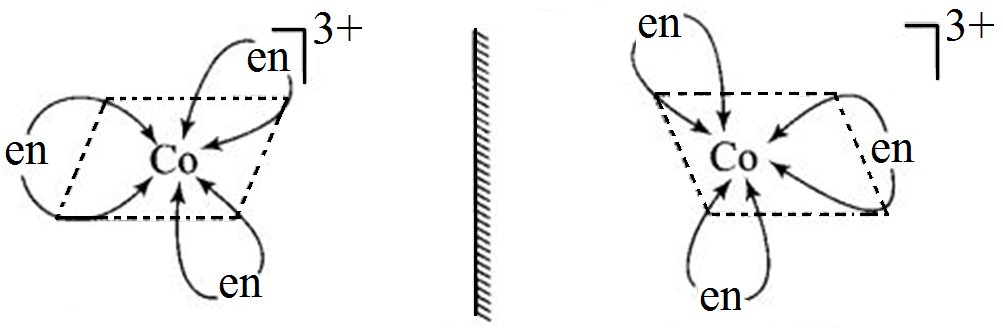
Non-supermposable isomers of [Co(en)3]3+
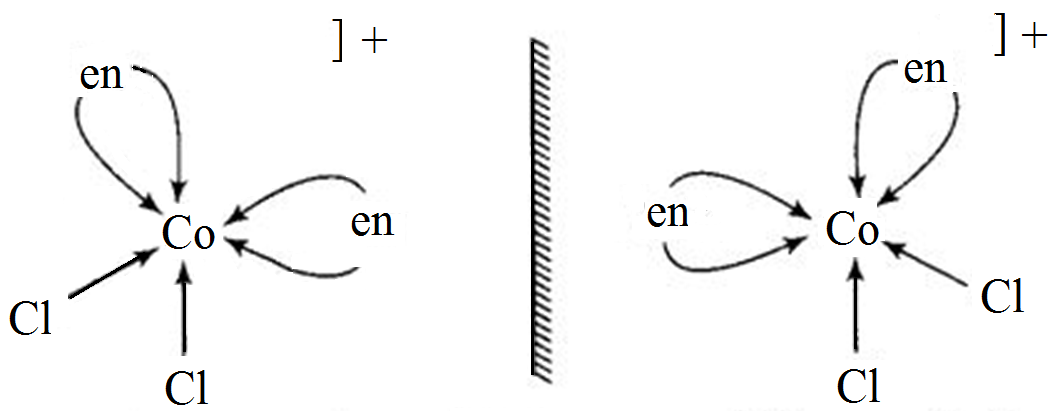
Non-superimosable isomers of [Co(en)2Cl2]+
Hence, (a) and (c) are correct choices.
Explanation:
Pentaamminesulphatocobalt (III) bromide is [Co(SO4)(NH3)4]Br and pentaamminesulphatocobalt (III) chloride is [Co(SO4)(NH3)5]Cl.
The two compounds pentaamminesulphatocobalt (III) bromide and pentaamminesulphatocobalt (III) chloride represent no isomerism.
Explanation:
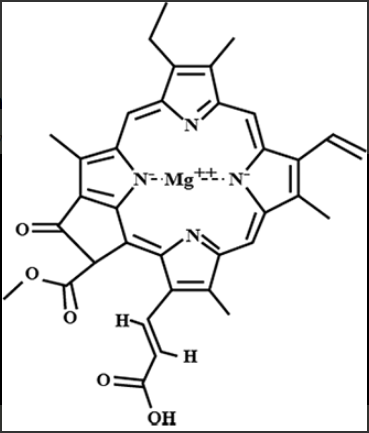
Chlorophylls are green pigments in plants and contain magnesium.
They are useful during photosynthesis to store energy in the form of glucose from carbon dioxide and water in presence of sunlight.
Explanation:
When KCN is added to CuSO4 solution, the following reaction occurs.
4KCN+CuSO4 → K3[Cu(CN)4].