MCQ 511 Mark
Let $R$ be a relation on the set of all natural numbers given by $\alpha b \Leftrightarrow \alpha$ divides $b^2$.
Which of the following properties does $R$ satisfy?
$I.$ Reflexivity $II.$ Symmetry $III.$ Transitivity
- ✓
$I$ only
- B
$III$ only
- C
$I$ and $III$ only
- D
$I$ and $II$ only
AnswerCorrect option: A. $I$ only
a
(a)
We have, $a R b: a$ divides $b^2$
For reflexive : $(a, a) \in R$
$\therefore \quad a R a: a$ divides $a^2$.
Hence, $R$ is reflexive.
For symmetric : $(a, b) \in R \Rightarrow(b, a) \in R$
$a$ divides $b^2$ and $b$ not divides $a^2$.
Hence, it is not symmetric.
For transitive : $(a, b) \in R,(b, c) \in R$
$\Rightarrow(a, c) \in R$
$\Rightarrow(8,4): 8$ divides $4^2$
$\Rightarrow(4,2): 4$ divides $2^2$
But $(8 / 2): 8$ not divides $2^2$
$\therefore$ It is not transitive.
View full question & answer→MCQ 521 Mark
Define a function $f(x)=\frac{16 x^2-96 x+153}{x-3}$ for all real $x \neq 3$. The least positive value of $f(x)$ is
Answerd
(d)
Given,
$f(x)=\frac{16 x^2-96 x+153}{x-3}$
Let $\quad f(x)=y$
$\therefore \quad y=\frac{16 x^2-96 x+153}{x-3}$
$\Rightarrow \quad x y-3 y=16 x^2-96 x+153$
$\Rightarrow 16 x^2-x(96+y)+153+3 y=0$
$\therefore \quad x \in R$
$\therefore \quad D \geq 0$
$\because(96+y)^2-4 \times 16(153+3 y) \geq 0$
$(96)^2+192 y+y^2-64(153)-192 y \geq 0$
$\quad y^2 \geq 64(153)-96^2$
$\quad y^2 \geq 9792-9216$
$\quad y^2 \geq 576$
$\therefore \quad y \in(-\infty,-24] \cup[24, \infty)$
$\therefore \text { Least positive value of } f(x)=24$
View full question & answer→MCQ 531 Mark
Let $R$ be the set of real numbers and $f: R \rightarrow R$ be defined by $f(x)=\frac{\{x\}}{1+[x]^2}$, where $[x]$ is the greatest integer less than or equal to $x$, and $\left\{x{\}}=x-[x]\right.$. Which of the following statements are true?
$I.$ The range of $f$ is a closed interval.
$II.$ $f$ is continuous on $R$.
$III.$ $f$ is one-one on $R$
AnswerCorrect option: D. None of $I$,$II$ and $III$
d
(d)
We have,
$f(x) =\frac{\{x\}}{1+[x]^2}$
$\Rightarrow \quad f(x) =\frac{x-[x]}{1+[x]^2}$
Range of $f(x)=[0,1)$.
$\therefore$ Range of $f$ is semi-closed interval $f$ is discontinuous on integer.
Clearly, $f$ is not one-one function.
$\therefore$ Option $(d)$ is correct.
View full question & answer→MCQ 541 Mark
Let $f$ be a function defined on the set of all positive integers such that $f(x y)=f(x)+f(y)$ for all positive integers $x, y$. If $f(12)=24$ and $f(8)=15$. The value of $f(48)$ is
Answerd
(d)
Given, $f(x y)=f(x)+f(y)$
$f(12)=24 \Rightarrow f(8)=15$
$f(8)=f(2 \cdot 2 \cdot 2)=f(2)+f(2)+f(2)$
$\Rightarrow \quad 15=3 f(2) \Rightarrow f(2)=5$
$\therefore f(48)=f(12 \cdot 2 \cdot 2)=f(12)+f(2)+f(2)$
$=24+5+5=34$
View full question & answer→MCQ 551 Mark
Let $P(x)$ be a polynomial with real coefficients such that $P\left(\sin ^2 x\right)=P\left(\cos ^2 x\right)$ for all $x \in[0, \pi / 2)$. Consider the following statements:
$I.$ $P(x)$ is an even function.
$II.$ $P(x)$ can be expressed as a polynomial in $(2 x-1)^2$
$III.$ $P(x)$ is a polynomial of even degree.
Then,
AnswerCorrect option: C. only $II$ and $III$ are true
c
(c)
We have,
$P\left(\sin ^2 x\right) =P\left(\cos ^2 x\right), x \in\left[0, \frac{\pi}{2}\right)$
$P\left(\sin ^2 x\right) =P\left(1-\sin ^2 x\right)$
$P(x) =P(1-x), x \in[0,1]$
$P^{\prime}(x) =-P^{\prime}(1-x)$
So, $P^{\prime}(x)$ is symmetric about line $x=\frac{1}{2}$
So, $P^{\prime}(x)$ has highest degree is odd. $\Rightarrow P(x)$ has highest degree is even.
Hence, option $(c)$ is correct.
View full question & answer→MCQ 561 Mark
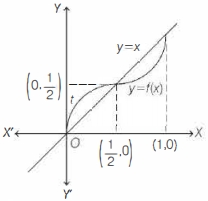
The graph of the function $f(x)=x+\frac{1}{8} \sin (2 \pi x), 0 \leq x \leq 1$ is shown below. Define $f_1(x)=f(x), f_{n+1}(x)=f\left(f_n(x)\right)$, for $n \geq 1$.
Which of the following statements are true?
$I.$ There are infinitely many $x \in[0,1]$ for which $\lim _{n \rightarrow \infty} f_n(x)=0$
$II.$ There are infinitely many $x \in[0,1]$ for which $\lim _{n \rightarrow \infty} f_n(x)=\frac{1}{2}$
$III.$ There are infinitely many $x \in[0,1]$ for which $\lim _{n \rightarrow \infty} f_n(x)=1$
$IV.$ There are infinitely many $x \in[0,1]$ for which $\lim _{n \rightarrow \infty} f_n(x)$ does not exist.
- A
$I$ and $III$ only
- ✓
$II$ only
- C
$I,II,III$ only
- D
$I, II, III$ and $IV$
AnswerCorrect option: B. $II$ only
b
(b)
$f_1(x)=x+\frac{1}{8} \sin (2 \pi x)$
$f_2(x)=x+\frac{1}{8} \sin 2 \pi x+\frac{1}{8} \sin \left(2 \pi\left(x+\frac{1}{8} \sin 2 \pi x\right)\right)$
Similarly, $f _3( x )= x +\frac{1}{8}\left(\sin (2 \pi x)+\sin \left( f _1( x )\right)+\sin \left( f _2( x )\right)\right)$
$\therefore f_n(x)=x+\frac{1}{8}\left(\sin 2 \pi x+\sin \left(f_1(x)\right)+\ldots \cdots+\sin \left(f_{n-1}(x)\right)\right)$
$f_n(x)=0$ at $x=0$ and $f_n(x)=1$ at $x=1$
Therefore $I$ and $III$ are not true
from the figure, $f _{ n }( x )=\frac{1}{2}$ for many value of $x \in[0,1]$
statement $II$ is true
for every $x , \quad 0 \leq f _1( x ) \leq 1$
therefore, for every value of $x, \quad 0 \leq f_n(x) \leq 1$
$\lim _{n \rightarrow 0} f_n(x)$ always exists for $x \in[0,1]$
$IV$ is also not true.
View full question & answer→MCQ 571 Mark
The range of the polynomial $P(x)=4 x^3-3 x$ as $x$ varies over the interval $\left(-\frac{1}{2}, \frac{1}{2}\right)$ is
AnswerCorrect option: C. $(-1,1)$
c
(c)
We have,
$P(x)=4 x^3-3 x x \in\left(-\frac{1}{2}, \frac{1}{2}\right)$
$P^{\prime}(x)=12 x^2-3=3\left(4 x^2-1\right)$
$P^{\prime}(x)<0 x \in\left(-\frac{1}{2}, \frac{1}{2}\right)$
View full question & answer→MCQ 581 Mark
Let $R$ be the set of all real numbers and let $f$ be a function from $R$ to $R$ such that $f(x)+\left(x+\frac{1}{2}\right) f(1-x)=1$, for all $x \in R$. Then $2 f(0)+3 f(1)$ is equal to
Answerc
(c)
Given,
$\Rightarrow f(x)+\left(x+\frac{1}{2}\right) f(1-x)=1$
$\text { Put } x=1-x \text {, we get }$
$f(1-x)+\left(1-x+\frac{1}{2}\right) f(1-(1-x)=1$
$\Rightarrow f(1-x)+\left(\frac{3}{2}-x\right) f(x)=1$
Eq.$(ii)$ multiply by $\left(x+\frac{1}{2}\right)$ we get
$\left(\frac{3}{2}-x\right)\left(x+\frac{1}{2}\right) f(x)+\left(x+\frac{1}{2}\right)$
$f(1-x)=x+\frac{1}{2}$
On subtracting Eq. $(iii)$ from Eq.$(i)$, we get
$f(x)\left[1-\left(\frac{3}{4}+x-x^2\right)\right]=1-x-\frac{1}{2}$
$\Rightarrow f(x)=\frac{\frac{1}{2}-x}{x^2-x+\frac{1}{4}} \Rightarrow f(0)=2 \text { and } f(1)=-2$
$\because 2 f(0)+3 f(1)-2(2)+3(-2)=4-6=-2$
View full question & answer→MCQ 591 Mark
The value of $\sum \limits_{n=0}^{1947} \frac{1}{2^n+\sqrt{2^{1994}}}$ is equal to
- ✓
$\frac{487}{\sqrt{2^{1945}}}$
- B
$\frac{1946}{\sqrt{2^{1947}}}$
- C
$\frac{1947}{\sqrt{2^{1947}}}$
- D
$\frac{1948}{\sqrt{2^{1947}}}$
AnswerCorrect option: A. $\frac{487}{\sqrt{2^{1945}}}$
a
(a)
We have,
$\sum \limits_{n=0}^{1947} \frac{1}{2^n+\sqrt{2^{1947}}}$
Let $\quad f(n)=\frac{1}{2^n+\sqrt{2^{1947}}}$
$f(0)+f(1947)=\frac{1}{1+2^{\frac{1947}{2}}}+\frac{1}{2^{1947}+2^{\frac{1947}{2}}}$
$=\frac{1}{1+2^{\frac{1947}{2}}}+\frac{1}{2^{\frac{1947}{2}}\left(2^{\frac{1947}{2}}+1\right)}$
$=\frac{2^{\frac{1947}{2}}+1}{2^{\frac{1947}{2}}\left(2^{\frac{1947}{2}+1}\right)}=\frac{1}{2^{\frac{1947}{2}}}$
Similarly, $f(1)+f(1946)=\frac{1}{2^{\frac{1947}{2}}}$
$\because \sum \limits_{n=0}^{1947} f(x)=f(0)+f(1)+f(2)+f(3)+\ldots .+f(1947)$
$=(f(0)+f(1947)+(f(1)+f(1946))+\ldots +(f(973)+f(974))$
$=974 \times \frac{1}{2^{\frac{1917}{2}}}$
$\sum \limits_{n=0}^{1947} f(n)=\frac{2 \times 487}{2 \times 2^{\frac{1945}{2}}}=\frac{487}{\sqrt{2^{1945}}}$
View full question & answer→MCQ 601 Mark
Let $f(x)$ be a non-constant polynomial with real coefficients such that $f\left(\frac{1}{2}\right)=100$ and $f(x) \leq 100$ for all real $x$. Which of the following statements is NOT necessarily true?
- A
The coefficient of the highest degree term in $f(x)$ is negative.
- B
$f(x)$ has at least two real roots.
- ✓
If $x \neq 1 / 2$ then $f(x) < 100$.
- D
At least one of the coefficients of $f(x)$ is bigger than $50.$
AnswerCorrect option: C. If $x \neq 1 / 2$ then $f(x) < 100$.
c
(c)
We have, $f\left(\frac{1}{2}\right)=100$
$f(x) \leq 100, \forall x \in R$
$\therefore \quad f(x)=a\left(x-\frac{1}{2}\right)$
$\left[a_0 x^{n-1}+a_1 x^{n-2}+\ldots+a_{n-1}\right]+100$
If $f(x) \leq 100, \forall x \in R$
$\therefore a < 0$ and $f(x)$ must be even degree polynomial.
Since, there may be more value of $x$ at which $f(x)$ attains maximum.
$\therefore$ If $x \neq \frac{1}{2}$, then $f(x) < 100$ may be false.
View full question & answer→MCQ 611 Mark
Let $f(x)=\sqrt{2-x-x^2}$ and $g(x)=\cos x$. Which of the following statements are true?
$I$. Domain of $f\left((g(x))^2\right)=$ Domain of $f(g(x))$
$II$. Domain of $f(g(x))+g(f(x))=$ Domain of $g(f(x))$
$III$. Domain of $f(g(x))=$ Domain of $g(f(x))$
$IV.$ Domain of $g\left((f(x))^3\right)=$ Domain of $f(g(x))$
- ✓
Only $I$
- B
Only $I$ and $II$
- C
Only $III$ and $IV$
- D
Only $I$ and $IV$
AnswerCorrect option: A. Only $I$
a
(a)
We have, $f(x)=\sqrt{2-x-x^2}$ and
$g(x) =\cos x$
$(g(x))^2 =\cos ^2 x$
$f\left((g(x))^2\right) =\sqrt{2-(g(x))^2-(g(x))^4}$
$=\sqrt{2-\cos ^2 x-\cos ^4 x}$
$f\left((g(x))^2\right)$ is defined if
$2-\cos ^2 x-\cos ^4 x \geq 0$
$\Rightarrow \quad \cos ^4 x+\cos ^2 x-2 \leq 0$
$\Rightarrow \cos ^4 x+2 \cos ^2 x-\cos ^2 x-2 \leq 0$
$\Rightarrow \quad\left(\cos ^2 x+2\right)\left(\cos ^2 x-1\right) \leq 0$
$\Rightarrow \quad \cos ^2 x \in[-2,1]$
$\therefore \quad f(g(x))=\sqrt{2-\cos x-\cos ^2 x}$
Similarly, for domain of $f(g(x))$ is $x \in R$
Hence, domain of $f\left(\left(g(x)^2\right)\right)=$ Domain of $f(g(x))$
View full question & answer→MCQ 621 Mark
The mid-point of the domain of the function $f(x)=\sqrt{4-\sqrt{2 x+5}}$ real $x$ is
- A
$\frac{1}{4}$
- ✓
$\frac{3}{2}$
- C
$\frac{2}{3}$
- D
$-\frac{2}{5}$
AnswerCorrect option: B. $\frac{3}{2}$
b
(b)
We have, $f(x)=\sqrt{4-\sqrt{2 x+5}}$
$f(x)$ is defined if
$4-\sqrt{2 x+5} \geq 0$ and $2 x+5 \geq 0$
$\Rightarrow 4 \geq \sqrt{2 x+5}$ and $x \geq-5 / 2$
$\Rightarrow 16 \geq 2 x+5$ and $x \geq-5 / 2$
$\Rightarrow x \leq \frac{11}{2}$ and $x \geq-5 / 2$
$\therefore$ Domain of $f(x) x \in\left[\frac{-5}{2}, \frac{11}{2}\right]$
Mid-point of domain $\frac{\frac{-5}{2}+\frac{11}{2}}{2}=\frac{3}{2}$
View full question & answer→MCQ 631 Mark
Let $f(x)=\frac{x+1}{x-1}$ for all $x \neq 1$. Let $f^1(x)=f(x), f^2(x)=f(f(x))$ and generally $f^n(x)=f\left(f^{n-1}(x)\right)$ for $n>1$. Let $P=f^1(2) f^2(3) f^3(4) f^4(5)$ Which of the following is a multiple of $P$ ?
Answerb
(b)
We have, $f^1(x)=\frac{x+1}{x-1}$
$f^3(x) =f(x), f^4(x)=x$
$P =f^1(2) \cdot f^2(3) \cdot f^3(4) \cdot f^4(5)$
$P =3 \times 3 \times \frac{5}{3} \times 5=75$
$\therefore$ Multiple of $P$ is $375$
View full question & answer→MCQ 641 Mark
Let $X$ be a non-empty set and let $P(X)$ denote the collection of all subsets of $X$. Define $f: X \times P(X) \rightarrow R$ by $f(x, A)=\left\{\begin{array}{ll}1, & \text { if } x \in A \\ 0, & \text { if } x \notin A^*\end{array}\right.$ Then, $f(x, A \cup B)$ equals
AnswerCorrect option: C. $f(x, A)+f(x, B)-1$
c
(c)
We have,
$\begin{array}{c}f: X \times P(X) \rightarrow R \\f(x, A)=\left\{\begin{array}{ll} 1, & \text { if } x \in A \\0, & \text { if } x \notin A\end{array}\right. \\f(x, A \cup B)=\left\{\begin{array}{ll}1, & \text { if } x \in A \cup B \\0, & \text { if } x \notin A \cup B\end{array}\right. \\\text { If } x \in A, x \in B \Rightarrow f(x, A \cup B)=1 \\\text { If } x \in A, x \notin B \Rightarrow f(x, A \cup B)=1 \\\text { If } x \notin A, x \in B \Rightarrow f(x, A \cup B)=1 \\ \text { If } x \notin A, x \notin B \Rightarrow f(x, A \cup B)=0\end{array}$
View full question & answer→MCQ 651 Mark
The number of relations $R$ from an $m$-element set $A$ to an $n$-element set $B$ satisfying the condition$\left(a, b_1\right) \in R,\left(a, b_2\right) \in R \Rightarrow b_1=b_2$ for $a \in A, b_1, b_2 \in B$ is
- ✓
$n^m$
- B
$2^{m+n}-2^m-2^n$
- C
$m n$
- D
$(n+1)^m$
Answera
(a)
Set $A$ have $m$-elements,
Set $B$ have $n$-elements
$\left(a, b_1\right) \in K,\left(a, b_2\right) \in R \Rightarrow\left(b_1=b_2\right)$
By condition relation is a function.
$\therefore$ Total number of function (Relation) $=n^m$
View full question & answer→MCQ 661 Mark
Let $R$ be a relation on $Z \times Z$ defined by$ (a, b)$$R(c, d)$ if and only if $ad - bc$ is divisible by $5$ . Then $\mathrm{R}$ is
- ✓
Reflexive and symmetric but not transitive
- B
Reflexive but neither symmetric not transitive
- C
Reflexive, symmetric and transitive.
- D
Reflexive and transitive but not symmetric
AnswerCorrect option: A. Reflexive and symmetric but not transitive
a
$(a, b) R(a, b)$ as $a b-a b=0$
Therefore reflexive
Let $(a, b) R(c, d) \Rightarrow a d-b c$ is divisible by $5$
$\Rightarrow \mathrm{bc}-\mathrm{ad}$ is divisible by $5 \Rightarrow(\mathrm{c}, \mathrm{d}) \mathrm{R}(\mathrm{a}, \mathrm{b})$
Therefore symmetric
Relation not transitive as $(3,1) \mathrm{R}(10,5)$ and $(10,5) \mathrm{R}(1,1)$ but $(3,1)$ is not related to $(1,1)$
View full question & answer→MCQ 671 Mark
If $\mathrm{R}$ is the smallest equivalence relation on the set $\{1,2,3,4\}$ such that $\{(1,2),(1,3)\} \subset R$, then the number of elements in $\mathrm{R}$ is
Answera
Given set $\{1,2,3,4\}$
Minimum order pairs are
$ (1,1),(2,2),(3,3),(4,4),(3,1),(2,1),(2,3),(3,2), (1,3),(1,2)$
Thus no. of elements $=10$
View full question & answer→MCQ 681 Mark
The number of symmetric relations defined on the set $\{1,2,3,4\}$ which are not reflexive is
Answerc
Total number of relation both symmetric and reflexive $=2^{\frac{\mathrm{n}^2-\mathrm{n}}{2}}$
Total number of symmetric relation $=2^{\left(\frac{\mathrm{n}^2+\mathrm{n}}{2}\right)}$
$\Rightarrow$ Then number of symmetric relation which are not reflexive
$ \Rightarrow $ $ 2^{\frac{n(n+1)}{2}}-2^{\frac{n(n-1)}{2}}$
$ \Rightarrow $ $2^{10}-2^6 $
$\Rightarrow $ $1024-64 $
$ =960$
View full question & answer→MCQ 691 Mark
Let $A=\{1,2,3, \ldots 20\}$. Let $R_1$ and $R_2$ two relation on $\mathrm{A}$ such that $\mathrm{R}_1=\{(\mathrm{a}, \mathrm{b}): \mathrm{b}$ is divisible by $\mathrm{a}\}$ $\mathrm{R}_2=\{(\mathrm{a}, \mathrm{b}): \mathrm{a}$ is an integral multiple of $\mathrm{b}\}$. Then, number of elements in $R_1-R_2$ is equal to_____.
Answerb
$ \mathrm{n}\left(\mathrm{R}_1\right)=20+10+6+5+4+3+2+2+2 $
$ +2+\underbrace{1+\ldots+1}_{10 \text { times }}$
$\mathrm{n}\left(\mathrm{R}_1\right)=66$
$\mathrm{R}_1 \cap \mathrm{R}_2=\{(1,1),(2,2), \ldots(20,20)\}$
$\mathrm{n}\left(\mathrm{R}_1 \cap \mathrm{R}_2\right)=20$
$\mathrm{n}\left(\mathrm{R}_1-\mathrm{R}_2\right)=\mathrm{n}\left(\mathrm{R}_1\right)-\mathrm{n}\left(\mathrm{R}_1 \cap \mathrm{R}_2\right)$
$=\mathrm{n}\left(\mathrm{R}_1\right)-20$
$=66-20$
$\mathrm{R}_1-\mathrm{R}_2=46 \text { Pair }$
View full question & answer→MCQ 701 Mark
Consider the relations $R_1$ and $R_2$ defined as $a R_1 b$ $\Leftrightarrow a^2+b^2=1$ for all $a, b, \in R$ and $(a, b) R_2(c, d)$ $\Leftrightarrow a+d=b+c$ for all $(a, b),(c, d) \in N \times N$. Then
- A
Only $R_1$ is an equivalence relation
- ✓
Only $R_2$ is an equivalence relation
- C
$R_1$ and $R_2$ both are equivalence relations
- D
Neither $R_1$ nor $R_2$ is an equivalence relation
AnswerCorrect option: B. Only $R_2$ is an equivalence relation
b
$a R_1 b \Leftrightarrow a^2+b^2=1 ; a, b \in R$
(a, b) $R_2(c, d) \Leftrightarrow a+d=b+c ;(a, b),(c, d) \in N$
for $R_1$ : Not reflexive symmetric not transitive
for $R_2: R_2$ is reflexive, symmetric and transitive
Hence only $R_2$ is equivalence relation.
View full question & answer→MCQ 711 Mark
Let a relation $R$ on $\mathbb{N} \times \mathbb{N}$ be defined as : $\left(\mathrm{x}_1, \mathrm{y}_1\right) \mathrm{R}\left(\mathrm{x}_2, \mathrm{y}_2\right)$ if and only if $\mathrm{x}_1 \leq \mathrm{x}_2$ or $\mathrm{y}_1 \leq \mathrm{y}_2$
Consider the two statements :
($I$) $\mathrm{R}$ is reflexive but not symmetric.
($II$) $\mathrm{R}$ is transitive
Then which one of the following is true?
AnswerCorrect option: B. Only ($I$) is correct.
b
All $\left(\left(\mathrm{x}_1 \mathrm{y}_1\right),\left(\mathrm{x}_1, \mathrm{y}_1\right)\right)$ are in $\mathrm{R}$ where
$\mathrm{x}_1, \mathrm{y}_1 \in \mathrm{N} \therefore \mathrm{R}$ is reflexive
$((1,1),(2,3)) \in \mathrm{R}$ but $((2,3),(1,1)) \notin \mathrm{R}$
$\therefore \mathrm{R}$ is not symmetric
$((2,4),(3,3)) \in \mathrm{R}$ and $((3,3),(1,3)) \in \mathrm{R}$ but $((2,4)$,
$(1,3)) \notin \mathrm{R}$
$\therefore \mathrm{R}$ is not transitive
View full question & answer→MCQ 721 Mark
Consider the function $\mathrm{f}:\left[\frac{1}{2}, 1\right] \rightarrow \mathrm{R}$ defined by $f(x)=4 \sqrt{2} x^3-3 \sqrt{2} x-1$. Consider the statements
$(I)$ The curve $y=f(x)$ intersects the $x$-axis exactly at one point
$(II)$ The curve $y=f(x)$ intersects the $x$-axis at $\mathrm{x}=\cos \frac{\pi}{12}$
Then
AnswerCorrect option: D. Both $(I)$ and $(II)$ are correct
d
$\mathrm{f}^{\prime}(\mathrm{x})=12 \sqrt{2} \mathrm{x}^2-3 \sqrt{2} \geq 0 \text { for }\left[\frac{1}{2}, 1\right]$
$\mathrm{f}\left(\frac{1}{2}\right)<0$
$\mathrm{f}(1)>0 \Rightarrow(\mathrm{A})$ is correct.
$f(x)=\sqrt{2}\left(4 x^3-3 x\right)-1=0$
Let $\cos \alpha=\mathrm{x}$,
$\cos 3 \alpha=\cos \frac{\pi}{4} \Rightarrow \alpha=\frac{\pi}{12}$
$\mathrm{x}=\cos \frac{\pi}{12}$
$(4)$ is correct.
View full question & answer→MCQ 731 Mark
Let $A=\{(x, y): 2 x+3 y=23, x, y \in N\}$ and $B=\{x:(x, y) \in A\}$. Then the number of one-one functions from $\mathrm{A}$ to $\mathrm{B}$ is equal to ................
Answera
$2 x+3y=23 $
$x=1 $ $ y=7 $
$x=4 $ $ y=5 $
$x=7 $ $ y=3 $
$x=10 $ $ y=1 $
$A $ $ B $
$(1,7) $ $ 1 $
$(4,5) $ $ 4 $
$(7,3) $ $ 7 $
$(10,1) $ $ 10$
The number of one-one functions from $\mathrm{A}$ to $\mathrm{B}$ is equal to $4$ !
View full question & answer→MCQ 741 Mark
The function $\mathrm{f}: \mathrm{N}-\{1\} \rightarrow \mathrm{N}$; defined by $\mathrm{f}(\mathrm{n})=$ the highest prime factor of $n$, is :
Answerd
$\mathrm{f}: \mathrm{N}-\{1\} \rightarrow \mathrm{N}$
$f(n)=$ The highest prime factor of $n$.
$f(2)=2$
$f(4)=2$
$\Rightarrow$ many one
$4$ is not image of any element
$\Rightarrow$ into
Hence many one and into
Neither one-one nor onto.
View full question & answer→MCQ 751 Mark
The function $f(x)=\frac{x^2+2 x-15}{x^2-4 x+9}, x \in R$ is
- A
- B
- ✓
neither one-one nor onto.
- D
AnswerCorrect option: C. neither one-one nor onto.
c
$f(x)=\frac{(x+5)(x-3)}{x^2-4 x+9}$
Let $g(x)=x^2-4 x+9$
$ D < 0 $
$ g(x) > 0$ for $x \in R$
$\therefore\left[\begin{array}{l}\mathrm{f}(-5)=0 \\ \mathrm{f}(3)=0\end{array}\right.$
So, $\mathrm{f}(\mathrm{x})$ is many-one.
again,
$ y x^2-4 x y+9 y=x^2+2 x-15 $
$ x^2(y-1)-2 x(2 y+1)+(9 y+15)=0 $
$ \text { for } \forall x \in R \Rightarrow D \geq 0 $
$ D=4(2 y+1)^2-4(y-1)(9 y+15) \geq 0 $
$ 5 y^2+2 y+16 \leq 0 $
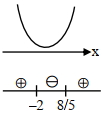
$ (5 y-8)(y+2) \leq 0$
$Image$
$\mathrm{y} \in\left[-2, \frac{8}{5}\right]$ range
Note : If function is defined from $f: R \rightarrow R$ then only correct answer is option ($3$)
$\Rightarrow$ Bonus
View full question & answer→MCQ 761 Mark
If $f(x)=\frac{4 x+3}{6 x-4}, x \neq \frac{2}{3}$ and $(f \circ f)(x)=g(x)$, where $\mathrm{g}: \mathbb{R}-\left\{\frac{2}{3}\right\} \rightarrow \mathbb{R}-\left\{\frac{2}{3}\right\}$, then $(gogog) (4)$ is equal to
- A
$-\frac{19}{20}$
- B
$\frac{19}{20}$
- C
$-4$
- ✓
$4$
Answerd
$ f(x)=\frac{4 x+3}{6 x-4} $
$ g(x)=\frac{4\left(\frac{4 x+3}{6 x-4}\right)+3}{6\left(\frac{4 x+3}{6 x-4}\right)-4}=\frac{34 x}{34}=x $
$ g(x)=x \therefore g(g(g(4)))=4$
View full question & answer→MCQ 771 Mark
Let $\mathrm{f}: R \rightarrow R$ and $\mathrm{g}: R \rightarrow R$ be defined as $f(x)=\left\{\begin{array}{lll}\log _e x & , & x>0 \\ e^{-x} & , & x \leq 0\end{array}\right.$ and $g(x)=\left\{\begin{array}{lll} x & , & x \geq 0 \\ e^{x} & , & x < 0\end{array}\right.$ Then $gof:R \to R$ is . . . .
Answerb
$\mathrm{g}(\mathrm{f}(\mathrm{x}))=\left\{\begin{array}{l}f(x), f(x) \geq 0 \\ e^{f(x)}, f(x)<0\end{array}\right.$
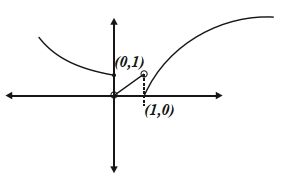
$\mathrm{g}(\mathrm{f}(\mathrm{x}))=\left\{\begin{array}{l}e^{-x},(-\infty, 0] \\ e^{\ln x},(0,1) \\ \ln x,[1, \infty)\end{array}\right.$
Graph of $g(f(x))$
$\mathrm{g}(\mathrm{f}(\mathrm{x})) \Rightarrow$ Many one into
View full question & answer→MCQ 781 Mark
Let $\mathrm{A}=\{1,2,3,4\}$ and $\mathrm{R}=\{(1,2),(2,3),(1,4)\}$ be a relation on $\mathrm{A}$. Let $\mathrm{S}$ be the equivalence relation on $A$ such that $\mathrm{R} \subset \mathrm{S}$ and the number of elements in $\mathrm{S}$ is $\mathrm{n}$. Then, the minimum value of $\mathrm{n}$ is...............
Answera
All elements are included Answer is $16$
View full question & answer→MCQ 791 Mark
Let $A=\{1,2,3, \ldots \ldots .100\}$. Let $R$ be a relation on A defined by $(x, y) \in R$ if and only if $2 x=3 y$. Let $R_1$ be a symmetric relation on $A$ such that $\mathrm{R} \subset \mathrm{R}_1$ and the number of elements in $\mathrm{R}_1$ is $\mathrm{n}$. Then, the minimum value of $n$ is..........................
Answerb
$ \mathrm{R}=\{(3,2),(6,4),(9,6),(12,8), \ldots \ldots \ldots .(99,66)\} $
$\mathrm{n}(\mathrm{R})=33 $
$ \therefore 66$
View full question & answer→MCQ 801 Mark
Let $S=\{1,2,3, \ldots, 10\}$. Suppose $M$ is the set of all the subsets of $S$, then the relation $R=\{(A, B): A \cap B \neq \phi ; A, B \in M\}$ is :
- A
symmetric and reflexive only
- B
- C
symmetric and transitive only
- ✓
Answerd
Let $S=\{1,2,3, \ldots, 10\}$
$R=\{(A, B): A \cap B \neq \phi ; A, B \in M\}$
For Reflexive,
$M$ is subset of ' $S$ '
So $\phi \in \mathrm{M}$
for $\phi \cap \phi=\phi$
$\Rightarrow$ but relation is $\mathrm{A} \cap \mathrm{B} \neq \phi$
So it is not reflexive.
For symmetric,
$\mathrm{ARB}$
$\mathrm{A} \cap \mathrm{B} \neq \phi,$
$\Rightarrow \mathrm{BRA} \quad \Rightarrow \mathrm{B} \cap \mathrm{A} \neq \phi$,
So it is symmetric.
For transitive,
If $\mathrm{A}=\{(1,2),(2,3)\}$
$ B=\{(2,3),(3,4)\} $
$C=\{(3,4),(5,6)\}$
$ARB$ $BRC$ but $A$ does not relate to $C$
So it not transitive
View full question & answer→MCQ 811 Mark
Let the relations $R_1$ and $R_2$ on the set $\mathrm{X}=\{1,2,3, \ldots, 20\}$ be given by $\mathrm{R}_1=\{(\mathrm{x}, \mathrm{y}): 2 \mathrm{x}-3 \mathrm{y}=2\}$ and $\mathrm{R}_2=\{(\mathrm{x}, \mathrm{y}):-5 \mathrm{x}+4 \mathrm{y}=0\}$. If $\mathrm{M}$ and $\mathrm{N}$ be the minimum number of elements required to be added in $R_1$ and $R_2$, respectively, in order to make the relations symmetric, then $\mathrm{M}+\mathrm{N}$ equals
Answerd
$ \mathrm{x}=\{1,2,3, \ldots \ldots .20\} $
$ \mathrm{R}_1=\{(\mathrm{x}, \mathrm{y}): 2 \mathrm{x}-3 \mathrm{y}=2\} $
$ \mathrm{R}_2=\{(\mathrm{x}, \mathrm{y}):-5 \mathrm{x}+4 \mathrm{y}=0\}$
$ \mathrm{R}_1=\{(4,2),(7,4),(10,6),(13,8),(16,10),(19,12)\} $
$ \mathrm{R}_2=\{(4,5),(8,10),(12,15),(16,20)\}$
in $\mathrm{R}_1 6$ element needed
in $\mathrm{R}_2 4$ element needed
So, total $6+4=10$ element
View full question & answer→MCQ 821 Mark
Let $\mathrm{A}=\{1,2,3,4,5\}$. Let $\mathrm{R}$ be a relation on $\mathrm{A}$ defined by $x R y$ if and only if $4 x \leq 5 y$. Let $m$ be the number of elements in $\mathrm{R}$ and $\mathrm{n}$ be the minimum number of elements from $\mathrm{A} \times \mathrm{A}$ that are required to be added to $\mathrm{R}$ to make it a symmetric relation. Then $m+n$ is equal to:
Answerc
Given : $4 x \leq 5 y$
then
$\mathrm{R}=\{ $$ (1,1),(1,2),(1,3),(1,4),(1,5),(2,2),(2,3),(2,4) $
$ (2,5),(3,3),(3,4),(3,5),(4,4),(4,5),(5,4),(5,5)\}$
i.e. $16$ elements.
i.e. $\mathrm{m}=16$
Now to make $\mathrm{R}$ a symmetric relation add
$\{(2,1)(3,2)(4,3)(3,1)(4,2)(5,3)(4,1)(5,2)(5,1)\}$
i.e. $\mathrm{n}=9$
So $\mathrm{m}+\mathrm{n}=25$
View full question & answer→MCQ 831 Mark
Let $A=\{2,3,6,8,9,11\}$ and $B=\{1,4,5,10,15\}$
Let $\mathrm{R}$ be a relation on $\mathrm{A} \times \mathrm{B}$ define by $(\mathrm{a}, \mathrm{b}) \mathrm{R}(\mathrm{c}, \mathrm{d})$ if and only if $3 \mathrm{ad}-7 \mathrm{bc}$ is an even integer. Then the relation $\mathrm{R}$ is
- A
reflexive but not symmetric.
- B
transitive but not symmetric.
- ✓
reflexive and symmetric but not transitive.
- D
AnswerCorrect option: C. reflexive and symmetric but not transitive.
c
$ \mathrm{A}=\{2,3,6,8,9,11\} \quad(\mathrm{a}, \mathrm{b}) \mathrm{R}(\mathrm{c}, \mathrm{d}) $
$ \mathrm{B}=\{1,4,5,10,15\} \quad 3 \mathrm{ad}-7 \mathrm{bc} $
$ \text { Reflexive : }(\mathrm{a}, \mathrm{b}) \mathrm{R}(\mathrm{a}, \mathrm{b})$
$\Rightarrow 3 \mathrm{ab}-7 \mathrm{ba}=-4 \mathrm{ab}$ always even so it is reflexive.
Symmetric : If $3 \mathrm{ad}-7 \mathrm{bc}=$ Even
Case $-I$ : odd odd
Case $-II$ : even even
$(\mathrm{c}, \mathrm{d}) \mathrm{R}(\mathrm{a}, \mathrm{b}) \Rightarrow 3 \mathrm{bc}-3 \mathrm{ab}$
Case $-I$ : odd odd
Case $-II$ : even even
so symmetric relation
Transitive :
Set $(3,4) R(6,4)$ Satisfy relation
Set $(6,4) R(3,1)$ Satisfy relation
but $(3,4) R(3,1)$ does not satisfy relation so not transitive.
View full question & answer→MCQ 841 Mark
Let $A=\{2,3,6,7\}$ and $B=\{4,5,6,8\}$. Let $R$ be a relation defined on A $\times$ B by $\left(a_1, b_1\right) R\left(a_2, b_2\right)$ is and only if $a_1+a_2=b_1+b_2$. Then the number of elements in $\mathrm{R}$ is ...........
Answerb
$ A=\{2,3,6,7\} $
$ B=\{2,5,6,8\} $
$ \left(a_1, b_1\right) R\left(a_2, b_2\right) $
$ a_1+a_2=b_1+b_2$
$1$. $(2,4) \mathrm{R}(6,4) \quad$ 2. $(2,4) \mathrm{R}(7,5)$
$3$. $(2,5) \mathrm{R}(7,4) \quad$ 4. $(3,4) \mathrm{R}(6,5)$
$5$. $(3,5) \mathrm{R}(6,4) \quad$ 6. $(3,5) \mathrm{R}(7,5)$
$7$. $(3,6) \mathrm{R}(7,4) \quad$ 8. $(3,4) \mathrm{R}(7,6)$ $\times 2$
$9$. $(6,5) \mathrm{R}(7,8) \quad$ 10. $(6,8) \mathrm{R}(7,5)$
$11$. $(7,8) \mathrm{R}(7,6) \quad$ 12. $(6,8) \mathrm{R}(6,4)$
$13$. $(6,6) \mathrm{R}(6,6)$
Total $24+1=25$
View full question & answer→MCQ 851 Mark
If the domain of the function $f(x)=\log _e$ $\left(\frac{2 x+3}{4 x^2+x-3}\right)+\cos ^{-1}\left(\frac{2 x-1}{x+2}\right)$ is $(\alpha, \beta]$, then the value of $5 \beta-4 \alpha$ is equal to
Answerb
$\frac{2 x+3}{4 x^2+x-3}>0 \text { and }-1 \leq \frac{2 x-1}{x+2} \leq 1 $
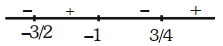
$\frac{2 \times+3}{(4 x-3)(x+1)}>0 \quad \frac{3 x+1}{x+2} \geq 0 \quad \& \quad \frac{x-3}{x+2} \leq 0 $
$(-\infty,-2) \cup\left[\frac{-1}{3}, \infty\right) \quad \ldots . .(1) $
$(-2,3] \quad \ldots . .(2)$
${\left[\frac{-1}{3}, 3\right] \ldots \ldots(3) \quad(1) \cap(2) \cap(3)} $
$ \left(\frac{3}{4}, 3\right] $
$ \alpha=\frac{3}{4} \beta=3 $
$ 5 \beta-4 \alpha=15-3=12$
View full question & answer→MCQ 861 Mark
Consider the function $f: \mathbb{R} \rightarrow \mathbb{R}$ defined by
$f(x)=\frac{2 x}{\sqrt{1+9 x^2}}$. If the composition of $f, \underbrace{(f \circ f \circ f \circ \ldots \circ f)}_{10 \text { times }}(x)=\frac{2^{10} x}{\sqrt{1+9 \alpha x^2}}$, then the value of $\sqrt{3 \alpha+1}$ is equal to....................
- A
$1044$
- B
$1075$
- C
$1056$
- ✓
$1024$
AnswerCorrect option: D. $1024$
d
$ \mathrm{f}(\mathrm{f}(\mathrm{x}))=\frac{2 \mathrm{f}(\mathrm{x})}{\sqrt{1+9 \mathrm{f}^2(\mathrm{x})}}=\frac{4 \mathrm{x}}{\sqrt{1+9 \mathrm{x}^2+9.2^2 \mathrm{x}^2}} $
$ \mathrm{f}(\mathrm{f}(\mathrm{f}(\mathrm{x})))=\frac{2^3 \mathrm{x} / \sqrt{1+9 \mathrm{x}^2}}{\sqrt{1+9\left(1+2^2\right) \frac{2^2 \mathrm{x}^2}{1+9 \mathrm{x}^2}}}=\frac{2^3 \mathrm{x}}{\sqrt{1+9 \mathrm{x}^2\left(1+2^2+2^4\right)}} $
$ \therefore \text { By observation } $
$ \alpha=1+2^2+2^4+\ldots+2^{18}=1\left(\frac{\left(2^2\right)^{10}-1}{2^2-1}\right)=\frac{2^{20}-1}{3} $
$ 3 \alpha+1=2^{20} \rightarrow \sqrt{3 \alpha+1}=2^{10}=1024$
View full question & answer→MCQ 871 Mark
Let $A=\{1,3,7,9,11\}$ and $B=\{2,4,5,7,8,10,12\}$. Then the total number of one-one maps $\mathrm{f}: \mathrm{A} \rightarrow \mathrm{B}$, such that $\mathrm{f}(1)+\mathrm{f}(3)=14$, is :
Answerd
$ A=\{1,3,7,9,11\} $
$ B=\{2,4,5,7,8,10,12\} $
$ f(1)+f(3)=14 $
$ \text { (i) } 2+12 $
$ \text { (ii) } 4+10 $
$ 2 \times(2 \times 5 \times 4 \times 3)=240$
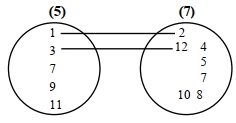
View full question & answer→MCQ 881 Mark
Let $[t]$ be the greatest integer less than or equal to $t$. Let $A$ be the set of al prime factors of $2310$ and $f: A \rightarrow \mathbb{Z}$ be the function $f(x)=\left[\log _2\left(x^2+\left[\frac{x^3}{5}\right]\right)\right]$. The number of one-to-one functions from $A$ to the range of $f$ is :
Answerb
$\mathrm{N}=2310 $$ =231 \times 10 $
$= 3 \times 11 \times 7 \times 2 \times 5$
$ A=\{2,3,5,7,11\} $
$ f(x)=\left[\log _2\left(x^2+\left[\frac{x^3}{5}\right]\right)\right]$
$ f(2)=\left[\log _2(5)\right]=2 $
$ f(3)=\left[\log _2(14)\right]=3 $
$ f(5)=\left[\log _2(25+25)\right]=5 $
$ f(7)=\left[\log _2(117)\right]=6 $
$ f(11)=\left[\log _2 387\right]=8$
Range of $f: B=\{2,3,5,6,8\}$
No. of one-one functions $=5 !=120$
View full question & answer→MCQ 891 Mark
If the domain of the function $f(x)=\sin ^{-1}\left(\frac{x-1}{2 x+3}\right)$ is $R-(\alpha, \beta)$ then $12 \alpha \beta$ is equal to :
Answerd
Domain of $f(x)=\sin ^{-1}\left(\frac{x-1}{2 x+3}\right)$ is
$ 2 x+3 \neq 0 \& x \neq \frac{-3}{2} \text { and }\left|\frac{(x-1)}{2 x+3}\right| \leq 1 $
$|x-1| \leq|2 x+3|$
$Image$
$ \text { For }|2 x+3| \geq|x-1| $
$ x \in(-\infty,-4] \cup\left(-\frac{2}{3}, \infty\right) $
$ \alpha=-4 \& \beta=-\frac{2}{3}: 12 \alpha \beta=32$
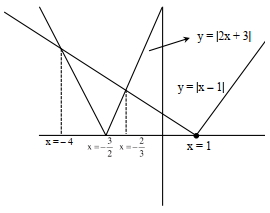
View full question & answer→MCQ 901 Mark
Let $ f, \mathrm{~g}: \mathrm{R} \rightarrow \mathrm{R}$ be defined as : $f(\mathrm{x})=|\mathrm{x}-1|$ and $g(x)=\left\{\begin{array}{cc}\mathrm{e}^{\mathrm{x}}, & \mathrm{x} \geq 0 \\ \mathrm{x}+1, & \mathrm{x} \leq 0\end{array}\right.$. Then the function $f(\mathrm{~g}(\mathrm{x}))$ is
- ✓
neither one-one nor onto.
- B
- C
- D
AnswerCorrect option: A. neither one-one nor onto.
a
$f(g(x))=|g(x)-1|$
fog $\left[\begin{array}{cc}\left|e^x-1\right| & x \geq 0 \\ |x+1-1| & x \leq 0\end{array}\right.$
$f o g\left[\begin{array}{cc}e^x-1 & x \geq 0 \\ -x & x \leq 0\end{array}\right.$
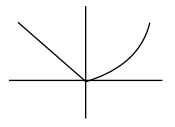
View full question & answer→MCQ 911 Mark
Let $f(\mathrm{x})=\left\{\begin{array}{cl}-\mathrm{a} & \text { if }-\mathrm{a} \leq \mathrm{x} \leq 0 \\ \mathrm{x}+\mathrm{a} & \text { if } 0<\mathrm{x} \leq \mathrm{a}\end{array}\right.$ where $\mathrm{a}>0$ and $\mathrm{g}(\mathrm{x})=(f|\mathrm{x}|)-|f(\mathrm{x})|) / 2$. Then the function $\mathrm{g}:[-\mathrm{a}, \mathrm{a}] \rightarrow[-\mathrm{a}, \mathrm{a}]$ is
- ✓
neither one-one nor onto.
- B
- C
- D
AnswerCorrect option: A. neither one-one nor onto.
a
$y=f(x)$
$Image$
$y=f|x|$
$Image$
$y=|f(x)|$
$Image$
$g(x)=\frac{f(|x|)-|f(x)|}{2}$
$Image$
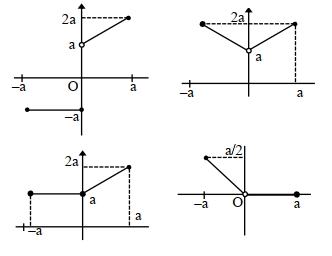
View full question & answer→MCQ 921 Mark
Let $\mathrm{f}: \mathrm{R}-\left\{\frac{-1}{2}\right\} \rightarrow \mathrm{R}$ and $\mathrm{g}: \mathrm{R}-\left\{\frac{-5}{2}\right\} \rightarrow \mathrm{R}$ be defined as $f(x)=\frac{2 x+3}{2 x+1}$ and $g(x)=\frac{|x|+1}{2 x+5}$. Then the domain of the function $fog$ is:
- ✓
$\mathrm{R}-\left\{-\frac{5}{2}\right\}$
- B
$R$
- C
$R-\left\{-\frac{7}{4}\right\}$
- D
$\mathrm{R}-\left\{-\frac{5}{2},-\frac{7}{4}\right\}$
AnswerCorrect option: A. $\mathrm{R}-\left\{-\frac{5}{2}\right\}$
a
$ \mathrm{f}(\mathrm{x})=\frac{2 \mathrm{x}+3}{2 \mathrm{x}+1} ; \mathrm{x} \neq-\frac{1}{2} $
$ \mathrm{~g}(\mathrm{x})=\frac{|\mathrm{x}|+1}{2 \mathrm{x}+5}, \mathrm{x} \neq-\frac{5}{2}$
Domain of $f(g(x))$
$f(g(x))=\frac{2 g(x)+3}{2 g(x)+1}$
$x \neq-\frac{5}{2}$ and $\frac{|x|+1}{2 x+5} \neq-\frac{1}{2}$
$x \in R-\left\{-\frac{5}{2}\right\}$ and $x \in R$
$\therefore$ Domain will be $R-\left\{-\frac{5}{2}\right\}$
View full question & answer→MCQ 931 Mark
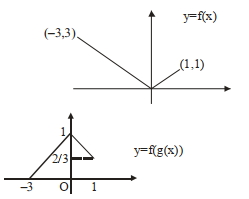
If $f(x)=\left\{\begin{array}{l}2+2 x,-1 \leq x < 0 \\ 1-\frac{x}{3}, 0 \leq x \leq 3\end{array}\right.$ and $g(x)=\left\{\begin{array}{l}-x,-3 \leq x \leq 0 \\ x, 0 < x \leq 1\end{array}\right.$then range of $(fog (X))$ is
- A
$(0,1]$
- B
$[0,3)$
- ✓
$[0,1]$
- D
$[0,1)$
AnswerCorrect option: C. $[0,1]$
c
$f(g(x))= \begin{cases}2+2 g(x) & ,-1 \leq g(x)<0 \\ 1-\frac{g(x)}{3}, & 0\leq g(x) \leq 3\end{cases}$
By $(1)$ $x \in \phi$
And by $(2)$ $x \in[-3,0]$ and $x \in[0,1]$
Range of $f(g(X))$ is $[0,1]$
View full question & answer→MCQ 941 Mark
Let $f(x)=\left\{\begin{array}{l}x-1, x \text { is even, } \\ 2 x, x \text { is odd, }\end{array}\right.$. If for some $a \in N, f(f(f(a)))=21$, then $\lim _{x \rightarrow a^{-}}\left\{\frac{|x|^3}{a}-\left[\frac{x}{a}\right]\right\}$, where $[t]$ denotes the greatest integer less than or equal to $t$, is equal to :
Answerb
$f(x)=\left\{\begin{array}{cc}x-1 ; & x=\text { even } \\ 2 x ; & x=\text { odd }\end{array}\right.$
$ f(f(\mathrm{a})))=21 $
$ \text { C-1: If } a=\text { even } $
$ f(\mathrm{a})=\mathrm{a}-1=\text { odd } $
$ f(a))=2(a-1)=\text { even } $
$ f(f(f(a)))=2 a-3=21 \Rightarrow a=12 $
$ \text { C-2: If } a=\text { odd } $
$ f(\mathrm{a})=2 \mathrm{a}=\text { even } $
$ f(f(\mathrm{a}))=2 \mathrm{a}-1=\text { odd } $
$ f(f(f(a)))=4 a-2=21 \text { (Not possible) } $
Hence $\mathrm{a}=12$
Now
$ \lim _{x \rightarrow 12^{-}}\left(\frac{|x|^3}{12}-\left[\frac{x}{12}\right]\right) $
$ =\lim _{x \rightarrow 12^{-}} \frac{|x|^3}{12}-\lim _{x \rightarrow 12^{-}}\left[\frac{x}{12}\right] $
$ =144-0=144 .$
View full question & answer→MCQ 951 Mark
The minimum number of elements that must be added to the relation $R =\{( a , b ),( b , c )$, (b, d) $\}$ on the set $\{a, b, c, d\}$ so that it is an equivalence relation, is $.........$
Answerd
Given $R=\{(a, b),(b, c),(b, d)\}$
In order to make it equivalence relation as per given set, $R$ must be
$\{(a, a),(b, b),(c, c),(d, d),(a, b),(b, a),(b, c),(c, b)$, $(b, d),(d, b),(a, c),(a, d),(c, d),(d, c),(c, a),(d, a)\}$
There already given so $13$ more to be added.
View full question & answer→MCQ 961 Mark
Let $R$ be a relation defined on $N$ as a $R$ b is $2 a+3 b$ is a multiple of $5, a, b \in N$. Then $R$ is
- A
- B
transitive but not symmetric
- C
symmetric but not transitive
- ✓
Answerd
$a R a \Rightarrow 5 a$ is multiple it 5
So reflexive
$a R b \Rightarrow 2 a +3 b =5 \alpha$,
Now b R a
$2 b+3 a=2 b+\left(\frac{5 \alpha-3 b}{2}\right) \cdot 3$
$=\frac{15}{2} \alpha-\frac{5}{2} b=\frac{5}{2}(3 \alpha-b)$
$=\frac{5}{2}(2 a+2 b-2 \alpha)$
$=5(a+b-\alpha)$
Hence symmetric
$\text { a R b } \quad \Rightarrow 2 a+3 b=5 \alpha \text {. }$
$\text { b R c } \quad \Rightarrow 2 b+3 c=5 \beta$
$\text { Now } \quad 2 a+5 b+3 c=5(\alpha+\beta)$
$\Rightarrow 2 a +5 b +3 c =5(\alpha+\beta)$
$\Rightarrow 2 a +3 c =5(\alpha+\beta- b )$
$\Rightarrow a R c$
Hence relation is equivalence relation.
View full question & answer→MCQ 971 Mark
Let $A =\{1,2,3,4,5,6,7\}$. Then the relation $R =$ $\{( x , y ) \in A \times A : x + y =7\}$ is
- A
transitive but neither symmetric nor reflexive
- B
reflexive but neither symmetric nor transitive
- C
- ✓
symmetric but neither reflexive nor transitive
AnswerCorrect option: D. symmetric but neither reflexive nor transitive
d
$R =\{(1,6),(2,5),(3,4),(4,3),(5,2),(6,1)\}$
View full question & answer→MCQ 981 Mark
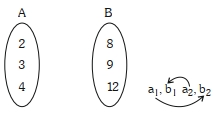
Let $A =\{2,3,4\}$ and $B =\{8,9,12\}$. Then the number of elements in the relation $R=\left\{\left(\left(a_1, b_1\right),\left(a_2, b_2\right)\right) \in(A \times B, A \times B): a_1\right.$ divides $b_2$ and $a_2$ divides $\left.b_1\right\}$ is:
Answera
$a_1$ divides $b_2$
Each element has 2 choices
$\Rightarrow 3 \times 2=6$
$a_2$ divides $b_1$
Each element has $2$ choices
$\Rightarrow 3 \times 2=6$
$\text { Total }=6 \times 6=36$
View full question & answer→MCQ 991 Mark
The number of relations, on the set $\{1,2,3\}$ containing $(1,2)$ and $(2,3)$, which are reflexive and transitive but not symmetric, is
Answerd
$A =\{1,2,3\}$
For Reflexive $(1,1)(2,2),(3,3) \in R$
For transitive : $(1,2)$ and $(2,3) \in R \Rightarrow(1,3) \in R$
Not symmetric : $(2,1)$ and $(3,2) \notin R$
$R _1=\{(1,1),(2,2),(3,3),(1,2),(2,3),(1,3)\}$
$R _2=\{(1,1),(2,2),(3,3),(1,2),(2,3),(1,3)(2,1)\}$
$R _3=\{(1,1),(2,2),(3,3),(1,2),(2,3),(1,3)(3,2)\}$
View full question & answer→MCQ 1001 Mark
Let $A=\{-4,-3,-2,0,1,3,4\}$ and $R =\{( a , b ) \in A$ $\times A : b =| a |$ or $\left.b ^2= a +1\right\}$ be a relation on $A$. Then the minimum number of elements, that must be added to the relation $R$ so that it becomes reflexive and symmetric, is $........$.
Answerb
$R=[(-4,4),(-3,3),(3,-2),(0,1),(0,0),(1,1)$, $(4,4),(3,3)\}$
For reflexive, add $\Rightarrow(-2,-2),(-4,-4),(-3,-3)$
For symmetric, add $\Rightarrow(4,-4),(3,-3),(-2,3),(1,0)$
View full question & answer→