MCQ 11 Mark
For a biased die, the probabilities for different faces to turn up are
| $Face :$ |
$1$ |
$2$ |
$3$ |
$4$ |
$5$ |
$6$ |
| $P(F)$ |
$0.2$ |
$0.22$ |
$0.11$ |
$0.25$ |
$0.05$ |
$0.17$ |
The die is tossed and you are told that either face $4$ or face $5$ has turned up. The probability that it is face $4$ is
- A
$\frac{1}{6}$
- B
$\frac{1}{4}$
- ✓
$\frac{5}{6}$
- D
AnswerCorrect option: C. $\frac{5}{6}$
c
(c) Let $A$ be the event that face $4$ turns up and $B$ be the event that face $5$ turns up then $P(A) = 0.25,$ $P(B) = 0.05$.
Since $A$ and $B$ are mutually exclusive,
so $P(A \cup B) = P(A) + P(B) = 0.25 + 0.05 = 0.30$.
We have to find $P\left( {\frac{A}{{A \cup B}}} \right),$ which is equal to
$P\frac{{[A \cap (A \cup B)]}}{{P(A \cup B)}} = \frac{{P(A)}}{{P(A \cup B)}} = \frac{{0.25}}{{0.30}} = \frac{5}{6}$.
View full question & answer→MCQ 21 Mark
If $A$ and $B$ are two independent events such that $P\,(A) = \frac{1}{2},\,\,P(B) = \frac{1}{5},$ then
- A
$P\,\left( {\frac{A}{B}} \right) = \frac{1}{2}$
- B
$P\,\left( {\frac{A}{{A \cup B}}} \right) = \frac{5}{6}$
- C
$P\,\left( {\frac{{A \cap B}}{{A' \cup B'}}} \right) = 0$
- ✓
Answerd
(d) $P(A/B) = P(A)$ as independent event $ = \frac{1}{2}.$
$P\{ A/(A \cup B)\} = \frac{{P[A \cap (A \cup B)]}}{{P(A \cup B)}}$
$\{$Since $A \cap (A \cup B) = A \cap [A - B - A \cap B]$$ = A - A \cap B - A \cap B = A\} $
$ \Rightarrow P\left( {\frac{A}{{A \cup B}}} \right) = \frac{{P(A)}}{{P(A \cup B)}}$
$= \frac{{\frac{1}{2}}}{{\frac{1}{2} - \frac{1}{5} - \frac{1}{{10}}}} = \frac{{\frac{1}{2}}}{{\frac{6}{{10}}}} = \frac{5}{6}$
and similarly $P\left( {\frac{{A \cap B}}{{A' \cup B'}}} \right)$.
View full question & answer→MCQ 31 Mark
For two events $A$ and $B$, if $P(A) = P\left( {\frac{A}{B}} \right) = \frac{1}{4}$ and $P\,\left( {\frac{B}{A}} \right) = \frac{1}{2},$ then
- A
$A$ and $B$ are independent
- B
$P\,\left( {\frac{{A'}}{B}} \right) = \frac{3}{4}$
- C
$P\,\left( {\frac{{B'}}{{A'}}} \right) = \frac{1}{2}$
- ✓
Answerd
(d) $A,\,\,B$ are independent as $P(A) = P\left( {\frac{A}{B}} \right)$
$P\left( {\frac{{A'}}{B}} \right) = 1 - \frac{1}{4} = \frac{3}{4}$ as $A,\,\,B$ are independent
$ \Rightarrow A',\,B$ are independent.
$P\left( {\frac{{B'}}{{A'}}} \right) = P(B') = 1 - \frac{1}{2} = \frac{1}{2}.$
View full question & answer→MCQ 41 Mark
There are $3$ bags which are known to contain $2$ white and $3$ black balls; $4$ white and $1$ black balls and $3$ white and $7$ black balls respectively. A ball is drawn at random from one of the bags and found to be a black ball. Then the probability that it was drawn from the bag containing the most black balls is
- ✓
$\frac{7}{{15}}$
- B
$\frac{5}{{19}}$
- C
$\frac{3}{4}$
- D
AnswerCorrect option: A. $\frac{7}{{15}}$
a
(a) Consider the following events :
$A \to $ Ball drawn is black; ${E_1} \to $ Bag $ I$ is chosen;
${E_2} \to $ Bag $II$ is chosen and ${E_3} \to $ Bag $III$ is chosen.
Then $P({E_1}) = ({E_2}) = P({E_3}) = \frac{1}{3},\,\,P\left( {\frac{A}{{{E_1}}}} \right) = \frac{3}{5}.$
$P\left( {\frac{A}{{{E_2}}}} \right) = \frac{1}{5},\,\,P\left( {\frac{A}{{{E_3}}}} \right) = \frac{7}{{10}}$
Required probability $ = P\left( {\frac{{{E_3}}}{A}} \right)$
$ = \frac{{P({E_3})P(A/{E_3})}}{{P({E_1})P(A/{E_1}) + P({E_2})P(A/{E_2}) + P({E_3})P(A/{E_3})}} = \frac{7}{{15}}$.
View full question & answer→MCQ 51 Mark
In an entrance test there are multiple choice questions. There are four possible answers to each question of which one is correct. The probability that a student knows the answer to a question is $90\%$. If he gets the correct answer to a question, then the probability that he was guessing, is
- A
$\frac{{37}}{{40}}$
- ✓
$\frac{1}{{37}}$
- C
$\frac{{36}}{{37}}$
- D
$\frac{1}{9}$
AnswerCorrect option: B. $\frac{1}{{37}}$
b
(b) We define the following events :
${A_1}:$ He knows the answer.
${A_2}:$ He does not know the answer.
$E:$ He gets the correct answer.
Then $P({A_1}) = \frac{9}{{10}},\,\,P({A_2}) = 1 - \frac{9}{{10}} = \frac{1}{{10}},$
$\,P{\rm{ }}\left( {\frac{E}{{{A_1}}}} \right) = 1,\,\,P\left( {\frac{E}{{{A_2}}}} \right) = \frac{1}{4}$
$\therefore $ Required probability $ = P\left( {\frac{{{A_2}}}{E}} \right) $
$= \frac{{P({A_2})P(E/{A_2})}}{{P({A_1})P(E/{A_1}) + P({A_2})P(E/{A_2})}} = \frac{1}{{37}}.$
View full question & answer→MCQ 61 Mark
For two events $A$ and $B$, if $P(A) = P\left( {\frac{A}{B}} \right) = \frac{1}{4}$ and $P\left( {\frac{B}{A}} \right) = \frac{1}{2}$, then
- A
$A$ and $B$ are independent
- B
$P\left( {\frac{{A'}}{B}} \right) = \frac{3}{4}$
- C
$P\left( {\frac{{B'}}{{A'}}} \right) = \frac{1}{2}$
- ✓
Answerd
(d)$P\left( {\frac{B}{A}} \right) = \frac{1}{2}$
$ \Rightarrow \,\frac{{P(B \cap A)}}{{P(A)}} = \frac{1}{2}$
$ \Rightarrow P(B \cap A) = \frac{1}{8}$
$P\left( {\frac{A}{B}} \right) = \frac{1}{4}$
$ \Rightarrow \,\frac{{P(A \cap B)}}{{P(B)}} = \frac{1}{4}$
$ \Rightarrow P(B)\, = \frac{1}{2}$
$P(A \cap B) = \frac{1}{8}\, = P(A).\,P(B)\,$
$\therefore $ Events $A$ and $B$ are independent.
Now, $P\,\left( {\frac{{A'}}{B}} \right) = \frac{{P(A' \cap B)}}{{P(B)}} $
$= \frac{{P(A')\,P(B)}}{{P(B)}} = \frac{3}{4}$
and $P\,\left( {\frac{{B'}}{{A'}}} \right) = \frac{{P(B' \cap A')}}{{P(A')}} $
$= \frac{{P(B')\,P(A')}}{{P(A')}} = \frac{1}{2}$.
View full question & answer→MCQ 71 Mark
One ticket is selected at random from $100$ tickets numbered $00, 01, 02, ...... 98, 99$. If $X$ and $Y$ denote the sum and the product of the digits on the tickets, then $P\,(X = 9/Y = 0)$ equals
- A
$\frac{1}{{19}}$
- ✓
$\frac{2}{{19}}$
- C
$\frac{3}{{19}}$
- D
AnswerCorrect option: B. $\frac{2}{{19}}$
b
(b) Event $(Y = 0)$ is $\{ 00,\,\,01,\,\,09,\,\,10,\,\,20,\,\,..........90\} $
Also $(X = 9) \cap (Y = 0) = 09,\,\,90,$ we have
$P(Y = 0) = \frac{{19}}{{100}}$ and $P(X = 9) \cap (Y = 0) = \frac{2}{{100}}$
Hence required probability
$ = P\left\{ {(X = 9)/(Y = 0)} \right\} = \frac{{\left\{ {P(X = 9) \cap (Y = 0)} \right\}}}{{P(Y = 0)}} = \frac{2}{{19}}$.
View full question & answer→MCQ 81 Mark
If $A$ and $B$ are two events such that $A \subset B$ and $P(B) \neq 0$, then which of the following is correct?
- A
$P(A | B)=\frac{P(B)}{P(A)}$
- B
$\mathrm{P}(\mathrm{A} | \mathrm{B})<\mathrm{P}(\mathrm{A})$
- ✓
$\mathrm{P}(\mathrm{A} | \mathrm{B}) \geq \mathrm{P}(\mathrm{A})$
- D
AnswerCorrect option: C. $\mathrm{P}(\mathrm{A} | \mathrm{B}) \geq \mathrm{P}(\mathrm{A})$
c
If $A \subset B$, then $A \cap B=A$
$\Rightarrow A \cap B=P(A)$
Also, $\mathrm{P}(\mathrm{A})<\mathrm{P}(\mathrm{B})$
Consider $\mathrm{P}(\mathrm{A} | \mathrm{B})=\frac{\mathrm{P}(\mathrm{A} \cap \mathrm{B})}{\mathrm{P}(\mathrm{B})}=\frac{\mathrm{P}(\mathrm{A})}{\mathrm{P}(\mathrm{B})} \neq \frac{\mathrm{P}(\mathrm{B})}{\mathrm{P}(\mathrm{A})}$ ............. $(1)$
Consider $P(A | B)=\frac{P(A \cap B)}{P(B)}=\frac{P(A)}{P(B)}$ ............. $(2)$
It is known that, $\mathrm{P}(\mathrm{B}) \leq 1$ $\Rightarrow \frac{1}{P(B)} \geq 1$
$\Rightarrow \frac{P(A)}{P(B)} \geq P(A)$
From $( 2 )$, we obtain
$\Rightarrow \mathrm{P}(\mathrm{A} | \mathrm{B}) \geq \mathrm{P}(\mathrm{A})$ ............. $(3)$
$\therefore \mathrm{P}(\mathrm{A} | \mathrm{B})$ is not less than $\mathrm{P}(\mathrm{A})$.
Thus, from $( 3 )$, it can be concluded that the relation given in alternative $C$ is correct.
View full question & answer→MCQ 91 Mark
A bag $X$ contains $2$ white and $3$ black balls and another bag $Y$ contains $4$ white and $2$ black balls. One bag is selected at random and a ball is drawn from it. Then the probability for the ball chosen be white is
- A
$\frac{2}{{15}}$
- B
$\frac{7}{{15}}$
- ✓
$\frac{8}{{15}}$
- D
$\frac{{14}}{{15}}$
AnswerCorrect option: C. $\frac{8}{{15}}$
c
(c) Let $A$ be the event of selecting bag $X$, $B$ be the event of selecting bag $Y$ and $E$ be the event of drawing a white ball,
then $P(A) = 1/2,\,P(B) = 1/2$, $P(E/A) = 2/5\, ,$ $P(E/B) = 4/6 = 2/3$.
$P(E) = P(A)P(E/A) + P(B)P(E/B) = \frac{1}{2} \cdot \frac{2}{5} + \frac{1}{2} \cdot \frac{2}{3} = \frac{8}{{15}}$.
View full question & answer→MCQ 101 Mark
A man is known to speak the truth $3$ out of $4$ times. He throws a die and reports that it is a six. The probability that it is actually a six, is
- ✓
$\frac{3}{8}$
- B
$\frac{1}{5}$
- C
$\frac{3}{4}$
- D
AnswerCorrect option: A. $\frac{3}{8}$
a
(a) Let $E$ denote the event that a six occurs and $A$ the event that the man reports that it is a ‘$6$’, we have
$P(E) = \frac{1}{6},\,\,P(E') = \frac{5}{6},\,\,P(A/E) = \frac{3}{4}$ and $P(A/E') = \frac{1}{4}$
From Baye’s theorem, $P(E/A) = \frac{{P(E).P(A/E)}}{{P(E).P(A/E) + P(E').P(A/E')}}$
$ = \frac{{\frac{1}{6} \times \frac{3}{4}}}{{\frac{1}{6} \times \frac{3}{4} + \frac{5}{6} \times \frac{1}{4}}} = \frac{3}{8}.$
View full question & answer→MCQ 111 Mark
Bag $A$ contains $4$ green and $3$ red balls and bag $B$ contains $4$ red and $3$ green balls. One bag is taken at random and a ball is drawn and noted it is green. The probability that it comes bag $B$
- A
$\frac{2}{7}$
- B
$\frac{2}{3}$
- ✓
$\frac{3}{7}$
- D
$\frac{1}{3}$
AnswerCorrect option: C. $\frac{3}{7}$
c
(c) It is based on Baye’s theorem.
Probability of picked bag $A$ $P(A) = \frac{1}{2}$
Probability of picked bag $B$ $P(B) = \frac{1}{2}$
Probability of green ball picked from bag $A$
$ = P(A).P\left( {\frac{G}{A}} \right)$$ = \frac{1}{2} \times \frac{4}{7} = \frac{2}{7}$
Probability of green ball picked from bag $B$
$ = P(B).P\left( {\frac{G}{B}} \right)$$ = \frac{1}{2} \times \frac{3}{7} = \frac{3}{{14}}$
Total probability of green ball = $\frac{2}{7} + \frac{3}{{14}} = \frac{1}{2}$
Probability of fact that green ball is drawn from bag $B$
$P\left( {\frac{G}{B}} \right) = \frac{{P(B)P\left( {\frac{G}{B}} \right)}}{{P(A)P\left( {\frac{G}{A}} \right) + P(B)P\left( {\frac{G}{B}} \right)}} $
$= \frac{{\frac{1}{2} \times \frac{3}{7}}}{{\frac{1}{2} \times \frac{4}{7} + \frac{1}{2} \times \frac{3}{7}}} = \frac{3}{7}$.
View full question & answer→MCQ 121 Mark
Probability that $A$ speaks truth is $\frac{4}{5}.$ A coin is tossed. A reports that a head appears. The probability that actually there was head is
- A
$\frac{1}{2}$
- ✓
$\frac{4}{5}$
- C
$\frac{1}{5}$
- D
$\frac{2}{5}$
AnswerCorrect option: B. $\frac{4}{5}$
b
Let $E_{1}$ and $E_{2}$ be the events such that
$E_{1}:$ A speaks truth
$E_{2}:$ A speaks false
Let $\mathrm{X}$ be the event that a head appears.
$\mathrm{P}\left(E_{1}\right)=\frac{4}{5}$
$\therefore \mathrm{P}\left(E_{2}\right)=1-\mathrm{P}\left(E_{1}\right)=1-\frac{4}{5}=\frac{1}{5}$
If a coin is tossed, then it may result in either head $(H)$ or tail $(T)$.
The probability of getting a head is $\frac{1}{2}$ whether $A$ speaks truth or not.
$\therefore \mathrm{P}\left(\mathrm{X} | \mathrm{E}_{1}\right)=\mathrm{P}\left(\mathrm{X} | \mathrm{E}_{2}\right)=\frac{1}{2}$
The probability that there is actually a head is given by $\mathrm{P}\left(\mathrm{E}_{1} | \mathrm{X}\right)$
$\mathrm{P}\left(\mathrm{E}_{1} | \mathrm{X}\right)=\frac{\mathrm{P}\left(\mathrm{E}_{1}\right) \mathrm{P}\left(\mathrm{X} | \mathrm{E}_{2}\right)}{\mathrm{P}\left(\mathrm{E}_{1}\right) \mathrm{P}\left(\mathrm{X} | \mathrm{E}_{1}\right)+\mathrm{P}\left(\mathrm{E}_{2}\right) \mathrm{P}\left(\mathrm{X} | \mathrm{E}_{2}\right)}$
$=\frac{\frac{4}{5} \cdot \frac{1}{2}}{\frac{4}{5} \cdot \frac{1}{2}+\frac{1}{5} \cdot \frac{1}{2}}$
$=\frac{\frac{1}{2} \cdot \frac{4}{5}}{\frac{1}{2}\left(\frac{4}{5}+\frac{1}{5}\right)}$
$=\frac{\frac{4}{5}}{1}$
$=\frac{4}{5}$
Therefore, the correct answer is $B$
View full question & answer→MCQ 131 Mark
The mean of the numbers obtained on throwing a die having written $1$ on three faces, $2$ on two faces and $5$ on one face is
- A
$1$
- ✓
$2$
- C
$5$
- D
$\frac {8}{3}$
Answerb
Let $\mathrm{X}$ be the random variable representing a number on the die.
The total number of observations is six.
$\therefore \mathrm{P}(\mathrm{X}=1)=\frac{3}{6}=\frac{1}{2}$
$\mathrm{P}(\mathrm{X}=2)=\frac{2}{6}=\frac{1}{3}$
$\mathrm{P}(\mathrm{X}=5)=\frac{1}{6}$
Therefore, the probability distribution is as follows.
| $X$ |
$1$ |
$2$ |
$5$ |
| $P(x)$ |
$\frac {1}{2}$ |
$\frac {1}{3}$ |
$\frac {1}{6}$ |
Mean $=\mathrm{E}(\mathrm{X})=\Sigma_{p_i} x_{i}$
$=\frac{1}{2} \times 1+\frac{1}{3} \times 2+\frac{1}{6} .5$
$=\frac{1}{2}+\frac{2}{3}+\frac{5}{6}$
$=\frac{3+4+5}{6}$
$=\frac{12}{6}$
$=2$
The correct answer is $B$.
View full question & answer→MCQ 141 Mark
$8$ coins are tossed simultaneously. The probability of getting at least $6$ heads is
- A
$\frac{{57}}{{64}}$
- B
$\frac{{229}}{{256}}$
- C
$\frac{7}{{64}}$
- ✓
$\frac{{37}}{{256}}$
AnswerCorrect option: D. $\frac{{37}}{{256}}$
d
(d) The required probability
$ = {}^8{C_6}{\left( {\frac{1}{2}} \right)^6}.{\left( {\frac{1}{2}} \right)^2} + {}^8{C_7}{\left( {\frac{1}{2}} \right)^7}.\left( {\frac{1}{2}} \right){\rm{ }} + {}^8{C_8}{\left( {\frac{1}{2}} \right)^8} = \frac{{37}}{{256}}$.
View full question & answer→MCQ 151 Mark
In a box containing $100$ eggs, $10$ eggs are rotten. The probability that out of a sample of $5$ eggs none is rotten if the sampling is with replacement is
- A
${\left( {\frac{1}{{10}}} \right)^5}$
- B
${\left( {\frac{1}{5}} \right)^5}$
- C
${\left( {\frac{9}{5}} \right)^5}$
- ✓
${\left( {\frac{9}{{10}}} \right)^5}$
AnswerCorrect option: D. ${\left( {\frac{9}{{10}}} \right)^5}$
d
(d) Let $P({\rm{fresh}}\,{\rm{egg}}) = \frac{{90}}{{100}} = \frac{9}{{10}} = p$
$P({\rm{rotten}}\,{\rm{egg}}) = \frac{{10}}{{100}} = \frac{1}{{10}} = q$; $n = 5,$ $r = 5$
So the probability that none egg is rotten
$ = {}^5{C_5}{\left( {\frac{9}{{10}}} \right)^5}.{\left( {\frac{1}{{10}}} \right)^0} = {\left( {\frac{9}{{10}}} \right)^5}$.
View full question & answer→MCQ 161 Mark
In a box of $10$ electric bulbs, two are defective. Two bulbs are selected at random one after the other from the box. The first bulb after selection being put back in the box before making the second selection. The probability that both the bulbs are without defect is
- A
$\frac{9}{{25}}$
- ✓
$\frac{{16}}{{25}}$
- C
$\frac{4}{5}$
- D
$\frac{8}{{25}}$
AnswerCorrect option: B. $\frac{{16}}{{25}}$
b
(b) Here $P$ (without defected) $ = \frac{8}{{10}} = \frac{4}{5} = p$
$P$(defected) $ = \frac{2}{{10}} = \frac{1}{5} = q$ and $n = 2,$ $r = 2$
Hence required probability $ = {}^n{C_r}{p^r}.{q^{n - r}}$
$ = {}^2{C_2}{\left( {\frac{4}{5}} \right)^2}.{\left( {\frac{1}{5}} \right)^0} = \frac{{16}}{{25}}.$
View full question & answer→MCQ 171 Mark
A fair coin is tossed $n$ times. If the probability that head occurs $6$ times is equal to the probability that head occurs $8$ times, then n is equal to
Answerb
(b) Probability that head occurs $6$ times $ = {}^n{C_6}{\left( {\frac{1}{2}} \right)^6}{\left( {\frac{1}{2}} \right)^{n - 6}}$ and
probability that head occurs $8$ times $ = {}^n{C_8}{\left( {\frac{1}{2}} \right)^8}{\left( {\frac{1}{2}} \right)^{n - 8}}$
$\therefore \,\,\,{}^n{C_6}{\left( {\frac{1}{2}} \right)^6}{\left( {\frac{1}{2}} \right)^{n - 6}} = {}^n{C_8}{\left( {\frac{1}{2}} \right)^8}{\left( {\frac{1}{2}} \right)^{n - 8}}$
${}^n{C_6} = {}^n{C_8} \Rightarrow n = 14$.
View full question & answer→MCQ 181 Mark
If three dice are thrown together, then the probability of getting $5$ on at least one of them is
- A
$\frac{{125}}{{216}}$
- B
$\frac{{215}}{{216}}$
- C
$\frac{1}{{216}}$
- ✓
$\frac{{91}}{{216}}$
AnswerCorrect option: D. $\frac{{91}}{{216}}$
d
(d) Required probability
$ = {}^3{C_1}\left( {\frac{1}{6}} \right){\rm{ }}{\left( {\frac{5}{6}} \right)^2} + {}^3{C_2}{\left( {\frac{1}{6}} \right)^2}\left( {\frac{5}{6}} \right) + {}^3{C_3}{\left( {\frac{1}{6}} \right)^3}{\left( {\frac{5}{6}} \right)^0} = \frac{{91}}{{216}}.$
View full question & answer→MCQ 191 Mark
If the mean and variance of a binomial variate $X$ are $2$ and $1$ respectively, then the probability that $X$ takes a value greater than $1$, is
- A
$\frac{2}{3}$
- B
$\frac{4}{5}$
- C
$\frac{7}{8}$
- ✓
$\frac{{15}}{{16}}$
AnswerCorrect option: D. $\frac{{15}}{{16}}$
d
(d) We have mean $(X) = np = 2$
and variance $(X) = npq = 1$ $⇒ q = \frac{1}{2}$ or $p = \frac{1}{2}$ and $n = 4$
Thus $p(X \ge 1) = 1 - p(X = 0) = 1 - {}^4{C_0}{\left( {\frac{1}{2}} \right)^4} = \frac{{15}}{{16}}$.
View full question & answer→MCQ 201 Mark
If $X$ follows a binomial distribution with parameters $n = 6$ and $p$. If $9P\,(X = 4) = P\,(X = 2),$ then $p = $
- A
$\frac{1}{3}$
- B
$\frac{1}{2}$
- ✓
$\frac{1}{4}$
- D
$1$
AnswerCorrect option: C. $\frac{1}{4}$
c
(c) $9.{}^6{C_4}{p^4}{q^2} = {}^6{C_2}{p^2}{q^4}$
Putting $q = 1 - p,$ we get required result.
View full question & answer→MCQ 211 Mark
A die is tossed thrice. If getting a four is considered a success, then the mean and variance of the probability distribution of the number of successes are
- A
$\frac{1}{2},\,\frac{1}{{12}}$
- B
$\frac{1}{6},\,\frac{5}{{12}}$
- C
$\frac{5}{6},\,\frac{1}{2}$
- ✓
Answerd
(d) We are given that $n = 3,$ $p = \frac{1}{6},$ $q = \frac{5}{6}$
Mean $ = np = 3 \times \frac{1}{6} = \frac{1}{2}$
Variance $ = nqp = 3 \times \frac{1}{6} \times \frac{5}{6} = \frac{5}{{12}}.$
View full question & answer→MCQ 221 Mark
A die is tossed twice. Getting a number greater than $4$ is considered a success. Then the variance of the probability distribution of the number of successes is
- A
$\frac{2}{9}$
- ✓
$\frac{4}{9}$
- C
$\frac{1}{3}$
- D
AnswerCorrect option: B. $\frac{4}{9}$
b
(b) Obviously, $p = \frac{2}{6} = \frac{1}{3} $
$\Rightarrow q = 1 - \frac{1}{3} = \frac{2}{3},$ also $n = 2.$
Therefore, variance $ = npq = 2 \times \frac{1}{3} \times \frac{2}{3} = \frac{4}{9}.$
View full question & answer→MCQ 231 Mark
A die is thrown three times. Getting a $3$ or a $6$ is considered success. Then the probability of at least two successes is
- A
$\frac{2}{9}$
- ✓
$\frac{7}{{27}}$
- C
$\frac{1}{{27}}$
- D
AnswerCorrect option: B. $\frac{7}{{27}}$
b
(b) Required probability $ = P$(exactly two)$ + P$(exactly three)
$ = {}^3{C_2}.{\left( {\frac{2}{6}} \right)^2}\left( {\frac{4}{6}} \right) + {}^3{C_3}{\left( {\frac{2}{6}} \right)^3} = \frac{2}{9} + \frac{1}{{27}} = \frac{7}{{27}}$.
View full question & answer→MCQ 241 Mark
The items produced by a firm are supposed to contain $5\%$ defective items. The probability that a sample of $8$ items will contain less than $2$ defective items, is
- ✓
$\frac{{27}}{{20}}\,{\left( {\frac{{19}}{{20}}} \right)^7}$
- B
$\frac{{533}}{{400}}\,{\left( {\frac{{19}}{{20}}} \right)^6}$
- C
$\frac{{153}}{{20}}\,{\left( {\frac{1}{{20}}} \right)^7}$
- D
$\frac{{35}}{{16}}\,{\left( {\frac{1}{{20}}} \right)^6}$
AnswerCorrect option: A. $\frac{{27}}{{20}}\,{\left( {\frac{{19}}{{20}}} \right)^7}$
a
(a) Required probability
$ = {}^8{C_1}{\left( {\frac{1}{{20}}} \right)^1}{\left( {\frac{{19}}{{20}}} \right)^7} + {}^8{C_0}{\left( {\frac{1}{{20}}} \right)^0}{\left( {\frac{{19}}{{20}}} \right)^8} $
$= \frac{{27}}{{20}}{\left( {\frac{{19}}{{20}}} \right)^7}$
View full question & answer→MCQ 251 Mark
The probability that a man can hit a target is $\frac{3}{4}$. He tries $5$ times. The probability that he will hit the target at least three times is
- A
$\frac{{291}}{{364}}$
- B
$\frac{{371}}{{464}}$
- C
$\frac{{471}}{{502}}$
- ✓
$\frac{{459}}{{512}}$
AnswerCorrect option: D. $\frac{{459}}{{512}}$
d
(d) We have $p = \frac{3}{4} \Rightarrow q = \frac{1}{4}$ and $n = 5$
Therefore required probability
$ = {}^5{C_3}{\left( {\frac{3}{4}} \right)^3}{\left( {\frac{1}{4}} \right)^2} + {}^5{C_4}{\left( {\frac{3}{4}} \right)^4}\left( {\frac{1}{4}} \right) + {}^5{C_5}{\left( {\frac{3}{4}} \right)^5}$
$ = \frac{{10\,.\,27}}{{{4^5}}} + \frac{{5\,.\,81}}{{{4^5}}} + \frac{{243}}{{{4^5}}} = \frac{{270 + 405 + 243}}{{1024}} = \frac{{459}}{{512}}.$
View full question & answer→MCQ 261 Mark
A fair coin is tossed a fixed number of times. If the probability of getting $7$ heads is equal to that of getting $9$ heads, then the probability of getting $3$ heads is
AnswerCorrect option: A. $\frac{{35}}{{{2^{12}}}}$
a
(a) Let the coin be tossed $n$ times
$P$ ($7$ heads) $ = {}^n{C_7}{\left( {\frac{1}{2}} \right)^7}{\left( {\frac{1}{2}} \right)^{n - 7}} = {}^n{C_7}{\left( {\frac{1}{2}} \right)^n}$
and $P$ ($9$ heads) $ = {}^n{C_9}{\left( {\frac{1}{2}} \right)^9}{\left( {\frac{1}{2}} \right)^{n - 9}} = {}^n{C_9}{\left( {\frac{1}{2}} \right)^n}$
$P$ ($7$ heads) $ = P$($9$ heads) $ \Rightarrow {}^n{C_7} = {}^n{C_9} \Rightarrow n = 16$
$\therefore \,\,\,P$($3$ heads) $ = {}^{16}{C_3}{\left( {\frac{1}{2}} \right)^3}{\left( {\frac{1}{2}} \right)^{16 - 3}} $
$= {}^{16}{C_3}{\left( {\frac{1}{2}} \right)^{16}} = \frac{{35}}{{{2^{12}}}}.$
View full question & answer→MCQ 271 Mark
A contest consists of predicting the results win, draw or defeat of $7$ football matches. $A$ sent his entry by predicting at random. The probability that his entry will contain exactly $4$ correct predictions is
- A
$\frac{8}{{{3^7}}}$
- B
$\frac{{16}}{{{3^7}}}$
- ✓
$\frac{{280}}{{{3^7}}}$
- D
$\frac{{560}}{{{3^7}}}$
AnswerCorrect option: C. $\frac{{280}}{{{3^7}}}$
c
(c) $P$(correct prediction) $ = \frac{1}{3}$; $P$(wrong prediction) $ = \frac{2}{3}$
For exactly $4$ right predictions
Probability $ = {}^7{C_4}{\left( {\frac{1}{3}} \right)^4}.\,{\left( {\frac{2}{3}} \right)^3} = \frac{{280}}{{{3^7}}}.$
View full question & answer→MCQ 281 Mark
A die is tossed thrice. A success is getting $1$ or $6$ on a toss. The mean and the variance of number of successes
- ✓
$\mu = 1,\,\,{\sigma ^2} = \frac{2}{3}$
- B
$\mu = \frac{2}{3} ,\,\,{\sigma ^2} = 1$
- C
$\mu = 2,\,\,{\sigma ^2} = \frac{2}{3}$
- D
AnswerCorrect option: A. $\mu = 1,\,\,{\sigma ^2} = \frac{2}{3}$
a
(a) For binomial distribution, mean$ = np$ and variance $ = npq$
$n = 3,$ $p = \frac{2}{6} = \frac{1}{3},$ $q = 1 - p = 1 - \frac{1}{3} = \frac{2}{3}$
So, mean $(\mu ) = 3 \times \frac{1}{3} = 1$
Variance $({\sigma ^2}) = 3 \times \frac{1}{3} \times \frac{2}{3} = \frac{2}{3}$.
View full question & answer→MCQ 291 Mark
If $X$ follows a binomial distribution with parameters $n = 6$ and $p$ and $4\,(P(X = 4)) = P(X = 2),$ then $p = $
- A
$\frac{1}{2}$
- B
$\frac{1}{4}$
- C
$\frac{1}{6}$
- ✓
$\frac{1}{3}$
AnswerCorrect option: D. $\frac{1}{3}$
d
(d) $4P(X = 4) = P(X = 2) \Rightarrow 4.{}^6{C_4}{p^4}{q^2} = {}^6{C_2}{p^2}{q^4}$
$ \Rightarrow 4{p^2} = {q^2} \Rightarrow 4{p^2} = {(1 - p)^2}$
$ \Rightarrow 3{p^2} + 2p - 1 = 0 \Rightarrow p = \frac{1}{3}$.
View full question & answer→MCQ 301 Mark
The probability that a bulb produced by a factory will fuse after $150$ days of use is $0.05$. What is the probability that out of $5$ such bulbs none will fuse after $150$ days of use
- A
$1 - {\left( {\frac{{19}}{{20}}} \right)^5}$
- ✓
${\left( {\frac{{19}}{{20}}} \right)^5}$
- C
${\left( {\frac{3}{4}} \right)^5}$
- D
$90\,{\left( {\frac{1}{4}} \right)^5}$
AnswerCorrect option: B. ${\left( {\frac{{19}}{{20}}} \right)^5}$
b
(b) Here $p = \frac{{19}}{{20}},\,\,\,q = \frac{1}{{20}},\,\,\,n = 5,\,\,\,r = 5$
The required probability $ = {}^5{C_5}{\left( {\frac{{19}}{{20}}} \right)^5}.{\left( {\frac{1}{{20}}} \right)^0} = {\left( {\frac{{19}}{{20}}} \right)^5}.$
View full question & answer→MCQ 311 Mark
The records of a hospital show that $10\%$ of the cases of a certain disease are fatal. If $6$ patients are suffering from the disease, then the probability that only three will die is
- ✓
$1458 \times {10^{ - 5}}$
- B
$1458 \times {10^{ - 6}}$
- C
$41 \times {10^{ - 6}}$
- D
$8748 \times {10^{ - 5}}$
AnswerCorrect option: A. $1458 \times {10^{ - 5}}$
a
(a) Probability of disease is fatal $= p = 10\% $
$p = \frac{{10}}{{100}} = \frac{1}{{10}},\,\,q = \frac{9}{{10}}$
Number of patients = $6$, Number of die cases = $3$
$\therefore $ Probability that $3$ will die
$ = {}^6{C_3}{\left( {\frac{1}{{10}}} \right)^3}{\left( {\frac{9}{{10}}} \right)^3} = 1458 \times {10^{ - 5}}$.
View full question & answer→MCQ 321 Mark
An experiment succeeds twice as often as it fails. Find the probability that in $4$ trials there will be at least three success
- A
$\frac{4}{{27}}$
- B
$\frac{8}{{27}}$
- ✓
$\frac{{16}}{{27}}$
- D
$\frac{{24}}{{27}}$
AnswerCorrect option: C. $\frac{{16}}{{27}}$
c
(c) Probability of failure $= \frac{1}{3}$
$\therefore$ Probability for getting success $ = \frac{2}{3}$
$\therefore$ Required probability
$ = {\,^4}{C_4}{\left( {\frac{2}{3}} \right)^4}{\left( {\frac{1}{3}} \right)^0} + {\,^4}{C_3}{\left( {\frac{2}{3}} \right)^3}\left( {\frac{1}{3}} \right)$
$ = {\left( {\frac{2}{3}} \right)^4} + 4{\left( {\frac{2}{3}} \right)^3}\left( {\frac{1}{3}} \right) = \frac{{16}}{{27}}$.
View full question & answer→MCQ 331 Mark
Five coins whose faces are marked $2, 3$ are tossed. The chance of obtaining a total of $12$ is
- A
$\frac{1}{{32}}$
- B
$\frac{1}{{16}}$
- C
$\frac{3}{{16}}$
- ✓
$\frac{5}{{16}}$
AnswerCorrect option: D. $\frac{5}{{16}}$
d
(d) Condition for sum of $12$ is $2, 2, 2, 3, 3$
$\therefore $ Required probability $ = {\,^5}{C_3}{\left( {\frac{1}{2}} \right)^3}\,{\left( {\frac{1}{2}} \right)^2}$$ = 10.\frac{1}{{{2^5}}} = \frac{5}{{16}}.$
View full question & answer→MCQ 341 Mark
A bag contains $2$ white and $4$ black balls. A ball is drawn $5$ times with replacement. The probability that at least $4$ of the balls drawn are white is
- A
$\frac{8}{{141}}$
- B
$\frac{{10}}{{243}}$
- ✓
$\frac{{11}}{{243}}$
- D
$\frac{8}{{41}}$
AnswerCorrect option: C. $\frac{{11}}{{243}}$
c
(c) Probability for white ball $ = \frac{2}{6} = \frac{1}{3}$
Probability for black ball $ = \frac{4}{6} = \frac{2}{3}$
$\therefore $ Required probability
$ = {\,^5}{C_5}{\left( {\frac{1}{3}} \right)^5}\,{\left( {\frac{2}{3}} \right)^0}\, + {\,^5}{C_4}{\left( {\frac{1}{3}} \right)^4}\left( {\frac{2}{3}} \right)$
$ = {\left( {\frac{1}{3}} \right)^4}\,\left[ {\frac{1}{3} + 5.\,\frac{2}{3}} \right]$$ = \frac{{11}}{{{3^5}}} = \frac{{11}}{{243}}$.
View full question & answer→MCQ 351 Mark
The mean and variance of a binomial distribution are $4$ and $3$ respectively, then the probability of getting exactly six successes in this distribution is
- A
${}^{16}{C_6}{\left( {\frac{1}{4}} \right)^{10}}{\left( {\frac{3}{4}} \right)^6}$
- ✓
${}^{16}{C_6}{\left( {\frac{1}{4}} \right)^6}{\left( {\frac{3}{4}} \right)^{10}}$
- C
${}^{12}{C_6}{\left( {\frac{1}{4}} \right)^{10}}{\left( {\frac{3}{4}} \right)^6}$
- D
$^{12}{C_6}{\left( {\frac{1}{4}} \right)^6}{\left( {\frac{3}{4}} \right)^6}$
AnswerCorrect option: B. ${}^{16}{C_6}{\left( {\frac{1}{4}} \right)^6}{\left( {\frac{3}{4}} \right)^{10}}$
b
(b) In Binomial distribution, Variance $= npq$ and
Mean $= np$, Variance $ = 3 = npq,$ Mean $ = \,4 = \,np$
Now, $q = \frac{3}{4},\,\,p = \frac{1}{4}$ and $n = 16$
Probability of success $ = \,{\,^{16}}{C_6}\,{\left( {\frac{3}{4}} \right)^{10}}\,{\left( {\frac{1}{4}} \right)^6}$.
View full question & answer→MCQ 361 Mark
If two coins are tossed $5$ times, then the probability of getting $5$ heads and $5$ tails is
- ✓
$\frac{{63}}{{256}}$
- B
$\frac{1}{{1024}}$
- C
$\frac{2}{{205}}$
- D
$\frac{9}{{64}}$
AnswerCorrect option: A. $\frac{{63}}{{256}}$
a
(a) Probability for a head $ = \frac{1}{2} \, i.e.,\,\,p = \frac{1}{2}$
$\therefore $ $q = \frac{1}{2}$ in a toss.
Required probability ${ = ^{10}}{C_5}{\left( {\frac{1}{2}} \right)^5}{\left( {\frac{1}{2}} \right)^5} = \frac{{63}}{{256}}$.
View full question & answer→MCQ 371 Mark
In a binomial distribution the probability of getting a success is $\frac{{1}}{{4}}$ and standard deviation is $3$, then its mean is
Answerc
(c) Probability of success $p = \frac{1}{4}$
Probability of unsuccess $q = \frac{3}{4}$
Mean $= np$
Standard deviation $= \sqrt {{\rm{Variance }}} $
$ \Rightarrow $ Variance $= 9$
$⇒ npq = 9 ⇒ n.\,\frac{1}{4}.\,\frac{3}{4} = 9 ⇒ n = 48$
Mean $ = np$ $ = \frac{1}{4} \times 48 = 12$.
View full question & answer→MCQ 381 Mark
If a dice is thrown twice, the probability of occurrence of $4$ at least once is
- ✓
$\frac{{11}}{{36}}$
- B
$\frac{7}{{12}}$
- C
$\frac{{35}}{{36}}$
- D
AnswerCorrect option: A. $\frac{{11}}{{36}}$
a
(a) Probability of occurrence of ‘$4$’$ = \frac{1}{6}$
Probability of inoccurrence of '$4$' $ = \frac{5}{6}$
$\therefore $ Required probability
$ = {\,^2}{C_1}\left( {\frac{1}{6}} \right)\,\left( {\frac{5}{6}} \right)\, + {\,^2}{C_2}{\left( {\frac{1}{6}} \right)^2}{\left( {\frac{5}{6}} \right)^0} = \frac{{11}}{{36}}$.
View full question & answer→MCQ 391 Mark
A coin is tossed $3$ times. The probability of obtaining at least two heads is
- A
$\frac{1}{8}$
- B
$\frac{3}{8}$
- ✓
$\frac{1}{2}$
- D
$\frac{2}{3}$
AnswerCorrect option: C. $\frac{1}{2}$
c
(c) Required probability $ = {\left( {\frac{1}{2}} \right)^3}.{}^3{C_2} + {\left( {\frac{1}{2}} \right)^3}.{}^3{C_3} = \frac{4}{8} = \frac{1}{2}.$
{Here at least two heads means two heads or three heads}.
View full question & answer→MCQ 401 Mark
Two cards are drawn successively with replacement from a well shuffled deck of $52$ cards then the mean of the number of aces is
AnswerCorrect option: C. $2/13$
c
(c) Let $X$ denote a random variable which is the number of aces. Clearly, $X$ takes values, $1, 2$.
$\therefore$ $p = \frac{4}{{52}} = \frac{1}{{13}},$ $q = 1 - \frac{1}{{13}} = \frac{{12}}{{13}}$
$P(X = 1) = 2 \times \left( {\frac{1}{{13}}} \right) \times \left( {\frac{{12}}{{13}}} \right) = \frac{{24}}{{169}}$
$P(X = 2) = 2.{\left( {\frac{1}{{13}}} \right)^2}{\left( {\frac{{12}}{{13}}} \right)^0} = \frac{1}{{169}}$
Mean = $\sum\limits_{}^{} {{P_i}{X_i}} = \frac{{24}}{{169}} + \frac{2}{{169}} = \frac{{26}}{{169}} = \frac{2}{{13}}$.
View full question & answer→MCQ 411 Mark
A sample of $4$ items is drawn at a random without replacement from a lot of $10$ items. Containing $3$ defective. If $X$ denotes the number of defective items in the sample then $P(0 < x < 3)$ is equal to
- A
$\frac{3}{{10}}$
- ✓
$\frac{4}{5}$
- C
$\frac{1}{2}$
- D
$\frac{1}{6}$
AnswerCorrect option: B. $\frac{4}{5}$
b
(b) Since the item are choosen without replacement.
$\therefore$ $P(X = x) = \frac{{^3{C_x}{ + ^7}{C_{4 - x}}}}{{^{10}{C_4}}}$
Putting $x = 1,\,2$ we have
$P(0 < x < 3)$$ = \frac{{^3{C_1}{ \times ^7}{C_3}}}{{210}} + \frac{{^3{C_2}{ \times ^7}{C_2}}}{{210}}$
$ = \frac{{3 \times 35 + 3 \times 21}}{{210}} = \frac{{105 + 63}}{{210}} = \frac{{168}}{{210}} = \frac{4}{5}$.
View full question & answer→MCQ 421 Mark
In a box containing $100$ bulbs, $10$ are defective. The probability that out of a sample of $5$ bulbs, none is defective is
AnswerCorrect option: D. $\left(\frac{9}{10}\right)^{5}$
d
The repeated sections of defective bulbs from a box are Bernoulli trials. Let $X$ denote the number of defective bulbs out of a sample of $5$ bulbs.
Probability of getting a defective bulb, $\mathrm{p}=\frac{10}{100}=\frac{1}{10}$
$\therefore q=1-p=1-\frac{1}{10}=\frac{9}{10}$
Clearly, $\mathrm{X}$ has binomial distribution with $\mathrm{n}=5$ and $\mathrm{p}=\frac{1}{10}$
$\therefore \mathrm{P}(\mathrm{X}=\mathrm{x})=^{\mathrm{n}} \mathrm{C}_{\mathrm{x}} q^{n-x} p^{x}=^{5} \mathrm{C}_{\mathrm{x}}\left(\frac{9}{10}\right)^{5-x} \cdot\left(\frac{1}{10}\right)^{x}$
$\mathrm{P}$ (none of the bulbs is defective) $=\mathrm{P}(\mathrm{X}=0)$
$=^{5} \mathrm{C}_{0} \cdot\left(\frac{9}{10}\right)^{5}$
$=1 .\left(\frac{9}{10}\right)^{5}$
$=\left(\frac{9}{10}\right)^{5}$
The correct answer is $D$.
View full question & answer→MCQ 431 Mark
The probability that a student is not a swimmer is $\frac{1}{5}$. Then the probability that out of five students, four are swimmers is
- ✓
$^{5} \mathrm{C}_{4}\left(\frac{4}{5}\right)^{4} \frac{1}{5}$
- B
$\left(\frac{4}{5}\right)^{4} \frac{1}{5}$
- C
$^{5} C_{1} \frac{1}{5}\left(\frac{4}{5}\right)^{4}$
- D
AnswerCorrect option: A. $^{5} \mathrm{C}_{4}\left(\frac{4}{5}\right)^{4} \frac{1}{5}$
a
The repeated selection of students who are swimmers are Bernoulli trials. Let $X$ denote the number of students, out of $5$ students, who are swimmers.
Probability of students who are not swimmers, $q=\frac{1}{5}$
$\therefore p=1-q=1-\frac{1}{5}=\frac{4}{5}$
Clearly, $\mathrm{X}$ has a binomial distribution with $\mathrm{n}=5$ and $\mathrm{p}=\frac{4}{5}$
$\therefore \mathrm{P}(\mathrm{X}=\mathrm{x})=^{\mathrm{n}} \mathrm{C}_{\mathrm{x}} q^{n-\mathrm{x}} p^{x}$ $=^{5} \mathrm{C}_{\mathrm{x}} \cdot\left(\frac{1}{5}\right)^{5-x} \cdot\left(\frac{4}{5}\right)^{x}$
$\mathrm{P}$ (four students are swimmers) $=\mathrm{P}(\mathrm{X}=4)=^{5} \mathrm{C}_{4}\left(\frac{1}{5}\right) \cdot\left(\frac{4}{5}\right)^{4}$
Therefore, the correct answer is $A$.
View full question & answer→MCQ 441 Mark
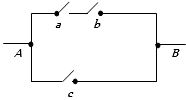
Consider the circuit,If the probability that each switch is closed is $p$, then find the probability of current flowing through $AB$
- ✓
${p^2} + p$
- B
${p^3} + p - 1$
- C
${p^3} + p$
- D
${p^2} + p + 1$
AnswerCorrect option: A. ${p^2} + p$
a
(a) Current in the upper part will flow only if both the switches $a$ and $b$ are closed
$\therefore $ Their probability $= p \cdot p = {p^2}$
Now current will flow in lower part of $c$, if $c$ is closed, its probability is $p$.
Thus current will flow from $A$ to $B$ if current flows either in upper part or flow in lower part.
$\therefore$ Required probability $={p^2} + p$.
View full question & answer→MCQ 451 Mark
A disease affects two-thirds of the population of a country. A test for the disease gives the correct outcome with probability $\frac{2}{3}$. A person $X$ tested positive for the disease. The probability that $X$ has disease is
- A
$\frac{1}{3}$
- B
$\frac{2}{3}$
- C
$\frac{4}{9}$
- ✓
$\frac{4}{5}$
AnswerCorrect option: D. $\frac{4}{5}$
d
(d)
Let $E$ be the event that $x$ has disease $A =$ person is tested positive $P ( A )=\frac{2}{3} \times \frac{2}{3}+\frac{1}{3} \times \frac{1}{3}=\frac{5}{9}$ From Baye's theorem
$P\left(\frac{E}{A}\right)=\frac{\frac{2}{3} \times \frac{2}{3}}{\frac{5}{9}}=\frac{4}{5}$
View full question & answer→MCQ 461 Mark
Let $A$ denote the set of all $4-$digit natural numbers with no digit being $0$ . Let $B \subset A$ consist of all numbers $x$ such that no permutation of the digits of $x$ gives a number that is divisible by $4$ . Then the probability of drawing a number from $B$ with all even digits is
- A
$\frac{625}{1641}$
- B
$\frac{16}{641}$
- ✓
$\frac{16}{1641}$
- D
$\frac{1000}{1641}$
AnswerCorrect option: C. $\frac{16}{1641}$
c
(c)
For number not divisible by $4$ and not having zero can be formed as
Number of ways to form
All digits odd numbers $=5^4$
$3$ digits odd numbers $+1$ even numbers $(4$ or 8$)=5^3 .2 .4$
$2$ digits odd numbers $+2$ even numbers $(4$ or 8$)=0$
$1$ digits odd numbers $+3$ even numbers $=0$
All even numbers $=2^4$ (only $24 or $64 can be used)
$\therefore$ Required probability $=\frac{2^4}{5^4+5^3 \cdot 8+2^4}$
$=\frac{16}{1641}$
View full question & answer→MCQ 471 Mark
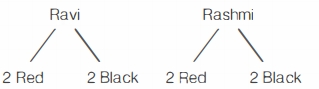
Ravi and Rashmi are each holding $2$ red cards and $2$ black cards (all four red and all four black cards are identical). Ravi picks a card at random from Rashmi and then Rashmi picks a card to random from Ravi. This process is repeated a second time. Let $p$ be the probability that both have all $4$ cards of the same colour. Then, $p$ satisfies
- ✓
$p \leq 5 \%$
- B
$5 \% < p \leq 10 \%$
- C
$10 \% < p \leq 15 \%$
- D
$15 \% < p$
AnswerCorrect option: A. $p \leq 5 \%$
a
(a)
lt is given that, Ravi and Rashmi are each holding $2$ red cards and $2$ black cards (all four red and all four black cards are identical).
Let Ravi picks a Red card from Rashmi and Rashmi picks black card from Ravi and in second time also Ravi picks a red card from Rashmi and Rashmi picks
black card from Ravi, then finally Ravi have four red cards and Rashmi have four black cards, then probability of such event is
$\frac{{ }^2 C_1}{{ }^4 C_1} \times \frac{{ }^2 C_1}{{ }^5 C_1} \times \frac{{ }^1 C_1}{{ }^4 C_1} \times \frac{{ }^1 C_1}{{ }^5 C_1}=\frac{4}{400}=\frac{1}{100}$
Similarly, the probability if at the end Ravi have four black and Rashmi have four red cards is $\frac{1}{100}$
So, required probability
$=\frac{1}{50}=2 \%=p \leq 5 \%$
View full question & answer→MCQ 481 Mark
Let $S=\{1,2,3, \ldots, 100\}$. Suppose $b$ and $c$ are chosen at random from the set $S$. The probability that $4 x^2+b x+c$ has equal roots is
- ✓
$0.001$
- B
$0.004$
- C
$0.007$
- D
$0.01$
AnswerCorrect option: A. $0.001$
a
(a)
The quadratic equation
$4 x^2+b x+c =0$
has equal roots if $b^2-16 c=0\,\,b^2=2^4 c$
Now,$c$ should be chosen from the set $S=\{1,2,3, \ldots, 100\}$, such that it is a perfect square number, so
$c=1,4,9,16,25,36,49,64,81,100$
$\therefore$ number of ordered pair $(b, c)$ will be $10$.
$\text { So, required probability } =\frac{10}{100 \times 100}$
$=\frac{1}{1000}=0.001$
View full question & answer→MCQ 491 Mark
The probability of men getting a certain disease is $\frac{1}{2}$ and that of women getting the same disease is $\frac{1}{5}$. The blood test that identifies the disease gives the correct result with probability $\frac{4}{5}$. Suppose a person is chosen at random from a group of $30$ males and $20$ females, and the blood test of that person is found to be positive. What is the probability that the chosen person is a man?
- ✓
$\frac{75}{107}$
- B
$\frac{3}{5}$
- C
$\frac{15}{19}$
- D
$\frac{3}{10}$
AnswerCorrect option: A. $\frac{75}{107}$
a
(a)
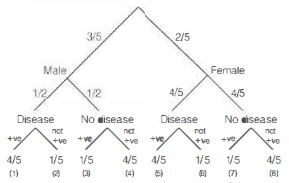
We have $30\,males$ and $20\,females$.
$P(\text { males }) =\frac{30}{50}=\frac{3}{5}$
$P(\text { females }) =\frac{20}{50}=\frac{2}{5}$
Required probability $=\frac{(1)+(3)}{(1)+(3)+(5)+(7)}$
$=\frac{\frac{3}{5} \times \frac{1}{2} \times \frac{4}{5}+\frac{3}{5} \times \frac{1}{2} \times \frac{1}{5}}{\frac{3}{5} \times \frac{1}{3} \times \frac{4}{5}+\frac{3}{5} \times \frac{1}{2} \times \frac{1}{5}}$
$+\frac{2}{5} \times \frac{1}{5} \times \frac{4}{5}+\frac{2}{5} \times \frac{4}{5} \times \frac{1}{5}$
$=\frac{\frac{15}{50}}{\frac{15}{50}+\frac{16}{125}}=\frac{75}{107}$
View full question & answer→MCQ 501 Mark
Suppose $A$ is $3 \times 3$ matrix consisting of integer entries that are chosen at random from the set $\{-1000,-999, \ldots 999,1000\}$. Let $P$ be the probability that either $A^2=-I$ or $A$ is diagonal, where $I$ is the $3 \times 3$ identity matrix. Then,
AnswerCorrect option: A. $P < \frac{1}{10^{18}}$
a
(a)
We have, $A$ is $3 \times 3$ matrix consisting of integer entries from $\{-1000,-999, \ldots 999,1000\}$
Total entries $=2001$
Total number of outcomes $=(2001)^9$
Given, $A^2=-I, A=-A^{-1}$ (which is not possible)
$A$ is diagonal matrix.
$A=\left[\begin{array}{lll}a & 0 & 0 \\ 0 & a & 0 \\ 0 & 0 & a\end{array}\right]$
Total number of favourable outcomes
$=(2001)^3$
Required probability
$=\frac{(2001)^3}{(2001)^9}(2001)^{-6}=(2000+1)^{-6}$
$p=(2000)^{-6}\left(1+\frac{1}{2000}\right)^{-6}$
$p=\frac{1}{2^6 \times 10^{18}}\left(1+\frac{1}{2000}\right)^{-6}$
$P < \frac{1}{2^6 \times 10^{18}} \quad\left[\because 1+\frac{1}{2000}\right.$ is decreasing $]$
$P < \frac{1}{10^{18}}$
View full question & answer→