Question 11 Mark
Area bounded by the lines y = |x| - 2 and y = 1 - |x - 1| is equal to:
- 4 sq. units
- 6 sq. units
- 2 sq. units
- 8 sq. units
Answer
View full question & answer→- 4 sq. units
50 questions · timed · auto-graded
$\frac{1}{2}$
Solution:
Given equation can also be written as y = 1 - |x|
point of intersection of the given line are (1, 0) and (0, 1) and (0, 0) will be the third vertices of the triangle formed
thus height and base of this triangle = 1
therefore Area $=1\times1\times\frac{1}{2}$
Solution:
To find the point of intersection of the parabola
y = x2 + 1 and the line x + y = 3
substitute y = 3 - x in y = x2 + 13 - x = x2 + 1
⇒ x2 + x - 2 = 0
⇒ (x - 1)(x + 2) = 0
⇒ x = 1 or x = -2
$\therefore$ y = 2 or y = 5
So, we get the points of intersection A (-2, 5) and C (1, 2).
Therefore, the required area ABC,
$\text{A} = \int\limits^1_{-2}(\text{y}_1-\text{y}_2)\text{dx}$ $\big(\text{Where}, \text{y}_1 = 3-\text{x }\text{and}\text{ y}_2 = \text{x}^2+1\big)$
$=\int\limits^1_{-2}\big[(3-\text{x})-(\text{x}^2+1)\big]\text{dx}$
$=\int\limits^1_{-2}(3-\text{x}-\text{x}^2-1)\text{dx}$
$=\int\limits^1_{-2}\big(2-\text{x}-\text{x}^2\big)\text{dx}$
$= \Big[2\text{x}-\frac{\text{x}^2}{2}-\frac{\text{x}^3}{3}\Big]^1_{-2}$
$=\bigg[2(1)-\frac{(1)^2}{2}-\frac{(1)^3}{3}\bigg]-\bigg[2(-2)-\frac{(-2)^2}{2}-\frac{(-2)^3}{3}\bigg]$
$=\Big[2-\frac{1}{2}-\frac{1}{3}\Big]-\Big[-4-2+\frac{8}{3}\Big]$
$=2-\frac{1}{2}-\frac{1}{3}+4+2-\frac{8}{3}$
$=8-\frac{1}{2}-\frac{9}{3}$
$=5-\frac{1}{2}$
$=\frac{9}{2}\text{ square units}$
$\frac{2}{3}$
Solution:
Required area
$=\int\limits^1_0\sqrt{\text{y}}\text{dx}=\frac{2}{3}$
$\frac{2}{3}$
Solution:
R.E.F image → y = (x + 1)2 is obtained by shifting origin to (-1, 0) in x2 = y,
for y = (x - 1)2 Similarly (1, 0) As graph is symmetric about y - axis, area A would be,
$=\text{A}=2\int\limits^1_0(\text{x}-1)^2\text{dx}$
$=2\int\limits^1_0\text{x}^2-2\text{x}+1\text{dx}=2$
$\Big[\text{x}\frac{3}{3}-\text{x}^2+\text{x}\Big]^1_0$
$=2\Big(\frac{1}{3}-1+1\Big)=\frac{2}{3}$
$\frac{2}{3}$
Solution:
$=\text{x}-\text{axis}:(-1,0)$
$=\text{Area}=\int\limits^0_{-1}(\text{x}^2-1)\text{dx}$
$=\Big[\frac{\text{x}^3}{3}-\text{x}\Big]^0_{-1}$
$=\Big[\frac{-1}{3}-(-1)\Big]-[0]$
$=-\frac{1}{3}+1$
$=\frac{2}{3}\text{sq}.\text{ units}$
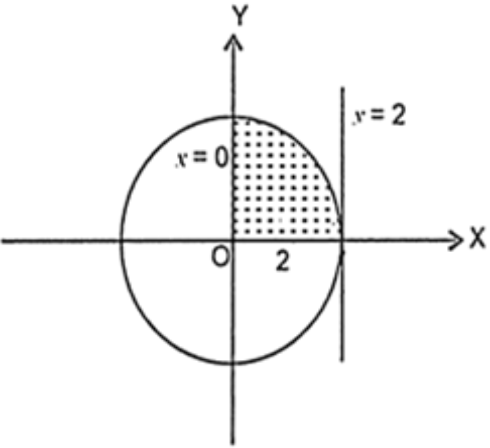
The equation of circle is x2 + y2 = 4
we are to find the area of the circle lying between the circle lying between the lines x = 0 and x = 2 in the first quadrant.
Required area $=\int\limits^2_0\text{y dx}$
$=\int\limits^2_0\sqrt{4-\text{x}^2}\text{dx}\ \ [\therefore\text{of}(1)]$
$=\int\limits^2_0\sqrt{(2)^2-\text{x}^2}\text{ dx}$ $=\Big[\frac{\text{x}}{2}\sqrt{(2)^2-\text{x}^2}+\frac{(2)^2}{2}\sin^{-1}\Big(\frac{\text{x}}{2}\Big)\Big]^2_0$
$=\Big[\frac{\text{x}}{2}\sqrt{4-\text{x}^2}+2\sin^{-1}\Big(\frac{\text{x}}{2}\Big)\Big]^2_0$
$=\Big[\frac{\text{2}}{2}\sqrt{4-\text{4}}+2\sin^{-1}\Big(\frac{\text{2}}{2}\Big)\Big]-[0+2\sin^{-1}0]$
$=\Big[0+2\sin^{-1}(1)-[0+2\times0]\Big]$
$=2\sin^{-1}1=2\times\frac{\pi}{2}=\pi$
Solution:
Required area enclosed by the curve $\text{y}\cos\text{x},$ and x = 0 and $\text{x}=\pi$
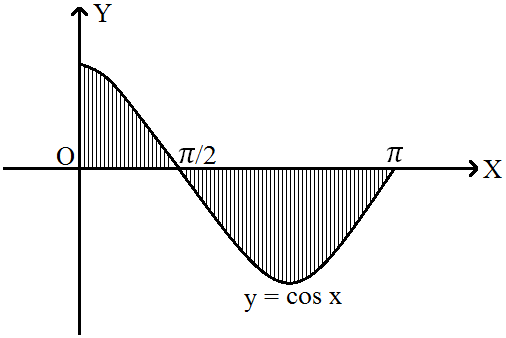
$\text{A}=\int\limits^{\frac{\pi}{2}}_0\cos\text{x dx}\Bigg|\int\limits^\pi_{\frac{\pi}{2}}\cos\text{x dx}\Bigg|$
$=\Big[\sin\frac{\pi}{2}-\sin0\Big]+\Big|\sin\frac{\pi}{2}-\sin\pi\Big|$
$=1+1=2\text{ sq. units}$
$\frac{49}{2}\pi\text{ sq}\text{ units}$
Solution:
$=\text{as}\text{ area}\text{ is}\text{ above}\text{ the}\text{ the}\text{x}-\text{axis}$
$\therefore\text{area}=2\int\limits^7_0\sqrt{49-\text{x}^2\text{dx}}$
$=2\Big[\frac{\text{x}}{2}\sqrt{49-\text{x}^2}+\frac{49}{2}\sin^{-1}\frac{\text{x}}{7}\Big]^7_0$
$=2\Big[\Big(\frac{7}{2}\times+\frac{49}{2}\sin^{-1}1\Big)-(0)\Big]$
$=\frac{49}{2}\pi\text{ sq}\text{ units}$
Solution:
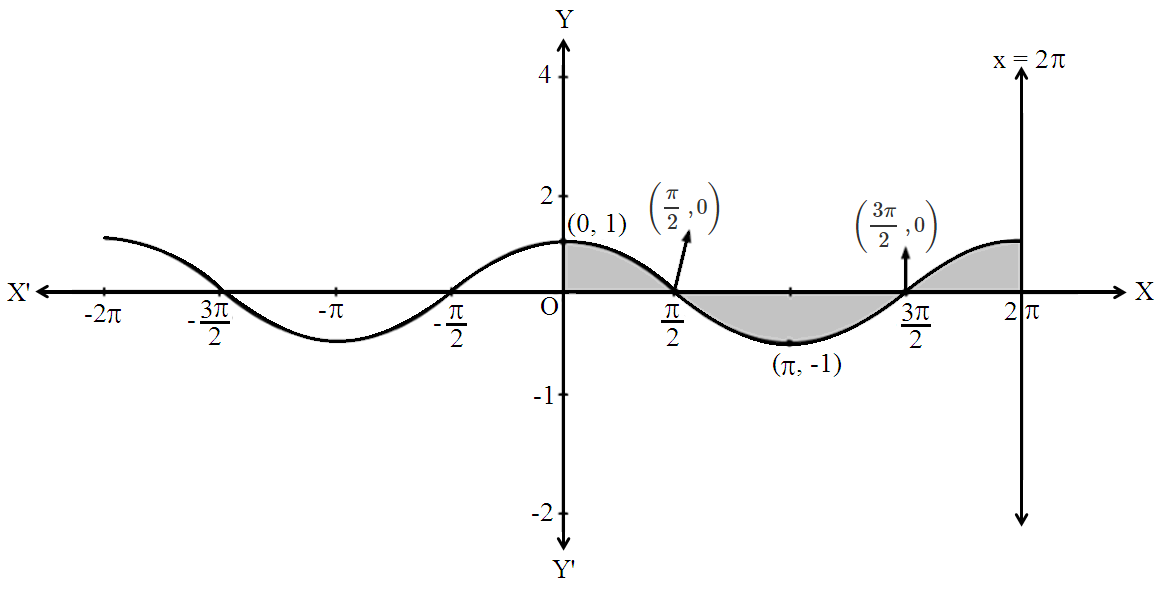
Required shaded area,
$\text{A} = \int\limits^\frac{\pi}{2}_0\cos\text{x}\text{ dx} + \int\limits^\frac{3\pi}{2}_\frac{\pi}{2}(-\cos\text{x})\text{dx} + \int\limits^{2\pi}_\frac{3\pi}{2}\cos\text{x}\text{ dx}$
$= \int\limits^\frac{\pi}{2}_0\cos\text{x}\text{ dx}-\int\limits^\frac{3\pi}{2}_\frac{\pi}{2}\cos\text{x}\text{ dx} + \int\limits^{2\pi}_\frac{3\pi}{2}\cos\text{x}\text{ dx}$
$=\Big[\sin\text{x}\Big]^{\frac{\pi}{2}}_0-\Big[\sin\text{x}\Big]^{\frac{3\pi}{2}}_\frac{\pi}{2}+\Big[\sin\text{x}\Big]^{2\pi}_\frac{3\pi}{2}$
$= \Big[\sin\text{x}\Big]^\frac{\pi}{2}_0-\Big[\sin\text{x}\Big]^\frac{3\pi}{2}_\frac{\pi}{2}+\Big[\sin\text{x}\Big]^{2\pi}_\frac{3\pi}{2}$
$=(1-0)-(-1-1)+\big[0-(-1)\big]$
$=1+2+1$
$=4\text{ sq. units}$
Solution:
The two curves meet at mx = x - x2 or = x2 = x (1 - m)
⇒ x2 = x - mx
$\therefore$ x = 0, 1 - m
$=\int\limits^{1-\text{m}}_0(\text{y}_1-\text{y}_2)\text{dx}$
$=\Big[(1-\text{m)}\frac{\text{x}^2}{2}-\frac{\text{x}^2}{3}\Big]^{1-\text{m}}_0$
$=\frac{9}{2}(\text{given)}\text{ If}\text{ m}<1$
$=\text{or}=(1-\text{m)}^3\Big[\frac{1}{2}-\frac{1}{3}\Big]=\frac{9}{2}$
$=\text{or}-(1-\text{m)}^3=-27$
$=\text{or }1-\text{m}=-3$
$\Rightarrow\text{m}=4$
Solution:
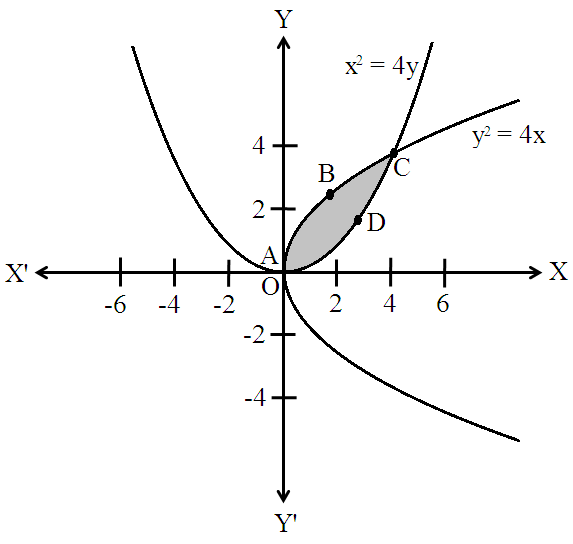
We have,
$\text{x} = \frac{\text{y}^{2}}{4}\ ....(1)$$\text{x}^{2} = 4\text{y}\ ....(2)$
points of intersection of two parabola is given by, y242 = 4y
$\Big(\frac{\text{y}^{2}}{4}\Big)^{2} = 4\text{y}$
$\Rightarrow\text{y}^{4} -64\text{y} = 0$
$\Rightarrow\text{y}(\text{y}^{3}-64) = 0$
$\Rightarrow\text{y} = 0, 4$
$\Rightarrow\text{x} = 0, 4$
Therefore, the points of intersection are A(0, 0) and C(4, 4).
Therefore, the area of the required region ABCD,
$= \int\limits^4_0\Big(2\sqrt{\text{x}}-\frac{\text{x}^{2}}{4}\Big) \text{dx}$
$= \bigg[2\times\frac{2\text{x}^\frac{3}{2}}{3}-\frac{\text{x}^{3}}{12}\bigg]^4_0$
$=\bigg(2\times\frac{2(4)^\frac{3}{2}}{3}-\frac{(4)^{3}}{12}-\frac{(0)^{3}}{12}\bigg)$
$= \big(\frac{32}{3}-\frac{16}{3}\big)-0$
$= \frac{16}{3}\text{ square units}$
Solution:
Points of intersection of the parabola and the circle is obtained by solving the simultaneous equation
x2 + y2 = 16 and y2 = 6x
⇒ x2 + 6x = 16
⇒x2 = 6x -16 = 0
⇒ (x + 8)(x - 2) = 0
⇒ x = 2 or x = -8
⇒ x = 2 or x = -8, x can not be -8 as in this case it will be the point outside circle.
$\therefore \text{x} = 2$
$\therefore \text{when } \text{x} = 2,\text{ y}=\pm\sqrt{6\times2}=\pm\sqrt{12}=\pm2\sqrt{3}$
$\therefore\text{B}(2, 2\sqrt{3})\text{ and}\text{ B}'(2,-2\sqrt{3})$ are points of intersection of the parabola and circle.
Required area
= Area OB'C' A'CBO
= area of circle - area OBAB'O Area of circle with radius 4
$= \pi\times4^2$
$=16\pi$
Now,
Area OBAB'O
= 2areaOBAO
= 2areaOBDO + areaDBAD
$= 2\times\Bigg[\int\limits^2_0\sqrt{6\text{x}}\text{dx}+ \int\limits^4_2\sqrt{16-\text{x}^{2}}\Bigg]$
$= 2\times\Bigg\{\Bigg[\sqrt{6}\frac{\text{x}^\frac{3}{2}}{\frac{3}{2}}\Bigg]^2_0+ \Big[\frac{\text{x}}{2}\sqrt{16-\text{x}^2}+\frac{1}{2}\times16\sin^{-1}\Big(\frac{\text{x}}{4}\Big)\Big]^4_2\Bigg\}$
$= 2\times\Big\{\Big(\sqrt{6}\times\frac{2}{3}\times2^\frac{3}{2}-0\Big)+ \Big(\frac{1}{2}4\sqrt{16-(4)^2}\frac{1}{2}\times16\sin^{-1}\frac{4}{4}\\-\frac{2}{2}\sqrt{16-2^2}-\frac{1}{2}\times16\sin^{-1}\frac{2}{4}\Big)\Big\}$
$= 2\times\bigg[\Big(\sqrt{6}\times\frac{2}{3}\times2\sqrt{2}\Big)+0+8\sin^{-1}(1)-\sqrt{12}-8\sin^{-1}\Big(\frac{1}{2}\Big)\bigg]$
$= 2\times \bigg[\frac{8\sqrt{3}}{3}+8\times\frac{\pi}{2}-2\sqrt{3}-8\frac{\pi}{6}\bigg]$
$= 2\bigg\{\frac{8\sqrt{3}-6\sqrt{3}}{3}+8\big(\frac{\pi}{2}-\frac{\pi}{2}\big)\bigg\}$
$= 2\bigg\{\frac{2\sqrt{3}}{3}+8\Big(\frac{2\pi}{6}\Big)\bigg\}$
$= \frac{4\sqrt{3}}{3}+\frac{16\pi}{3}$
Solution:
An = Area bounded by the curve $\text{y}=\big\{\tan(\text{x})\big\}^\text{n}=\tan^\text{n}\text{(x)}$ and the lines x = 0, y = 0, and $\text{x}=\frac{\pi}{4}.$
Therefore,
$\text{A}_\text{n}=\int\limits_\text{0}^{\frac{\pi}{4}}\tan^\text{n}\text{(x)}\text{dx}$
$\Rightarrow \text{A}_{\text{n}-2}=\int\limits_\text{0}^{\frac{\pi}{4}}\tan^{\text{n}-2}\text{(x)}\text{dx}$
Comsider, $\text{A}_\text{n}=\int\limits_\text{0}^{\frac{\pi}{4}}\tan^\text{n}\text{(x)}\text{dx}$
$\Rightarrow\ \text{A}_\text{n}=\int\limits_0^{\frac{\pi}{4}}\big\{\tan^{\text{n}-2}(\text{x})\big\}\big\{\tan^2(\text{x})\big\}\text{dx}$
$\Rightarrow\text{A}_\text{n}=\int\limits_0^\frac{\pi}{4}\big\{\tan^{\text{n}-2}(\text{x})\big\}\big\{\sec^2\text{(x)}-1\big\}\text{dx}$
$\Rightarrow\text{A}_\text{n}=\int\limits_0^\frac{\pi}{4}\big\{\tan^{\text{n}-2}\text{(x)} \sec^2(\text{x})-\tan^{\text{n}-2}(\text{x})\big\}\text{dx}$
$\Rightarrow\text{A}_\text{n}=\int\limits_0^{\frac{\pi}{4}}\big\{\tan^{\text{n}-2}\text{(x)}\sec^2(\text{x})\big\}\text{dx}-\int_0^\frac{\pi}{4}\tan^{\text{n}-2}\text{(x)}\text{ dx}$
$\Rightarrow\text{A}_\text{n}+\text{A}_{\text{n}-2}=\int\limits_0^\frac{\pi}{4}\tan^{\text{n}-2}(\text{x})\sec^2\text{(x) dx}$
Now, $\text{A}_\text{n}+\text{A}_{\text{n}+2}=\int\limits_0^\frac{\pi}{4}\tan^{\text{n}-2}\text{(x)}\sec^2(\text{x})\text{dx}$
Let $\text{u}=\tan\text{(x)}$
$\Rightarrow\text{du}=\sec^2\text{x }\text{dx}$
Also, when x = 0, u = 0 and when $\text{x}=\frac{\pi}{4},\text{u}=1$
Therefore,
$\text{A}_\text{n}+\text{A}_{\text{n}-2}=\int\limits_0^{\frac{\pi}{4}}\tan^{\text{n}-2}\text{(x)}\sec^2\text{(x) dx}$
$=\int\limits_0^1(\text{u}^{\text{n}-2})\text{du}$
$=\Big[\frac{\text{u}^{\text{n}-1}}{\text{n}-1}\Big]_0^1$
$=\Big[\frac{1}{\text{n}-1}-0\Big]=\frac{1}{\text{n}-1}$
Solution:
The area under the curve is given as
$=\int\limits^4_2\ 2\text{x}^3+4\text{x}^2\text{ dx}$
$=\int\limits^4_2\ 2\text{x}^3\text{ dx}+4\text{x}^2\text{ dx}$
$=2\frac{\text{x}^4}{4}\Big|^4_2+4\frac{\text{x}^3}{3}\Big|^\frac{2}{4}_2$
$=64\times2-8+\frac{4^4}{3}-\frac{32}{3}$
$=120-\frac{224}{3}=192.6$
Solution:
The two curves y2 = 4ax and y = mx intersect at
$=\Big(\frac{4\text{a}}{\text{m}^2},\frac{4\text{a}}{\text{m}}\Big)$ and the area enclosed by the two curves are given by
$=\int\limits^\frac{4\text{a}}{\text{m}2}_0\Big(\sqrt{4\text{ax}}-\text{mx}\Big)\text{dx}$
$\therefore\int\limits^\frac{4\text{a}}{\text{m}^2}\Big(\sqrt{4\text{ax}}-\text{mx}\Big)\text{dx}=\frac{\text{a}^2}{3}$
$\Rightarrow\frac{8}{3}.\frac{\text{a}^2}{\text{m}^3}=\frac{\text{a}^2}{3}$
$\Rightarrow\text{m}^3=8\Rightarrow\text{m}=2$
Solution:
x2 = 4y and x= 2
⇒ 4 = 4y
⇒ y = 1
A(2, 1) is the point of intersection of curve and straight the
Area of shaded region $\text{OAB} = \int\limits^2_0\text{y}\text{ dx}$
$=\int\limits^2_0\frac{\text{x}^2}{4}\text{ dx}$
$=\Big[\frac{\text{x}^3}{12}\Big]^2_0$
$= \frac{2^3}{12}-0$
$= \frac{2}{3}\text{ square units}$
Solution:
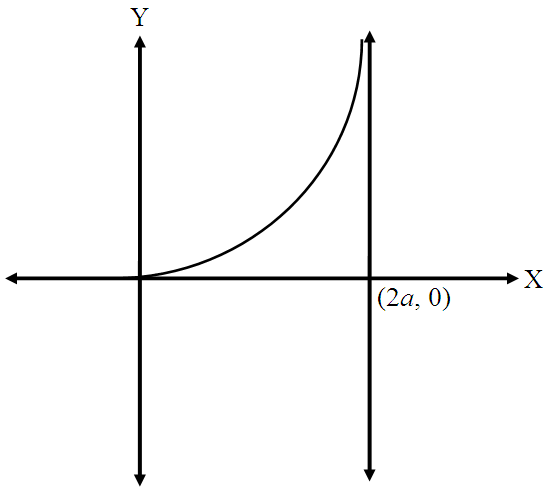
$\text{y}^2 (2\text{a}-\text{x})=\text{x}^3$
$\text{y}= \sqrt\frac{\text{x}^3}{2\text{a}-\text{x}}$
$\text{Let}\text{ x}= 2\text{a}\sin^2\theta$
$\text{dx}=4\text{a}\sin\theta\cos\theta\text{d}\theta$
$\text{Area}=\int\limits^\text{2a}_0\sqrt\frac{\text{x}^3}{2\text{a}-\text{x}}\text{dx}$
$=\int\limits^\frac{\pi}{2}_0\sqrt\frac{(8\text{a}^3)\sin^6\theta}{(2\text{a})\cos^2\theta}.(4\text{a})\sin\theta\cos\theta\text{d}\theta$
$= 8\text{a}^2\int^\frac{\pi}{2}_0\sqrt{\sin^6}\theta\sin\theta\text{d}\theta$
$=8\text{a}^2\Big[\int^\frac{\pi}{2}_0\sin^4\theta\text{d}\theta\Big]$
$= 8\text{a}^2\Big[\int^\frac{\pi}{2}_0\sin^2\theta(1-\cos^2\theta)\text{d}\theta\Big]$
$= 8\text{a}^2\Big[\int^\frac{\pi}{2}_0\frac{(1-\cos2\theta)}{2}\text{d}\theta-\frac{1}{4}\int^\frac{\pi}{2}_0\sin^2\theta\text{d}\theta\Big]$
$= 8\text{a}^2\bigg[\frac{1}{2}[\theta]^\frac{\pi}{2}_0-\Big[\frac{\sin2\theta}{4}\Big]^\frac{\pi}{2}_0\bigg]-\frac{1}{4}\bigg[\int^\frac{\pi}{2}_0\frac{1-\cos4\theta}{2}\text{d}\theta\bigg]$
$= 8\text{a}^2\Big[\Big(\frac{\pi}{4}\Big)-0\Big]-\frac{1}{4}\Big[\frac{\pi}{4}-0\Big]$
$= 8\text{a}^2\Big[\frac{\pi}{4}-\frac{\pi}{16}\Big]$
$=\frac{3}{2}\pi\text{a}^2$
Solution:
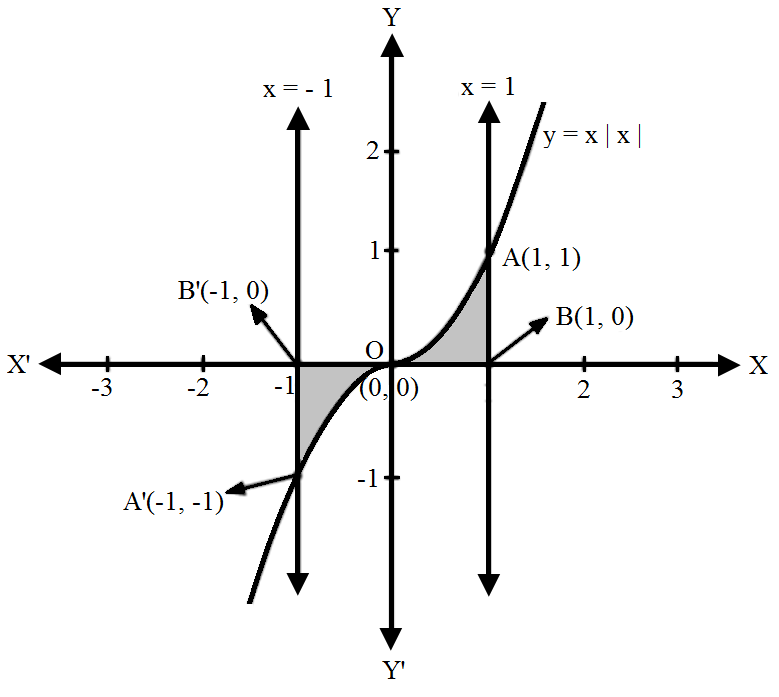
The given equation of the curve is
y = x|x|
$\Rightarrow \text{y}= \begin{cases}\text{x}^2 & \text{x} \geq0\\\text{-x}^2 & \text{x} < 0\end{cases}$
Now, solving x = 1 and y = x|x| we get
x = 1 ⇒ y = 1
⇒ A(1, 1) is point of intersection of the curve y = x|x| and x = 1
Also, solving x = -1 and y = x|x| we get
x = -1 ⇒ y = -1
⇒ A'(-1, -1) is point of intersection of the curve y = x |x| and x = -1
If P(x, y1), x > 0 is a point on y = x|x| then y1 >0 ⇒ |y1| = y1
And Q(x, y2), x < 0 is a point on y = x|x| then y2 < 0 ⇒ |y2| = -y2
Required area $=\int\limits^0_{-1}|\text{y}_2|\text{dx}+\int\limits^1_0|\text{y}_1|\text{dx}$
$= \int\limits^0_{-1}-\text{y}_2\text{ dx}+\int\limits^1_0\text{y}_1\text{ dx}$
$= \int\limits^0_{-1}-(-\text{x}^{2})\text{dx}+\int\limits^1_0\text{x}^2\text{ dx}$
$=\int\limits^0_{-1}\text{x}^2\text{dx}+\int\limits^1_0\text{x}^2\text{dx}$
$= \Big[\frac{\text{x}^3}{3}\Big]^0_{-1} +\Big[\frac{\text{x}^3}{3}\Big]^1_0$
$= \bigg[0-\frac{(-1)^3}{3}\bigg]+\Big(\frac{1^3}{3}-0\Big)$
$= \frac{1}{3}+\frac{1}{3}$
$= \frac{2}{3}\text{ sq. units}$
Solution:
We have $\frac{\text{x}^2}{5^2}+\frac{\text{y}^2}{4^2}=1,$ which is ellipse with is axis as coordinate axis.
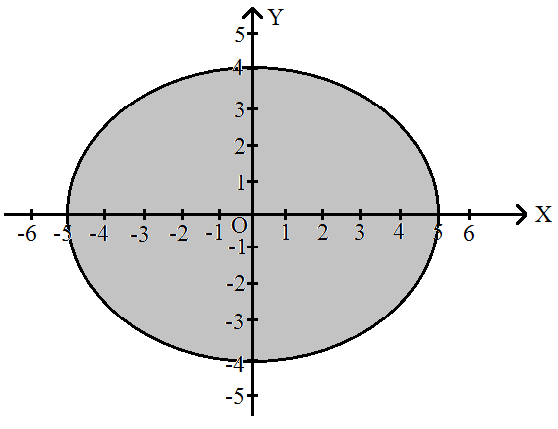
$\frac{\text{y}^2}{4^2}=1-\frac{\text{x}^2}{5^2}$
$\Rightarrow\ \text{y}^2=16\Big(1-\frac{\text{x}^2}{25}\Big) $
$\Rightarrow\ \text{y}=\frac{4}{5}\sqrt{5^2-\text{x}^2}$
From the figure, area of the shaded region
$\text{A}=4\int\limits_{0}^{5}\frac{4}{5}\sqrt{5^2-\text{x}^2}\text{ dx}$
$=\frac{16}{5}\bigg[\frac{\text{x}}{2}\sqrt{5^2-\text{x}^2}+\frac{5^2}{2}\sin^{-1}\frac{\text{x}}{5}\bigg]^{5}_{0} $
$=\frac{16}{5}\bigg[0+\frac{5^2}{2}\sin^{-1}1-0-0\bigg]$ $=\frac{16}{5}.\frac{25}{2}.\frac{\pi}{2}=20\pi\text{ sq. units}$
Soultion:
$\text{as}\text{ area}=\int\limits^1_0(2\text{y}+3)\text{dy}$
$=6\text{sq}\text{ units}$
Solution:
(d), as $\text{x}=\sin$ is positive in 1st and 2nd quadrant and negative is 3rd and 4th quadrant.
$=\text{Area}=\int\limits^{2\pi}_0\sin\text{x}\text{ dx}$
$=\int\limits^\pi_0\sin\text{x}+\int\limits^{2\pi}_\pi(-\sin\text{x})\text{dx}$
$=4\text{sq}\text{ units}$
Solution:
We have parabola x2 - 4y and the straight line x = 4y - 2
Solving we get
x2 = x + 2
⇒ x2 - x - 2 = 0
⇒ (x - 2)(x + 1) = 0
⇒ x = -1, 2
For x = -1, $\text{y}=\frac{1}{4}$
and for x = 2, y = 1
Thus point of intersection are $\Big(-1,\frac{1}{4}\Big)$ and $(2,1)$
Grapha of parabola x2 = 4y and x = 4y - 2 are as show in the following figure.
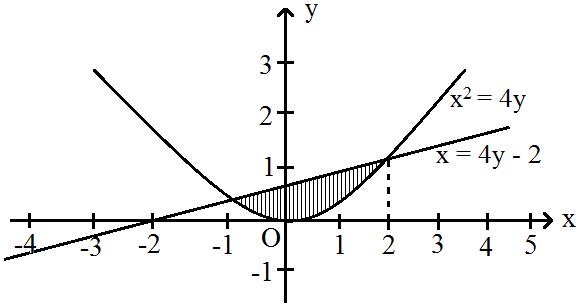
$\therefore$ From the figure, area of shaded region
$\text{A}=\int\limits^2_{-1}\Big(\frac{\text{x}+2}{4}-\frac{\text{x}^2}{4}\Big)\text{dx}$
$=\frac{1}{4}\Big[\frac{\text{x}^2}{2}+2\text{x}-\frac{\text{x}^3}{3}\Big]^2_{-1}$
$=\frac{1}{4}\bigg[\Big(\frac{4}{2}+4-\frac{8}{3}\Big)-\Big(\frac{1}{2}-2+\frac{1}{3}\Big)\bigg]$ $=\frac{1}{4}\bigg[8-\frac{1}{2}-3\bigg]=\frac{9}{8}\text{ sq. units}$
Solution:
Given curves are $\text{y}=\sqrt{\text{x}}$ ...(1)and 2y - x + 3 = 0 ...(2)
Solving (1) and (2), we get
$=\sqrt{2}-(\sqrt{\text{x}})^2+3=0$
$\Rightarrow(\sqrt{\text{x}})^2-2\sqrt{\text{x}}-3=0$
$\Rightarrow(\sqrt{\text{x}}-3)(\sqrt{\text{x}}-3=0$
$\Rightarrow\sqrt{\text{x}}-3$
$\because\sqrt{\text{x}}=-1 \text{ is}\text{ not}\text{ possible}$
$\therefore\text{y}=3$
Hence required area
$=\int\limits^3_0(\text{x}_2-\text{x}_1\text{dy}$
$=\int\limits^3_0((2\text{y}+3)-\text{y}^2)\text{dy}$
$=\Big[\text{y}^2+3\text{y}-\frac{\text{y}^3}{3}\Big]^3_0$
$=9+9-9=9$
$8\text{sq.}\text{units}$
$\frac{8}{3}\text{sq.}\text{units}$
$\frac{3}{8}\text{sq.}\text{units}$
$3\text{sq.}\text{units}$
$8\pi\text{ sqp}.\text{units}$
$4\pi\text{ sq}.\text{units}$
$8\pi\text{ sq}.\text{units}$
$3\pi\text{ sq}.\text{units}$
$8\pi\text{ sq}.\text{units}$
Solution:
Inverse function is the mirror image with respect to y = x
Then area bounded by $\text{x}+\sin\text{x}$ and its inverse function is
$=4\int\limits^\pi_0(\text{x}+\sin\text{x}-\text{x})\text{ dx}=8$
$\frac{5}{3}$
$\frac{1}{2}$
$\frac{1}{3}$
$\frac{1}{9}$
$\frac{1}{3}$
Solution:
$=\text{y}=\text{x}=\{\text{x};\text{x}\geq0-\text{x};\text{x}<0\}<0\}\text{p}$ and Q arex2 = x
= x2 - x = 0 x(x - 1) = 0 x = 0,1Q =1similarlyp
$=-\text{A}=\int\limits^1_0\text{x}-\text{x}^2\text{ dx}$
$=\text{A}=\Big[\frac{\text{x}^2}{2}-\frac{\text{x}^3}{3}\Big]^1_0$
$\text{A}=\frac{1}{2}-\frac{1}{3}$
$=\text{A}=\frac{1}{3}$
Statement I: The area bounded by the curve,
$\text{y}=\sin\text{x}$ between $\text{x}=0$ and x = 2p is 2 sq. units.Statement II: The area bounded by the curve,
$\text{y}=2\cos\text{x}$ and the x-axis from $\text{x}=0$ to x = 2p is 8 sq. units.$3(\pi-2)$
$\frac{3}{2\pi}$
$\frac{3}{2}(\pi-2)$
$\frac{2}{3}(\pi-2)$