Question 14 Marks
$\text{If}\cos^{-1}\frac{x}{\text{a}} + \cos^{-1}\frac{y}{\text{b}} = \alpha, \text{Prove that}\frac{{x}^{2}}{\text{a}^{2}} - 2\frac{xy}{\text{ab}}\cos\alpha +\frac{{y}^{2}}{\text{b}^{2}} = \sin^{2}\alpha$
AnswerFrom the equation: $\cos^{-1}\frac{\text{x}}{\text{a}} = \alpha - \cos^{-1}\frac{\text{y}}{\text{b}}$
$\frac{\text{x}}{\text{a}} = \cos\bigg(\alpha-\cos^{-1}\frac{\text{y}}{\text{b}}\bigg)\Rightarrow\frac{\text{x}}{\text{a}} = \cos\alpha. \cos\bigg(\cos^{-1}\frac{\text{y}}{\text{b}}\bigg) + \sin\alpha.\sin\bigg(\cos^{-1}\frac{\text{y}}{\text{b}}\bigg)$
$\Rightarrow\frac{\text{x}}{\text{a}} = \frac{\text{y}.\cos\alpha}{\text{b}} + \sin\alpha\sqrt{1 - \frac{\text{y}^{2}}{\text{b}^{2}}} \Rightarrow\frac{\text{x}}{\text{a}}- \frac{\text{y}}{\text{b}}\cos\alpha = \sin \alpha \sqrt{1 - \frac{\text{y}^{2}}{\text{b}^{2}}} $
$\Rightarrow\bigg(\frac{\text{x}}{\text{a}} - \text{y}\frac{\cos\alpha}{\text{b}}\bigg)^{2} = \bigg(\sin\alpha\sqrt{1 - \frac{\text{y}^{2}}{\text{b}^{2}}}\bigg)$
$\Rightarrow\frac{\text{x}^{2}}{\text{a}^{2}}- \frac{\text{2xy}}{\text{ab}}.\cos\alpha + \frac{\text{y}^{2}}{\text{b}^{2}} = \sin^{2}\alpha$
View full question & answer→Question 24 Marks
Find the general solution of the differential equation
$\frac{\text{dy}}{\text{dx}}-\text{y}=\sin\text{x}.$
AnswerGiven differential equation is $\frac{\text{dy}}{\text{dx}}-\text{y}=\sin\text{x}.$ ⇒ Integrating factor = $\text{e}^{-\text{x}}$ $\therefore\ $Solution is: $\lambda$e–x =$\int\sin \text{e}^{-\text{x}}\text{dx}=\text{I}_1$ $\text{I}_1=-\sin \text{x}\text{e}^{-\text{x}}+\int\cos \text{x}\text{e}^{-\text{x}}\text{dx}$ $=-\sin \text{x}\text{e}^{-\text{x}}+[-\cos \text{x}\text{e}^{-\text{x}}-\int+\sin\text{x}\text{e}^{-\text{x}}\text{dx}]$
$\text{I}_1=\frac{1}{2}[-\sin\text{x}-\cos\text{x}]\text{e}^{-\text{x}}$ $\therefore\ $Solution is: $\lambda$e–x $=\frac{1}{2}(-\sin\text{x}-\cos\text{x})\text{e}^{-\text{x}}+\text{c}$ $\text{or}\ \text{y}=-\frac{1}{2}(\sin\text{x}+\cos\text{x})+\text{ce}^\text{x}$ View full question & answer→Question 34 Marks
Find the particular solution of the differential equation $\text{(x - y)} \frac{\text{dy}}{\text{dx}} = \text{(x + 2y),}$ given that y = 0 when x = 1.
Answer$\frac{\text{dy}}{\text{dx}} = \frac{\text{x + 2y}}{\text{x - y}} = \frac{1 + \frac{\text{2y}}{\text{x}}}{1 - \frac{\text{y}}{\text{x}}}$
$\frac{\text{y}}{\text{x}} = \text{v} \Rightarrow \frac{\text{dy}}{\text{dx}} = \text{v + x} \frac{\text{dv}}{\text{dx}} \text{ }\text{ } \therefore \text{v + x} \frac{\text{dv}}{\text{dx}} = \frac{\text{1 + 2v}}{\text{1 -v}}$
$\Rightarrow \text{x} \frac{\text{dv}}{\text{dx}} = -\frac{\text{1 + 2v - v + v}^{2}}{\text{v - 1}} \Rightarrow \int \frac{\text{v - 1}}{\text{v}^{2} + \text{v + 1}} \text{dv} = - \frac{\text{dx}}{\text{x}}$
$\Rightarrow \int\frac{\text{2v + 1 - 3}}{\text{v}^{2} + \text{v + 1}} \text{dv} = \int - \frac{2}{\text{x}} \text{dx} \Rightarrow \int \frac{\text{2v + 1}}{\text{v}^{2} + \text{v + 1}} \text{dv - 3} \int \frac{1}{{\bigg(\text{v} + \frac{1}{2}\bigg)^{2} + \bigg(\frac{\sqrt{3}}{2}\bigg)^{2}}} = -\int \frac{2}{\text{x}} \text{dx}$
$\Rightarrow \log|\text{v}^{2} + \text{v} + 1| - 3. \frac{2}{\sqrt{3}} \tan^{-1} \bigg(\frac{\text{2v + 1}}{\sqrt{3}}\bigg) = \log |\text{x}|^{2} + \text{c}$
$\Rightarrow \log|\text{y}^{2} + \text{xy + x}^{2}| -2\sqrt{3}\tan^{-1} \bigg(\frac{\text{2y + x}}{\sqrt{3}\text{x}}\bigg) = \text{c}$
$\text{x = 1, y = 0} \Rightarrow \text{c} = -2\sqrt{3}. \frac{\pi}{6} = -\frac{\sqrt{3}}{3} \pi$
$\therefore \text{ } \log|\text{y}^{2} + \text{xy + x}^{2}| - 2\sqrt{3} \tan^{-1} \bigg(\frac{\text{2y + x}}{\sqrt{3x}}\bigg) + \frac{\sqrt{3}}{3} \pi = 0$
View full question & answer→Question 44 Marks
Find the equations of the tangent and normal to the curve$\frac{\text{x}^{2}}{\text{a}^{2}} - \frac{\text{y}^{2}}{\text{b}^{2}} = 1$ at the point ($\sqrt{2}$a, b).
Answer$\frac{\text{x}^{2}}{\text{a}^{2}} - \frac{\text{y}^{2}}{\text{b}^{2}} = 1 \Rightarrow\frac{2\text{x}}{\text{a}^{2}} - \frac{2\text{y}}{\text{b}^{2}}\frac{\text{dy}}{\text{dx}} = 0 \Rightarrow\frac{\text{dy}}{\text{dx}} =\frac{\text{b}^{2}\text{x}}{\text{a}^{2}\text{y}}$
slope of tangent at $(\sqrt{2}\text{ a, b }) = \frac{\sqrt{2}\text{b}}{\text{a}}$
slope of normal at $(\sqrt{2}\text{a , b }) = - \frac{\text{a}}{\sqrt{2}\text{b}}$
Equation of tangent is y – b $ = \frac{\sqrt{2}\text{b}}{\text{a}}(\text{x} - \sqrt{2}\text{a})$
i.e. $\sqrt{2}\text{ bx} - \text{ay} =\text{ab}$
and equation of normal is y – b = – $\frac{\text{a}}{\sqrt{2}\text{b}}(\text{x} - \sqrt{2}\text{ a})$
i.e. ax $ + \sqrt{2}\text{ by} = \sqrt{2}(\text{a}^{2} + \text{b}^{2}).$
View full question & answer→Question 54 Marks
If y = P eax + Q ebx, show that
$\frac{\text{d}^2\text{y}}{\text{dx}^2}-(\text{a}+\text{b})\frac{\text{dy}}{\text{dx}}+\text{aby}=0$
Answery = P eax + Q ebx $\Rightarrow\frac{\text{dy}}{\text{dx}}$ = a P eax + b Q ebx
$\frac{\text{d}^2\text{y}}{\text{dx}^2}=$ a2 p eax + b2 Q ebx
$\therefore\ \text{LHS}=$$\frac{\text{d}^2\text{y}}{\text{dx}^2}$– (a + b)$\frac{\text{dy}}{\text{dx}}$ +aby
= a2 P eax + b2 Q ebx – (a + b) {a P eax + b Q ebx}+ ab {P eax + Q ebx}
= P eax {a2 – a2 – ab + ab}+ Q ebx {b2 – ab – b2 + ab}
= 0 + 0 = 0. = R.H.S.
View full question & answer→Question 64 Marks
Find the particular solution of the differential equation log$\Big(\frac{\text{dy}}{\text{dx}}\Big)$= 3x + 4y, given that y = 0 when x = 0.
AnswerGiven differential equation can be written as
$\frac{\text{dy}}{\text{dx}}=\text{e}^{3\text{x}+4\text{y}}=\text{e}^{3\text{x}}.\text{e}^{4\text{y}}$
$\therefore\ \int\text{e}^{-4\text{y}}\text{dy}=\int\text{e}^{3\text{x}}\text{dx}$
$\frac{\text{e}^{-4\text{y}}}{-4}=\frac{\text{e}^{3\text{x}}}{3}+\text{c}$
$\therefore\ 4\text{e}^{3\text{y}}+3\text{e}^{-4\text{y}}+12\ \text{c}=0$
taking x = 0, y = 0 we get c = $-\frac{7}{12}$
$\therefore\ $The solution is 4 e3x + 3 e– 4y – 7 = 0
View full question & answer→Question 74 Marks
From the differential equation of the family of circles in the second quadrant and touching the coordinate axes.
AnswerLet radius of any of the circle touching coordinate axes in the second quadrant be “a” then centre is (–a, a)
$\therefore$ Equation of the family of circles is:
$\text{(x + a}^{2}) + \text{(y - a)}^{2} = \text{a}^{2}, \text{a} \in \text{R}$
$\Rightarrow\text{x}^{2} + \text{y}^{2} + \text{2ax - 2ay + a}^{2} = 0$
Differentiate w.r.t. $\text{“x”, 2x + 2yy}' + \text{2a – 2ay}{' = 0} \Rightarrow\text{a} =\frac{\text{x + yy}'}{\text{y}'{ - 1}}$
$\therefore$The differential equation is:
$\bigg(\text{x} + \frac{\text{x + yy}{'}}{\text{y}{' - 1}}\bigg)^{2}\bigg(\text{y} - \frac{\text{x + yy'}}{\text{y}{' - 1}}\bigg)^{2} = \bigg( \frac{\text{x + yy}{'}}{\text{y}{' - 1}}\bigg)^{2}$
$\Rightarrow\bigg(\frac{\text{xy}'{\text{ + yy}{'}}}{\text{y}{' - 1}}\bigg)^{2} + \bigg(\frac{\text{x + y}}{\text{y}{' - 1}}\bigg)^{2} = \bigg(\frac{\text{x + yy}{'}}{\text{y}{' - 1}}\bigg)^{2}$
View full question & answer→Question 84 Marks
Find the general solution of the differential equation
y dx – (x + 2y2) dy = 0.
AnswerGiven differential equation can be written as $\text{y}\frac{\text{dx}}{\text{dy}}-\text{x}=2\text{y}^2\ \text{or}\ \frac{\text{dx}}{\text{dy}}-\frac{1}{\text{y}}.\text{x}=2\text{y}$ Integrating factor is${\text{e}^{-\log \text{y}}}$ = $\frac{1}{\text{y}}$ $\therefore\ \ \text{solution is}\ \text{x}.\frac{1}{\text{y}}=\int2\text{dy}=2\text{y}+\text{c}$
or x = 2y2 + cy. View full question & answer→Question 94 Marks
Find the particular solution of the differential equation x (1 + y2) dx – y (1 + x2) dy = 0, given that y = 1 when x = 0.
AnswerGiven equation can be written as $\frac{\text{x}}{1+\text{x}^2}\text{dx}-\frac{\text{y}}{1+\text{y}^2}\text{dy}=0$ Integrating to get $\frac{1}{2}\log(1+\text{x}^2)-\frac1 2\log(1+\text{y}^2)=\log \text{c}_1$ $\Rightarrow\ \log(1+\text{x}^2)-\log(1+\text{y}^2)=\log \text{c}_1^2=\log\text{c}$
$\therefore\frac{(1+\text{x}^2)}{(1+\text{y}^2)}=\text{c}$
x = 0 y = 1$\Rightarrow\ \text{c}=\frac{1}{2}$ $\therefore\ 1+\text{y}^2=2(1+\text{x}^2)\ \ \ \text{or}\ \ \ \text{y}=\sqrt{2\text{x}^2+1}$
View full question & answer→Question 104 Marks
Solve the differential equation:
$y + x \frac{dy}{dx} = x - y \frac{dy}{dx}$
AnswerThe differential equation can be re-written as:
$\frac{\text{dy}}{\text{dx}} = \frac{\text{x -y}}{\text{x + y}}, \text{put y = vx,} \frac{\text{dy}}{\text{dx}} = \text{v + x} \frac{\text{dv}}{\text{dx}}$
$\Rightarrow\text{v + x}\frac{\text{dv}}{\text{dx}} = \frac{1 - \text{v}}{1 + \text{v}}\Rightarrow\frac{\text{1 + v}}{\text{1 - 2v - v}^{2}}\text{dv} = \frac{\text{1}}{\text{x}} \text{dx}$
integrating we get
$\Rightarrow\frac{1}{2}\int\frac{\text{2V + 2}}{\text{V}^{2} + \text{2V - 1}}\text{dv} = -\int\frac{1}{\text{x}} \text{dx}=\frac{1}{2}\log|\text{V}^{2} + \text{2V} - 1| = -\log\text{ x }+ \log \text{ C}$
$\therefore $ Solution of the differential equation is:
$\frac{1}{2}\log\bigg|\frac{\text{y}^{2}}{\text{x}^{2}} + \frac{\text{2y}}{\text{x}} - 1\bigg| = \log\text{C} - \log\text{x or,}\text{ y}^{2} + \text{2xy - x}^{2} = \text{C}^{2}$
View full question & answer→Question 114 Marks
$\text{If (ax + b)} \text{e}^{\text{y/x}} = \text{x},\text{then show that}$
$\text{x}^{3} \bigg(\frac{\text{d}^{2}\text{y}}{\text{dx}^{2}}\bigg) = \bigg(\text{x}\frac{\text{dy}}{\text{dx}}- \text{y}\bigg)^{2} $
Answer$\frac{\text{y}}{\text{x}} = \log\text{x} - \log (\text{ax + b)}$
differentiating w.r.t. x,
$=\frac {\text{x} {\frac{\text{dy}}{\text{dx}}- \text{y}}}{\text{x}^{2}} = \frac{1}{\text{x}}-\frac{\text{a}}{\text{ax + b}}=\frac{\text{b}}{\text{x ( ax + b)}}$
$= \text{x}. \frac{\text{dy}}{\text{dx}} - \text{y} = \frac{\text{bx}}{(\text{ax + b)}}\dots\dots\dots\dots\text{(1)} $
differentiating w.r.t. x, again
$\text{x} \frac{\text{d}^{2}\text{y}}{\text{dx}^{2}} + \frac{\text{dy}}{\text{dx}} -\frac{\text{dy}}{\text{dx}} = \frac{(\text{ax + b) b - abx}}{(\text{ax + b)}^{2}} $
$\text{x} \frac{\text{d}^{2}\text{y}}{\text{dx}^{2}} = \frac{\text{b}^{2}}{\text{(ax + b)}{2}}$
$\text{Writing}\Rightarrow \text{x}^{3}\ \frac{\text{d}^{2}\text{y}}{\text{dx}^{2}} = \bigg(\frac{\text{bx}}{\text{ax + b}} \bigg)^{2}\dots\dots\dots\text{(2)}$
From (1) and (2) $\Rightarrow$
$\text{x}^{3} \frac{\text{d}^{2}\text{y}}{\text{dx}^{2}} = \bigg(\text{x}. \frac{\text{dy}}{\text{dx}}- \text{y}\bigg)^{2}$
View full question & answer→Question 124 Marks
Find the differential equation of the family of curves $\text{(x- h)}^{2} + \text{(y - k)}^{2} = \text{r}^{2}, $ where h and k are arbitrary constants.
Answer$\text{(x - h ) + (y -k)} \frac{\text{dy}}{\text{dx}} = 0$
$\text{and 1 + (y - k)} \frac{\text{d}^{2}\text{y}}{\text{dx}^{2}} + \bigg(\frac{\text{dy}}{\text{dx}}\bigg)^{2} = 0$
$\Rightarrow \text{(y - k)} = \frac{-\Bigg[1 +\bigg(\frac{\text{dy}}{\text{dx}}\bigg)^{2}\Bigg]}{\frac{\text{d}^{2}{\text{y}}}{\text{dx}^{2}}} $
$\text{(1)} \Rightarrow \text{(x - h)} = -\frac{1 +\bigg(\frac{\text{dy}}{\text{dx}}\bigg)^{2}}{\frac{\text{d}^{2}{\text{y}}}{\text{dx}^{2}}}\frac{\text{dy}}{\text{dx}}$
Putting in the given eqn.
$-\frac{\Bigg(1 +\bigg(\frac{\text{dy}}{\text{dx}}\bigg)^{2}\Bigg)^{2}}{\bigg(\frac{\text{d}^{2}{\text{y}}}{\text{dx}^{2}}\bigg)^{2}}.\bigg(\frac{\text{dy}}{\text{dx}}\bigg)^{2} + \frac{\Bigg(1 +\bigg(\frac{\text{dy}}{\text{dx}}\bigg)^{2}\Bigg)^{2}}{\bigg(\frac{\text{d}^{2}{\text{y}}}{\text{dx}^{2}}\bigg)^{2}} = \text{r}^{2} $
$\text{or} \Bigg[1 +\bigg(\frac{\text{dy}}{\text{dx}}\bigg)^{2}\Bigg]^{3} = \text{r}^{2} \bigg(\frac{\text{d}^{2}\text{y}}{\text{dx}^{2}}\bigg)^{2}$
View full question & answer→Question 134 Marks
Show that the differential equation $\text{(x - y})\frac{\text{dy}}{\text{dx}} = \text{x + 2y}$ is homogeneous and solve it also.
Answer$\text{(x - y})\frac{\text{dy}}{\text{dx}} = \text{x + 2y}$
$\frac{\text{dy}}{\text{dx}} = \frac{\text{x } + 2\text{y}}{\text{x - y}}$
$\frac{\text{dy}}{\text{dx}} = \frac{1 + 2\frac{\text{y}}{\text{x}}}{1 - \frac{\text{y}}{\text{x}}} = \text{f}\bigg(\text{y}/\text{x}\bigg)\dots\dots\dots\dots\dots\dots\dots\dots\text{(1)}$
$\therefore$ differential equation is homogeneous Eqn.
$\text{y = vx to give}$
$\text{v + x}. \frac{\text{dv}}{\text{dx}} = \frac{1 + 2\text{v}}{1 - \text{v}}$
$\Rightarrow \int \frac{1 -\text{v}}{1 + \text{v + v}^{2}}\text{dv} = \int\frac{\text{dx}}{\text{x}}$
$\Rightarrow -\frac{1}{2}\int \frac{2 \text{v} + 1}{1 + \text{v + v}^{2}}\text{dv} + \frac{3}{2} \int\frac{\text{dv}}{\bigg(\text{v} +\frac{1}{2}\bigg)^{2} + \bigg(\frac{\sqrt{3}}{2}\bigg)^{2}} = \int\frac{\text{dx}}{\text{x}}$
$-\frac{1}{2}\log|1 +\text{ v + v}^{2}| + \sqrt{3}\tan^{-1}\bigg(\frac{2\text{v} + 1}{\sqrt{3}}\bigg) = \log|\text{x}| + \text{c}$
$- \frac{1}{2}\log\bigg|\frac{\text{x}^{2} + \text{xy + y}^{2}}{\text{x}^{2}}\bigg| + \sqrt{3}\tan^{-1} \bigg(\frac{2\text{y + x}}{x\sqrt{3}}\bigg)= \log|\text{|x| + c}$
View full question & answer→Question 144 Marks
Solve the differential equation $ (\tan^{–1} \text{x – y) dx = (1 + x}^{2}) \text{ dy}.$
AnswerGiven differential equation can be written as
$(1 + \text{x}^{2}) \frac{\text{dy}}{\text{dx}} + \text{y} = \tan^{-1} \text{x} \Rightarrow \frac{\text{dy}}{\text{dx}} + \frac{1} {1 + \text{x}^{2}} \text{y} = \frac{\tan^{-1} \text{x}}{\text{1 + x}^{2}}$
Integrating factor $ = \text{e}^{\tan^{-1}} \text{x}.$
$\therefore \text{Solution is y . e}^{\tan^{-1}}\text{x} = \int \tan^{-1} \text{x. e}^{\tan^{-1} \text{x}} \frac{1}{1 + \text{x}^{2}} \text{dx}$
$\Rightarrow \text{y. e}^{\tan^{-1}} \text{x} = \text{e}^{\tan^{-1}} \text{x} . (\tan^{-1}\text{x} - 1) + \text{c}$
$\text{ or } \text{ y} = (\tan^{-1} \text{x - 1)} + \text{c . e}^{-\tan^{-1_{\text{x}}}}$
View full question & answer→Question 154 Marks
If y = P eax + Qebx, show that
$\frac{\text{d}^{2}\text{y}}{\text{dx}^{2}} - (\text{a + b })\frac{\text{dy}}{\text{dx}} + \text{aby} = 0 .$
Answery = P eax+ Qebx $\Rightarrow\frac{\text{dy}}{\text{dx}} = \text{a P e}^{ax} + \text{b Q e}^{bx}$
$\frac{\text{d}^{2}\text{y}}{\text{dx}^{2}} = \text{a}^{2}\text{P e}^{ax} + \text{b}^{2} \text{Q e}^{bx}$
$\therefore\text{ LHS } =\frac{\text{d}^{2}\text{y}}{\text{dx}^{2}} - (\text{a + b })\frac{\text{dy}}{\text{dx}} + \text{ aby}$
$ =\text{a}^{2}\text{P e}^{ax} + \text{b}^{2}\text{ Q e}^{bx} -(\text{a + b })\left\{\text{a P e}^{ax} + \text{b Q e}^{bx}\right\} + \text{ab}\left\{\text{P e}^{ax} + \text{Q e}^{bx}\right\}$
$ = \text{P e}^{ax}\left\{\text{a}^{2} - \text{a}^{2} - \text{ab} + \text{ab}\right\} + \text{ Q e}^{bx}\left\{\text{b}^{2} - \text{ab} - \text{b}^{2} + \text{ab}\right\}$
= 0 + 0 = 0. = R.H.S.
View full question & answer→Question 164 Marks
Solve the differential equation (1 + x2) $\frac{\text{dy}}{\text{dx}} + \text{y} = \text{e}^{\tan^{-1}\text{x}.}$
AnswerGiven differential equation can be written as
$\frac{\text{dy}}{\text{dx}} + \frac{1}{1 + \text{x}^{2}}.\text{y} = \frac{1}{1 + \text{x}^{2}}.\text{e}^{\tan^{-1}\text{x}}$
Integrating factor $\text{e}^{\int\frac{1}{1 + \text{x}^{2}}\text{dx}} = \text{e}^{\tan^{-1}\text{x}}$
$\therefore\text{ solution is, y.}\text{e}^{\tan^{-1}\text{x}} = \int\frac{1}{1 + \text{x}^{2}}\text{e}^{2\tan^{-1}\text{x}}\text{dx}$
$\Rightarrow\text{y .e}^{\tan^{-1}\text{x}} = \frac{1}{2}\text{e}^{2\tan^{-1}\text{x}} + \text{c}$
$\text{or } \text{y} = \frac{1}{2}\text{e}^{\tan^{-1}\text{x}} + \text{c}\text{e}^{-\tan^{-1}\text{x}}.$
View full question & answer→Question 174 Marks
Find the particular solution of the differential equation$\frac{\text{ dy}}{\text{dx}} = 1 +\text{x + y +xy},\text{ given that }\text{y} = 0 \text{ when x } = 1.$
Answer$\frac{\text{dy}}{\text{dx}} = 1 + \text{x + y + xy} = (1 + \text{x})( 1 + \text{y})$
$\therefore\int\frac{\text{dy}}{1 + \text{y}} = \int(1 + \text{x})\text{dx}$
$\log|1 + \text{y}| = \text{x} + \frac{\text{x}^{2}}{2} + \text{c}$
$\text{x} = 1 ,\text{y} = 0 \Rightarrow\text{c} = - \frac{3}{2}$
$\therefore\text{ solution is } \log|1 + \text{y} | = \text{x} + \frac{\text{x}^{2}}{2} - \frac{3}{2}.$
View full question & answer→Question 184 Marks
If x = a cos3 $\theta$and y = a sin3 $\theta$, then find the value of $\frac{\text{f}^{2}\text{y}}{\text{dx}}\text{at}\theta = \frac{\pi}{6}.$
AnswerGiven: x = a cos3 $\theta$
Differentiating both sides w.r.t. $\theta$we get
$\frac{\text{dx}}{\text{d}\theta} = - 3 \text{a}\cos^{2}\theta.\sin\theta$ - - - - - - - -(i)
Also y = a sin3 $\theta$
Differentiating both sides w.r.t. $\theta$we get
$\frac{\text{dy}}{\text{d}\theta} = 3\text{a}\sin^{2}\theta.\cos\theta$ - - - - - - - - (ii)
Now $\frac{\text{dy}}{\text{dx}} =\frac{\text{dy}/\text{d}\theta}{\text{dx}/\text{d}\theta} = \frac{3\text{a}\sin^{2}\theta.\cos\theta}{-3\text{a}\cos^{2}\theta.\sin\theta}$
$\Rightarrow\frac{\text{dy}}{\text{dx}} = - \tan\theta$
$\Rightarrow\frac{\text{d}^{2}\text{y}}{\text{dx}^{2}} = -\sec^{2}\theta.\frac{\text{d}\theta}{\text{dx}}$
$ = \frac{-\sec^{2}\theta}{-3\text{a}\cos^{2}\theta.\sin\theta} =\frac{1}{3\text{a}}\sec^{4}\theta.\text{cosec}\theta$
$\therefore\frac{\text{d}^{2}\text{y}}{\text{dx}^{2}}\bigg]_{\text{x} = \pi/6} = \frac{1}{3\text{a}}\sec^{4}\frac{\pi}{6}.\text{cosec}\frac{\pi}{6}$
$ = \frac{1}{3\text{a}}.\bigg(\frac{2}{\sqrt{3}}\bigg)^{4}\times2 =\frac{32}{27\text{a}}.$
View full question & answer→Question 194 Marks
Find the equations of tangents to the curve 3x2 – y2 = 8, which pass through the point $\bigg(\frac{4}{3} , 0 \bigg).$
AnswerLet the point of contact be (x0 , y0 )
Now given curve is 3x2 - y2 = 8
Differentiating w.r.t. x we get, 6x - 2y.$\frac{\text{dy}}{\text{dx}} = 0 $
$\Rightarrow\frac{\text{dy}}{\text{dx}} = \frac{6\text{x}}{2\text{y}} = \frac{3\text{x}}{\text{y}}\Rightarrow\frac{\text{dy}}{\text{dx}}\bigg]_{(\text{x}_{0} ,\text{y}_{0})} = \frac{3\text{x}_{0}}{\text{y}_{0}}$
Now, equation of required tangent is
$(\text{y} - \text{y}_{0}) = \frac{3\text{x}_{0}}{\text{y}_{0}}(\text{x} - \text{x}_{0}) - - - - - -(i)$
$\because\text{ (i) passes through }\bigg(\frac{4}{3} , 0 \bigg)$
$\therefore(0 - \text{y}_{0}) = \frac{3\text{x}_{0}}{\text{y}_{0}}\bigg(\frac{4}{3} - \text{x}_{0}\bigg)$
$\Rightarrow - \text{y}_{0}^{2} = 4\text{x}_{0} - 3\text{x}_{0}^{2}$ - - - - - - - - -(ii)
Also, $\therefore$(x0 , y0 ) lie on given curve 3x2 - y2 = 8
$\Rightarrow3\text{x}_{0}^{2} - \text{y}_{0}^{2} = 8 \Rightarrow\text{y}_{0}^{2} = 3 \text{x}_{0}^{2} - 8 $
Putting y02 in (ii) we get
$ -(3\text{x}_{0}^{2} - 8 ) = 4 \text{x}_{0} - 3\text{x}_{0}^{2}$
$\Rightarrow4\text{x}_{0} = 8 \Rightarrow\text{x}_{0} = 2 $
$\therefore\text{y}_{0} = \sqrt{3\times2^{2} - 8} = \sqrt{4} = \pm2$
Therefore equations of required tangents are
$(\text{y} - 2 ) = \frac{3\times2}{2}(\text{x} - 2)\text{ and }(\text{y} + 2 ) = \frac{3 \times 2}{-2}(\text{x} - 2)$
$\Rightarrow\text{y} - 2 = 3\text{x} - 6 \text{ and }\text{y} + 2 = - 3\text{x} + 6 $
$\Rightarrow3\text{x} - \text{y} - 4 = 0 \text{ and }3\text{x} + \text{y} - 4 = 0 .$
View full question & answer→Question 204 Marks
Find the particular solution of the differential equation (tan–1 y – x) dy =(1 + y2 ) dx, given that when x = 0, y = 0.
Answer$(\tan^{-1}\text{y} - \text{x})\text{dy} = (1 + \text{y}^{2})\text{dx}$
$\Rightarrow\frac{\text{dx}}{\text{dy}} = \frac{(\tan^{-1}\text{y} - \text{x})}{(1 + \text{y}^{2})}$
$\Rightarrow\frac{\text{dx}}{\text{dy}} + \frac{\text{x}}{1 + \text{y}^{2}} = \frac{\tan^{-1}\text{y}}{1 + \text{y}^{2}}$
$\text{ Integrating Factor } = \text{e}^{\int\frac{\text{dy}}{1 + \text{y}^{2}}} = \text{e}^{\tan^{-1}\text{y}}$
$\Rightarrow(\text{ integrating Factor } ) \times\text{x} = \int(\text{ integrating Factor }) \times\frac{\tan^{-1}\text{y}}{1 + \text{y}^{2}}\text{dy}$
$\Rightarrow\text{xe}^{\tan^{-1}\text{y}} = \int\text{e}^{\tan^{-1}\text{y}}\frac{\tan^{-1}\text{y}}{1 + \text{y}^{2}}\text{dy} - - - - - - -(1)$
$\text{I} = \int\text{e}^{\tan^{-1}\text{y}}\frac{\tan^{-1}\text{y}}{1 + \text{y}^{2}}\text{dy}$
Let, $\tan^{-1}\text{y} = \text{t}\Rightarrow\frac{\text{dy}}{1 + \text{y}^{2}} = \text{dt}$
$\text{I} = \int\text{te}'\text{dt} = \text{t}(\text{e}') - \int\text{e}'\times\frac{\text{d}}{\text{dt}}(\text{t})\text{dt} = \text{te}' - \text{e}' =\text{e}'(\text{t} - 1) + \text{c} = \text{e}^{\tan^{-1}\text{y}}(\tan^{-1}\text{y} - 1 ) + \text{c} - - - - - - (2)$
Putting the value of I from (2) in (1), we get:
$\text{xe}^{\tan^{-1}\text{y}} = \text{I} = \text{e}^{tan^{-1}\text{y}}(\tan^{-1}\text{y} - 1) + \text{c}$
$\Rightarrow\text{x} = (\tan^{-1}\text{y} - 1 ) + \text{ce}^{-\tan^{-1}\text{y}}$
$\text{ When}\text{ x} = 0,\text{y} = 0\Rightarrow0 = 0- 1 + \text{c}\Rightarrow\text{c} = 1 $
Therefore, Particular solution of the differential equation is x = tan-1 y - 1 + e tan-1 y.
View full question & answer→Question 214 Marks
If yx = ey–x, prove that $\frac{\text{dy}}{\text{dx}} = \frac{(1 + \log\text{y})^{2}}{\log\text{y}}.$
Answer Given yx = ey-x Taking logarithm both sides we get
log
yx = log ey-x $\Rightarrow\text{x}.\log\text{y} = (\text{y} - \text{x}).\log e\Rightarrow\text{x}.\log\text{y} = (\text{y} - \text{x})$
$\Rightarrow\text{x}(1 + \log\text{y}) = \text{y}\Rightarrow\text{x} = \frac{\text{y}}{1 + \log\text{y}}$
Differentiating both sides w.r.t.y. We get
$\frac{\text{dx}}{\text{dy}} = \frac{(1 + \log\text{y}).1 - \text{y}.\bigg(0 + \frac{1}{\text{y}}\bigg)}{(1 + \log\text{y})^{2}}$
$ = \frac{1 + \log\text{y} - 1 }{(1 + \log\text{y})^{2}} = \frac{\log\text{y}}{(1 + \log\text{y})^{2}}\Rightarrow\frac{\text{dy}}{\text{dx}} = \frac{(1 + \log\text{y})^{2}}{\log\text{y}}$
$ \begin{bmatrix} \text{Note}:(i) \log_{e} \text{mn} = \log_{e}\text{m} + \log_{e}\text{n} \\ (ii)\log_{e}\frac{\text{m}}{\text{n}} = \log_{e}\text{m} - \log_{e}\text{n}\\ (iii)\log_{e } \text{ m}^{n} = \text{n}\log_{e}\text{m} \end{bmatrix}.$
View full question & answer→Question 224 Marks
Solve the following differential equation: (1 + x2) dy + 2xy dx = cot x dx; x $\neq$ 0.
AnswerThe given differential equation can be written as
$(1+\text{x}^2)\text{dy}+2\text{xy dx}=\cot\text{x dx}$
$(1+\text{x}^2)\frac{\text{dy}}{\text{dx}}+2\text{xy}=\cot\text{x}$
$\frac{\text{dy}}{\text{dx}}+\Big(\frac{2\text{x}}{1+\text{x}^2}\Big)\text{y}=\cot\text{x}$
$\text{here P}=\frac{2\text{x}}{1+\text{x}^2}$
$\text{I.F}=\text{e}^{\int\text{pdx}}$
$=\text{e}^{\int\frac{2\text{x}}{1+\text{x}^2}\text{dx}}$
$=\text{e}^{\log(1+\text{x}^2)}$
$\text{I.F}=1+\text{x}^2$
$\text{Y.I.F}=\int(1+\text{x}^2)\cdot\cot\text{x}\ \ \text{dx}$
$\text{y}.(1+\text{x}^2)=\log|\sin\text{x}|+\text{c}$
$\text{y}=(1+\text{x}^2)^{-1}\log|\sin\text{x}|+\text{c}(1+\text{x}^2)^{-1}$
View full question & answer→Question 234 Marks
Form the differential equation of the family of circles in the second quadrant and touching the coordinate axes.
Answer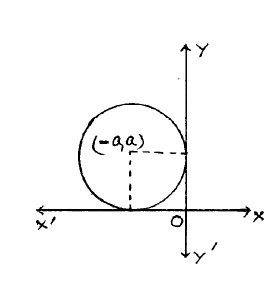 Equation of family of circle is (x + a)2 + (y – a)2 = a2 or x2 + y2 + 2ax – 2ay + a2 = 0.....(i) Differentiating we get 2x + 2y $\frac{\text{dy}}{\text{dx}}$ 2a – 2a $\frac{\text{dy}}{\text{dx}}$= 0
 $\Rightarrow\text{x+y }\frac{\text{dy}}{\text{dx}}=\text{a}\Bigg(\frac{\text{dy}}{\text{dx}}-1\Bigg)$
OR $\text{a}=\frac{\text{x+yy'}}{\text{y'-1}},\text{where y' }\frac{\text{dy}}{\text{dx}}$
substituting the value of a in (i) and simplifying (xy' – x + x + yy')2 + (yy' – y – x – yy')2 = (x + yy')2 OR (x + y)2 [(y')2 +1]= (x + yy')2. View full question & answer→Question 244 Marks
$\text{If x = }\sqrt{\text{a}^{\sin^{-1}t},}\text{ y}=\sqrt{\text{a}^{\text{cos}^{-1}}},\text{ show that }\frac{\text{dy}}{\text{dy}}=-\frac{\text{y}}{\text{x}}.$
Answer$\text{x}=\sqrt{\text{a}^{\text{sin}^{-1}t}}\Rightarrow\text{2 log x = sin}^{-1}\text{t }\text{log}\text{ a }\Rightarrow\frac{\text{dx}}{\text{dt}}=\frac{\text{x}}{2}\Bigg[\log \text{a}\frac{1}{\sqrt1-t^{2}}\Bigg]$
$\text{y}=\sqrt{\text{a}^{\text{cos}^{-1}t}}\Rightarrow\text{2}\log\text{y}=\log\text{a}\cos^{-1}\text{t}\Rightarrow\frac{\text{dy}}{\text{dt}}=-\frac{\text{y}}{2}\Bigg[\log\text{a}\cdot\frac{1}{\sqrt{\text{1-t}^{2}}}\Bigg]$
$\therefore\frac{\text{dy}}{\text{dx}}=-\frac{\text{y}}{2}\cdot\frac{2}{\text{x}}\frac{\sqrt{\text{1-t}^{2}}}{\sqrt{\text{1-t}^{2}}}=-\frac{\text{y}}{\text{x}}$.
View full question & answer→Question 254 Marks
Find the particular solution of the differential equation
x (x2 – 1) $\frac{\text{dy}}{\text{dx}}$ = 1; y = 0 when x = 2.
Answerx (x2 –1) $\frac{\text{dy}}{\text{dx}}$ = 1 $\Rightarrow\text{dy}=\frac{1}{\text{x(x}^{2}-1)}\text{dx}$
$\Rightarrow\int\text{dy}=\int\frac{1}{\Bigg(1-\frac{1}{\text{x}^{2}}\Bigg)}\frac{1}{\text{x}^{3}}\text{dx}$
$\Rightarrow\text{y}=\frac{1}{2}\log{\Bigg(1-\frac{1}{\text{x}^{2}}\Bigg)}+\text{C}$
x = 2, y = 0
$\Rightarrow\text{C}=-\frac{1}{2} \text{ }\log\text{ }\frac{3}{4}$ $\Rightarrow\text{y}=\frac{1}{2} \text{ }\log\text{ }\Bigg(1-\frac{1}{\text{x}^{2}}\Bigg)-\frac{1}{2}\text{ }\log\text{ }\frac{3}{4}$.
View full question & answer→Question 264 Marks
Solve the following differential equation: $\text{(y + 3x}^{2})\frac{\text{dx}}{\text{dy}}=\text{x}$.
AnswerGiven equation can be written as $\text{x}\frac{\text{dy}}{\text{dx}}-\text{y}=\text{3x}^{2}$ OR $\frac{\text{dy}}{\text{dx}}-\frac{1}{\text{x}}\cdot\text{y}=\text{3x}$ $\text{I.F.}=\text{e}^{-\int\frac{1}{\text{x}}\text{dx}}=\text{e}^{-\log\text{x}}=\text{e}^{\log\frac{1}{\text{x}}}=\frac{1}{\text{x}}$ $\therefore\text{ solution is, y}\cdot\frac{1}{ \text{x}}=\int\text{3x}\cdot\frac{1}{\text{x}}\text{dx}=\text{3x + c}$ $\Rightarrow\text{y}=\text{3x}^{2}+\text{cx}$.
View full question & answer→Question 274 Marks
If xy = ex –y, show that $\frac{\text{dy}}{\text{dx}}=\frac{\text{log x}}{\left\{\text{log(x e)}\right\}^{2}}.$
Answerxy = ex–y $\Rightarrow$ y . log x = (x – y) log e = x – y
$\text{y}=\frac{\text{x}}{\text{1 + log x}}$
$\frac{\text{dy}}{\text{dx}}=\frac{\text{(1 + log x)}\cdot\text{1 - x}\cdot\Big(\frac{1}{\text{x}}\Big)}{\text{(1 + log x)}^{2}}=\frac{\text{log x}}{\text{(1 + log x)}^{2}}$
$=\frac{\log\text{x}}{\text{(log e + log x)}^{2}}=\frac{\text{log x}}{\text{[log(xe)]}^{2}}$.
View full question & answer→Question 284 Marks
Solve the following differential equation:
x dy – y dx = $\sqrt{\text{x}^{2}+\text{y}^{2}}\text{ dx}$ .
AnswerGiven equation can be written as $\frac{\text{dy}}{\text{dx}}=\frac{\text{y}}{\text{x}}+\sqrt{1+\Big(\frac{\text{y}}{\text{x}}\Big)^{2}}$
$\Rightarrow\text{v + x }\frac{\text{dv}}{\text{dx}}=\text{v}+\sqrt{1+\text{v}^{2}}$ where $\frac{\text{y}}{\text{x}}=\text{v}$
$\Rightarrow\int\frac{\text{dv}}{\sqrt{1 + \text{v}^{2}}}=\int\frac{\text{dx}}{\text{x}}$
$\Rightarrow\log|\text{v}+\sqrt{1+\text{v}^{2}}|=\log\text{cx}$
$\Rightarrow\text{v}+\sqrt{1+\text{v}^{2}}=\text{cx}\therefore\text{y}+\sqrt{\text{x}^{2}+\text{y}^{2}}=\text{cx}^{2}$.
View full question & answer→Question 294 Marks
Solve the following differential equation: ${(\text{x}^{2}-1)}\frac{\text{dy}}{\text{dx}}+\text{2xy}=\frac{1}{\text{x}^{2}-1};|\text{x}|\neq1$.
AnswerGiven differential equation can be written as $\frac{\text{dy}}{\text{dx}}+\frac{{\text{2x}}}{{\text{x}^{2}-1}}\cdot{\text{y}}=\frac{1}{(\text{x}^{2}-\text{1})^{2}}$
Which is of the form $\frac{\text{dy}}{\text{dx}}+\text{P(x)}\cdot\text{y = Q(x)}$ $\int\text{P(x) dx}=\int\frac{\text{2x}}{\text{x}^{2}-1}\text{dx}=\log|\text{x}^{2}-1|$
$\therefore$ Integrating factor = $\text{e}^{\int\text{p(x) dx}}=\text{(x}^{2}-1)$ $\therefore$ The solution is (x2 - 1). Y = $\int\frac{1}{\text{(x}^{2}-1)^{2}}\text{(x}^{2}-1)\text{ dx}$ $\text{(x}^{2}-1)\cdot\text{y}=\frac{1}{2}\log\Bigg|\frac{\text{x - 1}}{\text{x + 1}}\Bigg|+\text{c}$.
View full question & answer→Question 304 Marks
Show that the differential equation (x – y) $\frac{\text{dy}}{\text{dx}}$ = x + 2y, is homogeneous and solve it.
AnswerGiven differential equation can be written as
$\frac{\text{dy}}{\text{dx}}=\frac{\text{x+2y}}{\text{x-y}}=\frac{1+2\ \text{y}/{\text{x}}}{1-\text{y}/\text{x}\ }=\text{f}(\text{y}/\text{x})$
hence, the differential equation is homogeneous.
$\text{Taking}\ \frac{\text{y}}{\text{x}}= \text{v}\ \text{OR}\ \text{y}=\ \text{vx}\Rightarrow \frac{\text{dy}}{\text{dx}}=\text{v+x}\frac{\text{dv}}{\text{dx}}$
$\therefore \text{v+x}\ \frac{\text{dv}}{\text{dx}}=\frac{1+2\text{v}}{1-\text{v}}\ \text{or}\ \text{x}\frac{\text{dv}}{\text{dx}}=\frac{1+2\text{v}}{1-\text{v}}-\text{v}=\frac{1+\text{v+v}^2}{1-\text{v}}$
$\Rightarrow\int\frac{\text{v}-1}{\text{v}^2+\text{v+1}}\text{dv}=-\int\frac{\text{dx}}{\text{x}}$
$\Rightarrow\frac{1}{2}\int\frac{2\text{v}+1-3}{\text{v}^2+\text{v}+1}\ \text{dv}=-\log |\text{x}|+\text{c}$
$\text{or}\ \frac{1}{2}\ \log\ |\text{v}^2+\text{v}+1|-\frac{3}{2}\int\frac{\text{dv}}{\bigg(\text{v}+\frac{1}{2}\bigg)^2+\bigg(\frac{\sqrt{3}}{2}\bigg)^2}= -\log |\text{x}|+\text{c}$
$\Rightarrow\log\ |\text{v}^2+\text{v}+1|+\log\text{x}^2=2\sqrt{3}\ \tan^{-1}\bigg(\frac{2\text{v}+1}{\sqrt{3}}\bigg)+\text{c}$
$\Rightarrow\log\ |\text{y}^2+\text{xy}+\text{x}^2|\ =2\sqrt{3}\ \tan^{-1}\bigg(\frac{2\text{y}+\text{x}}{\sqrt{3}\ \text{x}}\bigg)+\text{c}$
View full question & answer→Question 314 Marks
Solve the following differential equation: $\sqrt{\text{1 + x}^{2}+\text{y}^{2}+\text{x}^{2}\text{y}^{2}}+\text{xy}\frac{\text{dy}}{\text{dx}}=0.$
AnswerGiven differential equation can be written as
$\sqrt{\text{(1 + x}^{2})}\sqrt{(\text{1 + y}^{2})}+\text{xy}\frac{\text{dy}}{\text{dx}}=0$
$\Rightarrow\frac{\text{y}}{\sqrt{\text{1 + y}^{2}}}\text{ dy}=-\frac{\sqrt{\text{1 + x}^{2}}}{\text{x}}\text{dx}$
Integrating both sides, we get
$\sqrt{\text{1 + y}^{2}}=-\int\frac{\sqrt{\text{1 + x}^{2}}}{\text{x}^{2}}\cdot\text{x dx}=-\int\frac{\text{t}^{2}\text{ dt}}{\text{t}^{2}-1}\text{where }(1+\text{x}^{2})=\text{t}^{2}$
$\Rightarrow\sqrt{\text{1 + y}^{2}}=-\int\Bigg(1+\frac{1}{\text{t}^{2}-1}\Bigg)\text{dt}=-\text{t}-\frac{1}{2}\log\frac{\text{t - 1}}{\text{t + 1}}\text{c}$
$=-\sqrt{\text{1 + x}^{2}}-\frac{1}{2}\log\Bigg|\frac{\sqrt{\text{1 + x}^{2}}-1}{\sqrt{\text{1 + x}^{2}}+1}\Bigg|+\text{c}$
OR $\sqrt{\text{1 + y}^{2}}+\sqrt{\text{1 + x}^{2}}-\frac{1}{2}\log\Bigg|\frac{\sqrt{\text{1 + x}^{2}}-1}{\sqrt{\text{1 + x}^{2}}+1}\Bigg|=\text{c}$.
View full question & answer→Question 324 Marks
If y = ea sin–1 x, –1 < x < 1, then show that
$\big(1-\text{x}^2\big)\frac{\text{d}^2\text{y}}{\text{dx}^2}-\text{a}^2\text{y}=0\dot{}$
Answer$\frac{\text{dy}}{\text{dx}}=\text{e}^\text{a}\;\sin^{-1}\text{x}\frac{a}{\sqrt{1-\text{x}^2}}=\frac{\text{ay}}{\sqrt{1-\text{x}^2}}$
$\Rightarrow\sqrt{1-\text{x}^2}\ \dot{}\ \frac{\text{dy}}{\text{dx}}=\text{ay}.............(\text{i})$
$\Rightarrow\sqrt{1-\text{x}^2}\ \dot{}\ \frac{\text{d}^2\text{y}}{\text{dx}^2}-\frac{\text{x}}{\sqrt{1-\text{x}^2}} \dot{}\ \ \frac{\text{dy}}{\text{dx}}=\ \text{a} \frac{\text{dy}}{\text{dx}}$
$\Rightarrow\big(1-\text{x}^2\big)\frac{\text{d}^2\text{y}}{\text{dx}^2}-\text{x}\frac{\text{dy}}{\text{dx}}-\text{a}\sqrt{1-\text{x}^2}\frac{\text{dy}}{\text{dx}}=0$
$\Rightarrow\big(1-\text{x}^2\big)\frac{\text{d}^2\text{y}} {\text{dx}^2}-\text{x}\frac{\text{dy}}{\text{dx}}-\text{a}^2\text{y}=0 \ [\text{Using (i)}]$
View full question & answer→Question 334 Marks
Solve the following differential equation: $\text{x }\frac{\text{dy}}{\text{dx}}=\text{y - x}\tan\Bigg(\frac{\text{y}}{\text{ax}}\Bigg).$
Answer$\frac{\text{dy}}{\text{dx}}=\frac{\text{y}}{\text{x}}-\tan\Bigg(\frac{\text{y}}{\text{x}}\Bigg).........\text{(i)}$ Let y = vx $\Rightarrow$ $\frac{\text{dy}}{\text{dx}}=\text{v + x }\frac{\text{dv}}{\text{dx}}$ $\therefore\text{(i) becomes v + x }\frac{\text{dv}}{\text{dx}}=\text{v - tan v}$ $\Rightarrow-\cot\text{v dv}=\frac{\text{dx}}{\text{x}}$
log | cosec v | = log | cx |
$\Rightarrow\text{ c x }=\text{cosec }\Bigg(\frac{\text{y}}{\text{x}}\Bigg)$
$\text{OR }\Bigg(\text{x sin}\Bigg(\frac{\text{y}}{\text{x}}\Bigg)=\text{c}\Bigg).$
View full question & answer→Question 344 Marks
Solve the following differential equation: $\text{x}^{2}\frac{\text{dy}}{\text{dx}}=\text{y}^{2}+\text{2xy}$
Given that y = 1, when x = 1. Answer$\frac{\text{dy}}{\text{dx}}=\frac{\text{y}^{2}+\text{2xy}}{\text{x}^{2}}$
Let y = vx $\Rightarrow\frac{\text{dy}}{\text{dx}}=\text{v + x}\frac{\text{dv}}{\text{dx}}$
$\text{v + x}\frac{\text{dv}}{\text{dx}}=\text{v}^{2}+\text{2v}\Rightarrow\text{x}\frac{\text{dv}}{\text{dx}}=\text{v}^{2}+\text{v}$
$\Rightarrow\int\frac{\text{dv}}{\text{v(v+1)}}=\int\frac{\text{dx}}{\text{x}}$
$\Rightarrow\int\Bigg(\frac{1}{\text{v}}-\frac{1}{\text{v+1}}\Bigg)\text{dv}=\int\frac{\text{dx}}{\text{x}}$
$\log\frac{\text{v}}{\text{v+1}}=\log\text{cx}$
$\text{cx}=\frac{\frac{\text{y}}{\text{x}}}{\frac{\text{y}}{\text{x}}+1}=\frac{\text{y}}{\text{x+y}}$
When x = 1, y = 1, c = $\frac{1}{2}$
$\Rightarrow\frac{\text{x}}{2}=\frac{\text{y}}{\text{x+y}}\Rightarrow\text{x}^{2}+\text{xy - 2y}=0.$
View full question & answer→Question 354 Marks
Solve the following differential equation: $(\text{x}^{2}+1)\frac{\text{dy}}{\text{dx}}+\text{2xy}=\sqrt{\text{x}^{2}+4}$.
Answer$(\text{x}^{2}+1)\frac{\text{dy}}{\text{dx}}+\text{2xy}=\sqrt{\text{x}^{2}+4}$
$\frac{\text{dy}}{\text{dx}}+\frac{\text{2x}}{\text{x}^{2}+1}\text{y}=\frac{\sqrt{\text{x}^{2}+4}}{\text{x}^{2}+1}$
$\text{I.F.}=\text{e}^{\int\frac{\text{2x}}{\text{x}^{2}+1}\text{dx}}=(\text{x}^{2}+1)$
Solution is y . (x2 + 1) =$\int\sqrt{\text{x}^{2}+4}\text{ dx + c}$
y (x2 + 1) = $\frac{1}{2}\text{x}\sqrt{\text{x}^{2}+4}+2\log\Big(\text{x}+\sqrt{\text{x}^{2}+4}\Big)+\text{c.}$
View full question & answer→Question 364 Marks
Find the particular solution of the differential equation(1 + y2) + (x – $\text{e}^{\tan^{-1}}$y)$\frac{\text{dy}}{\text{dx}}=0$ given that y = 0 when x=1.
AnswerGiven differential equation can be written as
$\frac{\text{dx}}{\text{dy}}+\frac{\text{x}}{1+\text{y}^2}=\frac{\text{e}^{\tan^{-1}}\text{y}}{1+\text{y}^2}$
$\text{I.F.}=\text{e}^{\int\frac{\text{dy}}{1+\text{y}^2}}=\text{e}^{\tan^{-1}}\text{y}$
Solution is given by
$\text{x}\text{e}^{\tan^{-1}\text{y}}=\int\frac{\text{e}^{\tan^{-1}\text{y}}}{1+\text{y}^2}\times\text{e}^{\tan^{-1}\text{y}}\ \text{dy}=\int\frac{\text{e}^{2\tan{-1}\ \text{y}}}{1+\text{y}^2}\text{dy}$
$\Rightarrow\text{x}\text{e}^{\tan^{-1}\text{y}}=\int\frac{\text{e}^{2\tan^{-1}\text{y}}}{2}+\text{c}$
when x = 1, y = 0 ⇒ c = $\frac1 2$
$\therefore$ Solution is given by$\ \text{x}\text{e}^{\tan^{-1}\text{y}}=\frac1 2\text{e}^{2\tan^{-1}\text{y}}+\frac1 2\ \ \ \text{or}\ \ \ \text{x}=\frac1 2(\text{e}^{\tan^{-1}\text{y}}+\text{e}^{-\tan^{-1}\text{y}} )$
View full question & answer→Question 374 Marks
Find the general solution of the differential equation $\text{x}\cos\Big(\frac{\text{y}}{\text{x}}\Big)\frac{\text{dy}}{\text{dx}}=\text{y}\cos\Big(\frac{\text{y}}{\text{x}}\Big)+\text{x}.$
AnswerGiven differential equation can be written as $\frac{\text{dy}}{\text{dx}} = \frac{\text{y}}{\text{x}} + \frac{1}{\cos\big(\frac{\text{y}}{\text{x}}\big)}$ $\text{put y = vx} \Rightarrow \frac{\text{dy}}{\text{dx}} = \text{v + x} \frac{\text{dv}}{\text{dx}}$ $\therefore \text{v + x} \frac{\text{dv}}{\text{dx}} = \text{v} + \frac{1}{\cos{\text{v}}}$ $\Rightarrow \int{\cos\text{v}}\ {\text{dv}} = \int \frac{\text{dx}}{\text{x}}$ $\Rightarrow \sin\text{v}=\log |\text{x}| +\text{c}$ $\Rightarrow\ \sin\big(\frac{\text{y}}{\text{x}}\big)=\log|\text{x}|+\text{c}$
View full question & answer→Question 384 Marks
Solve the following differential equation:
y2dx + (x2 – xy + y2)dy = 0
Answery2 dx + (x2 – xy + y2) dy = 0
$\Rightarrow \frac{\text{dx}}{\text{dy}} = -\frac{(\text{x}^{2} - \text{xy + y}^{2})}{\text{y}^{2}}$
$\text{put x = vy} \Rightarrow \frac{\text{dx}}{\text{dy}} = \text{v + y} \frac{\text{dv}}{\text{dy}}$
$\text{v + y} \frac{\text{dv}}{\text{dy}} = \frac{\text{(v}^{2}\text{y}^{2} - \text{y}^{2} \text{v} + \text{y}^{2})}{\text{y}^{2}}$
$\Rightarrow \frac{\text{dv}}{\text{v}^{2} + 1} = -\frac{\text{dy}}{\text{y}}$
Integrating both sides
$\tan^{-1} \text{v} = -\log \text{y + c}$
$\Rightarrow \tan^{-1} \frac{\text{x}}{\text{y}} = -\log \text{y + c}$
View full question & answer→Question 394 Marks
Solve the following differential equation :
(cot–1y + x) dy = (1 + y2) dx
Answer$\frac{\text{dx}}{\text{dy}}-\frac{\text{x}}{1+\text{y}^2}=\frac{\cot^{-1}}{1+\text{y}^{2}}$
$\text{I.F.}=\text{e}^{-\int\frac{\text{x}}{1+\text{y}^2}}=\text{e}^{\cot^{-1}\text{y}}$
$\text{x}.\text{e}^{\cot^{-1}\text{y}}=\int\frac{\cot^{-1}\text{y}\ \text{e}^{\cot^{-1}\text{y}}}{1+\text{y}^2}\text{dy}$
Integrating, we get
$\text{x}.\text{e}^{\cot^{-1}\text{y}}=\int\frac{\cot^{-1}\text{y}\ \text{e}^{\cot^{-1}\text{y}}}{1+\text{y}^2}\text{dy}$
put cot–1 y = t
$=-\int\text{t }\text{e}^{\text{t}}\text{dt}$
= (1 – t) et + c
⇒ x = (1 – cot–1y) + ce–cot–1 y
View full question & answer→Question 404 Marks
Find the particular solution of the differential equation dy = cos x (2 – y cosec x) dx, given that y = 2 when$\text{x} = \frac{\pi}{2}.$
AnswerGiven differential equation can be written as
$\frac{\text{dy}}{\text{dx}}+\text{y}\cot\text{x}=2\cos\text{x}$
$\text{I.F.}=\text{e}^{\int\cot\text{x}\ \text{dx}}=\text{e}^{\int\log\sin\text{x}}=\sin\text{x}$
Solution is given by
$\text{y}\sin\text{x}=\int2\sin\text{x}\cos\text{x}\ \text{dx}=\int\sin2\text{x}\ \text{dx}$
$=\frac{-\cos2\text{x}}{2}+\text{c}$
$\text{When}\ \text{x}=\frac{\pi}{2}\ ,\ \text{y}=2,\Rightarrow\text{c}=\frac{3}{2}$
Solution is given by y sin x $=-\frac{1}{2}\cos2\text{x}+\frac{3}{2}$or y = cosec x + sin x
View full question & answer→Question 414 Marks
Find the particular solution of the differential equation
2y ex/y dx + (y – 2x ex/y) dy = 0, given that x = 0 when y = 1.
AnswerGiven differential equation can be written as
$\frac{\text{dx}}{\text{dy}} = \frac{\text{x}}{\text{y}} - \frac{1}{\text{2e}^{\text{x/y}}}$
$\text{put x = vy} \Rightarrow \frac{\text{dx}}{\text{dy}} = \text{v + y} \frac{\text{dv}}{\text{dy}}$
$\therefore \text{v + y} \frac{\text{dv}}{\text{dy}} = \text{v} - \frac{1}{\text{2e}^{\text{v}}}$
$\Rightarrow \int \frac{\text{dy}}{\text{y}} = -2 \int \text{e}^{\text{v}} \text{dv}$
$\Rightarrow \log |\text{y}| = -2\text{e}^{\text{v}} + \text{c} = -2 \text{e}^{\text{x/y}} + \text{c}$
$\text{when x = 0, y = 1} \Rightarrow \text{c} = 2$
$\therefore \log |\text{y}| = 2 (1 - \text{e}^{\text{x/y}})$
View full question & answer→Question 424 Marks
Find the particular solution of the differential equation $\frac{\text{dy}}{\text{dx}} - \text{3y} \cot \text{x} = \sin \text{2x}, $ given that y = 2 when $\text{x} = \frac{\pi}{2}.$
AnswerHere, $\text{I.F.} = \text{e}^{\int - 3\cot {\text{x dx}}} = \frac{1}{\sin^{3}\text{x}}$
Solution is given by, $\text{y} \bigg(\frac{1}{\sin^{3} \text{x}}\bigg) = \int \frac{\sin \text{2x}}{\sin^{3} \text{x}} \text{dx} = 2 \int \frac{\cos \text{x}}{\sin^{2}\text{x}} \text{dx}$
$\Rightarrow \frac{\text{y}}{\sin^{3} \text{x}} = \frac{-2}{\sin \text{x}} + \text{c}$
$\text{when x} = \frac{\pi}{2}, \text{y} = 2 \Rightarrow \text{c = 4}$
$\therefore \frac{\text{y}}{\sin^{3} \text{x}} = \frac{-2}{\sin \text{x}} + 4 \text{ } \text{or } \text{y} = -2 \sin^{2} \text{x} + \text{ 4 } \sin^{3} \text{x}$
View full question & answer→Question 434 Marks
Show that the family of curves for which $\frac{\text{dy}}{dx}=\frac{\text{x}^2+\text{y}^2}{2\text{xy}},\text{is given by}\ \text{x}^2-\text{y}^2=\text{c}x.$
Answer$\text{x}^2-\text{y}^2=\text{cx}\Rightarrow\frac{\text{x}^2-\text{y}^2}{\text{x}}=\text{c}$
$\Rightarrow\frac{\text{x}(2\text{x}-2\text{y}\frac{\text{dy}}{\text{dx}})-(\text{x}^2-\text{y}^2)}{\text{x}^2}=0$
$\Rightarrow2\text{x}^2-2\text{x}\text{y}\frac{\text{dy}}{\text{dx}}-\text{x}^2+\text{y}^2=0$
$\Rightarrow\frac{\text{dy}}{\text{dx}}=\frac{\text{x}^2+\text{y}^2}{2\text{xy}}$
Hence proved.
View full question & answer→Question 444 Marks
Find the particular solution of the differential equation
$\tan x.\frac{\text{dy}}{\text{dx}}=2x \tan x+x^2-\text{y};(\tan x\neq0)\text{given that y}=0 \ \text{when x}=\frac{\pi}{2}$
AnswerGiven equation can be written as
$\Rightarrow\ \frac{\text{dy}}{\text{dx}}+(\cot\text{x})\text{y}=2\text{x}+\text{x}^2\cot\ \text{x}$
$\text{I.F.}=\text{e}^{\int\cot\text{x dx}}=\text{e}^{\log \sin\text{x}}=\sin\text{x}$
Solution is, y × sin x$=\int(2\text{x}\sin\text{x}+\text{x}^2\cos\text{x})\text{dx}$
⇒ y sin x = x2 sin x + C
$\text{When x}=\frac{\pi}{2},\text{y}=0,\text{we get c}=\frac{-\pi^2}{4}$
$\therefore\ \text{Required solution is,}\ \ \ 4\text{y}\sin\text{x}=4\text{x}^2\sin\text{x}-\pi^2$
or, y = x2 – $\pi$2/4 cosec x
View full question & answer→Question 454 Marks
View full question & answer→Question 464 Marks
Find the particular solution of the differential equation $\frac{dy}{dx} = \frac{xy}{x^{2} + y^{2}}$ given that $\text{y - 1, when x = 0.}$
AnswerGiven differential equation is $\frac{\text{dx}}{\text{dy}} = \frac{\text{y}/\text{x}}{1 + \bigg({\text{y/x}\bigg)^{2}}}$
$\text{Putting}\frac{\text{y}}{\text{x}} = \text{v to get v + x} \frac{\text{dv}}{\text{dx}} = \frac{\text{v}}{1 + \text{v}^{2}}$
$\therefore \text{x} \frac{\text{dv}}{\text{dx}} = \frac{\text{v}}{1 + \text{v}^{2}} -\text{v} = \frac{\text{-v}^{3}}{ 1 + \text{v}^{2}}$
$\Rightarrow \int \frac{\text{v}^{2} + 1}{\text{v}^{3}} \text{dv} = - \int\frac{\text{dx}}{\text{x}}$
$\Rightarrow \log| \text{v}| - \frac{1}{2\text{v}^{2}} = - \log|\text{x}| + \text{c}$
$\therefore \log \text{y} - \frac{\text{x}^{2}}{2\text{y}^{2}} = \text{c}$
$\text{x = 0, y = 1} \Rightarrow \text{c = 0} \therefore \log \text{y} - \frac{\text{x}^{2}}{2\text{y}^{2}} = 0$
View full question & answer→Question 474 Marks
Find the particular solution of the differential equation $\frac{\text{dy}}{\text{d}x}=\frac{x(2\log x +1)}{\sin y+y\cos y}$given that $\text{y}=\frac{\pi}{2}\text{ when } x=1.$
AnswerDifferential equation can bewritten as: (sin y+ y . cos y) dy =x . (2 . log x + 1) dx
Integrating both sideswe get
– cos y + y sin y + cos y $=2\bigg(\frac{\text{x}^2}{2}\log\text{x}-\frac{\text{x}^2}{4}\bigg)+\frac{\text{x}^2}{2}+\text{c}$
⇒ y sin y = x2 log x + c
At x = 1 and
$\text{y}=\frac{\pi}{2},\ \text{c}=\frac{\pi}{2}\ \ \therefore\ \ $solution is : y sin y = x2 log x + $\frac{\pi}{2}$
View full question & answer→Question 484 Marks
Prove that x2 – y2 = c(x2 + y2)2 is the general solution of the differential equation (x3 – 3xy2) dx = (y3 – 3x2y) dy, where C is a parameter.
Answer$\text{x}^{2} – \text{y}^{2} = \text{C}(\text{x}^{2} + \text{y}^{2})^{2} \Rightarrow \text{2x – 2yy}' = \text{2C}(\text{x}^{2} + \text{y}^{2})(\text{2x + 2yy}')$
$\Rightarrow \text{(x - yy}') = \frac{\text{x}^{2} - \text{y}^{2}}{\text{y}^{2} + \text{x}^{2}} \text{(2x + 2yy}') \Rightarrow \text{(y}^{2} + \text{x}^{2}) \text{(x - yy}') = \text{(x}^{2} - \text{y}^{2}) \text{(2x + 2yy}')$
$\Rightarrow [ -\text{2y(x}^{2} - \text{y}^{2}) - \text{y}(\text{y}^{2} + \text{x}^{2})] \frac{\text{dy}}{\text{dx}} = \text{2x} \text{(x}^{2} - \text{y}^{2}) - \text{x} \text{(y}^{2} + \text{x}^{2}) $
$\Rightarrow \text{(y}^{3} - \text{3x}^{2}\text{y}) \frac{\text{dy}}{\text{dx}} = \text{(x}^{3} - \text{3xy}^{2})$
$\Rightarrow \text{y}^{3} - \text{3x}^{2}\text{y}) \text{dy} = \text{(x}^{3} - \text{3xy}^{2}) \text{dx}$
Hence $\text{x}^{2} - \text{y}^{2} = \text{C}\text{(x}^{2} + \text{y}^{2})^{2}$ is the solution of given differential equation.
View full question & answer→Question 494 Marks
Find the particular solution of the differential equation
$(1 -\text{y}^{2})(1 + \log x) \text{dx + 2xy dy} = \text{0, given that y = 0 when x = 1.} $
AnswerGiven differential equation can be written as
$\frac{(1 + \log\text{x)}}{\text{x}}\text{dx} + \frac{\text{2y}}{1 - \text{y}^{2}}\text{dy} = 0$
Integrating to get, $\frac{1}{2}(1 + \log\text{x})^{2}- \log| 1- \text{y}^{2}| = \text{C}$
$\text{x} = 1, \text{y} = 0 \Rightarrow\text{C} = \frac{1}{2}$
$\Rightarrow(1 + \log \text{x})^{2} - 2\log|1 - \text{y}^{2}| = 1$
View full question & answer→Question 504 Marks
Solve the following differential equation:
$\text{cosec }x\ \log\text{ y}\frac{\text{dy}}{\text{d}x}+x^2\text{y}^2=0$
Answer$\text{cosec }x.\ \log\text{y}\frac{\text{dy}}{\text{d}x}=-x^2\text{y}^2$$\Rightarrow\frac{\log\text{ y}}{\text{y}^2}\text{ dy}=-\text{x}^2\sin\text{x dx}$
Integrating both sideswe get
$\Rightarrow-\frac{\log\text{ y}}{\text{y}}\frac{1}{\text{y}}=-[-\text{x}^2\cos\text{x}+2\int\text{x}\cos\text{x dx}]$
$=-[-\text{x}^2\cos\text{x}+2(\text{x}\sin\text{x}-\int1.\sin\text{x dx}]$
$\therefore\frac{\log\text{y}}{\text{y}}-\frac{1}{\text{y}}=-\text{x}^2\cos\text{x}+2\text{x}\sin\text{x}+2\cos\text{x}+\text{c}$
View full question & answer→
