Questions · Page 1 of 4

M.C.Q (1 Marks)

🎯

Test yourself on this topic

50 questions · timed · auto-graded

Question 11 Mark
The principal value of $\tan^{-1}\Big(\tan\frac{3\pi}{5}\Big)$ is:
  1. $\frac{2\pi}{5}$
  2. $\frac{-2\pi}{5}$
  3. $\frac{3\pi}{5}$
  4. $\frac{-3\pi}{5}$
Answer
  1. $\frac{-2\pi}{5}$

Solution:

$\tan^{-1}\Big(\tan\Big(\frac{3\pi}{5}\Big)\Big)$

Let $\text{y}=\tan^{-1}\Big(\tan\Big(\frac{3\pi}{5}\Big)\Big)$

$\Rightarrow\tan\text{y}=\tan\Big(​​\frac{3\pi}{5}\Big)$

$\Rightarrow\tan\text{y}=\tan(108^\circ)$

We know that the range of principal value of $\tan^{-1}$ is $\Big(\frac{-\pi}{2},\frac{\pi}{2}\Big)$

Hence y = 108º not possible.

Now, $\tan\text{y}=\tan(108^\circ)$

$\Rightarrow\tan\text{y}=\tan(180^\circ-72^\circ)$

$\Rightarrow\tan\text{y}=-\tan(72^\circ)$ $(\text{as}\tan(180^\circ-\theta)=-\tan\theta)$

$\Rightarrow\tan\text{y}=\tan(72^\circ)$ $(\text{as}\tan(-\theta)=-\tan\theta)$

$\Rightarrow\tan\text{y}=\tan\Big(-72^\circ\times\frac{\pi}{180}\Big)$

$\Rightarrow\tan\text{y}=\tan\Big(\frac{-2\pi}{5}\Big)$

$\Rightarrow\text{y}=\frac{-2\pi}{5}$
View full question & answer
Question 21 Mark
$\tan^{-1}(\sqrt{3})$
  1. $\frac{\pi}{6}$
  2. $\frac{\pi}{3}$
  3. $\frac{2\pi}{3}$
  4. $\frac{5\pi}{6}$
Answer
  1. $\frac{\pi}{3}$
View full question & answer
Question 31 Mark
Choose the correct answer from the given four options.

Which of the following is the principal value branch of cosec-1x?

  1. $\Big(\frac{-\pi}{2},\frac{\pi}{2}\Big)$

  2. $[0,\pi]-\Big\{\frac{\pi}{2}\Big\}$

  3. $\Big[\frac{-\pi}{2},\frac{\pi}{2}\Big]$

  4. $\Big[\frac{-\pi}{2},\frac{\pi}{2}\Big]-\{0\}$

Answer
  1. $\Big[\frac{-\pi}{2},\frac{\pi}{2}\Big]-\{0\}$

Solution:

We know that, the principal value branch of cosec-1x is $\Big[\frac{-\pi}{2},\frac{\pi}{2}\Big]-\{0\}$

View full question & answer
Question 41 Mark
Choose the correct answer from the given four options.

The value of $\sin^{-1}\bigg[\cos\Big(\frac{33\pi}{5}\Big)\bigg]$ is:

  1. $\frac{3\pi}{5}$

  2. $\frac{-7\pi}{5}$

  3. $\frac{\pi}{10}$

  4. $\frac{-\pi}{10}$

Answer
  1. $\frac{-\pi}{10}$

Solution:

We have, $\sin^{-1}\bigg[\cos\Big(\frac{33\pi}{5}\Big)\bigg]=\sin^{-1}\bigg[\cos\Big(6\pi+\frac{33\pi}{5}\Big)\bigg]$

$=\sin^{-1}\bigg[\cos\Big(\frac{3\pi}{5}\Big)\bigg]$

$\Big[\because\ \cos(2\text{n}\pi+\theta)=\cos\theta\Big]$

$=\sin^{-1}\Big[\cos\Big(\frac{\pi}{2}+\frac{\pi}{10}\Big)\Big]$

$=\sin^{-1}\Big(-\sin\frac{\pi}{10}\Big)$

$=-\sin^{-1}\Big(\sin\frac{\pi}{10}\Big)$

$[\because\ \sin^{-1}(-\text{x})=-\sin^{-1}\text{x}]$

$=-\frac{\pi}{10}\ \Big[\because\ \sin^{-1}(\sin\text{x})=\text{x},\ \text{x}\in\Big(\frac{-\pi}{2},\frac{\pi}{2}\Big)\Big]$

View full question & answer
Question 51 Mark
Choose the correct answer from the given four options.

The domain of the function cos-1(2x - 1) is:

  1. $[0,1]$

  2. $[-1,1]$

  3. $(-1,1)$

  4. $[0,\pi]$

Answer
  1. $[0,1]$

Solution:

We have, cos-1(2x - 1)

Now, we know that the domain of cos-1(x) is $-1\leq\text{x}\leq1$

$\therefore\ -1\leq2\text{x}-1\leq1$

Adding 1 to all terms, we get

$\Rightarrow\ 0\leq2\text{x}\leq2$

Dividing all terms by 2, we get

$\Rightarrow\ 0\leq\text{x}\leq1$

$\therefore\ \text{x}\in[0,1]$

View full question & answer
Question 61 Mark
Choose the correct answer from the given four options.

If $\cos^{-1}\text{x}>\sin^{-1}\text{x},$ then:

  1. $\frac{1}{\sqrt{2}}<\text{x}\leq1$

  2. $0\leq\text{x}<\frac{1}{\sqrt{2}}$

  3. $-1\leq\text{x}<\frac{1}{\sqrt{2}}$

  4. $\text{x}>0$

Answer
  1. $-1\leq\text{x}<\frac{1}{\sqrt{2}}$

Solution:

We have, $\cos^{-1}\text{x}>\sin^{-1}\text{x}$

$\Rightarrow\ \frac{\pi}{2}-\sin^{-1}\text{x}>\sin^{-1}\text{x}$

$\Rightarrow\ \frac{\pi}{2}>2\sin^{-1}\text{x}$

$\Rightarrow\ \sin^{-1}\text{x}<\frac{\pi}{4}\ ....(\text{i})$

But $-\frac{\pi}{2}\leq\sin^{-1}\text{x}\leq\frac{\pi}{2}\ ....(\text{ii})$

From (i) and (ii), $-\frac{\pi}{2}\leq\sin^{-1}\text{x}<\frac{\pi}{4}$

$\Rightarrow\ \sin\Big(-\frac{\pi}{2}\Big)\leq\text{x}<\sin\frac{\pi}{4}$

$\Rightarrow\ -1\leq\text{x}<\frac{1}{\sqrt{2}}$

View full question & answer
Question 71 Mark
The value of $\tan\Big(\cos^{-1}\frac{3}{5}+\tan^{-1}\frac{1}{4}\Big)=$

  1. $\frac{19}{8}$

  2. $\frac{8}{19}$

  3. $\frac{19}{2}$

  4. $\frac{3}{4}$

Answer
  1. $\frac{19}{8}$

Solution:

$\tan\Big(\cos^{-1}\frac{3}{5}+\tan^{-1}\frac{1}{4}\Big)$

$=\tan\Bigg(\tan^{-1}\frac{\sqrt{1-\frac{9}{25}}}{\frac{3}{5}}+\tan^{-1}\frac{1}{4}\Bigg)$

$=\tan\Bigg(\tan^{-1}\frac{\frac{4}{5}}{\frac{3}{5}}+\tan^{-1}\frac{1}{4}\Bigg)$

$=\tan\Big(\tan^{-1}\frac{4}{3}+\tan^{-1}\frac{1}{4}\Big)$

$=\tan\bigg(\tan^{-1}\frac{\frac{4}{3}+\frac{1}{4}}{1-\frac{1}{3}}\bigg)$

$=\frac{\frac{16+3}{12}}{\frac{2}{3}}$

$=\frac{19}{8}$

Hence, the correct answer is option (a).

View full question & answer
Question 81 Mark
Choose the correct answer from the given four options.

Which of the following is the principal value branch of cos-1x?

  1. $\Big[\frac{-\pi}{2},\frac{\pi}{2}\Big]$

  2. $(0,\pi)$

  3. $[0,\pi]$

  4. $(0,\pi)-\Big\{\frac{\pi}{2}\Big\}$

Answer
  1. $[0,\pi]$

Solution:

The principal value branch of cos-1x is $[0,\pi].$

View full question & answer
Question 91 Mark
$ \sin ^{ -1 } \frac { 3 }{ 5 } +\sin^{ -1 }\frac { 4 }{ 5 }$ is equal to

  1. $ \frac{\pi}{2}$

  2. $ \frac{\pi}{3}$

  3. $ \frac{\pi}{4}$

  4. $ \frac{\pi}{6}$

Answer
  1. $ \frac{\pi}{2}$

Solution:

Given, $ \sin ^{ -1 } \frac { 3 }{ 5 } +\sin^{ -1 }\frac { 4 }{ 5 }$

$⇒\sin^{−1}\text{x}+\sin^{−1}\text{y}=\sin ^{ -1 } \Big(\text{x}\sqrt { 1-{ \text{y} }^{ 2 } } +\text{y}\sqrt { 1-\text{x}^{ 2 } }\Big)$

$ \Rightarrow \sin ^{ -1 } \left(\frac { 3 }{ 5 } \sqrt { 1-\left(\frac { 4 }{ 5 } \right) } +\frac { 4 }{ 5 } \sqrt { 1-\left(\frac { 3 }{ 5 } \right)^{ 2 } } \right)$

$ \Rightarrow \sin ^{ -1 } \left(\frac { 3 }{ 5 } \sqrt { \frac { 25-16 }{ 25 } ) } +\frac { 4 }{ 5 } \sqrt { \frac { 25-9 }{ 25 } } \right)$

$ \Rightarrow \sin ^{ -1 } \left(\frac { 3 }{ 5 } \times \frac { 3 }{ 5 } +\frac { 4 }{ 5 } \times \frac { 4 }{ 5 } \right)$

$ \Rightarrow \sin ^{ -1 } \left(\frac { 16 }{ 25 } +\frac { 9 }{ 25 } \right)$

$ \Rightarrow \sin ^{ -1 } \left(\frac { 25 }{ 25 } \right)$

$ \Rightarrow \sin ^{ -1 } (1)$

$ \Rightarrow \cfrac { \pi }{ 2 }$

View full question & answer
Question 101 Mark
The domain of $\cos^{-1}\big(\text{x}^2-4\big)$ is:

  1. $[3,5]$

  2. $[-1,1]$

  3. $\Big[-\sqrt5,-\sqrt3\Big]\cup\Big[\sqrt3,\sqrt5\Big]$

  4. $\Big[-\sqrt5,-\sqrt3\Big]\cap\Big[\sqrt3,\sqrt5\Big]$

Answer
  1. $\Big[-\sqrt5,-\sqrt3\Big]\cup\Big[\sqrt3,\sqrt5\Big]$

Solution:

Let, $\cos^{-1}\big(\text{x}^2-4\big)=\text{y}$

$\Rightarrow\cos\text{y}=\text{x}^2-4$

$\Rightarrow-1\leq\text{x}^2-4\leq1$

$\Rightarrow3\leq\text{x}^2\leq5$

$\Rightarrow\pm\sqrt3\leq\text{x}\pm\sqrt5$

$\text{x}\in\Big[-\sqrt5,-\sqrt3\Big]\cup\Big[\sqrt3,\sqrt5\Big]$

View full question & answer
Question 111 Mark
If $\alpha=\tan^{-1}\Big(\tan\frac{5\pi}{4}\Big)$ and $\beta=\tan^{-1}\Big(-\tan\frac{2\pi}{3}\Big),$ then:

  1. $4\alpha=3\beta$

  2. $3\alpha=4\beta$

  3. $\alpha-\beta=\frac{7\pi}{12}$

  4. $\text{none of these}$

Answer
  1. $4\alpha=3\beta$

Solution:

We know that $\tan^{-1}(\tan\text{x})=\text{x}$

$\therefore\ \alpha=\tan^{-1}\Big(\tan\frac{5\pi}{4}\Big)$

$=\tan^{-1}\Big\{\tan\Big(\pi+\frac{\pi}{4}\Big)\Big\}$

$=\tan^{-1}\Big(\tan\frac{\pi}{4}\Big)$

$=\frac{\pi}{4}$

and

$\beta=\tan^{-1}\Big\{-\tan\Big(\frac{2\pi}{3}\Big)\Big\}$

$=\tan^{-1}\Big\{-\tan\Big(\pi-\frac{\pi}{3}\Big)\Big\}$

$=\tan^{-1}\Big\{\tan\Big(\frac{\pi}{3}\Big)\Big\}$

$=\frac{\pi}{3}$

$\therefore\ 4\alpha=\pi$

$3\beta=\pi$

$\therefore\ 4\alpha=3\beta$

View full question & answer
Question 121 Mark
The value of $\sin\Big(\frac{1}{4}\sin^{-1}\frac{\sqrt{63}}{8}\Big)$ is:

  1. $\frac{1}{\sqrt2}$

  2. $\frac{1}{\sqrt3}$

  3. $\frac{1}{2\sqrt2}$

  4. $\frac{1}{3\sqrt3}$

Answer
  1. $\frac{1}{2\sqrt2}$

Solution:

$\sin\Big(\frac{1}{4}\sin^{-1}\frac{\sqrt{63}}{8}\Big)$

Let, $\sin^{-1}\frac{\sqrt{63}}{8}=\text{x}$

$\sin\text{x}=\frac{\sqrt{63}}{8}$

$\cos\text{x}\sqrt{1-\sin^2\text{x}}$

$\cos\text{x}=\sqrt{1-\frac{63}{64}}$

$\cos\text{x}=\frac{1}{8}$

Consider,

$\sin\Big(\frac{1}{4}\sin^{-1}\frac{\sqrt{63}}{8}\Big)$

$=\sin\Big(\frac{1}{4}\text{x}\Big)$

$=\sqrt{\frac{1-\cos\frac{\text{x}}{2}}{2}}$ $\Big(\because\ \sin\text{x}=\frac{1-\cos2\text{x}}{2}\Big)$

$=\sqrt{\frac{1-\sqrt{\frac{1+\cos\text{x}}{2}}}{2}}$ $\Big(\because\ \cos\text{x}=\frac{1+\cos2\text{x}}{2}\Big)$

$=\sqrt{\frac{1-\sqrt{1-\frac{1}{8}}}{2}}$

$=\sqrt{\frac{1-\frac{3}{4}}{2}}$

$=\sqrt{\frac{1}{8}}$

$=\frac{1}{2\sqrt2}$

View full question & answer
Question 131 Mark
$\tan^{-1}\frac{1}{3}+\tan^{-1}\frac{1}{5}+\tan^{-1}\frac{1}{7}+\tan^{-1}\frac{1}{8}=$

  1. $\pi$

  2. $\frac{\pi}{2}$

  3. $\frac{\pi}{4}$

  4. $\frac{3\pi}{4}$

Answer
  1. $\frac{\pi}{4}$
View full question & answer
Question 141 Mark
If $\sin^{-1}\text{x}-\cos^{-1}\text{x}=\frac{\pi}{6},$ then x =

  1. $\frac{1}{2}$

  2. $\frac{\sqrt3}{2}$

  3. $-\frac{1}{2}$

  4. $\text{none of these}$

Answer
  1. $\frac{\sqrt{3}}{2}$

Solution:

We know that $\sin^{-1}\text{x}+\cos^{-1}\text{x}=\frac{\pi}{2}$

$\therefore\ \sin^{-1}\text{x}-\cos^{-1}\text{x}=\frac{\pi}{6}$

$\Rightarrow\frac{\pi}{2}-\cos^{-1}\text{x}-\cos^{-1}\text{x}=\frac{\pi}{6}$

$\Rightarrow-2\cos^{-1}\text{x}=\frac{\pi}{6}-\frac{\pi}{2}$

$\Rightarrow-2\cos^{-1}\text{x}=-\frac{\pi}{3}$

$\Rightarrow\cos^{-1}\text{x}=\frac{\pi}{6}$

$\Rightarrow\text{x}=\cos\frac{\pi}{6}$

$\Rightarrow\text{x}=\frac{\sqrt3}{2}$

View full question & answer
Question 151 Mark
If $ \cos^{-1}\left (\frac {1 - \text{x}^{2}}{1 + \text{x}^{2}}\right ) + \cos^{-1}\left (\frac {1 - \text{y}^{2}}{1 + \text{y}^{2}}\right )=\frac{\pi}{2}$, where xy < 1, then:
  1. x - y - xy = 1
  2. x - y + xy = 1
  3. x + y - xy = 1
  4. x + y + xy = 1
Answer
  1. x + y + xy = 1

Solution:

Given, $ \cos^{-1} \left (\frac {1 - \text{x}^{2}}{1 +\text{x}^{2}}\right ) + \cos^{-1}\left (\frac {1 - \text{y}^{2}}{1 + \text{y}^{2}}\right ) = \frac {\pi}{2}$

$ \Rightarrow \tan^{-1} \left (\frac {\text{x} + \text{y}}{1 - \text{xy}}\right ) = \frac {\pi}{4}$

$ \Rightarrow \frac {\text{x} + \text{y}}{1 -\text{ xy}} = \tan \frac {\pi}{4}$

$\Rightarrow \text{x} + \text{y} = 1 - \text{xy} = \text{x} + \text{y} + \text{xy}$

View full question & answer
Question 161 Mark
Choose the correct answer from the given four options.

If $3\tan^{-1}\text{x}+\cot^{-1}\text{x}=\pi,$ then x equals:

  1. $0$

  2. $1$

  3. $-1$

  4. $\frac{1}{2}$

Answer
  1. $1$

Solution:

We have, $3\tan^{-1}\text{x}+\cot^{-1}\text{x}=\pi$

$\Rightarrow\ 2\tan^{-1}\text{x}+(\tan^{-1}\text{x}+\cot^{-1}\text{x})=\pi$

$\Rightarrow\ 2\tan^{-1}\text{x}+\frac{\pi}{2}=\pi$

$\Big(\because\ \tan^{-1}\text{x}+\cot^{-1}\text{x}=\frac{\pi}{2}\Big)$

$\Rightarrow\ 2\tan^{-1}\text{x}=\frac{\pi}{2}$

$\Rightarrow\ \tan^{-1}\text{x}=\frac{\pi}{4}$

$\Rightarrow\ \text{x}=1$

View full question & answer
Question 171 Mark
Choose the correct answer from the given four options.

The domain of the function defined by $\text{f}(\text{x})=\sin^{-1}\sqrt{\text{x}-1}$ is:

  1. [1, 2]
  2. [-1, 1]
  3. [0, 1]
  4. none of these.
Answer
  1. [1, 2]

Solution:

$\text{f}(\text{x})=\sin^{-1}\sqrt{\text{x}-1}$

$\Rightarrow\ 0\leq\text{x}-1\leq1$ $[\because\ \sqrt{\text{x}-1}\geq0\ \text{and}\ -1\leq\sqrt{\text{x}-1}\leq1]$

$\Rightarrow\ 1\leq\text{x}\leq2$

$\therefore\ \text{x}\in[1,2]$

View full question & answer
Question 181 Mark
$\cot\Big(\frac{\pi}{4}-2\cot^{-1}3\Big)=$
  1. 7
  2. 6
  3. 5
  4. none of these
Answer
  1. 7

Solution:

Let $2\cot^{-1}3=\text{y}$

Then, $\cot\frac{\text{y}}{2}=3$

$\cot\Big(\frac{\pi}{4}-2\cot^{-1}3\Big)=\cot\Big(\frac{\pi}{4}-\text{y}\Big)$

$=\frac{\cot\frac{\pi}{4}\cot\text{y}+1}{\cot\text{y}-\cot\frac{\pi}{4}}$

$=\frac{\cot\text{y}+1}{\cot\text{y}-1}$

$=\frac{\frac{\cot^2\frac{\text{y}}{2}-1}{2\cot\frac{\text{y}}{2}}+1}{\frac{\cot^2\frac{\text{y}}{2}-1}{2\cot\frac{\text{y}}{2}}-1}$

$=\frac{\cot^2\frac{\text{y}}{2}+2\cot\frac{\text{y}}{2}-1}{\cot^2\frac{\text{y}}{2}-2\cot\frac{\text{y}}{2}-1}$

$=\frac{9+6-1}{9-6-1}$

$=7$

View full question & answer
Question 191 Mark
The positive integral solution of the equation

$\tan^{-1}\text{x}+\cos^{-1}\frac{\text{y}}{\sqrt{1+\text{y}^2}}=\sin^{-1}\frac{3}{\sqrt{10}}$ is:

  1. x = 1, y = 2
  2. x = 2, y = 1
  3. x = 3, y = 2
  4. x = -2, y = -1
Answer
  1. x = 1, y = 2

Solution:

We have,

$\tan^{-1}\text{x}+\cos^{-1}\frac{\text{y}}{\sqrt{1+\text{y}^2}}=\sin^{-1}\frac{3}{\sqrt{10}}$

$\Rightarrow\tan^{-1}\text{x}+\tan^{-1}\begin{bmatrix}\frac{\sqrt{1-\bigg(\frac{\text{y}}{\sqrt{1+\text{y}^2}}\bigg)^2}}{\frac{\text{y}}{\sqrt{1+\text{y}^2}}}\end{bmatrix}=\tan^{-1}\begin{bmatrix}\frac{\frac{3}{\sqrt{10}}}{\sqrt{1-\Big(\frac{3}{\sqrt{10}}\Big)^2}}\end{bmatrix}$

View full question & answer
Question 201 Mark
Simplify $ {\cot ^{ - 1}}\frac{1}{{\sqrt {{\text{x}^2} - 1} }}\text{for} \text{ x} < - 1$:

  1. $ \cos ^{-1}\text{x}$

  2. $ \sec ^{-1}\text{x}$

  3. $ \text{cosec} ^{-1}\text{x}$

  4. $ \tan ^{-1}\text{x}$

Answer
  1. $ \sec ^{-1}\text{x}$
View full question & answer
Question 211 Mark
If x > 1, then $2\tan^{-1}\text{x}+\sin^{-1}\Big(\frac{2\text{x}}{1+\text{x}^2}\Big)$ is equal to:
  1. $4\tan^{-1}\text{x}$
  2. $0$
  3. $\frac{\pi}{2}$
  4. $\pi$
Answer
  1. $4\tan^{-1}\text{x}$

Solution:

$2\tan^{-1}\text{x}+\sin^{-1}\Big(\frac{2\text{x}}{1+\text{x}^2}\Big)=2\tan^{-1}\text{x}+2\tan^{-1}\text{x}$

$\Big[\because\ \sin^{-1}\Big(\frac{2\text{x}}{1+\text{x}^2}\Big)=2\tan^{-1}\text{x}\Big]$

$=4\tan^{-1}\text{x}$

View full question & answer
Question 221 Mark
Choose the correct answer from the given four options.

The number of real solutions of the equation $\sqrt{1+\cos2\text{x}}=\sqrt{2}\cos^{-1}(\cos\text{x})$ in $\Big[\frac{\pi}{2},\pi\Big]$ is:

  1. $0$

  2. $1$

  3. $2$

  4. $\infty$

Answer
  1. $0$

Solution:

We have $\sqrt{1+\cos2\text{x}}=\sqrt{2}\cos^{-1}(\cos\text{x}),$ $\text{x}\in\Big[\frac{\pi}{2},\pi\Big]$

$\Rightarrow\ \sqrt{2\cos^2\text{x}}=\sqrt{2}\cos^{-1}(\cos\text{x})$

$\Rightarrow\ \sqrt{2}\cos\text{x}=\sqrt{2}\cos^{-1}(\cos\text{x})$

$\Rightarrow\ \cos\text{x}=\cos^{-1}(\cos\text{x})$

$\Rightarrow\ \cos\text{x}=\text{x}$

$[\because\ \cos^{-1}(\cos\text{x})=\text{x}]$

For $\text{x}\in\Big[\frac{\pi}{2},\pi\Big],\ \cos\text{x}\leq0$

$\therefore$ cosx = x is not possible for any value of x.

View full question & answer
Question 231 Mark
$\sin\Big\{2\cos^{-1}\Big(\frac{-3}{5}\Big)\Big\}$ is equal to:
  1. $\frac{6}{25}$
  2. $\frac{24}{25}$
  3. $\frac{4}{5}$
  4. $-\frac{24}{25}$
Answer
  1. $-\frac{24}{25}$

Solution:

Let $\cos^{-1}\Big(-\frac{3}{5}\Big)=\text{x},0\leq\text{x}\leq\pi$

Then, $\cos\text{x}=-\frac{3}{5}$
$\therefore\ \sin\text{x}=\sqrt{1-\cos^2\text{x}}=\sqrt{1-\Big(-\frac{3}{5}\Big)^2}=\sqrt{\frac{16}{25}}=\frac{4}{5}$

Now,

$\sin\Big\{2\cos^{-1}\Big(\frac{-3}{5}\Big)\Big\}=\sin(2\text{x})$

$=2\sin\text{x}\cos\text{x}$

$=2\times\frac{4}{5}\times\frac{-3}{5}$

$=-\frac{24}{25}$

View full question & answer
Question 241 Mark
If $ \frac{3\text{x}+1}{(\text{x}-1)(\text{x}+3)} = \frac{\text{A}}{\text{x}-1}+\frac{B}{\text{x}+3} $ then $ {\sin}^{-1} \frac{\text{A}}{\text{B}} :$

  1. $ \frac{\pi}{2}$
  2. $ \frac{\pi}{3}$

  3. $ \frac{\pi}{6}$

  4. $ \frac{\pi}{8}$

Answer
  1. $ \frac{\pi}{6}$

Solution:

We have,$ \frac{3\text{x}+1}{(\text{x}-1)(\text{x}+3)} = \frac{\text{A}}{\text{x}-1}+\frac{B}{\text{x}+3} $

⇒ 3x + 1 = A (x + 3) + B(x - 1)

Substitute x = 1 both sides

⇒ 3(1) + 1 = A(1 + 3) + 0 ⇒ A = 1

Substitute x = - 3x both sides

⇒ 3( -3) + 1 = 0 + B(-3 -1)

⇒ -8 - 4B ⇒ B = 2

Hence $ \sin^{-1}\frac{\text{A}}{\text{B}}=\sin^{-1}\frac{1}{2}=\frac{\pi}{6}$

View full question & answer
Question 251 Mark
If $\sin^{-1}\Big(\frac{2\text{a}}{1-\text{a}^2}\Big)+\cos^{-1}\Big(\frac{1-\text{a}^2}{1+\text{a}^2}\Big)=\tan^{-1}\Big(\frac{2\text{x}}{1-\text{x}^2}\Big),$ where $\text{a},\text{x}\in(0,1),$ then the value of x is:
  1. $0$
  2. $\frac{\text{a}}{2}$
  3. $\text{a}$
  4. $\frac{2\text{a}}{1-\text{a}^2}$
Answer
  1. $\frac{2\text{a}}{1-\text{a}^2}$

Solution:

$\sin^{-1}\Big(\frac{2\text{a}}{1-\text{a}^2}\Big)+\cos^{-1}\Big(\frac{1-\text{a}^2}{1+\text{a}^2}\Big)=\tan^{-1}\Big(\frac{2\text{x}}{1-\text{x}^2}\Big)$

Let, $\text{a}=\tan\theta\Rightarrow\theta=\tan^{-1}\text{a}$

$\sin^{-1}(\sin2\theta)+\cos^{-1}(\cos2\theta)=2\tan^{-1}(\text{x})$

$2\theta+2\theta=2\tan^{-1}(\text{x})$

$4\theta=2\tan^{-1}(\text{x})$

$2\tan^{-1}\text{a}=\tan^{-1}(\text{x})$

$\tan^{-1}\Big(\frac{2\text{a}}{1-\text{a}^2}\Big)=\tan^{-1}(\text{x})$

$\text{x}=\frac{2\text{a}}{1-\text{a}^2}$

View full question & answer
Question 261 Mark
Choose the correct answer from the given four options.
The value of $\cos^{-1}\Big(\cos\frac{3\pi}{2}\Big)$ is equal to:
  1. $\frac{\pi}{2}$
  2. $\frac{3\pi}{2}$
  3. $\frac{5\pi}{2}$
  4. $\frac{7\pi}{2}$
Answer
  1. $\frac{\pi}{2}$

Solution:

We have, $\cos^{-1}\Big(\cos\frac{3\pi}{2}\Big)$

$=\cos^{-1}\cos\Big(2\pi-\frac{\pi}{2}\Big)$

$=\cos^{-1}\cos\Big(\frac{\pi}{2}\Big)$

$[\because\ \cos(2\pi-\theta)=\cos\theta]$

$=\frac{\pi}{2}\ \Big[\because\ \cos^{-1}(\cos\text{x})=\text{x},\ \text{x}\in[0,\pi]\Big]$

View full question & answer
Question 271 Mark
Choose the correct answer from the given four options.
If $\sin^{-1}\Big(\frac{2\text{a}}{1+\text{a}^2}\Big)+\cos^{-1}\Big(\frac{1-\text{a}^2}{1+\text{a}^2}\Big)=\tan^{-1}\Big(\frac{2\text{x}}{1-\text{x}^2}\Big),$ where $\text{a},\ \text{x}\in[0,1]$ then the value of x is:
  1. $0$
  2. $\frac{\text{a}}{2}$
  3. $\text{a}$
  4. $\frac{2\text{a}}{1-\text{a}^2}$
Answer
  1. $\frac{2\text{a}}{1-\text{a}^2}$

Solution:

We have, $\sin^{-1}\Big(\frac{2\text{a}}{1+\text{a}^2}\Big)+\cos^{-1}\Big(\frac{1-\text{a}^2}{1+\text{a}^2}\Big)=\tan^{-1}\Big(\frac{2\text{x}}{1-\text{x}^2}\Big)$

$\Rightarrow\ 2\tan^{-1}\text{a}+2\tan^{-1}\text{a}=\tan^{-1}\Big(\frac{2\text{x}}{1-\text{x}^2}\Big)$

$\bigg[\because\ 2\tan^{-1}\text{a}=\sin^{-1}\Big(\frac{2\text{a}}{1+\text{a}^2}\Big)=\cos^{-1}\Big(\frac{1-\text{a}^2}{1+\text{a}^2}\Big)\bigg]$

$\Rightarrow\ 4\tan^{-1}\text{a}=2\tan^{-1}\text{x}$

$\Big[\because\ 2\tan^{-1}\text{x}=\tan^{-1}\Big(\frac{2\text{x}}{1-\text{x}^2}\Big)\Big]$

$\Rightarrow\ 2\tan^{-1}\text{a}=\tan^{-1}\text{x}$

$\Big[\because\ 2\tan^{-1}\text{x}=\tan^{-1}\Big(\frac{2\text{x}}{1-\text{x}^2}\Big)\Big]$

$\Rightarrow\ \tan^{-1}\Big(\frac{2\text{a}}{1-\text{a}^2}\Big)=\tan^{-1}\text{x}$

$\Big[\because\ 2\tan^{-1}\text{a}=\tan^{-1}\Big(\frac{2\text{a}}{1-\text{a}^2}\Big)\Big]$

$\Rightarrow\ \text{x}=\frac{2\text{a}}{1-\text{a}^2}$

View full question & answer
Question 281 Mark
If ${ \sin }^{ -1 }\frac { \text{x} }{ 5 } +{ \text{cosec} }^{ -1 }\frac { 5 }{ 4 } $ then x is equal to:
  1. 1
  2. 4
  3. 3
  4. 5
Answer
  1. 3

Solution:

${ \sin }^{ -1 }\frac { x }{ 5 } +{ \text{cosec} }^{ -1 }\frac { 5 }{ 4 } =\frac{ \pi }{ 2 }$

$ \Rightarrow { \sin }^{ -1 }\frac { \text{x} }{ 5 } +{ \sin }^{ -1 }\frac { 4 }{ 5 } =\frac { \pi }{ 2 }$

$ \Rightarrow \sin^{-1}\frac{\text{x}}{5}=\frac{\pi}{2}-\sin^{-1}\frac{4}{5}=\cos^{-1}\frac{4}{5}$

$ \Rightarrow \text{x}=5\sin\cos^{-1}\frac{4}{5}=5\sin\sin^{-1}\frac{3}{5}=3$

View full question & answer
Question 291 Mark
What is $ \tan ^{ -1 }{ \left( \frac { 1 }{ 2 } \right) } +\tan ^{ -1 }{ \left( \frac { 1 }{ 3 } \right) }$equal to?
  1. $ \frac { \pi }{ 3 }$
  2. $ \frac { \pi }{ 4 }$
  3. $ \frac { \pi }{ 6 }$
  4. $ \frac { \pi }{ 9 }$
Answer
  1. $ \frac { \pi }{ 4 }$

Solution:

We know the formula $ \tan^{-1}\text{a}+\tan^{-1}\text{b}=\tan^{-1}\left(\frac { \text{a}+\text{b} }{ 1-\text{ab} } \right)$

So $\tan^{-1}\big(\frac{1}{2}\big)+\tan^{-1}\big(\frac{1}{3}\big)=\tan^{-1}\Bigg(\frac{\big(\frac{1}{2}\big)+\big(\frac{1}{3}\big)}{1-\big(\frac{1}{2}\big)\big(\frac{1}{2}\big)}\Bigg)$

$=\tan^{-1}\Bigg(\frac{\big(\frac{5}{6}\big)}{\big(\frac{5}{6}\big)}\Bigg)=\tan^{-1}(1)=\frac{\pi}{4}$

View full question & answer
Question 301 Mark
If $\tan^{-1}2\text{x}+\tan^{-1}3\text{x}=\frac{\pi}{4},$ then x is:
  1. $\frac{1}{6}$
  2. $1$
  3. $(\frac{1}{6},-1)$
  4. None of these.
Answer
  1. $\frac{1}{6}$
View full question & answer
Question 311 Mark
The value of $\sin^{-1}\Big(\cos\frac{33\pi}{5}\Big)$ is:
  1. $\frac{33}{5}$
  2. $-\frac{\pi}{10}$
  3. $\frac{\pi}{10}$
  4. $\frac{7\pi}{5}$
Answer
  1. $-\frac{\pi}{10}$

Solution:

$\sin^{-1}\Big(\cos\frac{33\pi}{5}\Big)$

$=\sin^{-1}\Big(\cos\Big(6\pi+\frac{3\pi}{5}\Big)\Big)$

$=\sin^{-1}\Big(\cos\Big(\frac{3\pi}{5}\Big)\Big)$

$=\sin^{-1}\Big(\sin\Big(\frac{\pi}{2}-\frac{3\pi}{5}\Big)\Big)$

$=\frac{\pi}{2}-\frac{3\pi}{5}$

$=\frac{-\pi}{10}$

View full question & answer
Question 321 Mark
If $\alpha=\tan^{-1}\Big(\frac{\sqrt3\text{x}}{2\text{y}-\text{x}}\Big),\beta=\tan^{-1}\Big(\frac{2\text{x}-\text{y}}{\sqrt3\text{y}}\Big),$ then $\alpha-\beta=$
  1. $\frac{\pi}{6}$
  2. $\frac{\pi}{3}$
  3. $\frac{\pi}{2}$
  4. $-\frac{\pi}{3}$
Answer
  1. $\frac{\pi}{6}$

Solution:

We have

$\alpha=\tan^{-1}\Big(\frac{\sqrt3\text{x}}{2\text{y}-\text{x}}\Big),\beta=\tan^{-1}\Big(\frac{2\text{x}-\text{y}}{\sqrt3\text{y}}\Big)$

Now, $\alpha-\beta=\tan^{-1}\Big(\frac{\sqrt3\text{x}}{2\text{y}-1}\Big)-\tan^{-1}\Big(\frac{2\text{x}-\text{y}}{\sqrt3\text{y}}\Big)$

$=\tan^{-1}\begin{pmatrix}\frac{\frac{\sqrt3\text{x}}{2\text{y}-\text{x}}-\frac{2\text{x}-\text{y}}{\sqrt3\text{y}}}{1+{\frac{\sqrt3\text{x}}{2\text{y}-\text{x}}\times\frac{2\text{x}-\text{y}}{\sqrt3\text{y}}}}\end{pmatrix}$

$=\tan^{-1}\begin{pmatrix}\frac{\frac{3\text{xy}-4\text{xy}+2\text{y}^2+2\text{x}^2-\text{xy}}{\sqrt{3}\text{y}(2\text{y}-\text{x})+\sqrt{3}\text{x}(2\text{z}-\text{y})}}{\sqrt{3}\text{y}(2\text{y}-\text{x})}\end{pmatrix}$

$=\tan^{-1}\Big(\frac{3\text{xy}-4\text{xy}+2\text{y}^2+2\text{x}^2-\text{xy}}{2\sqrt3\text{y}^2-\sqrt3\text{xy}+2\sqrt3\text{x}^2-\sqrt3\text{xy}}\Big)$

$=\tan^{-1}\Big(\frac{2\text{y}^2+2\text{x}^2-2\text{xy}}{2\sqrt3\text{y}^2+2\sqrt3\text{x}^2-2\sqrt3\text{xy}}\Big)$

$=\tan^{-1}\Big(\frac{1}{\sqrt3}\Big)=\frac{\pi}{6}$

View full question & answer
Question 331 Mark
$\cos[\tan^{-1}\{\sin(\cot^{-1}\text{x})\}]$ is equal to:
  1. $\sqrt{\frac{\text{x}^2+2}{\text{x}^3+3}}$
  2. $\sqrt{\frac{\text{x}^2+2}{\text{x}^2+1}}$
  3. $\sqrt{\frac{\text{x}^2+1}{\text{x}^2+2}}$
  4. None of these.
Answer
  1. $\sqrt{\frac{\text{x}^2+1}{\text{x}^2+2}}$

View full question & answer
Question 341 Mark
If two angles of a triangle are $ \tan ^{ -1 }{ (2) }$ and $ \tan ^{ -1 }{ (3) }$, then the third angle is:

  1. $ \frac { \pi }{ 4 }$

  2. $ \frac { \pi }{ 5 }$

  3. $ \frac { \pi }{ 6 }$

  4. $ \frac { \pi }{ 8 }$

Answer
  1. $ \frac { \pi }{ 4 }$

Solution:

Given two angles are $ \tan ^{ -1 }{ (2) }$ and $ \tan ^{ -1 }{ (3) }$. Now, (2) (3) > 1

$= \tan ^{ -1 }{ (2) } +\tan ^{ -1 }{ (3) }$

$ =\pi +\tan ^{ -1 }{ \cfrac { 2+3 }{ 1-2\times 3 }}$

$ =\pi +\tan ^{ -1 }{ (-1) } =\pi -\frac { \pi }{ 4 } =\frac { 3\pi }{ 4 }$

Hence the third angle is $ \pi -\frac { 3\pi }{ 4 } =\frac { \pi }{ 4 }π$

View full question & answer
Question 351 Mark
The domain of the function defind by $\text{f(x)}=\sin^{-1}\sqrt{\text{x}-1}$ is:
  1. [1, 2]
  2. [-1, 1]
  3. [0, 1]
  4. None of these.
Answer
  1. [1, 2]
View full question & answer
Question 361 Mark
If $\cos^{-1}\text{x}>\sin^{-1}\text{x},$ then:
  1. $\frac{1}{\sqrt2}<\text{x}\leq1$
  2. $0\leq\text{x}\leq\frac{1}{\sqrt2}$
  3. $-1\leq\text{x}<\frac{1}{\sqrt2}$
  4. $\text{x}>0$
Answer
The correct option is $C$
$
-1 \leq x < \frac{1}{\sqrt{2}}
$
Explanation for the correct options:
Step 1. Find the intervals in which $x$ lies:
We have given $\cos ^{-1} x > \sin ^{-1} x$, and we know that,
$
\begin{array}{l}
\sin ^{-1} x+\cos ^{-1} x=\frac{\pi}{2} \\
\Rightarrow \cos ^{-1} x=\frac{\pi}{2}-\sin ^{-1} x \\
\text { But } \frac{\pi}{2}-\sin ^{-1} x > \sin ^{-1} x \\
\Rightarrow \frac{\pi}{2} > 2 \sin ^{-1} x \\
\Rightarrow \frac{\pi}{4} > \sin ^{-1} x \quad \ldots \ldots \ldots(1)
\end{array}
$
Also $-\frac{\pi}{2} \leq \sin ^{-1} x \leq \frac{\pi}{2} \ldots \ldots(2)$
View full question & answer
Question 371 Mark
If $\cos^{-1}\frac{\text{x}}{3}+\cos^{-1}\frac{\text{y}}{2}=\frac{\theta}{2},$ then, $4\text{x}^2-12\text{xy}\cos^2\frac{\theta}{2}+9\text{y}^2=$
  1. $36$
  2. $36-36\cos\theta$
  3. $18-18\cos\theta$
  4. $18+18\cos\theta$
Answer
  1. $18-18\cos\theta$

Solution:

$\cos^{-1}\text{x}+\cos^{-1}\text{y}=\cos^{-1}\Big(\text{xy}\sqrt{1-\text{x}^2}\sqrt{1-\text{y}^2}\Big)$

$\Rightarrow\cos^{-1}\frac{\text{x}}{3}+\cos^{-1}\frac{\text{y}}{2}=\frac{\theta}{2}$

$\Rightarrow\cos^{-1}\Bigg(\frac{\text{x}}{3}\times\frac{\text{y}}{2}-\sqrt{1-\Big(\frac{\text{x}}{3}\Big)^2}\sqrt{1-\Big(\frac{\text{y}}{2}\Big)^2}\Bigg)=\frac{\theta}{2}$

$\Rightarrow\frac{\text{xy}}{6}-\sqrt{1-\Big(\frac{\text{x}^2}{9}\Big)}\sqrt{1-\Big(\frac{\text{y}^2}{4}\Big)}=\cos\frac{\theta}{2}$

$\Rightarrow\frac{\text{xy}-6\cos\frac{\theta}{2}}{6}=\frac{\sqrt{9-\text{x}^2}\sqrt{4-\text{y}^2}}{6}$

$\Rightarrow\text{xy}-6\cos\frac{\theta}{2}=\sqrt{9-\text{x}^2}\sqrt{4-\text{y}^2}$

Taking square on both sides,

$\Rightarrow\text{x}^2\text{y}^2-12\text{xy}\cos\frac{\theta}{2}+36\cos^2\frac{\theta}{2}=\big(9-\text{x}^2\big)\big(4-\text{y}^2\big)$

$\Rightarrow\text{x}^2\text{y}^2-12\text{xy}\cos\frac{\theta}{2}+36\cos^2\frac{\theta}{2}=36-9\text{y}^2-4\text{x}^2+\text{x}^2\text{y}^2$

$\Rightarrow4\text{x}^2+9\text{y}^2-12\text{xy}\cos^2\frac{\theta}{2}=36\Big(1-\cos^2\frac{\theta}{2}\Big)$

$\Rightarrow4\text{x}^2+9\text{y}^2-12\text{xy}\cos^2\frac{\theta}{2}=36\Big(1-\frac{1+\cos\theta}{2}\Big)$

$\Rightarrow4\text{x}^2+9\text{y}^2-12\cos^2\frac{\theta}{2}=18-18\cos\theta$

View full question & answer
Question 381 Mark
The equation $\sin^{-1}\text{x}-\cos^{-1}\text{x}=\cos^{-1}(\frac{\sqrt3}{2})$ has:
  1. Nique solution.
  2. No solution.
  3. Infinitely many solution.
  4. None of these.
Answer
  1. Nique solution.
View full question & answer
Question 391 Mark
If the polynomial equation $\text{a}_0\text{x}^{\text{n}}+\text{a}_{\text{n}-1}\text{x}^{\text{n}-1}+\text{a}_{\text{n}-2}\text{x}^{\text{n}-2}+...\text{a}_2\text{x}^2+\text{a}_1\text{x}+\text{a}_0=0$ n positive integer,has two different real roots $\alpha$ and $\beta,$ then between $\alpha$ and $\beta,$ the equation $\text{n}\text{a}_{\text{n}}\text{x}^{\text{n}-1}+(\text{n}-1)\text{a}_{\text{n}-1}\text{x}^{\text{n}-2}+...+\text{a}_1=0$ has:
  1. Exactly one root.
  2. Almost one root.
  3. At least one root.
  4. No root.
Answer
  1. At least one root.

Solution:

We observe that, $\text{n}\text{a}_{\text{n}}\text{x}^{\text{n}-1}+(\text{n}-1)\text{a}_{\text{n}-1}\text{x}^{\text{n}-2}+...+\text{a}_1=0$ is the derivative of the polynomial $\text{a}_{\text{n}}\text{x}^{\text{n}}+\text{a}_{\text{n}-1}\text{x}^{\text{n}-1}+\text{a}_{\text{n}-2}\text{x}^{\text{n}-2}+...\text{a}_2\text{x}^2+\text{a}_1\text{x}+\text{a}_0=0$Polynomial function is continuous everywhere in R and concequently derivative in R.

Therefore, $\text{a}_{\text{n}}\text{x}^{\text{n}}+\text{a}_{\text{n}-1}\text{x}^{\text{n}-1}+\text{a}_{\text{n}-2}\text{x}^{\text{n}-2}+...\text{a}_2\text{x}^2+\text{a}_1\text{x}+\text{a}_0$ is continuous on $\alpha,\beta$ and derivative on $\alpha,\beta.$

Hence, it is satisfies the both the conditions of Rolle's theorem.

By algebric interpretation of Roll's theorem, we know that between any two roots of a function f(x), there exists atleast one root of its derivative.

Hence, the equation $\text{n}\text{a}_{\text{n}}\text{x}^{\text{n}-1}+(\text{n}-1)\text{a}_{\text{n}-1}\text{x}^{\text{n}-2}+...+\text{a}_1=0$ will have atleast one root between $\alpha$ and $\beta.$

View full question & answer
Question 401 Mark
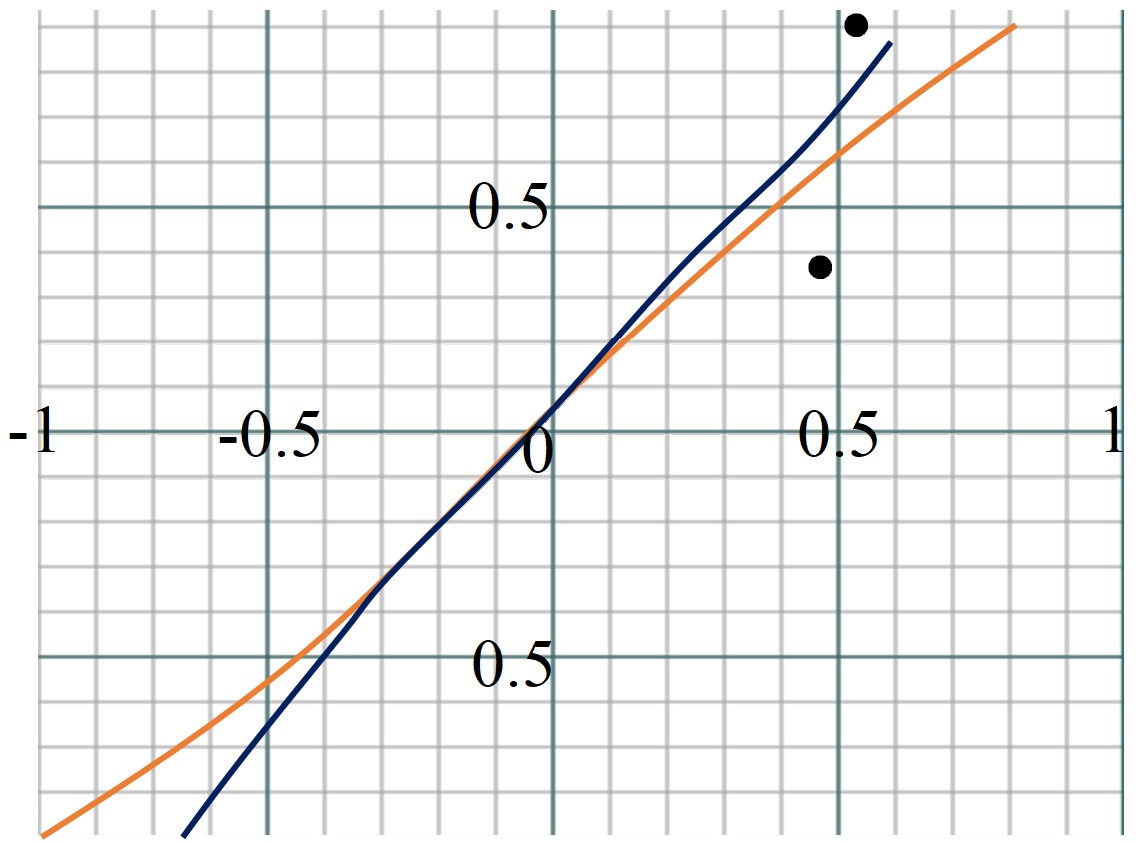
The given graph is for which equation?

  1. $\text{y}= \sin\text{x}$

  2. $\text{y} = \sin-1\text{x}$

  3. $\text{y} = \text{cosec }\text{x}$

  4. $\text{y} = \sec\text{x}$

Answer
  1. $\text{y} = \sin-1\text{x}$

Solution:

The following graph represents 2 equations.

The pink curve is the graph of $\text{y} = \sin\text{x}$

The blue curve is the graph for $\text{y} = \sin^{-1}{\text{x}}$

This curve passes through the origin and approaches to infinity in both positive and negative axes.

View full question & answer
Question 411 Mark
If $\tan^{-1}\frac{\text{x}+1}{\text{x}-1}+\tan^{-1}\frac{\text{x}-1}{\text{x}}=\tan^{-1}(-7),$ then the value of x is:
  1. 0
  2. -2
  3. 1
  4. 2
Answer
  1. 2

Solution:

$\tan^{-1}\frac{\text{x}+1}{\text{x}-1}+\tan^{-1}\frac{\text{x}-1}{\text{x}}=\tan^{-1}(-7),$

$\Rightarrow\tan^{-1}\Bigg(\frac{\frac{\text{x}+1}{\text{x}-1}+\frac{\text{x}-1}{\text{x}}}{1-\frac{\text{x}+1}{\text{x}-1}\times\frac{\text{x}-1}{\text{x}}}\Bigg)=\tan^{-1}(-7)$

$\Rightarrow\tan^{-1}\Big(\frac{\text{x}^2+\text{x}+\text{x}^2-2\text{x}+1}{\text{x}^2-\text{x}-(\text{x}^2-1)}\Big)\tan^{-1}(-7)$

$\Rightarrow\frac{2\text{x}^2-\text{x}+1}{-\text{x}+1}=-7$

$\Rightarrow2\text{x}^2-\text{x}+1=7\text{x}-7$

$\Rightarrow2\text{x}^2-8\text{x}+8=0$

$\Rightarrow\text{x}^2-4\text{x}+4=0$

$\Rightarrow(\text{x}-2)^2=0$

$\Rightarrow\text{x}=2$

View full question & answer
Question 421 Mark
The number of solutions of the equation
$\tan^{-1}2\text{x}+\tan^{-1}3\text{x}=\frac{\pi}{4}$ 
is:
  1. 2
  2. 3
  3. 1
  4. none of these
Answer
  1. 2

Solution:

We know that $\tan^{-1}\text{x}+\tan^{-1}\text{y}=\tan^{-1}\Big(\frac{\text{x}+\text{y}}{1-\text{xy}}\Big).$

$\therefore\ \tan^{-1}2\text{x}+\tan^{-1}3\text{x}=\frac{\pi}{4}$

$\Rightarrow\tan^{-1}\Big(\frac{2\text{x}+3\text{x}}{1-2\text{x}\times3\text{x}}\Big)=\frac{\pi}{4}$

$\Rightarrow\frac{2\text{x}+3\text{x}}{1-2\text{x}\times3\text{x}}=\tan\frac{\pi}{4}$

$\Rightarrow\frac{5\text{x}}{1-6\text{x}^2}=1$

$\Rightarrow5\text{x}=1-6\text{x}^2$

$\Rightarrow6\text{x}^2+5\text{x}-1=0$

View full question & answer
Question 431 Mark
$2\tan^{-1}\big\{\text{cosec}\big(\tan^{-1}\text{x}\big)-\tan\big(\cot^{-1}\text{x}\big)\big\}$ is equal to:
  1. $\cot^{-1}\text{x}$
  2. $\cot^{-1}\text{x}$
  3. $\tan^{-1}\text{x}$
  4. $\text{none of these}$
Answer
  1. $\tan^{-1}\text{x}$

Solution:

$\therefore\ 2\tan^{-1}\big\{\text{cosec}\big(\tan^{-1}\text{x}\big)-\tan\big(\cot^{-1}\text{x}\big)\big\}$

$=2\tan^{-1}\Big\{\text{cosec}\big(\tan^{-1}\text{x}\big)-\tan\Big(\tan^{-1}\frac{1}{\text{x}}\Big)\Big\}$

$=\frac{3}{29}=2\tan^{-1}\Big\{\text{cosec}\big(\tan^{-1}\text{x}\big)-\frac{1}{\text{x}}\Big\}$

$=2\tan^{-1}\Big\{\text{cosec y}-\frac{1}{\tan\text{y}}\Big\}$

$=2\tan^{-1}\Big\{\frac{1-\cos\text{y}}{\sin\text{y}}\Big\}$

$=2\tan^{-1}\bigg\{\frac{2\sin^2\frac{\text{y}}{2}}{\sin\text{y}}\bigg\}$

$=2\tan^{-1}\bigg\{\frac{2\sin^2\frac{\text{y}}{2}}{2\sin\frac{\text{y}}{2}\cos\frac{\text{y}}{2}}\bigg\}$

$=2\tan^{-1}\Big\{\tan\frac{\text{y}}{2}\Big\}$

$=\text{y}$

$=\tan^{-1}\text{x}$

View full question & answer
Question 451 Mark
The value of $\tan\Big\{\cos^{-1}\frac{1}{5\sqrt2}-\sin^{-1}\frac{4}{\sqrt{17}}\Big\}$ is:
  1. $\frac{\sqrt{29}}{3}$
  2. $\frac{29}{3}$
  3. $\frac{\sqrt3}{29}$
  4. $\frac{3}{29}$
Answer
  1. $\frac{3}{29}$

Solution:

Let, $\cos^{-1}\frac{1}{5\sqrt2}=\text{y}$ and $\sin^{-1}\frac{4}{\sqrt{17}}=\text{z}$

$\therefore\ \cos\text{y}=\frac{1}{5\sqrt2}\Rightarrow\sin\text{y}=\frac{7}{5\sqrt2}\Rightarrow\tan\text{y}=7$

$\sin\text{z}=\frac{4}{\sqrt{17}}\Rightarrow\cos\text{z}=\frac{1}{\sqrt{17}}\Rightarrow\tan\text{z}=4$

$\therefore\ \tan\Big(\cos^{-1}\frac{1}{5\sqrt2}-\sin^{-1}\frac{1}{\sqrt{17}}\Big)=\tan(\text{y}-\text{z})$

$=\frac{\tan\text{y}-\tan\text{z}}{1+\tan\text{y}\tan\text{z}}$

$=\frac{7-4}{1+7\times4}$

$=\frac{3}{29}$

View full question & answer
Question 461 Mark
$\Bigg(\cot\Bigg(\sin^{-1}\sqrt{\frac{2-\sqrt{3}}{4}}+\cos^{-1}\frac{\sqrt{-12}}{4}+\sec^{\sqrt{2}}\Bigg)\Bigg)$ is:
  1. 0
  2. $ 2π​$
  3. $ 3π​$
  4. none of these
Answer
  1. 0

Solution:

The above expression can be rewritten as

$\sin^{-1}(\cot(15^{0}+30^{0}+45^{0}))$

$ =\sin^{-1}(\cot(90^{0}))$

$ =\sin^{-1}(0)$

$ = 0$

View full question & answer
Question 471 Mark
$ \tan^{−1}\sqrt{3}+\sec−12–\cos−^{1}1$ is equal to ________.
  1. 0
  2. $ \frac{2}{π3}$
  3. $ \frac{\pi}{3}$
  4. $ \frac{\pi}{4}$
Answer
  1. $ \frac{2}{π3}$

solution:

$\tan^{-1}\sqrt{3}=\frac{\pi}{3},\sec^{-1}2,\cos^{-1}1=0$

$ ∴\tan^{−1}\sqrt{13}+\sec^{−1}2−\cos^{−1}1=\frac{π}{3}+\frac{π}{3}−0$

$ =\frac{2π}{3}$

View full question & answer
Question 481 Mark
The value of $ \cos \left( \sin^{-1} \left( \frac {2}{3} \right) \right)$ is equal to :
  1. $ \frac {\sqrt4}{8}$
  2. $ \frac {\sqrt4}{3}$
  3. $ \frac {\sqrt5}{4}$
  4. $ \frac {\sqrt5}{3}$
Answer
  1. $ \frac {\sqrt5}{3}$

Solution:

The value of $ \cos \left( \sin^{-1} \left( \frac {2}{3} \right) \right)$ is

$=\cos\Bigg(\cos^{-1}\sqrt{1-\bigg(1-\frac{2}{3}\bigg)^2}\Bigg)$

$ = \cos \left( \cos^{-1}\left( \sqrt{1 - \frac{4}{9} } \right) \right)$

$ = \cos \left( \cos^{-1} \left( \frac {\sqrt5}{3} \right) \right)$

$ = \frac {\sqrt5}{3}$

View full question & answer
Question 491 Mark
Number of triplets (x, y, z) satisfying $ \sin ^{-1}\text{x}+\sin ^{-1}\text{y}+\cos ^{-1}\text{z}=2\pi$ is:
  1. 1
  2. 0
  3. 2
Answer
  1. 1

Solution:

Let f(x, y, z) $ =\sin ^{-1}\text{x}+\sin ^{-1}\text{y}+\cos^{-1}\text{z}$

It will attain the value 2π only if $ \sin ^{-1}\text{x}=\sin ^{-1}\text{y}=\frac{\pi }{2} \text{and } \cos^{-1}\text{z}=\pi$

This ispossible only if x = y = 1and z = -1

Hence there is only one solutionf $ (1, 1, -1)= 2π.$

View full question & answer
Question 501 Mark
If $\tan^{-1}3+\tan^{-1}\text{x}=\tan^{-1}8,$ then x =
  1. $5$
  2. $\frac{1}{5}$
  3. $\frac{5}{14}$
  4. $\frac{14}{5}$
Answer
  1. $\frac{1}{5}$

Solution:

We know that $\tan^{-1}\text{x}+\tan^{-1}\text{y}=\tan^{-1}\frac{\text{x}+\text{y}}{1-\text{xy}}$

Now,

$\tan^{-1}3+\tan^{-1}\text{x}=\tan^{-1}8$

$\Rightarrow\tan^{-1}\Big(\frac{3+\text{x}}{1-3\text{x}}\Big)=\tan^{-1}8$

$\Rightarrow\frac{3+\text{x}}{1-3\text{x}}=8$

$\Rightarrow3+\text{x}=8-24\text{x}$

$\Rightarrow3-8=-24\text{x}-\text{x}$

$\Rightarrow-5=-25\text{x}$

$\Rightarrow\text{x}=\frac{5}{25}=\frac{1}{5}$

View full question & answer
M.C.Q (1 Marks) - Maths STD 12 Science Questions - Vidyadip