Questions

3 Marks

🎯

Test yourself on this topic

9 questions · timed · auto-graded

Question 13 Marks
A bag contains 4 red and 4 black balls, another bag contains 2 red and 6 black balls. One of the two bags is selected at random and a ball is drawn from the bag wich is found to be red Find the probability that the ball is drawn from the first bag.
Answer
Event $E_1$ : selection of ball from first bag
Event $E_2$ : selection of ball from second bag
Event A : second ball is red ball
$\begin{aligned} \therefore & P\left(E_1 \mid A\right)=\frac{P\left(E_1\right) \cdot P\left(A \mid E_1\right)}{P(A)} \text { (Bayes' rule) } \\ & P\left(E_1\right)=\frac{1}{2} ; P\left(E_2\right)=\frac{1}{2} \\ & P\left(A \mid E_1\right)=\frac{{ }^4 C_1}{{ }^8 C_1}=\frac{4}{8}=\frac{1}{2} \\ & P\left(A \mid E_2\right)=\frac{{ }^2 C_1}{{ }^8 C_1}=\frac{2}{8}=\frac{1}{4} \\ \therefore & P(A)=P\left(E_1\right) \cdot P\left(A \mid E_1\right)+P\left(E_2\right) \cdot P\left(A \mid E_2\right)\end{aligned}$
$\begin{array}{l}=\frac{1}{2} \times \frac{1}{2}+\frac{1}{2} \times \frac{1}{4} \\ =\frac{1}{4}+\frac{1}{8} \\ =\frac{3}{8}\end{array}$
Probability that the ball is drawn from the first bag which is found to be red,
$\begin{aligned}
\therefore P\left(E_1 \mid A\right) & =\frac{P\left(A \mid E_1\right) \cdot P\left(E_1\right)}{P(A)} \\
& =\frac{\frac{1}{2} \times \frac{1}{2}}{\frac{3}{8}} \\
& =\frac{2}{3}
\end{aligned}$
View full question & answer
Question 23 Marks
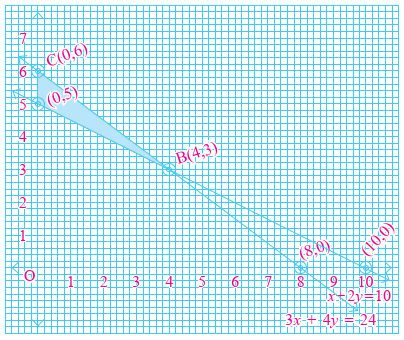
Solve the following linear programming problem graphically :
Minimise $Z=200 x+500 y$
subject to the constraints :
$\begin{array}{l}
x+2 y \geq 10; \\
3 x+4 y \leq 24; \\
x \geq 0, y \geq 0.
\end{array}$
View full question & answer
Question 33 Marks
Find the shortest distance between the lines $I_1$ and $l_2$ whose vector equation are
$\begin{array}{l}
\vec{r}=\hat{i}+\hat{j}+\lambda(2 \hat{i}-\hat{j}+\hat{k}) \text { and } \\
\vec{r}=2 \hat{i}+\hat{j}-\hat{k}+\mu(3 \hat{i}-5 \hat{j}+2 \hat{k})
\end{array}$
Answer
Comparing (1) and (2) with $\vec{r}=\overrightarrow{a_1}+\lambda \overrightarrow{b_1}$ and $\vec{r}=\overrightarrow{a_2}+\mu \overrightarrow{b_2}$ respectively
We get,
$\overrightarrow{a_1}=\hat{i}+\hat{j}, \overrightarrow{b_1}=2 \hat{i}-\hat{j}+\hat{k}, \overrightarrow{a_2}=2 \hat{i}+\hat{j}-\hat{k}$
and $\overrightarrow{b_2}=3 \hat{i}-5 \hat{j}+2 \hat{k}$
Therefore, $\overrightarrow{a_2}-\overrightarrow{a_1}=\hat{i}-\hat{k}$
and $\overrightarrow{b_1} \times \overrightarrow{b_2}=(2 \hat{i}-\hat{j}+\hat{k}) \times(3 \hat{i}-5 \hat{j}+2 \hat{k})$
$\begin{array}{l}
=\left|\begin{array}{ccc}
\hat{i} & \widehat{j} & \widehat{k} \\
2 & -1 & 1 \\
3 & -5 & 2
\end{array}\right| \\
=3 \hat{i}-\hat{j}+7 \hat{k}
\end{array}$
So, $\left|\overrightarrow{b_1} \times \overrightarrow{b_2}\right|=\sqrt{9+1+49}$
$=\sqrt{59}$
Hence, the shortest distance between the given lines is given by
$\begin{aligned}
d & =\left|\frac{\left(\overrightarrow{b_1} \times \overrightarrow{b_2}\right) \cdot\left(\overrightarrow{a_2}-\overrightarrow{a_1}\right)}{\left|\overrightarrow{b_1} \times \overrightarrow{b_2}\right|}\right| \\
& =\left|\frac{3-0+7}{\sqrt{59}}\right| \\
& =\frac{10}{\sqrt{59}} \text { unit }
\end{aligned}$
View full question & answer
Question 43 Marks
With reference to the right handed system of mutually perpendicular unit vectors
$\hat{i}, \hat{j}$ and $\hat{k}$, if $\vec{\alpha}=3 \hat{i}-\hat{j}, \vec{\beta}=2 \hat{i}+\hat{j}-3 \hat{k}$, then express $\vec{\beta}$ in the form $\vec{\beta}=\vec{\beta}_1+\vec{\beta}_2$, where $\vec{\beta}_1$ is parallel to $\vec{\alpha}$ and $\vec{\beta}_2$ is perpendicular to $\vec{\alpha}$.
Answer
Let, $\overrightarrow{\beta_1}=\lambda \vec{\alpha}$ is a scalar,
i.e., $\overrightarrow{\beta_1}=3 \lambda \vec{i}-\lambda \vec{j}$
Now, $\overrightarrow{\beta_2}=\vec{\beta}-\overrightarrow{\beta_1}=(2-3 \lambda) \hat{i}+(1+\lambda) \hat{j}-3 \hat{k}$
Now, since $\overrightarrow{\beta_2}$ is to be perpendicular $\vec{\alpha}$
we should have $\vec{\alpha} \cdot \overrightarrow{\beta_2}=0$.
i.e., $3(2-3 \lambda)-(1+\lambda)=0$
OR $\lambda=\frac{1}{2}$.
Therefore, $\overrightarrow{\beta_1}=\frac{3}{2} \widehat{i}-\frac{1}{2} \widehat{j}$ and $\overrightarrow{\beta_2}=\frac{1}{2} \widehat{i}+\frac{3}{2} \widehat{j}-3 \widehat{k}$
View full question & answer
Question 53 Marks
Prove that $y=\frac{4 \sin \theta}{(2+\cos \theta)}-\theta$ is an increasing function in $\left[0, \frac{\pi}{2}\right]$.
Answer

$\begin{array}{l}y=\frac{4 \sin \theta}{(2+\cos \theta)}-\theta, \theta \in\left[0, \frac{\pi}{2}\right] \\ \therefore \frac{d y}{d \theta}=\frac{(2+\cos \theta)(4 \cos \theta)-4 \sin \theta(-\sin \theta)}{(2+\cos \theta)^2}-1\end{array}$
$\begin{array}{l}=\frac{8 \cos \theta+4 \cos ^2 \theta+4 \sin ^2 \theta}{(2+\cos \theta)^2}-1 \\ =\frac{8 \cos \theta+4\left(\cos ^2 \theta+\sin ^2 \theta\right)-(2+\cos \theta)^2}{(2+\cos \theta)^2} \\ =\frac{8 \cos \theta+4-4-4 \cos \theta-\cos ^2 \theta}{(2+\cos \theta)^2} \\ =\frac{4 \cos \theta-\cos ^2 \theta}{(2+\cos \theta)^2}\end{array}$
$\frac{d y}{d \theta}=\frac{\cos \theta(4-\cos \theta)}{(2+\cos \theta)^2}$
Here, $\theta \in\left[0, \frac{\pi}{2}\right] \Rightarrow \cos \theta \geq 0$
$\begin{array}{l}
\Rightarrow(4-\cos \theta)>0 \\
\Rightarrow(2+\cos \theta)^2>0 \\
\Rightarrow \frac{\cos \theta(4-\cos \theta)}{(2+\cos \theta)^2} \geq 0 \\
\Rightarrow \frac{d y}{d \theta} \geq 0
\end{array}$
Therefore, $f(\theta)$ is increasing function in the interval of $\left[0, \frac{\pi}{2}\right]$.
View full question & answer
Question 63 Marks
$\begin{array}{l}\text { Find } \frac{d^2 y}{d x^2}: \\ x=a\left(\cos t+\log \tan \frac{t}{2}\right), y=a \sin t\end{array}$
Answer
Differentiating with respect to $t$,
$\begin{aligned}
\frac{d x}{d t} & =a\left(-\sin t+\frac{1}{\tan \frac{t}{2}} \cdot \sec ^2 \frac{t}{2} \cdot \frac{1}{2}\right) \\
& =a\left(-\sin t+\frac{1}{\frac{\sin \frac{t}{2}}{\cos \frac{t}{2}}} \cdot \frac{1}{\cos ^2 \frac{t}{2}} \cdot \frac{1}{2}\right) \\
& =a\left(-\sin t+\frac{1}{2 \sin \frac{t}{2} \cos \frac{t}{2}}\right) \\
& =a\left(-\sin t+\frac{1}{\sin t}\right) \\
& =a\left(\frac{-\sin ^2 t+1}{\sin t}\right) \\
& =\frac{a \cos ^2 t}{\sin t}
\end{aligned}$
$\begin{aligned} \frac{d y}{d t} & =\frac{d}{d t}(a \sin t) \\ & =a \cos t \\ \frac{d y}{d x} & =\frac{\frac{d y}{d t}}{\frac{d x}{d t}} \\ & =\frac{a \cos t}{\frac{a \cos ^2 t}{\sin t}} \\ & =\frac{\sin t}{\cos t}\end{aligned}$
$\begin{array}{l}\therefore \quad \frac{d y}{d x}=\tan t \\ \therefore \quad \frac{d}{d x}\left(\frac{d y}{d x}\right)=\frac{d}{d x}(\tan t)\end{array}$
$\begin{array}{l}=\sec ^2 t \frac{d t}{d x} \\ =\frac{1}{\cos ^2 t} \cdot \frac{1}{\frac{d x}{d t}} \\ =\frac{1}{\cos ^2 t} \cdot \frac{1}{\frac{a \cos ^2 t}{\sin t}} \\ =\frac{1}{a} \sec ^3 t \cdot \tan t\end{array}$
View full question & answer
Question 73 Marks
If $A=\left[\begin{array}{lll}1 & 3 & 3 \\ 1 & 4 & 3 \\ 1 & 3 & 4\end{array}\right]$, then verify that $A \operatorname{adj} A =| A | I$. Also find $A ^{-1}$.
Answer
We have,
$\begin{array}{l}
|A|=1(16-9)-3(4-3)+3(3-4)=1 \neq 0 \\
\text { Now, } A_{11}=7, A_{12}=-1, A_{13}=-1, A_{21}=-3, A_{22}=1, \\
A_{23}=0, A_{31}=-3, A_{32}=0, A_{33}=1
\end{array}$
Therefore, adj $A =\left[\begin{array}{ccc}7 & -3 & -3 \\ -1 & 1 & 0 \\ -1 & 0 & 1\end{array}\right]$
Now, $A (\operatorname{adj} A )=\left[\begin{array}{lll}1 & 3 & 3 \\ 1 & 4 & 3 \\ 1 & 3 & 4\end{array}\right] \cdot\left[\begin{array}{ccc}7 & -3 & -3 \\ -1 & 1 & 0 \\ -1 & 0 & 1\end{array}\right]$
$\begin{array}{l}=\left[\begin{array}{llll}7-3 & -3 & -3+3+0 & -3+0+3 \\ 7-4 & -3 & -3+4+0 & -3+0+3 \\ 7-3 & -4 & -3+3+0 & -3+0+4\end{array}\right] \\ =\left[\begin{array}{lll}1 & 0 & 0 \\ 0 & 1 & 0 \\ 0 & 0 & 1\end{array}\right] \\ =(1)\left[\begin{array}{lll}1 & 0 & 0 \\ 0 & 1 & 0 \\ 0 & 0 & 1\end{array}\right] \\ =| A | I \end{array}$
Also, $A ^{-1}=\frac{1}{|A|} \operatorname{adj} A$
$=\frac{1}{1}\left[\begin{array}{ccc}7 & -3 & -3 \\ -1 & 1 & 0 \\ -1 & 0 & 1\end{array}\right]=\left[\begin{array}{ccc}7 & -3 & -3 \\ -1 & 1 & 0 \\ -1 & 0 & 1\end{array}\right]$
View full question & answer
Question 83 Marks
Express the given matrix as the sum of a symmetric and a skew symmetric matrix :
$\left[\begin{array}{ccc}
6 & -2 & 2 \\
-2 & 3 & -1 \\
2 & -1 & 3
\end{array}\right]$
Answer
$\begin{array}{l}A^T=\left[\begin{array}{ccc}6 & -2 & 2 \\ -2 & 3 & -1 \\ 2 & -1 & 3\end{array}\right] \\ \therefore P=\frac{1}{2}\left(A+A^T\right)\end{array}$
$\begin{aligned} & =\frac{1}{2}\left\{\left[\begin{array}{ccc}6 & -2 & 2 \\ -2 & 3 & -1 \\ 2 & -1 & 3\end{array}\right]+\left[\begin{array}{ccc}6 & -2 & 2 \\ -2 & 3 & -1 \\ 2 & -1 & 3\end{array}\right]\right\} \\ & =\frac{1}{2}\left[\begin{array}{ccc}6+6 & -2-2 & 2+2 \\ -2-2 & 3+3 & -1-1 \\ 2+2 & -1-1 & 3+3\end{array}\right] \\ & =\frac{1}{2}\left[\begin{array}{ccc}12 & -4 & 4 \\ -4 & 6 & -2 \\ 4 & -2 & 6\end{array}\right] \\ P & =\left[\begin{array}{ccc}6 & -2 & 2 \\ -2 & 3 & -1 \\ 2 & -1 & 3\end{array}\right] \\ P^T & =\left[\begin{array}{ccc}6 & -2 & 2 \\ -2 & 3 & -1 \\ 2 & -1 & 3\end{array}\right]\end{aligned}$
$\therefore P=P^{T}$
$\therefore P$ is symmetric matrix.
$Q =\frac{1}{2}\left(A- A ^{ T }\right)$
$\begin{array}{l}=\frac{1}{2}\left\{\left[\begin{array}{rrr}6 & -2 & 2 \\ -2 & 3 & -1 \\ 2 & -1 & 3\end{array}\right]-\left[\begin{array}{rrr}6 & -2 & 2 \\ -2 & 3 & -1 \\ 2 & -1 & 3\end{array}\right]\right\} \\ =\frac{1}{2}\left[\begin{array}{lll}0 & 0 & 0 \\ 0 & 0 & 0 \\ 0 & 0 & 0\end{array}\right] \\ =\left[\begin{array}{lll}0 & 0 & 0 \\ 0 & 0 & 0 \\ 0 & 0 & 0\end{array}\right]\end{array}$
$\begin{array}{l}
\therefore Q^T=\left[\begin{array}{lll}
0 & 0 & 0 \\
0 & 0 & 0 \\
0 & 0 & 0
\end{array}\right] \\
\therefore-Q^T=\left[\begin{array}{lll}
0 & 0 & 0 \\
0 & 0 & 0 \\
0 & 0 & 0
\end{array}\right] \\
\therefore Q=-Q^T
\end{array}$
$\therefore Q$ is skew symmetric matrix.
$\begin{aligned}
P+Q & =\left[\begin{array}{ccc}
6 & -2 & 2 \\
-2 & 3 & -1 \\
2 & -1 & 3
\end{array}\right]+\left[\begin{array}{lll}
0 & 0 & 0 \\
0 & 0 & 0 \\
0 & 0 & 0
\end{array}\right] \\
& =\left[\begin{array}{ccc}
6 & -2 & 2 \\
-2 & 3 & -1 \\
2 & -1 & 3
\end{array}\right] \\
& =A
\end{aligned}$
View full question & answer
Question 93 Marks
Let $A=R-\{3\}$ and $B=R-\{1\}$. Consider the function $f: A \rightarrow B$ defined by, $f(x)=\left(\frac{x-2}{x-3}\right)$. Is $f$ one-one and onto ? Justify your answer.
Answer

$\begin{array}{l}
\text { Here, } A=R-\{3\}, B=R-\{1\}, f(x)=\left(\frac{x-2}{x-3})\right. \\
\forall x_1, x_2 \in A, \quad f\left(x_1\right)=f\left(x_2\right) \\
\therefore \quad \frac{x_1-2}{x_1-3}=\frac{x_2-2}{x_2-3} \\
\therefore \quad\left(x_1-2\right)\left(x_2-3\right)=\left(x_2-2\right)\left(x_1-3\right) \\
\therefore \quad x_1 x_2-3 x_1-2 x_2+6=x_1 x_2-3 x_2-2 x_1+6 \\
\therefore \quad x_1=x_2
\end{array}$
$\therefore f$ is one-one function.
Suppose, $y \in B= R -\{1\}$
$\begin{array}{l}
y=f(x) \\
\therefore \quad y=\frac{x-2}{x-3}
\end{array}$
$\begin{array}{l}\therefore y(x-3)=x-2 \\ \therefore y x-3 y=x-2 \\ \therefore y x-x \quad=3 y-2 \\ \therefore x(y-1)=3 y-2 \\ \therefore \quad x=\frac{3 y-2}{y-1} \in R -\{3\} \text { (Domain) }\end{array}$
Now, $f(x)=f\left(\frac{3 y-2}{y-1}\right)=\frac{\frac{3 y-2}{y-1}-2}{\frac{3 y-2}{y-1}-3}$
$=\frac{3 y-2-2 y+2}{3 y-2-3 y+3}=y$
$\therefore \quad \forall y \in B=R-\{1\}\{kxu$
$x=\frac{3 y-2}{y-1} \in A= R -\{3\}$ such that
$f(x)=y$
$\therefore f$ is onto function.
View full question & answer
3 Marks - Maths STD 12 Science Questions - Vidyadip