Questions · Page 2 of 4

M.C.Q (1 Marks)

Question 511 Mark
By graphical method, the solution of linear programming problem
Maximize Z = 3x1 + 5x2
Subject to
3x1 + 2x2 ≤ 18
x1 ≤ 4
x2 ≤ 6
x1 ≥ 0, x2 ≥ 0, is:
  1. x1 = 2, x2 = 0, Z = 6
  2. x1 = 2, x2 = 6, Z = 36
  3. x1 = 4, x2 = 3, Z = 27
  4. x1 = 4, x2 = 6, Z = 42
Answer
  1. x1 = 2, x2 = 6, Z = 36

Solution:

We need to maximize the function Z = 3x4 + 5x2

First, we will convert the given inequations into equations, we obtain the following equations:

3x1 + 2x2 = 18, x1 = 4, x2 = 6, x1 = 0 and x2 = 0

Region represented by 3x1 + 2x2 ≤ 18:

The line 3x1 + 2x2 = 18 meets the coordinate axes at A(6, 0) and B(0, 9) respectively.

By joining these points we obtain the line 3X1 + 2x2 = 18.

Clearly (0, 0) satisfies the inequation 3x1 + 2x2 = 18.

So the region in the plane which contain the origin represents the solution set of the inequation 3x1 + 2x2 ≤ 18.

Region represented by x1 ≤ 4:

The line x1 = 4 is the line that passes through C(4, 0) and is parallel to the Y axis.

The region to the left of the line x1 = 4 will satisfy the inequation x1 ≤ 4.

Region represented by x2 ≤ 6:

The line x2 = 6 is the line that passes through D(0, 6) and is parallel to the X axis.

The region below the line x2 = 6 will satisfy the inequation X2 ≤ 6.

Region represented by x1 ≥ 0 and x2 ≥ 0:

Since, every point in the first quadrant satisfies these inequations.

So, the first quadrant is the region represented by the inequations x1 ≥ 0 and x2 ≥ 0.

The feasible region determined by the system of constraints, 3x1 + 2x2 ≤ 18, x1 ≤ 4, x2 ≤ 6, x1 ≥ 0 and x2 ≥ 0 are as follows
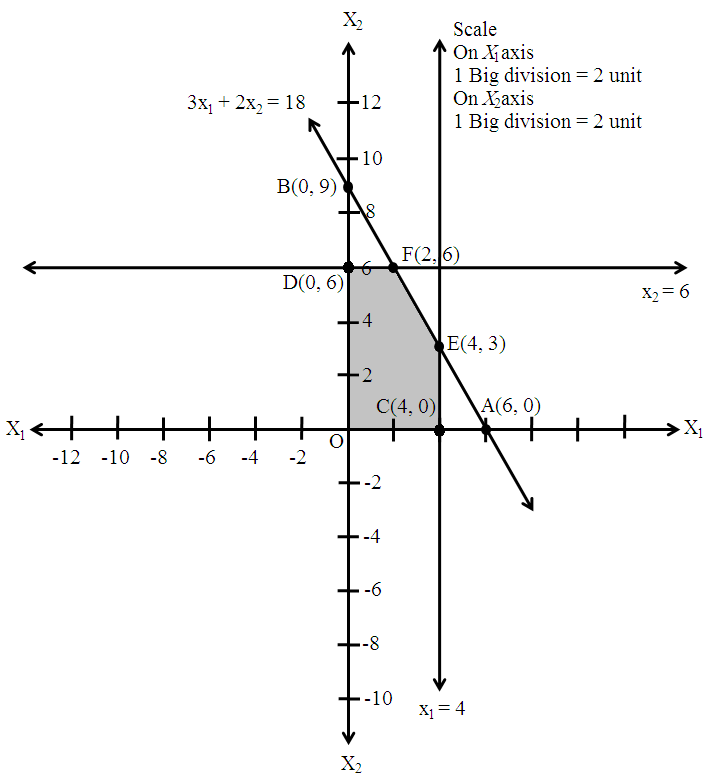
Corner points are O(0, 0), D(0, 6), F(2, 6), E(4, 3) and C(4, 0).

The values of the objective function at these points are given in the following table.

Points
Value of Z
O(0, 0)
3(0) + 5(0) = 0
D(0, 6)
3(0) + 5(6) = 30
F(2, 6)
3(2) + 5(6) = 36
E(4, 3)
3(4) + 5(3) = 27
C(4, 0)
3(4) + 5(0) = 12

We see that the maximum value of the objective function Z is 36 which is at F(2, 6).
View full question & answer
Question 521 Mark
Maximize Z = 3x + 5y, subject to constraints: $\text{x}+4\text{y}\leq24,3\text{x}+\text{y}\leq21,\text{x}+\text{y}\geq9,\text{x}\geq0,\text{y}\geq0.$
  1. 20 at (1, 0)
  2. 30 at (0, 6)
  3. 37 at (4, 5)
  4. 33 at (6, 3)
Answer
  1. 37 at (4, 5)

Solution:

Find the maximum value of Z = 3x + 5y referring to the explanation of Q.5.

View full question & answer
Question 531 Mark
Maximize Z = 10 x1 + 25 x2, subject to $0\leq\text{x}_{1}\leq3,0\leq\text{x}_{2}\leq3,\text{x}_{1}+\text{x}_{2}\leq5.$
  1. 80 at (3, 2)
  2. 75 at (0, 3)
  3. 30 at (3, 0)
  4. 95 at (2, 3)
Answer
  1. 95 at (2, 3)
View full question & answer
Question 541 Mark
The optimal value of the objective function is attained at the points:
  1. On x - axis
  2. On y - axis
  3. Which are corner points of the feasible region
  4. None of these
Answer
  1. Which are corner points of the feasible region
View full question & answer
Question 551 Mark

The corner points of the feasible region determined by the following system of linear inequalities:

2x + y ≤ 10, x + 3y ≤ 15, x, y ≥ 0 are (0, 0), (5, 0), (3, 4) and (0, 5).

Let Z = px + qy, where p.q > 0.

Condition on p and q so that the maximum of Z occurs at both (3, 4) and (0, 5) is:

  1. P = q
  2. p = 2q
  3. p = 3q
  4. q = 3q
Answer
  1. q = 3p

Solution:

The maximum value of Z is unique.

It is given that the maximum value of Z occurs at two points (3, 4) and (0,5).

Value of Z at (3, 4) = Value of Z at (0,5)

= p(3) + q(4) = p(0) + 7(5)

= 3p + 4q = 5q

= q = 3p

View full question & answer
Question 561 Mark

The objective function Z = 4x + 3y can be maximised subjected to the constraints 3x + 4y ≤ 24, 8x + 6y ≤ 48, x ≤ 5, y ≤ 6, x, y ≥ 0

  1. at only one point
  2. at two points only
  3. at an infinite number of points
  4. none of these
Answer
  1. at an infinite number of points

Solution:

We need to maximize Z = 4x + 3y

First, we will convert the given inequations into equations, we obtain the following equations: 3x + 4y = 24, 8x + 6y = 48, x = 5, y = 6, x = 0 and y = 0.

The line 3x + 4y = 24 meets the coordinate axis at A(8, 0) and B(0, 6).

Join these points to obtain the line 3x + 4y = 24.

Clearly, (0, 0) satisfies the inequation 3x + 4y ≤ 24.

So, the region in xy-plane that contains the origin represents the solution set of the given equation.

The line 8x + 6y = 48 meets the coordinate axis at C(6, 0) and D(0, 8).

Join these points to obtain the line 8x + 6y = 48.

Clearly, (0, 0) satisfies the inequation 8x + 6y ≤ 48.

So, the region in xy plane that contains the origin represents the solution set of the given equation.

x = 5 is the line passing through x = 5 parallel to the Y axis.

y = 6 is the line passing through y = 6 parallel to the X axis.

Region represented by x ≥ 0 and y ≥ 0:

Since, every point in the first quadrant satisfies these inequations.

So, the first quadrant is the region represented by the inequations.

These lines are drawn using a suitable scale.

and B (0,6).

The corner points of the feasible region are O(0, 0), G(5, 0), $\text{F}\Big(5,\frac{4}{3}\Big),\text{E}\Big(\frac{24}{7},\frac{24}{7}\Big)$and B(0, 6).

The values of Z at these corner points are as follows.

$\text{Corner point}$ $\text{Z} = 4\text{x} + 3\text{y}$
$\text{O}(0, 0)$ $4 \times 0 + 3 \times 0= 0$
$\text{G}(5, 0)$ $4 \times 5 + 3 \times 0 = 20$
$\text{F}\Big(5,\frac{4}{3}\Big)$ $4\times5+3\times\frac{4}{3}=24$
$\text{E}\Big(\frac{24}{7},\frac{24}{7}\Big)$ $4\times\frac{24}{7}+3\times\frac{24}{7}=\frac{196}{7}=24$
$\text{B}(0, 6)$ $4\times0+3\times6=18$

We see that the maximum value of the objective function Z is 24 which is at F(5, 4) and $\text{E}\Big(\frac{24}{7},\frac{24}{7}\Big).$

Thus, the optimal value of Z is 24.

As, we know that if a LPP has two optimal solution, then there are an infinite number of optimal solutions.

Therefore, the given objective function can be subjected at an infinite number of points.

View full question & answer
Question 571 Mark

The value of objective function is maximum under linear constraints

  1. at the centre of feasible region
  2. at (0, 0)
  3. at any vertex of feasible region
  4. the vertex which is maximum distance from (0, 0)
Answer
  1. at any vertex of feasible region

Solution:

In linear programming problem we substitute the coordinates of vertices of feasible region in the objective function and then we obtain the maximum or minimum value.

Therefore, the value of objective function is maximum under linear constraints at any vertex of feasible region.

View full question & answer
Question 581 Mark
 

For the LPP; maximise z = x + 4y subject to the constraints $\text{x}+2\text{y}\leq2,$ $\text{x}+2\text{y}\geq8,$ $\text{x},\text{y}\geq0.$

  1. zmax ​= 4
  2. zmax​ = 8
  3. zmax​ = 16
  4. Has no feasible solution
Answer
  1. Has no feasible solution

Solution:

$\text{x}+2\text{y}\leq2$

$\text{x}+2\text{y}\geq8$

$\text{x},\text{y}\geq0.$

View full question & answer
Question 591 Mark
Which of the following sets are convex?

  1. $\{(\text{x},\text{y}):\text{x}^2+\text{y}^2\geq1\}$

  2. $\{(\text{x},\text{y}):\text{y}^2\geq\text{x}\}$

  3. $\{(\text{x},\text{y}):3\text{x}^2+4\text{y}^2\geq5\}$

  4. $\{(\text{x},\text{y}):\text{y}\geq2,\text{y}\leq4\}$

Answer
  1. $\{(\text{x},\text{y}):\text{y}\geq2,\text{y}\leq4\}$

Solution:

is the region between two parallel lines, so any line segment joining any two points in it lies in it.

Hence, it is a convex set.

View full question & answer
Question 601 Mark
The solution set of the inequation 3x + 2y > 3 is:
  1. Half plane not containing the origin
  2. Half plane containing the origin
  3. The point being on the line 3x + 2y = 3
  4. None of these
Answer
  1. Half plane not containing the origin
View full question & answer
Question 611 Mark
Maximize Z = 6x + 4y, subject to $\text{x}\leq2,\text{x}+\text{y}\leq3,-2\text{x}+\text{y}\leq1,\text{x}\geq0,\text{y}\geq0.$
  1. 12 at (2, 0)
  2. 16 at (2, 1)
  3. $\frac{140}{3}$ at $\Big(\frac{2}{3},\frac{1}{3}\Big)$
  4. 4 at (0, 1)
Answer
  1. $\frac{140}{3}$ at $\Big(\frac{2}{3},\frac{1}{3}\Big)$
View full question & answer
Question 621 Mark
Region represented by $\text{x}\geq0, \text{y}\geq0$ is:
  1. First quadrant
  2. Second quadrant
  3. Third quadrant
  4. Fourth quadrant
Answer
  1. First quadrant

Solution:

 All the positive values of x and y will lie in the first quadrant.

View full question & answer
Question 631 Mark
Which of the following is not true about feasibility?
  1. It cannot be determined in a graphical solution of an LPP.
  2. It is independent of the objective function.
  3. It implies that there must be a convex region satisfying all the constraints.
  4. Extreme points of the convex region gives the optimum solution.
Answer
  1. It cannot be determined in a graphical solution of an LPP. 

Solution:

There are various methods to solve the linear programming problems namely simplex method, ellipsoid method, graphical method, interior points method, etc.

Therefore a linear programming problem can be solved using the graphical method.

Hence, the feasibility of the linear programming problem can be determined by the graphical method.

View full question & answer
Question 641 Mark
The maximum value of Z = 4x + 3y subjected to the constraints $2\text{x}+3\text{y}\leq18,$ $\text{x}+\text{y}\geq10;\text{x},\text{y}\geq0$ is:
  1. 36
  2. 40
  3. 20
  4. None of these
Answer
  1. None of these
View full question & answer
Question 651 Mark
For a linear programming equations, convex set of equations is included in region of:
  1. Feasible solutions
  2. Disposed solutions
  3. Profit solutions
  4. Loss solutions
Answer
  1. Feasible solutions

Solution:

In order for a linear programming problem to have a unique solution, the solution must exist at the intersection of two or more constraints.

Then the problem becomes convex and has a single optimum(maximum or minimum) solution.

Therefore the convex set of equations is included in the feasible region.

View full question & answer
Question 661 Mark
Which of the following is a property of all linear programming problems?
  1. Alternate courses of action to choose from.
  2. Minimization of some objective.
  3. A computer program.
  4. Usage of graphs in the solution.
  5. Usage of linear and nonlinear equations and inequalities.
Answer
  1. Alternate courses of action to choose from.

Solution:

According to Robbins, the resources(capital, land, labour, materials, ...) are always limited.

Every resource have multiple uses.

The problem before any organisation or manager is to choose the best alternatives which can maximize the profit or minimize the cost of production.

Linear programming is the method which is used to select the best possible alternatives from the all alternatives.

According to William M. Fox, "Linear programming is a planning technique that permits some objective function to be maximized or minimized within the framework of given situational restrictions"

Therefore, the linear programming is the process of selecting best courses of action to choose from various alternatives.

View full question & answer
Question 671 Mark
To write the dual; it should be ensured that
  1.  All the primal variables are non - negative.
  2. All the bi values are non - negative.
  3. All the constraints are $\leq$ type if it is maximization problem and $\geq$ type if it is a minimization problem.
  1. I and II
  2. II and III
  3. I and III
  4. I, II and IIl
Answer
  1. I and III

Solution:

To write the dual, then all the primal variables must be non-negative.

All the constraints are $\leq$ type if it ia maximization problem and $\geq$ type if it is a minimization problem.

View full question & answer
Question 681 Mark
If two constraints do not intersect in the positive quadrant of the graph, then.
  1. The problem is infeasible
  2. The solution is unbounded
  3. One of the constraints is redundant
  4. None of the above
Answer
  1. The problem is infeasible

Solution:

Any linear programming problem must have the following properties:-1.

The relationship between variables and constraints must be linear2.

The constraints must be non - negative.3.. objective function must be linear.

Non - negativity conditions are used because the variables cannot take negative values.

i.e., it is not possible to have negative resources (land, capital, labour cannot be negative).

Because of the non - negativity condition, the feasible region exists only in I quadrant.

View full question & answer
Question 691 Mark
Let X1 and X2 are optimal solutions of a LPP, then:
  1. $\text{X}=\lambda\ \text{X}_1+(1-\lambda)\text{X}_2,\lambda\in$ R is also an optimal solution
  2. $\text{X}=\lambda\ \text{X}_1+(1-\lambda)\text{X}_2,0\leq\lambda\leq1$ given an optimal solution
  3. $\text{X}=\lambda\ \text{X}_1+(1+\lambda)\text{X}_2,0\leq\lambda\leq1$ given an optimal solution
  4. $\text{X}=\lambda\ \text{X}_1+(1+\lambda)\text{X}_2,\lambda\in$ R given an optimal solution
Answer
  1.  $\text{X}=\lambda\ \text{X}_1+(1-\lambda)\text{X}_2,0\leq\lambda\leq1$ given an optimal solution

Solution:

A set A is convex if, for any two points X1, X$\in\text{A}$ and $\lambda\in0,1$ imply that $\lambda\times1+1-\lambda\times2\in\text{A}$.

Since, here X1 and X2 are optimal solution

Therefore, their convex combination will also be an optimal solution

Thus, $\text{X}=\lambda\ \text{X}_1+(1-\lambda)\text{X}_2,0\leq\lambda\leq1$ gives an optimal solution.

View full question & answer
Question 701 Mark
Apply linear programming to this problem. A firm wants to determine how many units of each of two products (products D and E) they should produce to make the most money. The profit in the manufacture of a unit of product D is 100 and the profit in the manufacture of a unit of product E is100 and the profit in the manufacture of aunit of product E is 87. The firm is limited by its total available labor hours and total available machine hours. The total labor hours per week are 4,000. Product D takes 5 hours per unit of labor and product E takes 7 hours per unit. The total machine hours are 5,000 per week. Product D takes 9 hours per unit of machine time and product E takes 3 hours per unit. Which of the following is one of the constraints for this linear program?
  1. $5\text{D}+7\text{E}\leq5,000$
  2. $9\text{D}+3\text{E}\geq4,000$
  3. $5\text{D}+7\text{E}=4,000$
  4. $5\text{D}+9\text{E}\leq5,000$
  5. $9\text{D}+3\text{E}\leq5,000$
Answer
  1. $9\text{D}+3\text{E}\leq5,000$

Solution:

Given, product D takes 5 hours per unit of labour, and product E takes 7 hours per unit of labour.

Therefore, to produce D units of product D takes 5D hours andto produce E units of product E takes 7E hours Given, total labour hours per week are 4000 hours.

Hence, $5\text{D}+7\text{E}\leq4,000$

Given, product D takes 9 hours per unit of machine time, andproduct E takes 3 hours per unit of machine time.

Therefore, to produce D units of product D takes 9D hours andto produce E units of product E takes 3E hours Given, total machine hours per week are 5000 hours.

Hence, $9\text{D}+3\text{E}\leq5,000$

View full question & answer
Question 711 Mark
Maximize Z = 11x + 8y, subject to $\text{x}\leq4,\text{y}\leq6,\text{x}\geq0,\text{y}\geq0.$
  1. 44 at (4, 2)
  2. 60 at (4, 2)
  3. 62 at (4, 0)
Answer
  1. 60 at (4, 2)
View full question & answer
Question 721 Mark
The value of $\frac{0.76\times0.76\times0.76+0.24\times0.24\times0.24}{0.76\times0.76-0.76\times0.24+ 0.24+0.24}$is:
  1. 0.52
  2. 1
  3. 0.01
  4. 0.1
Answer
  1. 1

Solution:

Formula used:

a3 + b3 = (a + b)(a2 - ab + b2)

$\frac{0.76\times0.76\times0.76+0.24\times0.24\times0.24}{0.76\times0.76-0.76\times0.24+ 0.24+0.24}$

$\frac{(0.76)^{3}+(0.24)^{3}}{0.76\times0.76-0.76\times0.24+0.24+0.24}$

$=\frac{(0.76+0.24)(0.76\times0.76-0.76\times0.24+0.24\times0.24)}{0.76\times0.76-0.76\times0.24+0.24\times0.24}$

$=(0.76+0.24)=1$

View full question & answer
Question 731 Mark
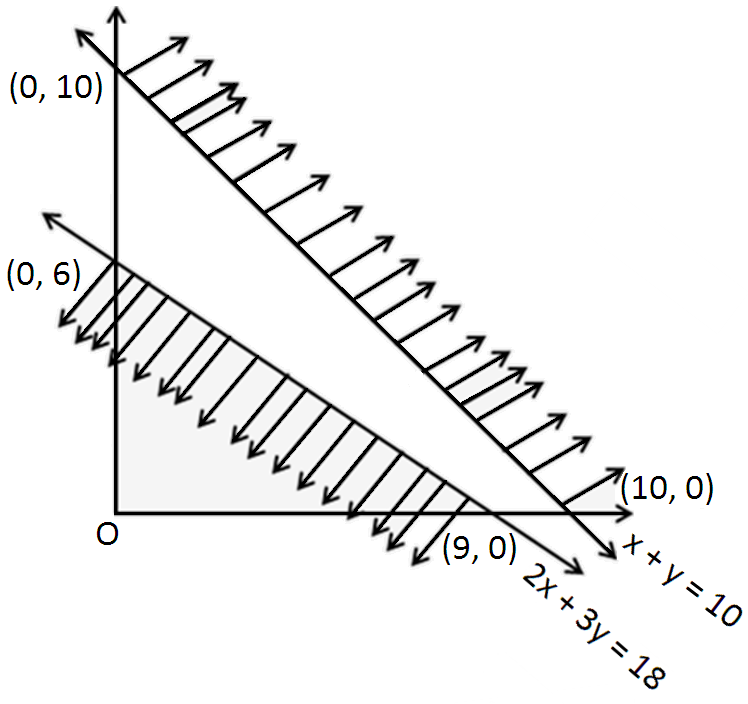
The maximum value of Z = 4x + 2y Subjected to the constraints $2\text{x}+3\text{y}\leq18,\text{x}+\text{y}\geq10,\text{x},\text{y}\geq0$ is:
  1. 36
  2. 40
  3. 20
  4. none of these
Answer
  1. none of these

Solution:

Consider, 2x + 3y = 18

x
y
(x, y)
0
6
(0, 6)
9
0
(9, 0)

Consider, x + y = 10

x
y
(x, y)
0
10
(0, 10)
10
0
(10, 0)

From the graph we conclude that no feasible region exist.

View full question & answer
Question 741 Mark
In transportation models designed in linear programming, points of demand is classified as:
  1. Ordination
  2. Transportation
  3. Destinations
  4. Origins
Answer
  1. Destinations

Solution:

In linear programming, transportation modeltransportation model are applied to problems related to the study of efficient transportation routes.

i.e., how effectively the available resources are transported to different destinations with minimum cost.

Therefore, the points of demand is classified as destinations.

View full question & answer
Question 751 Mark
Objective function of a LPP is:
  1. a constraint
  2. a function to be optimized
  3. a relation between the variables
  4. none of these
Answer
  1. a function to be optimized

Solution:

The objective function of a linear programming problem is either to be maximized or minimized i.e. objective function is to be optimized.

View full question & answer
Question 761 Mark
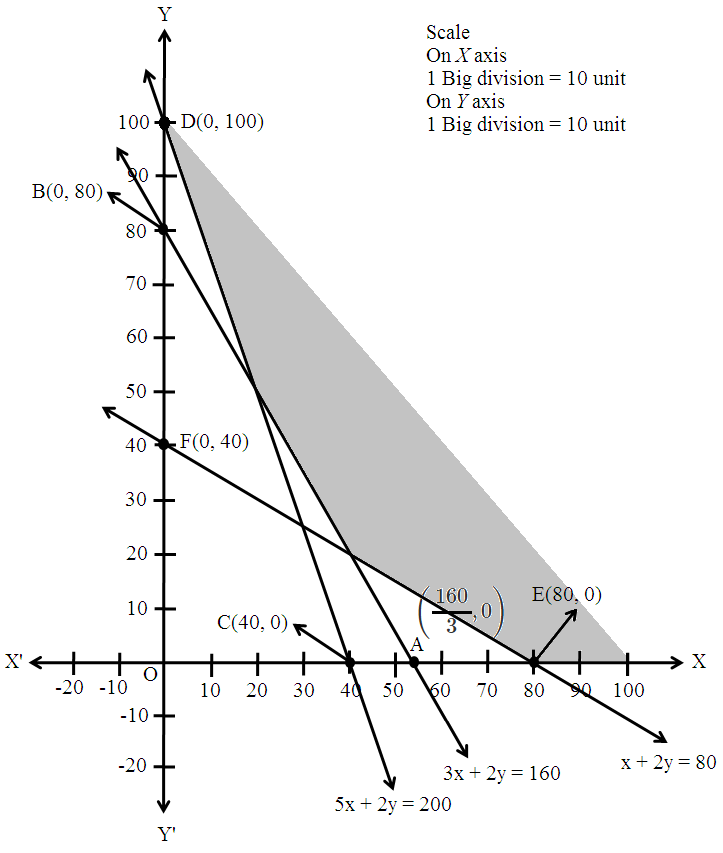
The maximum value of Z = 4x + 3y subjected to the constraints 3x + 2y ≥ 160, 5x + 2y ≥ 200, x + 2y ≥ 80, x, y ≥ 0 is:
  1. 320
  2. 300
  3. 230
  4. none of these
Answer
  1. none of these

Solution:

We need to maximize the function Z = 4x + 3y

Converting the given inequations into equations, we obtain

3x + 2y = 160, 5x + 2y = 200, x + 2y = 80, x = 0 and y = 0

Region represented by 3x + 2y ≥ 160:

The line 3x + 2y = 160 meets the coordinate axes at A1603,0 and B(0, 80) respectively.

By joining these points we obtain the line 3x + 2y = 160.

Clearly (0, 0) does not satisfies the inequation 3x + 2y ≥ 160.

So, the region in xy plane which does not contain the origin represents the solution set of the inequation 3x + 2y ≥ 160.

Region represented by 5x +2y ≥ 200:

The line 5x + 2y = 200 meets the coordinate axes at C(40, 0) and D(0, 100) respectively.

By joining these points we obtain the line 5x + 2y = 200.

Clearly (0, 0) does not satisfies the inequation 5x +2y ≥ 200.

So, the region which does not contain the origin represents the solution set of the inequation 5x +2y ≥ 200.

Region represented by x +2y ≥ 80:

The line x + 2y = 80 meets the coordinate axes at E(80, 0) and F(0, 40) respectively.

By joining these points we obtain the line x + 2y = 80.

Clearly (0, 0) does not satisfies the inequation x + 2y ≥ 80.

So, the region which does not contain the origin represents the solution set of the inequation x + 2y ≥ 80.

Region represented by x ≥ 0 and y ≥ 0:

Since, every point in the first quadrant satisfies these inequations.

So, the first quadrant is the region represented by the inequations x ≥ 0, and y ≥ 0.

The feasible region determined by the system of constraints 3x + 2y ≥ 160,5x+2y ≥ 200, x +2y ≥ 80, x ≥ 0, and y ≥ 0 are as follows.

Here, we see that the feasible region is unbounded.

Therefore,maximum value is infinity.

View full question & answer
Question 771 Mark
Graphical method can be used only when the decision variables is:
  1. More than 3.
  2. More than 1.
  3. Two
  4. One
Answer
  1. Two

Solution:

Graphical method can be used only when the decision variables is two.

View full question & answer
Question 781 Mark
A constraint in an LP model becomes redundant because:
  1. Two iso - profit line may be parallel to each other
  2. The solution is unbounded
  3. This constraint is not satisfied by the solution values
  4. None of the above
Answer
  1. None of the above

Solution:

A constraint in an LP model becomes redundant when the feasible region doesnt change by the removing the constraint.

For example, $\text{x}+2\text{y}\leq20$ and $2\text{x}+4\text{y}\leq40$ are the constraints.

$2\text{x}+4\text{y}\leq40$

$\Rightarrow2\times(\text{x}+2\text{y})\leq2\times20$

$\Rightarrow\text{x}+2\text{y}\leq20$

 which is same as the first constraint.

Therefore, $2\text{x}+4\text{y}\leq40$ can be removed.

By removing this constraint feasible region doesnt change.

View full question & answer
Question 791 Mark
The corner points of the feasible region determined by the following system of linear inequalities:
$2\text{x}+\text{y}\le10,\ \text{x}+3\text{y}\le15,\ \text{x},\ \text{y}\ge0$ are (0, 0), (5, 0), (3, 4) and (0, 5). Let Z = px + qy, where p, q > 0. Condition on p and q so that the maximum of Z occurs at both (3, 4) and (0, 5) is:
  1. p = q
  2. p = 2q
  3. p = 3q
  4. q = 3p.
Answer
  1. q = 3p.

Explanation:

The maximum value of Z is unique.

It is given that the maximum value of Z occurs at two points, (3, 4) and (0, 5).

$\therefore$ Value of z at (3, 4) = Value of z at (0, 5)

⇒ p(3) + q(4) = p(0) + q(5)

⇒ 3p + 4q = 5q

⇒ q = 3p

Hence, the correct answer is D.

View full question & answer
Question 801 Mark
Z = 8x + 10y, subject to $2\text{x}+\text{y}\geq1,2\text{x}+3\text{y}\geq15,\text{y}\geq2,\text{x}\geq0,\text{y}\geq0.$ The minimum value of Z occurs at.
  1. (4.5, 2)
  2. (1.5, 4)
  3. (0, 7)
  4. (7, 0)
Answer
  1. (1.5, 4)
View full question & answer
Question 811 Mark
Unboundedness is usually a sign that the LP problem.
  1. Has finite multiple solutions.
  2. Is degenerate.
  3. Contains too many redundant constraints.
  4. Has been formulated improperly.
  5. None of the above.
Answer
  1. Has been formulated improperly.

Solution:

A linear programming problem is said to have unbounded solution if it has infinite number of solutions.

I.e., the problem has been formulated improperly.

View full question & answer
Question 821 Mark
The maximum value of the object function Z = 5x + 10y subject to the constraints $\text{x}+2\text{y}\leq120,\text{x}+\text{y}\geq60,\text{x}-2\text{y}\geq0,\text{x}\geq0,\text{y}\geq0$ is:
  1. 300
  2. 600
  3. 400
  4. 800
Answer
  1. 600
View full question & answer
Question 831 Mark
Z = 4x1 + 5x2, subject to $2\text{x}_{1}+\text{x}_{2}\geq7,2\text{x}_{1}+3\text{x}2\leq15,\text{x}_{2}\leq3,\text{x}_{1},\text{x}_{2}\geq0.$ The minimum value of Z occurs at:
  1. (3.5, 0)
  2. (3, 3)
  3. (7.5, 0)
  4. (2, 3)
Answer
  1. (3.5, 0)
View full question & answer
Question 841 Mark
If the feasible region for a solution of linear inequations is bounded, it is called as:
  1. Concave Polygon
  2. Finite Region
  3. Convex Polygon
  4. None of the above
Answer
  1. Convex Polygon

Solution:

A bounded feasible region will have both a maximum value and a minimum value for the objective function. It is bounded if it can be enclosed in any shape.

A convex polygon is a simple not self-intersecting closed shape in which no line segment between two points on the boundary ever goes outside the polygon.

Hence, the answer is convex polygon.

View full question & answer
Question 851 Mark
Choose the correct answer from the given four options.
Let F = 3x - 4y be the objective function.
Minimum value of F is:
  1. 0.
  2. -16.
  3. 12.
  4. Does not exist.
Answer
  1. -16

Solution:

the feasible region as show in the figure, has objective function F= 3x - 4y

Corner points
Corresponding value of z = 3x - 4y
(0, 0)
0
(12, 6)
12 (masimum)
(0, 4)
-16 (miminum)

We have minimum value of F is -16at (0, 4).

View full question & answer
Question 861 Mark
Z = 6x + 21y, subject to $ \text{x}+2\text{y}\geq3,\text{x}+4\text{y}\geq4,3\text{x}+\text{y}\geq3,\text{x}\geq0,\text{y}\geq0.$ The minimum value of Z occurs at.
  1. $(4,0)$
  2. $(28,8)$
  3. $\Big(2,\frac{7}{2}\Big)$
  4. $(0,3)$
Answer
  1. $\Big(2,\frac{7}{2}\Big)$
View full question & answer
Question 871 Mark
The taxi fare in a city is as follows. For the first km the fare is Rs.10 and subsequent distance is Rs.6/ km.Taking the distance covered as x km and fare as Rs y, write a linear equation.
  1. y = 4 + 6x
  2. y = 4 + 5x
  3. y = 3 + 6x
  4. y = 3 + 5x
Answer
  1. y = 4 + 6x

Solution:

First kmkm fare = Rs.10 Subsequent distance fare = Rs 6/ km

Then fare x km of distance y = (x - 1) × 6 + 10y = 6x - 6 + 10y = 6x + 4

View full question & answer
Question 881 Mark
In graphical solutions of linear inequalities, solution can be divided into.
  1. One subset
  2. Two subsets
  3. Three subsets
  4. Four subsets
Answer
  1. Two subsets

Solution:

In graphical solutions of linear inequalities, solution can be divided into two subsets.

for example, $2\text{x}+\text{y}\leq4$

One subset includes all values (x, y) that satisfy the equation 2x + y = 4 and the other subset includes all the values (x, y) that satisfy 2x + y < 4.

View full question & answer
Question 891 Mark
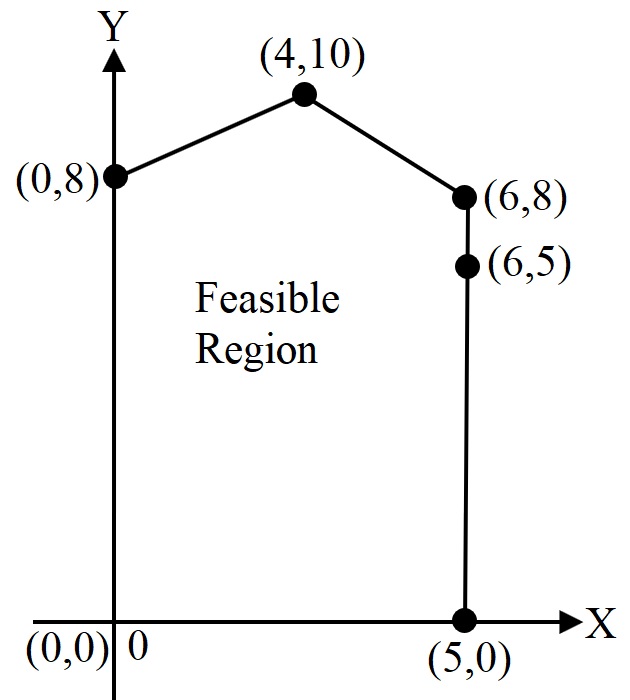
The feasible region for a LPP is shown shaded in the figure. Let Z = 3x - 4y be the objective function. Minimum of Z occurs at.

  1. (0, 0)
  2. (0, 8)
  3. (5, 0)
  4. (4, 10)
Answer
  1. (0, 8)
View full question & answer
Question 901 Mark
In Graphical solution the feasible solution is any solution to a LPP which satisfies.
  1. Only objective function.
  2. Non - negativity restriction.
  3. Only constraint.
  4. All the three
Answer
  1. Non - negativity restriction.

Solution:

The feasible region is the set of all the points that satisfy all the given constraints.

The variables of the linear programs must always take the non - negative values (i.e., $\text{x}\geq0$ and $\text{y}\geq0$).

These are used because x and y are usually the number of items produced and we cannot produce the negative number of items.

The least possible number of items could be zero.

Therefore, the feasible solution should satisfy the non - negativity restriction.

View full question & answer
Question 911 Mark
Which of the following is a type of Linear programming problem?
  1. Manufacturing problem
  2. Diet problem
  3. Transportation problems
  4. All of the above
Answer
  1. All of the above
View full question & answer
Question 921 Mark
If an iso-profit line yielding the optimal solution coincides with a constaint line, then:
  1. The solution is unbounded
  2. The solution is infeasible
  3. The constraint which coincides is redundant
  4. None of the above
Answer
  1. None of the above

Solution:

If an iso profit line which is yielding the optimal solution coincide with a constant line; then

→ the solution will b bounded, i.e there will be a definite bounded area where the solution would be optional.

→ Since the area is bounded,the solution is feasible

→ And the constant which coincides is not a redundant

Hence None of above is the answer.

View full question & answer
Question 931 Mark
The Convex Polygon Theorem states that the optimum (maximum or minimum) solution of a LPP is attained at atleastone of the ______ of the convex set over which the solution is feasible.
  1. Origin
  2. Corner points
  3. Centre
  4. Edge
Answer
  1. Corner points

Solution:

The fundamental theorem of programming (i.e., Convex Polygon Theorem) states that the optimum value(maximum or minimum) of a linear programming problem over a convex region occur at the corner points.

View full question & answer
Question 941 Mark
The solution of the set of constraints of a linear programming problem is a convex (open or closed) is called ______ region.
  1. Feasible
  2. Active
  3. Linear
  4. None of these
Answer
  1. Feasible

Solution:

Our experts are building a solution for this.

View full question & answer
Question 951 Mark
Given a system of inequation: $2\text{y}-\text{x}\leq4$ $-2\text{x}+\text{y}\geq-4$Find the value of s, which is the greatest possible sum of the x and y co - ordinates of the point which satisfies the following inequalities as graphed in the xy plane.
  1. 8
  2. 12
  3. 2
  4. 4
Answer
  1. 8

Solution:

First, rewrite each equation, so that it is in the slope - intercept form of a line, which is y = mx + b, where mm is the slope and b is the y - intercept of the line.

The first equation becomes 2y < x + 4 or $\text{y}\leq\frac{1}{2}\text{x}+2.$

The second equation becomes $\text{y}\geq2\text{x}-4.$

The greatest x + y is the point at which the two lines intersect.

Set the equations of the two lines, $\text{y}=\frac{1}{2}\text{x}+2$ and y = 2x - 4, equal to each other and solve for x.

The resulting equation is $\text{y}=\frac{1}{2}\text{x}+2$ 

and y = 2x - 4.

Solve for x to get $\text{y}=\frac{3}{-2}\text{x}+2=-4$ or $\frac{3}{-2}\text{x}=-6,$

$\Rightarrow\text{x}=4$

Next, plug 4 into one of the two equations to solve for y.

Therefore, y = 2(4) - 4 = 4 and x + y = 4 + 4 = 8.

View full question & answer
Question 961 Mark
Directions: In the following questions, the Assertions (A) and Reason(s) (R) have been put forward. Read both the statements carefully and choose the correct alternative from the following:
Assertion (A): Assertion (A):For an objective function Z= 15x + 20y, corner points are (0, 0), (10, 0), (0, 15) and (5, 5). Then optimal values are 300 and 0 respectively.
Reason (R): The maximum or minimum value of an objective function is known as optimal value of LPP. These values are obtained at corner points.
  1. Both A and R are true and R is the correct explanation of A
  2. Both A and R are true but R is NOT the correct explanation of A
  3. A is true but R is false.
  4. A is false but R is true.
Answer
  1. Both A and R are true and R is the correct explanation of A
View full question & answer
Question 971 Mark
Maximize Z = 11 x + 8y subject to $\text{x}\leq4,\text{y}\leq6,\text{x}+\text{y}\leq6,\text{x}\geq0,\text{y}\geq0.$
  1. 44 at (4, 2)
  2. 60 at (4, 2)
  3. 62 at (4, 0)
  4. 48 at (4, 2)
Answer
  1. 60 at (4, 2)
View full question & answer
Question 981 Mark
Which of the following is not a convex set?
  1. {(x, y) ; 2x + 5y ≤ 7}
  2. {(x, y) : x2 + y2 ≤ 4}
  3. {x : |x| = 5}
  4. {(x, y) : 3x2 + 2y2 ≤ 6}
Answer
  1. {x : |x| = 5}

Solution:

|x| = 5 is not a convex set as any two points from negative and positive x-axis if are joined will not lie in set.

View full question & answer
Question 991 Mark
In an LPP, if the objective function Z = ax + by has the same maximum value on two corner points of the feasible region, then the number of points of which Zmax occurs is:
  1. 0
  2. 2
  3. Finite
  4. Infinite
Answer
  1. Infinite
View full question & answer
Question 1001 Mark
If the constraints in a linear programming problem are changed:
  1. Solution is not defined.
  2. The objective function has to be modified.
  3. The problems is to be re - evaluated.
  4. None of these.
Answer
  1. The problems is to be re - evaluated.
View full question & answer
M.C.Q (1 Marks) - Page 2 - Maths STD 12 Science Questions - Vidyadip