Sample QuestionsMATRICES questions
One sample from each question group in this chapter. Select any group above to see the full set with answer keys.
If A is a square matrix of order 3 and |A| = 5, then the value of |2A'| is:
- -10
- 10
- -40
- 40
If A is a square matrix such that A
2 = A, then (I - A)
3 + A is equal to:
- I
- 0
- I - A
- I + A
If $\text{A} = \begin{bmatrix}\cos\alpha&-\sin\alpha\\ \sin\alpha&\cos\alpha\end{bmatrix},\text{then}\ \text{A + A}'=\text{I}$, if the value of a is:
- $\frac{\pi}{6}$
- $\frac{\pi}{3}$
- $\text{n}$
- $\frac{3\pi}{2}$
View full solution →If A, B are symmetric matrices of same order, then AB - BA is a
- Skew symmetric matrix.
- Symmetric matrix.
- Zero matrix.
- Identity matrix.
If n = p, then order of matrix 7X - 5Z is:
- p × 2
- 2 × n
- n × 3
- p × n
Directions: In the following questions, a statement of assertion (A) is followed by a statement of reason (R). Mark the correct choice as:
Assertion: If $\text{A}=\begin{pmatrix}1 & 2\\ 2& 3 \end{pmatrix}$ and $\text{B}=\begin{pmatrix}-1&4\\0&5\end{pmatrix}.$ (A + B)2 = A2 + 2AB + B2.
Reason: $\text{AB}\neq\text{BA}.$
- Both A and R are true and R is the correct explanation of A.
- Both A and R are true but R is not the correct explanation of A.
- A is true but R is false.
- A is false but R is true.
- Both A and R are false.
View full solution →Directions: In the following questions, a statement of assertion (A) is followed by a statement of reason (R). Mark the correct choice as:
Assertion: Let $\text{A}_{\theta}=\begin{pmatrix}\cos\theta+\sin\theta&\sqrt{2}\sin\theta\\-\sqrt{2}\sin\theta&\cos\theta-\sin\theta\end{pmatrix}\Big(\text{A}_{\frac{\pi}{3}}\Big)^{3}=-\text{I}.$
Reason: $\text{A}_{\theta}\cdot\text{A}_{\phi}=\text{A}_{\theta+\phi}.$
- Both A and R are true and R is the correct explanation of A.
- Both A and R are true but R is not the correct explanation of A.
- A is true but R is false.
- A is false but R is true.
- Both A and R are false.
View full solution →Directions: In the following questions, a statement of assertion (A) is followed by a statement of reason (R). Mark the correct choice as:
Assertion: If $\text{A}=\begin{pmatrix}0 & 2 & -1\\ -2 & 0 & 3 \\ 1& -3 & 0 \end{pmatrix},$ then A-1 is symmetric matrix.
Reason: If A is skew symmetric matrix then A-1 is skew symmetric matrix.
- Both A and R are true and R is the correct explanation of A.
- Both A and R are true but R is not the correct explanation of A.
- A is true but R is false.
- A is false but R is true.
- Both A and R are false.
View full solution →Directions: In the following questions, a statement of assertion (A) is followed by a statement of reason (R). Mark the correct choice as:
Assertion: $(\text{A}+\text{B})^{2}\neq\text{A}^{2}+2\text{AB}+\text{B}^{2}.$
Reason: Generally AB = BA.
- Both A and R are true and R is the correct explanation of A.
- Both A and R are true but R is not the correct explanation of A.
- A is true but R is false.
- A is false but R is true.
- Both A and R are false.
View full solution →Directions: In the following questions, a statement of assertion (A) is followed by a statement of reason (R). Mark the correct choice as:
Assertion: If A is a square matrix such that A
2 = I, then (I + A)
2 - 3A = I.
Reason: Al = IA = A, where I is Idetity matrix.
- Both A and R are true and R is the correct explanation of A.
- Both A and R are true but R is not the correct explanation of A.
- A is true but R is false.
- A is false but R is true.
- Both A and R are false.
Use elementary column operation $\text{C}_{2}\rightarrow\text{C}_{2} + 2\text{C}_{1}$ in the following matrix equation:
$ \begin{bmatrix} 2 & 1 \\ 2 & 0 \\ \end{bmatrix} = \begin{bmatrix} 3 & 1 \\ 2 & 0 \\ \end{bmatrix} \begin{bmatrix} 1 & 0 \\ -1 & 1 \\ \end{bmatrix} $
View full solution →Write the number of all possible matrices of order $2\times2$ with each entry 1, 2 or 3.
View full solution →If for any $2 \times 2$ square matrix A, A(adj A) $= \begin{bmatrix} 8 & 0 \\ 0 & 8 \end{bmatrix},$ then write the value of |A|.
View full solution →If A is a square matrix such that A2 = A, then write the value of 7A – (I + A)3, where I is an identity matrix.
If $\text{A} = \begin{bmatrix} \\cos\theta & \sin\theta & \\ -\sin\theta & \cos\theta & \\ \end{bmatrix}, $ then for any natural number n, find the value of Det $(A^{n}).$
View full solution →If A is a skew-symmetric matrix of order 3, then prove that det A = 0.
If A and B are square matrices of order 3 such that |A| = – 1, |B| = 3, then find the value of |2AB|.
Show that all the diagonal elements of a skew symmetric matrix are zero.
Given $\text{A}=\begin{bmatrix}2 & -3 \\-4 & 7 \end{bmatrix},$ compute A-1 and show that 2A-1 = 9I – A.
View full solution →Find a matrix A such that 2A - 3B + 5C = O, where $\text{B}=\begin{bmatrix}-2 & 2 & 0 \\3 & 1 & 4 \end{bmatrix}$ and $\text{C}=\begin{bmatrix}2 & 0 & -2 \\7 & 1 & 6\end{bmatrix}.$
View full solution →Express the matrix $\begin{bmatrix} 0 & \frac{9}{2} & \frac{9}{2} \\ -\frac{9}{2} & 0 & -\frac{3}{2} \\ -\frac{9}{2} & \frac{3}{2} & 0 \end{bmatrix} $ as the sum of a symmetric and skew symmetric matrix.
View full solution →Express the following matrix as the sum of a symmetric and a skew symmetric matrix: $ \begin{bmatrix} 1 & 3 & 5 \\ - 6 & 8 & 3 \\ - 4 & 6 & 5 \end{bmatrix} $
View full solution →Find the matrix A such that
$\begin{bmatrix}2&-1\\1&0\\-3&4\end{bmatrix}\text{A}=\begin{bmatrix}-1&-8&-10\\1&-2&-5\\9&22&15\end{bmatrix}$
View full solution →If $\text{A}=\begin{bmatrix}\cos\text{x}&\sin\text{x}\\-\sin\text{x}&\cos\text{x}\end{bmatrix},$ find x satisfying $0<\text{x}<\frac{\pi}{2}$ when A + AT = I
View full solution →Given: $3\begin{bmatrix}x & y \\z & w \end{bmatrix} = \begin{bmatrix}x & 6 \\-1 & 2w \end{bmatrix} + \begin{bmatrix}4 & x + y \\z + w & 3 \end{bmatrix},$ find the values of x, y, z and w.
View full solution →Find matrix A such that
$\begin{pmatrix} 2 & -1 \\ 1 & 0 \\ -3 & 4 \end{pmatrix}\text{A} = \begin{pmatrix} -1 & -8 \\ 1 & -2 \\ 9 & 22 \end{pmatrix}$
View full solution →If A = $\begin{bmatrix} 2 & -3 & 5 \\ 3 & 2 &-4 \\ 1 & 1 & -2 \end{bmatrix} $, then find A–1 and hence solve the system of linear equations 2x – 3y + 5z = 11, 3x + 2y – 4z = – 5 and x + y – 2z = – 3.
View full solution →$\text{If A} = \begin{bmatrix} 0 & 6 & 7 \\ -6 & 0 & 8 \\ 7 & -8 & 0 \end{bmatrix}, \text{B} = \begin{bmatrix} 0 & 1 & 1 \\ 1 & 0 & 2 \\ 1 & 2 & 0 \end{bmatrix}, \text{C} = \begin{bmatrix} 2 \\ -2 \\ 3 \end{bmatrix},$ then calculate AC, BC and (A + B) C. Also verify that (A + B) C = AC + BC.
View full solution →Using elementary row operations (transformations), find the inverse of the following matrix:
$\begin{bmatrix} 0 & 1 & 2 \\ 1 & 2 & 3 \\ 3 & 1 & 0 \end{bmatrix}$
View full solution →Using properties of determinants, prove that
$\begin{vmatrix} \text{a}^2+2\text{a}& 2\text{a}+1 & 1\\[0.3em] 2\text{a}+1 & \text{a}+2 & 1 \\[0.3em] 3 & 3 & 1 \end{vmatrix}=(\text{a}-1)^3$
View full solution →Two farmers Shyam and Balwan Singh cultivate only three varieties of pulses namely Urad, Masoor and Mung. The sale (in ₹) of these varieties of pulses by both the farmers in the month of September and October are given by the following matrices A and B.
September sales (in ₹)
$\begin{matrix}\ \ \ \ \ \ \ \ \ \ \text{Urad}&\text{Masoor}&\text{Mung}\end{matrix}\\\text{A}=\begin{bmatrix}10000&20000&30000\\50000&30000&10000\end{bmatrix}\begin{matrix}\text{Shayam}\\\text{Balwan singh}\end{matrix}$
October sales (in ₹)
$\begin{matrix}\ \ \ \ \ \ \ \ \ \ \text{Urad}&\text{Masoor}&\text{Mung}\end{matrix}\\\text{B}=\begin{bmatrix}10000&20000&30000\\50000&30000&10000\end{bmatrix}\begin{matrix}\text{Shayam}\\\text{Balwan singh}\end{matrix}$
Using algebra of matrices, answer the following questions.
- The combined sales of Masoor in September and October, for farmer Balwan Singh, is:
- ₹ 80000
- ₹ 90000
- ₹ 40000
- ₹ 135000
- The combined sales of Urad in September and October, for farmer Shyam is:
- ₹ 20000
- ₹ 30000
- ₹ 36000
- ₹ 15000
- Find the decrease in sales of Mung from September to October, for the farmer Shyam.
- ₹ 24000
- ₹ 10000
- ₹ 30000
- No change
- If both farmers receive 2% profit on gross sales, compute the profit for each farmer and for each variety sold in October.
- $\begin{matrix} \ \text{Urad}&\text{Masoor}&\text{Mung}\end{matrix}\\\begin{bmatrix}100&\ \ \ \ \ \ 200&\ \ \ \ \ 220\\400&\ \ \ \ \ \ 300&\ \ \ \ \ 200\end{bmatrix}\begin{matrix}\text{Shayam}\\\text{Balwan singh}\end{matrix}$
- $\begin{matrix} \ \text{Urad}&\text{Masoor}&\text{Mung}\end{matrix}\\\begin{bmatrix}100&\ \ \ \ \ \ 200&\ \ \ \ \ 120\\400&\ \ \ \ \ \ 200&\ \ \ \ \ 200\end{bmatrix}\begin{matrix}\text{Shayam}\\\text{Balwan singh}\end{matrix}$
- $\begin{matrix} \ \text{Urad}&\text{Masoor}&\text{Mung}\end{matrix}\\\begin{bmatrix}150&\ \ \ \ \ \ 200&\ \ \ \ \ 220\\400&\ \ \ \ \ \ 200&\ \ \ \ \ 280\end{bmatrix}\begin{matrix}\text{Shayam}\\\text{Balwan singh}\end{matrix}$
- $\begin{matrix} \ \text{Urad}&\text{Masoor}&\text{Mung}\end{matrix}\\\begin{bmatrix}100&\ \ \ \ \ \ 200&\ \ \ \ \ 120\\250&\ \ \ \ \ \ 200&\ \ \ \ \ 220\end{bmatrix}\begin{matrix}\text{Shayam}\\\text{Balwan singh}\end{matrix}$
- Which variety of pulse has the highest selling value in the month of September for the farmer Balwan Singh?
- Urad
- Masoor
- Mung
- All of these have the same price
View full solution →In a city there are two factories A and B. Each factory produces sports clothes for boys and girls. There are three types of clothes produced in both the factories, type I, II and III. For boys the number of units of types I, II and III respectively are 80, 70 and 65 in factory A and 85, 65 and 72 are in factory B. For girls the number of units of types I, II and III respectively are 80, 75, 90 in factory A and 50, 55, 80 are in factory B.

Based on the above information, answer the following questions:
- If P represents the matrix of number of units of each type produced by factory A for both boys and girls, then P is given by:
- $\begin{matrix}&\text{Boys}&\text{Girls}\end{matrix}\\\begin{matrix}\text{I}\\\text{II}\\\text{III}\end{matrix}\begin{bmatrix}85&50\\65&55\\72&80\end{bmatrix}$
- $\begin{matrix}&&&\text{I}\ \ \ &\text{II}&\text{III}\end{matrix}\\\begin{matrix}\text{Boys}\\\text{Girls}\end{matrix}\begin{bmatrix}50&55&80\\85&65&72\end{bmatrix}$
- $\begin{matrix}&&&\text{I}\ \ \ &\text{II}&\text{III}\end{matrix}\\\begin{matrix}\text{Boys}\\\text{Girls}\end{matrix}\begin{bmatrix}80&75&90\\80&70&65\end{bmatrix}$
- $\begin{matrix}&\text{Boys}&\text{Girls}\end{matrix}\\\begin{matrix}\text{I}\\\text{II}\\\text{III}\end{matrix}\begin{bmatrix}80&80\\70&75\\65&90\end{bmatrix}$
- If Q represents the matrix of number of units of each type produced by factory B for both boys and girls, then Q is given by:
- $\begin{matrix}&\text{Boys}&\text{Girls}\end{matrix}\\\begin{matrix}\text{I}\\\text{II}\\\text{III}\end{matrix}\begin{bmatrix}85&50\\65&55\\72&80\end{bmatrix}$
- $\begin{matrix}&&&\text{I}\ \ \ &\text{II}&\text{III}\end{matrix}\\\begin{matrix}\text{Boys}\\\text{Girls}\end{matrix}\begin{bmatrix}80&75&90\\80&70&65\end{bmatrix}$
- $\begin{matrix}&&&\text{I}\ \ \ &\text{II}&\text{III}\end{matrix}\\\begin{matrix}\text{Boys}\\\text{Girls}\end{matrix}\begin{bmatrix}80&75&90\\80&70&65\end{bmatrix}$
- $\begin{matrix}&\text{Boys}&\text{Girls}\end{matrix}\\\begin{matrix}\text{I}\\\text{II}\\\text{III}\end{matrix}\begin{bmatrix}80&80\\70&75\\65&90\end{bmatrix}$
- The total production of sports clothes of each type for boys is given by the matrix.
-
$\begin{matrix}\ \ \text{I}&\ \ \ \ \text{II}&\ \ \ \text{III}\end{matrix}\\\begin{matrix}[165&130&137]\end{matrix}\\$
-
$\begin{matrix}\ \ \text{I}&\ \ \ \ \text{II}&\ \ \ \text{III}\end{matrix}\\\begin{matrix}[130&165&137]\end{matrix}\\$
-
$\begin{matrix}\ \ \text{I}&\ \ \ \ \text{II}&\ \ \ \text{III}\end{matrix}\\\begin{matrix}[165&135&137]\end{matrix}\\$
-
$\begin{matrix}\ \ \text{I}&\ \ \ \ \text{II}&\ \ \ \text{III}\end{matrix}\\\begin{matrix}[137&135&165]\end{matrix}\\$
- The total production of sports clothes of each type for girls is given by the matrix.
- $\begin{matrix}\ \ \text{I}&\ \ \ \ \text{II}&\ \ \ \text{III}\end{matrix}\\\begin{matrix}[130&130&170]\end{matrix}\\$
- $\begin{matrix}\ \ \text{I}&\ \ \ \ \text{II}&\ \ \ \text{III}\end{matrix}\\\begin{matrix}[170&130&130]\end{matrix}\\$
- $\begin{matrix}\ \ \text{I}&\ \ \ \ \text{II}&\ \ \ \text{III}\end{matrix}\\\begin{matrix}[130&170&130]\end{matrix}\\$
- None of these
- Let R be a 3 × 2 matrix that represent the total production of sports dothes of each type for boys and girls, then transpose of R is:
- $\begin{bmatrix}165 & 135 & 137\\130 & 130 & 170 \end{bmatrix}$
- $\begin{bmatrix}130 & 130 & 170\\165 & 135 & 138 \end{bmatrix}$
- $\begin{bmatrix}165 & 132 \\135 & 130 \\137 & 170 \end{bmatrix}$
- $\begin{bmatrix}130 & 168 \\130 & 135 \\170 & 137 \end{bmatrix}$
View full solution →Three schools A, B and C organized a mela for collecting funds for helping the rehabilitation of flood victims. They sold hand made fans, mats and plates from recycled material at a cost of ₹ 25, ₹ 100 and ₹ 50 each. The number of articles sold by school A, B, C are given below.

| Article | School |
| A | B | C |
| Fans | 40 | 25 | 35 |
| Mats | 50 | 40 | 50 |
| Plates | 20 | 30 | 40 |
Based on above information, answer the following questions.
- If P be a 3 × 3 matrix represent the sale of handmade fans, mats and plates by three schools A, B and C, then
- $\begin{matrix}& \ \ \ \ \ \ \ \ \ \ \text{Fans}&\text{Mats}&\text{Plates}\end{matrix}\\\begin{matrix}\ \ \ \ \ \ \ \ \ \ \text{A}\\\text{P}\ =\text{B}\\\ \ \ \ \ \ \ \ \ \ \text{C}\end{matrix}\begin{bmatrix} \ \ 40 \ \ \ & 50 & \ \ \ \ \ 25\\25 & 40 & \ \ \ \ \ 30\\35& \ 50& \ \ \ \ \ 40\end{bmatrix}$
- $\begin{matrix}& \ \ \ \ \ \ \ \ \ \ \text{Fans}&\text{Mats}&\text{Plates}\end{matrix}\\\begin{matrix}\ \ \ \ \ \ \ \ \ \ \text{A}\\\text{P}\ =\text{B}\\\ \ \ \ \ \ \ \ \ \ \text{C}\end{matrix}\begin{bmatrix} \ \ 25 \ \ \ & 40 & \ \ \ \ \ 20\\35 & 40 & \ \ \ \ \ 30\\40& \ 50& \ \ \ \ \ 20\end{bmatrix}$
- $\begin{matrix}& \ \ \ \ \ \ \ \ \ \ \text{Fans}&\text{Mats}&\text{Plates}\end{matrix}\\\begin{matrix}\ \ \ \ \ \ \ \ \ \ \text{A}\\\text{P}\ =\text{B}\\\ \ \ \ \ \ \ \ \ \ \text{C}\end{matrix}\begin{bmatrix} \ \ 40 \ \ \ & 25 & \ \ \ \ \ 35\\50 & 40 & \ \ \ \ \ 50\\20& \ 30& \ \ \ \ \ 40\end{bmatrix}$
- $\begin{matrix}& \ \ \ \ \ \ \ \ \ \ \text{Fans}&\text{Mats}&\text{Plates}\end{matrix}\\\begin{matrix}\ \ \ \ \ \ \ \ \ \ \text{A}\\\text{P}\ =\text{B}\\\ \ \ \ \ \ \ \ \ \ \text{C}\end{matrix}\begin{bmatrix} \ \ 25 \ \ \ & 35 & \ \ \ \ \ 40\\40 & 40 & \ \ \ \ \ 50\\20& \ 30& \ \ \ \ \ 20\end{bmatrix}$
- If Q be a 3 x 1 matrix represent the sale prices (in ₹) of given products per unit, then
- $\text{Q}=\begin{bmatrix}25\\50\\100\end{bmatrix}\begin{matrix}\text{Fans}\\\text{Mats}\\\text{Plates}\end{matrix}$
- $\begin{matrix}\ \ \ \ \ \ \text{Fans}&\text{Mats}&\text{Plates}\end{matrix}\\\text{Q}=\begin{matrix}[25\ \ \ &50&\ \ \ 100]\end{matrix}\\$
- $\begin{matrix}\ \ \ \ \ \ \text{Fans}&\text{Mats}&\text{Plates}\end{matrix}\\\text{Q}=\begin{matrix}[25\ \ \ &100&\ \ \ 50]\end{matrix}\\$
- $\text{Q}=\begin{bmatrix}25\\100\\50\end{bmatrix}\begin{matrix}\text{Fans}\\\text{Mats}\\\text{Plates}\end{matrix}$
- The funds collected by school A by selling the given articles is:
- ₹ 7000
- ₹ 6125
- ₹ 7875
- ₹ 8000
- The funds collected by school B by selling the given articles is:
- ₹ 5125
- ₹ 6125
- ₹ 7125
- ₹ 8125
- The total funds collected for the required purpose is:
- ₹ 20000
- ₹ 21000
- ₹ 30000
- ₹ 35000
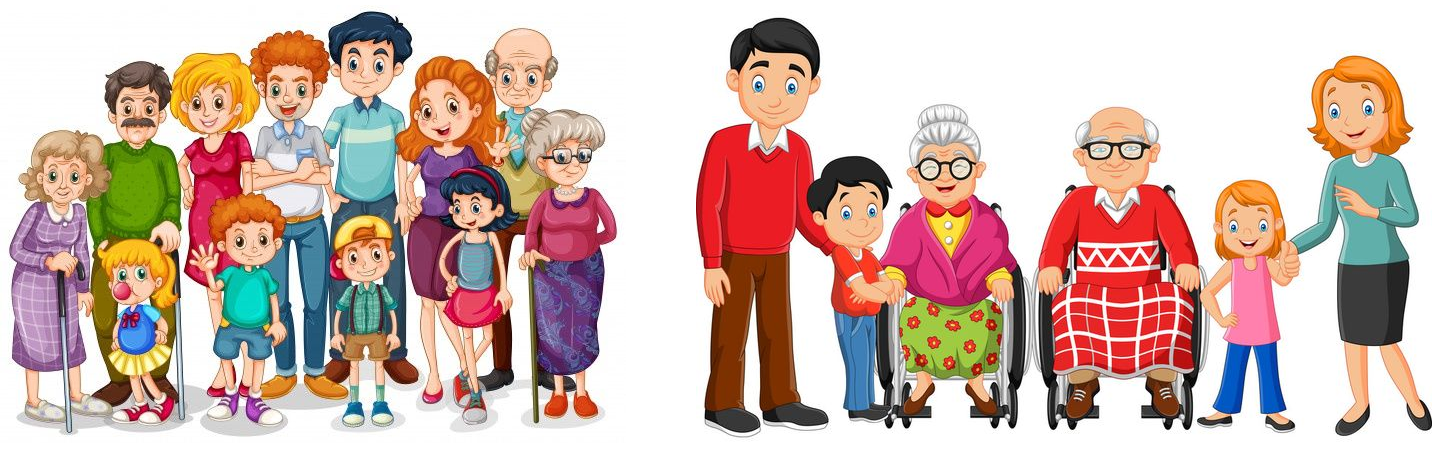
View full solution →Consider 2 families A and B. Suppose there are 4 men,4 women and 4 children in family A and 2 men, 2 women and 2 children in family B. The recommend daily amount of calories is 2400 for a man, 1900 for a woman, 1800 for a children and 45 grams of proteins for a man, 55 grams for a woman and 33 grams for children.
Based on the above information, answer the following questions.
- The requirement of calories and proteins for each person in matrix form can be represented as:
- $\begin{matrix}& \ \ \ \ \ \ \ \ \ \ \ \ \ \text{Calorise}&\text{Proteins}\end{matrix}\\\begin{matrix}\text{Man}\\\text{Woman}\\\text{Children}\end{matrix}\begin{bmatrix} \ \ 2400 \ \ \ & 45\\1900 & 55\\1800& \ 33&\end{bmatrix}$
- $\begin{matrix}& \ \ \ \ \ \ \ \ \ \ \ \ \ \text{Calorise}&\text{Proteins}\end{matrix}\\\begin{matrix}\text{Man}\\\text{Woman}\\\text{Children}\end{matrix}\begin{bmatrix} \ \ 1900 \ \ \ & 55\\2400 & 45\\1800& \ 33&\end{bmatrix}$
- $\begin{matrix}& \ \ \ \ \ \ \ \ \ \ \ \ \ \text{Calorise}&\text{Proteins}\end{matrix}\\\begin{matrix}\text{Man}\\\text{Woman}\\\text{Children}\end{matrix}\begin{bmatrix} \ \ 1800 \ \ \ & 33\\1900 & 55\\2400& \ 45&\end{bmatrix}$
- $\begin{matrix}& \ \ \ \ \ \ \ \ \ \ \ \ \ \text{Calorise}&\text{Proteins}\end{matrix}\\\begin{matrix}\text{Man}\\\text{Woman}\\\text{Children}\end{matrix}\begin{bmatrix} \ \ 2400 \ \ \ & 33\\1900 & 55\\1800& \ 45&\end{bmatrix}$
- Requirement of calories of family A is:
- 24000
- 24400
- 15000
- 15800
- Requirement of proteins for family B is:
- 560 grams
- 332 grams
- 266 grams
- 300 grams
- If A and Bare two matrices such that AB = B and BA = A, then A2 + B2 equals.
- 2AB
- 2BA
- A + B
- AB
- If $\text{A}=(\text{a}_\text{ij})_{\text{m}\times\text{n}},\ \ \text{B}=(\text{b}_\text{ij})_{\text{n}\times\text{p}}$ and $\text{C}=(\text{c}_\text{ij})_{\text{p}\times\text{q}}$ then the product (BC) A is possible only when.
- m = q
- n = q
- p = q
- m = p
View full solution →To promote the making of toilets for women, an organisation tried to generate awareness through (i) house call (ii) emails and (iii) announcements. The cost for each mode per attempt is given below:

- ₹ 50
- ₹ 20
- ₹ 40
The number of attempts made in the villages X, Y and Z are given below:
| | (i) | (ii) | (iii) |
| X | 400 | 300 | 100 |
| Y | 300 | 250 | 75 |
| Z | 500 | 400 | 150 |
Also, the chance of making of toilets corresponding to one attempt of given modes is:
- 2%
- 4%
- 20%
Based on the above information, answer the following questions.
- The cost incurred by the organisation on village X is:
- ₹ 10000
- ₹ 15000
- ₹ 30000
- ₹ 20000
- The cost incurred by the organisation on village Y is:
- ₹ 25000
- ₹ 18000
- ₹ 23000
- ₹ 28000
- The cost incurred by the organisation on village Z is:
- ₹ 19000
- ₹ 39000
- ₹ 45000
- ₹ 50000
- The total number of toilets that can be expected after the promotion in village X, is:
- 20
- 30
- 40
- 50
- The total number of toilets that can be expected after the promotion in village Z, is
- 56
- 26
- 36
- 46