Questions

2 Marks Questions

🎯

Test yourself on this topic

7 questions · timed · auto-graded

Question 12 Marks
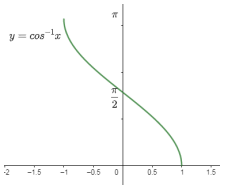
Write the interval for the principal value of function and draw its graph: $\cos ^{-1} x$.
Answer
Principal value branch of $\cos ^{-1} x$ is $[0, \pi]$ and its graph is shown here,
Image
View full question & answer
Question 22 Marks
Find the matrix $X$ for which: $\left[\begin{array}{ll}3 & 2 \\ 7 & 5\end{array}\right] X\left[\begin{array}{ll}-1 & 1 \\ -2 & 1\end{array}\right]=\left[\begin{array}{ll}2 & -1 \\ 0 & 4\end{array}\right]$
Answer
$
\text { Let } A=\left[\begin{array}{ll}
3 & 2 \\
7 & 5
\end{array}\right] B=\left[\begin{array}{cc}
-1 & 1 \\
-2 & 1
\end{array}\right] C=\left[\begin{array}{cc}
2 & -1 \\
0 & 4
\end{array}\right]
$
Then The given equation becomes as
$
\begin{array}{l}
AXB=C \\
\Rightarrow X=A^{-1} CB^{-1} \\
\text { how }|A|=35-14=21 \\
\text { and }|B|=-1+2=1
\end{array}
$
$
\begin{array}{l}
A^{-1}=\frac{\operatorname{adj}(A)}{|A|}=\frac{1}{21}\left[\begin{array}{cc}
5 & -2 \\
-7 & 3
\end{array}\right] \\
\text { and } B^{-1}=\frac{a d(B)}{|B|}=\frac{1}{1}\left[\begin{array}{cc}
1 & -1 \\
2 & -1
\end{array}\right]
\end{array}
$
$
\begin{array}{l}
\Rightarrow X=A^{-1} CB^{-1}=\frac{1}{21}\left[\begin{array}{cc}
5 & -2 \\
-7 & 3
\end{array}\right]\left[\begin{array}{cc}
2 & -1 \\
0 & 4
\end{array}\right]\left[\begin{array}{ll}
1 & -1 \\
2 & -1
\end{array}\right] \\
=\frac{1}{21}\left[\begin{array}{cc}
10+0 & -5-8 \\
-14+0 & 7+12
\end{array}\right]\left[\begin{array}{ll}
1 & -1 \\
2 & -1
\end{array}\right] \\
=\frac{1}{21}\left[\begin{array}{cc}
10 & -13 \\
-14 & 19
\end{array}\right]\left[\begin{array}{cc}
1 & -1 \\
2 & -1
\end{array}\right] \\
=\frac{1}{21}\left[\begin{array}{cc}
10-26 & -10+13 \\
-14+38 & 14-19
\end{array}\right]
\end{array}
$
Hence, $x=\frac{1}{21}\left[\begin{array}{cc}-16 & 3 \\ 24 & -5\end{array}\right]$
View full question & answer
Question 32 Marks
Integrate the function: $\frac{1}{9 x^2+6 x+5}$
Answer
Clearly, $9 x^2+6 x+5=(3 x+1)^2+(2)^2$
$\Rightarrow \int \frac{1}{9 x^2+6 x+5} d x=\int \frac{1}{(3 x+1)^2+(2)^2} d x$
Let $3 x +1= t$
$\Rightarrow 3 dx=dt$
$\therefore \int \frac{1}{(3 x+1)^2+(2)^2} d x=\frac{1}{3} \int \frac{1}{t^2+2^2} d t$
$=\frac{1}{3}\left[\frac{1}{2} \tan ^{-1}\left(\frac{t}{2}\right)\right]+C$
$=\frac{1}{6} \tan ^{-1}\left(\frac{3 x+1}{2}\right)+C$
View full question & answer
Question 42 Marks
Show that the function given by $f(x)=\sin x$ is neither increasing nor decreasing in $(0, \pi)$
Answer
The function is $f(x)=\sin x$
Then, $f^{\prime}(x)=\cos x$
Since for each $x \in\left(0, \frac{\pi}{2}\right), \cos x >0$, we have $f^{\prime}(x)>0$
Therefore, $f$ is strictly increasing in $\left(0, \frac{\pi}{2}\right)$.
Now, The function is $f ( x )=\sin x$
Then, $f^{\prime}(x)=\cos x$
Since, for each $x \in\left(\frac{\pi}{2}, \pi\right), \cos x <0$, we have $f^{\prime}(x)<0$
Therefore, $f$ is strictly decreasing in $\left(\frac{\pi}{2}, \pi\right) \ldots . .(2)$
From (1) and (2),
It is clear that f is neither increasing nor decreasing in $(0, \pi)$.
View full question & answer
Question 52 Marks
Show that $f(x)=\cos \left(2 x+\frac{\pi}{4}\right)$ is an increasing function on $\left(\frac{3 \pi}{8}, \frac{7 \pi}{8}\right)$
View full question & answer
Question 62 Marks
A particle moves along the curve $6 y=x^3+2$. Find the points on the curve at which $y-$coordinates is changing $2$ times as fast as $x -$ coordinates.
Answer
Given curve is$,$
$6 y=x^3+2$
$\Rightarrow 6 \frac{d y}{d t}=3 x^2 \cdot \frac{d x}{d t} \ldots$
Given: $\frac{d y}{d t}=2 \cdot \frac{d x}{d t} \ldots (ii)$
from $(i)$ and $(ii),$
$2\left(2 \frac{d x}{d i}\right)=x^2 \cdot \frac{d x}{d x}$
$\Rightarrow x= \pm 2$
when $x=2, y=\frac{5}{3}$; when $x=-2, y=-1$
Therefore$,$ Points are $\left(2, \frac{5}{3}\right)$ and $(-2,-1)$
View full question & answer
Question 72 Marks
Find the value of $\cos ^{-1} \frac{1}{2}+2 \sin ^{-1} \frac{1}{2}$.
Answer
Let $\cos ^{-1}\left(\frac{1}{2}\right)=x$. Then, $\cos x=\frac{1}{2}=\cos \left(\frac{\pi}{3}\right)$.
$\therefore \cos ^{-1}\left(\frac{1}{2}\right)=\frac{\pi}{3}$
Let $\sin ^{-1}\left(\frac{1}{2}\right)=y$. Then, $\sin y=\frac{1}{2}=\sin \left(\frac{\pi}{6}\right)$.
$\therefore \sin ^{-1}\left(\frac{1}{2}\right)=\frac{\pi}{6}$
$\therefore \cos ^{-1}\left(\frac{1}{2}\right)+2 \sin ^{-1}\left(\frac{1}{2}\right)$
$=\frac{\pi}{3}+\frac{2 \pi}{6}$
$=\frac{\pi}{3}+\frac{\pi}{3}$
$=\frac{2 \pi}{3}$
View full question & answer