Questions

Case study (4 Marks)

🎯

Test yourself on this topic

3 questions · timed · auto-graded

Question 14 Marks
Read the following text carefully and answer the questions that follow:
Mrs. Maya is the owner of a high-rise residential society having $50$ apartments. When he set rent at $₹ 10000 $ month, all apartments are rented. If he increases rent by $₹ 250$ / month, one fewer apartment is rented. The maintenance cost for each occupied unit is $₹ 500$ / month.
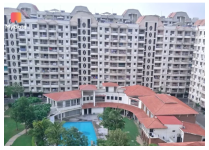
Image
$i.$ If $P$ is the rent price per apartment and $N$ is the number of rented apartments, then find the profit. $(1)$
$ii.$ If $x$ represents the number of apartments which are not rented, then express profit as a function of $x. (1)$
$iii.$ Find the number of apartments which are not rented so that profit is maximum. $(2)$
OR
Verify that profit is maximum at critical value of $x$ by second derivative test. $(2)$
Answer
$i.$ If $P$ is the rent price per apartment and $N$ is the number of rented apartments, the profit is given by $N P-500 N= N ( P -500)\ [ \because. ₹ 500 /$ month is the maintenance charge for each occupied unit$]$
$ii.$ Let $R$ be the rent price per apartment and $N$ is the number of rented apartments.
Now, if $x$ be the number of non $-$ rented apartments,
then $N(x)=50-x$ and $R(x)=10000+250 x$
Thus, profit $= P ( x )= NR =(50- x )(10000+250 x -500)$
$=(50-x)(9500+250 x)=250(50-x)(38+x)$
$iii$. We have, $P(x)=250(50-x)(38+x)$
Now, $P^{\prime}(x)=250[50-x-(38+x)]=250[12-2 x]$
For maxima/minima,
put $P ^{\prime}( x )=0$
$\Rightarrow 12-2 x=0$
$ \Rightarrow x=6$
Number of apartments are $6 $.
OR
$P^{\prime}(x)=250(12-2 x)$
$P^{\prime \prime}(x)=-500<0$
$\Rightarrow P ( x )$ is maximum at $x =6$
View full question & answer
Question 24 Marks
Read the following text carefully and answer the questions that follow:
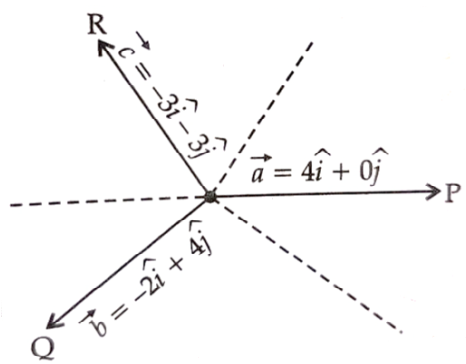
Team $P, Q, R$ went for playing a tug of war game. Teams $P, Q, R$ have attached a rope to a metal ring and is trying to pull the ring into their own areas $($team areas when in the given figure below$)$. Team $P$ pulls with force$F _1=4 \hat{i}+0 \hat{j} KN$
Team $Q$ pull with force $F _2=-2 \hat{i}+4 \hat{j} KN$
Team $R$ pulls with force $F _3=-3 \hat{i}-3 \hat{j} KN$
Image
$i$. What is the magnitude of the teams combined force? $(1)$
$ii$. Find the magnitude of Team $B. (1)$
$iii$. Which team will win the game? $(2)$
OR
Find the probability that she gets grade $A$ in at least one subject. $(2)$
Answer
$i$. Let $F$ be the combined force,
$ \therefore \vec{F}=\vec{F}_1+\vec{F}_2+\vec{F}_3$
$=(4 \hat{i}+0 \hat{j})+(-2 \hat{i}+4 \hat{j})+(-3 \hat{i}-3 \hat{j})$
$=(4-2-3) \hat{i}+(0+4-3) \hat{j}$
$=-\hat{i}+\hat{j}$
$\therefore \vec{F}\left|=\left|\sqrt{(-1)^2+1^2}\right|\right.$
$=|\sqrt{2}| KN $
$ii$. Magnitude of force of Team $B =$
$ \left|\vec{F}_2\right|=\left|\sqrt{(-2)^2+4^2}\right|=\sqrt{20} KN$
$=2 \sqrt{5} KN$
$\left|\vec{F}_2\right|=\left|\sqrt{(-2)^2+4^2}\right|=\sqrt{20} KN$
and $\left|\vec{F}_3\right|=\left|\sqrt{(-3)^2+(-3)^2}\right|=\sqrt{18} KN $
Here, the magnitude of force $F_2$ is greater,
therefore team $Q$ will win the game.
OR
we have, Combined force,$\vec{F}=-\hat{i}+\hat{j}$
$\therefore \theta \tan ^{-1}\left(\frac{F_y}{F_x}\right)=\tan ^{-1}\left(\frac{1}{-1}\right)$
$=\tan ^{-1}(1)$
$=\tan ^{-1}\left(\tan \frac{3 \pi}{4}\right)$
$=\frac{3 \pi}{4} \text { radians }$
View full question & answer
Question 34 Marks
Read the following text carefully and answer the questions that follow:
Shama is studying in class $XII$. She wants do graduate in chemical engineering. Her main subjects are mathematics, physics, and chemistry. In the examination, her probabilities of getting grade $A$ in these subjects are $0.2, 0.3,$ and $0.5$ respectively.
Image
$1$. Find the probability that she gets grade $A$ in all subjects.$ (1)$
$2.$ Find the probability that she gets grade $A$ in no subjects. $(1)$
$3$. Find the probability that she gets grade $A$ in two subjects. $(2)$
OR
Find the probability that she gets grade $A$ in at least one subject. $(2)$
Answer
$i. P\ ($Grade $A$ in Maths$) = P(M) = 0.2$
$P \ ($Grade $A$ in Physics$) = P(P) = 0.3$
$P\  ($Grade $A$ in Chemistry$) = P(C) = 0.5$
$ P\ ($not $A$ garde in Maths$) = P (\bar{M})=1-0.2=0.8$
$P\ ($ not $A$ garde in Physics $)= P (\bar{P})=1-0.3=0.7$
$P\ ( $ not $A$ garde in Chemistry $)= P (\bar{C})=1-0.5=0.5$
$P \ ($ getting grade  $A$  in all subjects $)= P ( M \cap P \cap C )$
$= P ( M ) \times P ( P ) \times P ( C )$
$=0.2 \times 0.3 \times 0.5=0.03$
$ii. P\ ($Grade $A $ in Maths$) = P(M) = 0.2$
$P\ ($Grade $A$ in Physics$) = P(P) = 0.3$
$P\ ($Grade $A$ in Chemistry$) = P(C) = 0.5$
$P\ ($ not $A$ garde in Maths $)= P (\bar{M})=1-0.2=0.8$
$P\ ($ not $A $ garde in Physics $)= P (\bar{P})=1-0.3=0.7$
$P\ ($ not $A$ garde in Chemistry $)= P (\bar{C})=1-0.5=0.5$
$P\ (\text{getting grade} A \text { in on subjects })=P(\bar{M} \cap \bar{P} \cap \bar{C})$
$=P\ (\bar{M}) \times P(\bar{P}) \times P(\bar{C})$
$=0.8 \times 0.7 \times 0.5=0.280$
$P\ ($Grade $A$ in Maths $)= P(M) = 0.2$
$P\ ($Grade $A$ in Physics$) = P(P) = 0.3$
$P\ ($Grade $A$ in Chemistry$) I = P(C) = 0.5$
$ P ($ not $A$ garde in Maths $)= P (\bar{M})=1-0.2=0.8$
$P ($ not $A$ garde in Physics $)= P (\bar{P})=1-0.3=0.7$
$P ($ not  $A$  garde in Chemistry $)= P (\bar{C})=1-0.5=0.5$
$P\ ($getting grade $A$ in $2$ subjects$)$
$\Rightarrow P (\text { grade } A \text { in } M \text { and } P \text { not in } C )+ P (\text { grade } A \text { in } P \ C \text { not in } M )+ P (\text { grade } A \text { in } M \ C \text { not in } P )$
$\Rightarrow P (M \cap P \cap \bar{C})+ P (P \cap C \cap \bar{M})+ P (M \cap C \cap \bar{P})$
$\Rightarrow 0.2 \times 0.3 \times 0.5+0.3 \times 0.5 \times 0.8+0.2 \times 0.5 \times 0.7=0.03+0.12+0.07$
$P\ ($getting grade $A$ in $2$ subjects$) = 0.22$
OR
$P\ ($Grade $A$ in Maths$) = P(M) = 0.2$
$P\ ($Grade $A$ in Physics$) = P(P) = 0.3$
$P\ ($Grade$ A$ in Chemistry $)= P(C) = 0.5$
$ P\ ($ not $A$ garde in Maths $)= P (\bar{M})=1-0.2=0.8$
$P \ ($ not $A$ garde in Physics $)= P (\bar{P})=1-0.3=0.7$
$P \ ($ not $A$ garde in Chemistry $)= P (\bar{C})=1-0.5=0.5$
$P\ ($getting grade $A$ in $1$ subjects$)$
$\Rightarrow P (\text { grade } A \text { in } M \text { not in } P \text { and } C )+ P (\text { grade } A \text { in } P \text { not in } M \text { and } C )+ P (\text { grade } A \text { in } C \text { not in } P \text { and } M )$
$\Rightarrow P (M \cap \bar{P} \cap \bar{C})+ P (P \cap \bar{C} \cap \bar{M})+ P (C \cap \bar{M} \cap \bar{P})$
$\Rightarrow 0.2 \times 0.7 \times 0.5+0.3 \times 0.5 \times 0.8+0.5 \times 0.8 \times 0.7=0.07+0.12+0.028$
$P \ ($ getting grade  $A$  in  $1$  subjects$) =0.47$
View full question & answer
Case study (4 Marks) - Maths STD 12 Science Questions - Vidyadip