Question 14 Marks
Read the following text carefully and answer the questions that follow:
A tank, as shown in the figure below, formed using a combination of a cylinder and a cone, offers better drainage as compared to a flat bottomed tank.
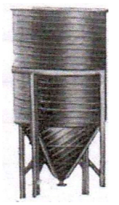
A tap is connected to such a tank whose conical part is full of water. Water is dripping out from a tap at the
bottom at the uniform rate of $2 \ cm^3 / s$. The semi $-$ vertical angle of the conical tank is $45^{\circ}$.
$i$. Find the volume of water in the tank in terms of its radius $r. \ (1)$
$ii$. Find rate of change of radius at an instant when $r =2 \sqrt{2} \ cm. (1)$
$iii$. Find the rate at which the wet surface of the conical tank is decreasing at an instant when radius $r =2 \sqrt{2} \ cm.(2)$
OR
Find the rate of change of height h at an instant when slant height is $4 \ cm. (2)$
A tank, as shown in the figure below, formed using a combination of a cylinder and a cone, offers better drainage as compared to a flat bottomed tank.
A tap is connected to such a tank whose conical part is full of water. Water is dripping out from a tap at the
bottom at the uniform rate of $2 \ cm^3 / s$. The semi $-$ vertical angle of the conical tank is $45^{\circ}$.
$i$. Find the volume of water in the tank in terms of its radius $r. \ (1)$
$ii$. Find rate of change of radius at an instant when $r =2 \sqrt{2} \ cm. (1)$
$iii$. Find the rate at which the wet surface of the conical tank is decreasing at an instant when radius $r =2 \sqrt{2} \ cm.(2)$
OR
Find the rate of change of height h at an instant when slant height is $4 \ cm. (2)$
Answer
View full question & answer→$i. v=\frac{1}{3} \pi r^2 h=\frac{1}{3} \pi r ^3\ ($as $\theta=45^{\circ}$ gives $r = h )$
$ii. \frac{dv}{dt}=\pi r^2 \frac{dr}{dt}$
$\Rightarrow\left(\frac{dr}{dt}\right)_{r=2 \sqrt{2}}=-\frac{1}{4 \pi} \ cm / \sec$
$iii. C=\pi rl=\pi r \sqrt{2} r=\sqrt{2} \pi r^2$
$\frac{dC}{dt}=\sqrt{2} \pi 2 r \frac{dr}{dt}$
$\left(\frac{dC}{dt}\right)_{r=2 \sqrt{2}}=-2 \ cm^2 / \sec$
$\text { OR }$
$l^2=h^2+r^2$
$I=4 $
$\Rightarrow r=h=2 \sqrt{2}$
$h=r $
$\Rightarrow \frac{dh}{dt}$
$=\frac{dr}{dt}=-\frac{1}{4 \pi} \ cm / \sec$
$ii. \frac{dv}{dt}=\pi r^2 \frac{dr}{dt}$
$\Rightarrow\left(\frac{dr}{dt}\right)_{r=2 \sqrt{2}}=-\frac{1}{4 \pi} \ cm / \sec$
$iii. C=\pi rl=\pi r \sqrt{2} r=\sqrt{2} \pi r^2$
$\frac{dC}{dt}=\sqrt{2} \pi 2 r \frac{dr}{dt}$
$\left(\frac{dC}{dt}\right)_{r=2 \sqrt{2}}=-2 \ cm^2 / \sec$
$\text { OR }$
$l^2=h^2+r^2$
$I=4 $
$\Rightarrow r=h=2 \sqrt{2}$
$h=r $
$\Rightarrow \frac{dh}{dt}$
$=\frac{dr}{dt}=-\frac{1}{4 \pi} \ cm / \sec$