Question 11 Mark
An electronic assembly consists of two subsystems, say, A and B. From previous testing procedures, the following probabilities are assumed to be known:
P(A fails) = 0.2
P(B fails alone) = 0.15
P(A and B fail) = 0.15
Evaluate the following probabilities P(A fails alone).
P(A fails) = 0.2
P(B fails alone) = 0.15
P(A and B fail) = 0.15
Evaluate the following probabilities P(A fails alone).
Answer
View full question & answer→Let us define events;
A : A fails. and B : B fails.
Given: P (A) = 0.2
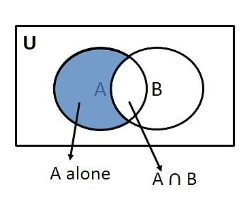
Event failed by both, $P\left(A \cap B\right)$ = 0.15
We have,
P(A fails alone) = P(A) - $P\left(A \cap B\right)$
= 0.2 - 0.15
= 0.05
A : A fails. and B : B fails.
Given: P (A) = 0.2
Event failed by both, $P\left(A \cap B\right)$ = 0.15
We have,
P(A fails alone) = P(A) - $P\left(A \cap B\right)$
= 0.2 - 0.15
= 0.05