Questions

3 Marks

🎯

Test yourself on this topic

7 questions · timed · auto-graded

Question 13 Marks
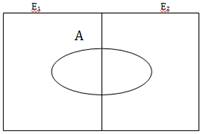
Assume that the chances of a patient having a heart attack is 40%. It is also assumed that a meditation and yoga course reduce the risk of heart attack by 30% and prescription of certain drug reduces its chances by 25%. At a time a patient can choose any one of the two options with equal probabilities. It is given that after going through one of the two options the patient selected at random suffers a heart attack. Find the probability that the patient followed a course of meditation and yoga?
Answer
A patient has options to have the treatment of yoga and meditation and that of prescription of drugs.
Let these events be denoted by E1 and E2 i.e.,
E1 = Treatment of yoga and meditation
E2 = Treatment of prescription of certain drugs
P (E1) = $ \frac{1}{2}$ and P(E2) = $ \frac{1}{2}$
Let A denotes that a person has heart attack, then P (A) = 40% = 0.40
Yoga and meditation reduces heart attack by 30.
$ \Rightarrow $ Inspite of getting yoga and meditation treatment heart risk is 70% of 0.40
$ \Rightarrow P\left( {A|{E_1}} \right)$  = 0.40 $\times$ 0.70 = 0.28
Also, Drug prescription reduces the heart attack rick by 25%
Even after adopting the drug prescription hear rick is 75% of 0.40
$ \Rightarrow P\left( {A|{E_2}} \right) $ = 0.40 $\times$ 0.75 = 0.30
$P\left( {{E_1}|A} \right) = \frac{{P({E_1})P(A|{E_1})}}{{P({E_1})P\left( {A|{E_1}} \right) + P({E_2})P\left( {A|{E_2}} \right)}}$
$ = \frac{{\frac{1}{2} \times 0.28}}{{\frac{1}{2} \times 0.28 + \frac{1}{2} \times 0.30}}$
$ = \frac{{0.28}}{{0.28 + 0.30}} = \frac{{0.28}}{{0.58}} = \frac{{28}}{{58}} = \frac{{14}}{{29}}$
View full question & answer
Question 23 Marks
Suppose that 5% of men and 0.25% of women have grey hair. A grey haired person is selected at random. What is the probability of this person being male? Assume that there are equal number of males and females.
Answer
Men are represented by E1 and women are represented by E2.
$\therefore $ P (E1) = $\frac{1}{2}$ and P (E2) = $\frac{1}{2}$
A represents grey hair persons.

$\therefore P\left( {A|{E_1}} \right) = \frac{5}{{100}}$ and $P\left( {A/{E_2}} \right) = \frac{{25}}{{10000}}$
$P\left( {{E_1}/A} \right) = \frac{{P({E_1})P(A|{E_1})}}{{P({E_1})P(A/{E_1}) + P({E_2})P(A|{E_2})}}$
$ = \frac{{\frac{1}{2} \times \frac{5}{{100}}}}{{\frac{1}{2} \times \frac{5}{{100}} + \frac{1}{2} \times \frac{{25}}{{10000}}}} = \frac{{\frac{5}{{100}}}}{{\frac{5}{{100}} + \frac{{25}}{{10000}}}}$$ = \frac{{\frac{5}{{100}}}}{{\frac{{525}}{{10000}}}} = \frac{5}{{100}} \times \frac{{10000}}{{525}} = \frac{{20}}{{21}}$   

View full question & answer
Question 33 Marks
Bag I contains 3 red and 4 black balls and Bag II contains 4 red and 5 black balls. One ball is transferred from Bag I to Bag II and then a ball is drawn from Bag II. The ball so drawn is found to be red in colour. Find the probability that the transferred ball is black.
Answer
Let us define events,
A1 : Red ball is transferred from bag I to II.
A2 : Black ball is transferred from bag I to II.
$\therefore P\left(A_{1}\right)=\frac{3}{7}$ and $P\left(A_{2}\right)=\frac{4}{7}$ 
Let X be the event that the drawn ball is red
$\therefore$ when red ball is transferred from bag I to II, $P\left(X | A_{1}\right)=\frac{5}{10}$  = $\frac{1}{2}$ 
And, when black ball is transferred from bag I to II, $P\left(X | A_{2}\right)=\frac{4}{10}$ = $\frac{2}{5}$
Hence, $P\left(A_{2} | X\right)=\frac{P\left(A_{2}\right) P\left(X | A_{2}\right)}{P\left(A_{1}\right) P\left(X | A_{1}\right)+P\left(A_{2}\right) P\left(X | A_{2}\right)}$ 
= $\frac{\frac{4}{7} \times \frac{2}{5}}{\frac{3}{7} \times \frac{1}{2}+\frac{4}{7} \times \frac{2}{5}}$ 
= $\frac{16}{31}$
View full question & answer
Question 43 Marks
Of the students in a college, it is known that 60% reside in hostel and 40% are day scholars (not residing in hostel). Previous year results report that 30% of all students who reside in hostel attain. A grade and 20% of day scholars attain A grade in their annual examination. At the end of year, one student is chosen at random from the college and he has an A grade, what is the probability that the student is a hostlier?
Answer
Let us define the events as
E1: Student reside in a hostel.
E2: Student is a day scholar.
A: Student gets  A grade.
Then,
P(E1) = Probability that student resides in a hostel
= 60% = $\frac { 60 } { 100 }$
and P(E2) = Probability that student is 
day scholar$= 1 - \frac { 60 } { 100 } = \frac { 40 } { 100 }$
Also, P($\frac {A}{E_1}$) = Probability that the student residing in a hostel gets A grade = 30% = $ \frac { 30 } { 100 }$
and P($\frac {A}{E_2}$) = Probability that student having
day scholars gets A grade = 20% = $ \frac { 20 } { 100 }$
$\therefore$ The probability that the selected student is a hosteler having A grade
= $P(\frac {{E_1}}{ A}) = \frac{{P({E_1}).P(A/{E_1})}}{{P\left( {{E_1}} \right)P\left( {A/{E_1}} \right) + P({E_2}).P(A/{E_2})}}$
[by Bayes's therorem]
$= \frac { \frac { 60 } { 100 } \times \frac { 30 } { 100 } } { \left( \frac { 60 } { 100 } \times \frac { 30 } { 100 } \right) + \left( \frac { 40 } { 100 } \times \frac { 20 } { 100 } \right) }$
$= \frac { 1800 } { 1800 + 800 } = \frac { 1800 } { 2600 } = \frac { 18 } { 26 } = \frac { 9 } { 13 }$
View full question & answer
Question 53 Marks
Probability that A speaks truth is $\frac{4}{5}$. A coin is tossed. A reports that a head appears. The probability that actually there was head is
Answer
Let E1 be the event that A speaks the truth, E2 be the event that A lies and X be the event that it appears head.
Therefore, $\mathrm{P}\left(\mathrm{E}_{1}\right)=\frac{4}{5}$ 
E1 and E2 are events that are complementary to each other.
Then P (E1) + P (E2) = 1
$\Rightarrow$ P (E2) = 1 - P (E1)
$\Rightarrow$ P (E2) = $1-\frac{4}{5}=\frac{1}{5}$ 
If a coin is tossed it may show head or tail.
Hence the probability of getting a head is $\frac{1}{2}$, irrespective of whether A speaks truth or lies.
i,e, P(X|E1) = P(X|E2) = $\frac{1}{2}$
Now the probability that actually there was head, given that A speaks truth is P(E1|X).
By using bayes’ theorem, we have:
$\mathrm{P}\left(\mathrm{E}_{1} | \mathrm{x}\right)=\frac{\mathrm{P}\left(\mathrm{E}_{1}\right) \cdot \mathrm{P}\left(\mathrm{X} | \mathrm{E}_{1}\right)}{\mathrm{P}\left(\mathrm{E}_{1}\right) \cdot \mathrm{P}\left(\mathrm{X} | \mathrm{E}_{1}\right)+\mathrm{P}\left(\mathrm{E}_{2}\right) \cdot \mathrm{P}\left(\mathrm{X} | \mathrm{E}_{2}\right)}$ 
= $\frac{\frac{4}{5} \cdot \frac{1}{2}}{\frac{4}{5} \cdot \frac{1}{2}+\frac{1}{5} \cdot \frac{1}{2}}$
= $\frac{\frac{2}{5}}{\frac{2}{5}+\frac{1}{10}}=\frac{\frac{2}{5}}{\frac{5}{10}}=\frac{4}{5}$ 
$\Rightarrow \mathrm{P}\left(\mathrm{E}_{1} | \mathrm{x}\right)=\frac{4}{5}$  
View full question & answer
Question 63 Marks
An urn contains 5 red and 5 black balls. A ball is drawn at random, its colour is noted and is returned to the urn. Moreover, 2 additional balls of the colour drawn are put in the urn and then a ball is drawn at random. What is the probability that the second ball is red?
Answer
Case (i) : S1 = {5 red balls, 5 black balls}
$ \Rightarrow n\left( {{S_1}} \right) = 10$
Let us draw a red balls first, i.e., A1 = {5 red balls}
$ \Rightarrow n({A_1}) = 5$
$P({A_1}) = \frac{{n({A_1})}}{{n({S_1})}} = \frac{5}{{10}} = \frac{1}{2}$
Now after adding 2 balls of the same colour, i.e., when the first draw gives a red ball, two additional red balls are put in the urn so that its contents are 7 (5 + 2) red and 5 balck balls. When the first draw gives a black ball, two additional black balls are put in the urn so that its contents are 5 red and 7 (5 + 2) black balls.
Total balls = S2 = {7 red balls, 5 black balls}
$ \Rightarrow n({S_2}) = 12$
Let us draw a red balls first, i.e., A2 = {7 red balls}
$ \Rightarrow n({A_2}) = 7$

$P({A_2}) = \frac{{n({A_2})}}{{n({S_2})}} = \frac{7}{{12}}$
$\therefore $ P (a red ball is drawn) $ = \frac{1}{2} \times \frac{7}{{12}} = \frac{7}{{24}}$

Case (ii) : When a black ball is drawn, i.e., A2 = {5 red balls}
$ \Rightarrow n({A_2}) = 5$
$ = P({A_1}) = \frac{{n({A_2})}}{{n({S_1})}} = \frac{5}{{12}}$

Now after adding 2 balls of the same colour, i.e.,
S2 = {5 red balls, 7 black balls}
$ \Rightarrow n({S_2}) = 12$

Let us draw a red balls first, i.e., A2 = {5 red balls}
$ \Rightarrow n({A_2}) = 5$
$P({A_2}) = \frac{{n({A_2})}}{{n({S_2})}} = \frac{5}{{12}}$
$\because $ P (a red ball is drawn) $ = \frac{1}{2} \times \frac{5}{{12}} = \frac{5}{{24}}$
Therefore, required probability in both cases
= Probability that first ball is red and then second ball after two red are added in the urn is also red + Probability that first ball is black and second is red $ = \frac{7}{{24}} + \frac{5}{{24}} = \frac{{12}}{{24}} = \frac{1}{2}$

View full question & answer
Question 73 Marks
A fair coin and an unbiased die are tossed. Let A be the event head appears on the coin and B be the event 3 on the die. Check whether A and B are independent events or not.
Answer
Let A be the sample space of given experiment.
S = { (H, 1), (H, 2) , (H, 3), (H, 4) , (H, 5) , (H, 6) , (T, 1), (T , 2), (T, 3), (T, 4), (T, 5), (T, 6) }
A : Head appear on the coin
B : 3 appear on the dice
A = {(H, 1), (H, 2), (H, 3), (H, 4), (H, 5), (H, 6)}
B = {(H, 3), (T, 3)}
$A \cap B = \left\{ {(H,3)} \right\}$
$P(A) = \frac{6}{{12}} = \frac{1}{2},p(B) = \frac{2}{{12}} = \frac{1}{6}$
$P(A \cap B) = \frac{1}{{12}}$
$P(A) \times P(B) = \frac{1}{2} \times \frac{1}{6}$
$ = \frac{1}{{12}}$
$ = P\left( {A \cap B} \right)$
Hence A and B are independent events.
View full question & answer
3 Marks - Maths STD 12 Science Questions - Vidyadip