MCQ 11 Mark
The lines $\frac{1-x}{2}=\frac{y-1}{3}=\frac{z}{1}$ and $\frac{2 x-3}{2 p}=\frac{y}{-1}=\frac{z-4}{7}$ are perpendicular to each other for $p$ equal to :
- A
$-\frac{1}{2}$
- B
$\frac{1}{2}$
- C
- D
AnswerAs the given lines can be written as
$\frac{x-1}{-2}=\frac{y-1}{3}=\frac{z-0}{1} \text { and } \frac{x-3 / 2}{p}=\frac{y}{-1}=\frac{z-4}{7}$
These lines are perpendicular, then
$
\begin{aligned}
& -2 \times p+3(-1)+1 \times 7=0 \Rightarrow-2 p-3+7=0 \\
\Rightarrow \quad & -2 p+4=0 \Rightarrow-2 p=-4 \therefore p=2
\end{aligned}$
View full question & answer→MCQ 21 Mark
The coordinates of the foot of the perpendicular drawn from the point $(0,1,2)$ on the $x$-axis are given by:
- A
$(1,0,0)$
- B
$(2,0,0)$
- C
$(\sqrt{5}, 0,0)$
- ✓
$(0,0,0)$
AnswerCorrect option: D. $(0,0,0)$
$(0,0,0)$
View full question & answer→MCQ 31 Mark
The Cartesian equation of the line passing through the point $(1,-3,2)$ and parallel to the line $\vec{r}=(2+\lambda) \hat{i}+\lambda \hat{j}+(2 \lambda-1) \hat{k}$ is
- A
$\frac{x-1}{2}=\frac{y+3}{0}=\frac{z-2}{-1}$
- B
$\frac{x+1}{1}=\frac{y-3}{0}=\frac{z+2}{2}$
- C
$\frac{x+1}{2}=\frac{y-3}{0}=\frac{z+2}{-1}$
- D
$\frac{x-1}{1}=\frac{y+3}{1}=\frac{z-2}{2}$
AnswerGiven line is
$\begin{aligned}
\vec{r} & =(2+\lambda) \hat{i}+\lambda \hat{j}+(2 \lambda-1) \hat{k} \\
& =2 \hat{i}-\hat{k}+\lambda(\hat{i}+\hat{j}+2 \hat{k})
\end{aligned}$
And, position vector of a point on the required line is
$\hat{i}-3 \hat{j}+2 \hat{k} \text {. }
$Thus, vector equation of the line is
$\vec{r}=(\hat{i}-3 \hat{j}+2 \hat{k})+\lambda(\hat{i}+\hat{j}+2 \hat{k}), \lambda \in R
$The line passes through $(1,-3,2)$ and has direction ratios $1,1,2$
$\therefore \quad$ The cartesian equation of the line is
$\frac{x-1}{1}=\frac{y+3}{1}=\frac{z-2}{2}$
View full question & answer→MCQ 41 Mark
The angle which the line $\frac{x}{1}=\frac{y}{-1}=\frac{z}{0}$ makes with the positive direction of $Y$-axis is :
- A
$\frac{5 \pi}{6}$
- B
$\frac{3 \pi}{4}$
- C
$\frac{5 \pi}{4}$
- D
$\frac{7 \pi}{4}$
AnswerGiven, $\frac{x}{1}=\frac{y}{-1}=\frac{z}{0}$.........(i)
Dr's of (i) is $1,-1,0$.
Dr's of $y$-axis is $0,1,0$.
Now, $\cos \theta=\left|\frac{1 \times 0+1(-1)+0 \times 0}{\sqrt{1^2+(-1)^2} \sqrt{1^2}}\right|=\frac{1}{\sqrt{2}} \quad \therefore \quad \theta=\frac{7 \pi}{4}$
View full question & answer→MCQ 51 Mark
Direction ratios of a vector parallel to line $\frac{x-1}{2}=-y=\frac{2 z+1}{6}$ are :
- A
$2,-1,6$
- B
$2,1,6$
- C
$2,1,3$
- D
$2,-1,3$
AnswerThe given line can be written as
$
\frac{x-1}{2}=\frac{y}{-1}=\frac{z+1 / 2}{3}
$
So, direction ratios of line parallel to given line is <2,-1,3>
View full question & answer→MCQ 61 Mark
If a line makes an angle of $30^{\circ}$ with the positive direction of $x$-axis, $120^{\circ}$ with the positive direction of $y$-axis, then the angle which it makes with the positive direction of $z$-axis is :
- A
$90^{\circ}$
- B
$120^{\circ}$
- C
$60^{\circ}$
- D
$0^{\circ}$
AnswerLet the angle made with positive direction of $z$-axis be $\gamma$.
Then, $\cos ^2 30^{\circ}+\cos ^2 120^{\circ}+\cos ^2 \gamma=1$
$\begin{array}{l}
\Rightarrow\left(\frac{\sqrt{3}}{2}\right)^2+\left(\frac{-1}{2}\right)^2+\cos ^2 \gamma=1 \\
\Rightarrow \cos ^2 \gamma=1-\frac{3}{4}-\frac{1}{4}=0 \Rightarrow \gamma=90^{\circ}
\end{array}$
View full question & answer→MCQ 71 Mark
The vector equation of a line passing through the point $(1,-1,0)$ and parallel to $Y$-axis is :
- A
$\vec{r}=\hat{i}-\hat{j}+\lambda(\hat{i}-\hat{j})$
- B
$\vec{r}=\hat{i}-\hat{j}+\lambda \hat{j}$
- C
$\vec{r}=\hat{i}-\hat{j}+\lambda \hat{k}$
- D
$\vec{r}=\lambda \hat{j}$
AnswerEquation of line passing through the point $(1,-1,0)$ and parallel to $y$ - axis is given by
$\vec{r}=(\hat{i}-\hat{j}+0 \hat{k})+\lambda(0 \hat{i}+\hat{j}+0 \hat{k}) \quad \therefore \quad \vec{r}=(\hat{i}-\hat{j})+\lambda \hat{j}$
View full question & answer→MCQ 81 Mark
The angle between the lines $2 x=3 y=-z$ and $6 x=-y=-4 z$ is
- A
$0^{\circ}$
- B
$30^{\circ}$
- C
$45^{\circ}$
- D
$90^{\circ}$
AnswerThe given equation of lines can be rewritten as
$\begin{array}{l}
\frac{x-0}{1 / 2}=\frac{y-0}{1 / 3}=\frac{z-0}{-1} \text { and } \frac{x-0}{1 / 6}=\frac{y-0}{-1}=\frac{z-0}{-1 / 4} \\
\therefore a_1=\frac{1}{2}, b_1=\frac{1}{3}, c_1=-1 \text { and } a_2=\frac{1}{6}, b_2=-1, c_2=\frac{-1}{4}
\end{array}
$
Now, $\cos \theta=\frac{a_1 a_2+b_1 b_2+c_1 c_2}{\sqrt{a_1^2+b_1^2+c_1^2} \sqrt{a_2^2+b_2^2+c_2^2}}$
$=\frac{\frac{1}{2} \cdot \frac{1}{6}+\frac{1}{3} \cdot(-1)+(-1) \cdot\left(\frac{-1}{4}\right)}{\sqrt{\left(\frac{1}{2}\right)^2+\left(\frac{1}{3}\right)^2+(-1)^2} \sqrt{\left(\frac{1}{6}\right)^2+(-1)^2+\left(\frac{-1}{4}\right)^2}}=0$
$\Rightarrow \cos \theta=0 \Rightarrow \theta=90^{\circ}$
View full question & answer→MCQ 91 Mark
A line $\overrightarrow{O P}$ in space, represented by the figure below; has a magnitude of $2 \sqrt{2}$ units.
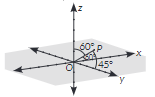
Which of these are the direction ratios of $\overrightarrow{O P}$ ? - A
$(2, \sqrt{2}, 2)$
- ✓
$(\sqrt{2}, 2, \sqrt{2})$
- C
$\left(\frac{1}{2}, \frac{1}{\sqrt{n}}, \frac{1}{2}\right)$
- D
$(2 \sqrt{2}, 2 \sqrt{2}, 2 \sqrt{2})$
AnswerCorrect option: B. $(\sqrt{2}, 2, \sqrt{2})$
$(\sqrt{2}, 2, \sqrt{2})$
View full question & answer→MCQ 101 Mark
Distance of the point $(p, q, r)$ from $y$-axis is
- A
$q$
- B
$|q|$
- C
$|q|+|r|$
- D
$\sqrt{p^2+r^2}$
AnswerGiven point is $(p, q, r)$
The foot of perpendicular drawn from point $(p, q, r)$ on the $y$-axis is $(0, q, 0)$.
Now, distance between these two points is
$\sqrt{(p-0)^2+(q-q)^2+(r-0)^2}=\sqrt{p^2+r^2}$
View full question & answer→MCQ 111 Mark
Direction cosines of the line $\frac{x-1}{2}=\frac{1-y}{3}=\frac{2 z-1}{12}$ are:
- A
$\frac{2}{7}, \frac{3}{7}, \frac{6}{7}$
- B
$\frac{2}{\sqrt{157}},-\frac{3}{\sqrt{157}}, \frac{12}{\sqrt{157}}$
- C
$\frac{2}{7},-\frac{3}{7},-\frac{6}{7}$
- D
$\frac{2}{7},-\frac{3}{7}, \frac{6}{7}$
AnswerGiven equation of the line is $\frac{x-1}{2}=\frac{1-y}{3}=\frac{2 z-1}{12}$ Which can be written as
$\frac{x-1}{2}=\frac{(y-1)}{-3}=\frac{z-\frac{1}{2}}{6}$
$\therefore \quad$ The direction cosines are
$\begin{array}{l}
\frac{2}{\sqrt{(2)^2+(-3)^2+(6)^2}}, \frac{-3}{\sqrt{(2)^2+(-3)^2+(6)^2}}, \frac{6}{\sqrt{(2)^2+(-3)^2+(6)^2}} \\
=\frac{2}{\sqrt{49}}, \frac{-3}{\sqrt{49}}, \frac{6}{\sqrt{49}}=\frac{2}{7}, \frac{-3}{7}, \frac{6}{7}
\end{array}$
View full question & answer→MCQ 121 Mark
The vector equation of a line which passes through the point $(2,-4,5)$ and is parallel to the line $\frac{x+3}{3}=\frac{4-y}{2}=\frac{z+8}{6}$ is :
- A
$\vec{r}=(-2 \hat{i}+4 \hat{j}-5 \hat{k})+\lambda(3 \hat{i}+2 \hat{j}+6 \hat{k})$
- B
$\vec{r}=(2 \hat{i}-4 \hat{j}+5 \hat{k})+\lambda(3 \hat{i}-2 \hat{j}+6 \hat{k})$
- C
$\vec{r}=(2 \hat{i}-4 \hat{j}+5 \hat{k})+\lambda(3 \hat{i}+2 \hat{j}+6 \hat{k})$
- D
$\vec{r}=(-2 \hat{i}+4 \hat{j}-5 \hat{k})+\lambda(3 \hat{i}-2 \hat{j}-6 \hat{k})$
AnswerLet $\vec{a}$ be the position vector of the point $(2,-4,5)$, then $\vec{a}=2 \hat{i}-4 \hat{j}+5 \hat{k}$.
The given equation of line is $\frac{x+3}{3}=\frac{4-y}{2}=\frac{z+8}{6}$ $\Rightarrow \frac{x+3}{3}=\frac{y-4}{-2}=\frac{z+8}{6}$
$\therefore \quad$ Direction ratios of (i) are $3,-2,6$.
Let $\vec{b}$ be the vector parallel to line (i).
Then, $\vec{b}=3 \hat{i}-2 \hat{j}+6 \hat{k}$
$\therefore$ The vector equation of required line is $\vec{r}=\vec{a}+\lambda \vec{b}$ $\Rightarrow \vec{r}=(2 \hat{i}-4 \hat{j}+5 \hat{k})+\lambda(3 \hat{i}-2 \hat{j}+6 \hat{k})$
View full question & answer→MCQ 131 Mark
If the direction cosines of a line are $\left(\frac{1}{a}, \frac{1}{a}, \frac{1}{a}\right)$, then
- A
- B
$a>2$
- C
$a>0$
- D
$a= \pm \sqrt{3}$
AnswerGiven that the direction cosines of a line are
$\left(\frac{1}{a}, \frac{1}{a}, \frac{1}{a}\right)
$
We know that the sum of squares of the direction cosines is 1 .
$\begin{array}{l}
\Rightarrow \frac{1}{a^2}+\frac{1}{a^2}+\frac{1}{a^2}=1 \Rightarrow \frac{3}{a^2}=1 \Rightarrow a^2=3 \\
\Rightarrow a= \pm \sqrt{3}
\end{array}$
View full question & answer→MCQ 141 Mark
If a line makes angles of $90^{\circ}, 135^{\circ}$ and $45^{\circ}$ with the $x, y$ and $z$ axes respectively, then its direction cosines are
- A
$0,-\frac{1}{\sqrt{2}}, \frac{1}{\sqrt{2}}$
- B
$\frac{1}{\sqrt{2}}, 0, \frac{1}{\sqrt{2}}$
- C
$\frac{1}{\sqrt{2}}, 0,-\frac{1}{\sqrt{2}}$
- D
$0, \frac{1}{\sqrt{2}}, \frac{1}{\sqrt{2}}$
AnswerDirection cosines are $\left\langle\cos 90^{\circ}, \cos 135^{\circ}, \cos 45^{\circ}\right\rangle$
$
=\left\langle 0, \cos \left(90^{\circ}+45^{\circ}\right), \frac{1}{\sqrt{2}}\right\rangle=\left\langle 0,-\sin 45^{\circ}, \frac{1}{\sqrt{2}}\right\rangle=\left\langle 0,-\frac{1}{\sqrt{2}}, \frac{1}{\sqrt{2}}\right\rangle$
View full question & answer→MCQ 151 Mark
$P$ is a point on the line joining the points $A(0,5,-2)$ and $B(3,-1,2)$. If the $x$-coordinate of $P$ is 6 , then its $z$-coordinate is
AnswerThe line through the points $(0,5,-2)$ and $(3,-1,2)$ is
\[\frac{x}{3-0}=\frac{y-5}{-1-5}=\frac{z+2}{2+2} \text { or } \frac{x}{3}=\frac{y-5}{-6}=\frac{z+2}{4}\]
Any point on the line is $P(3 k,-6 k+5,4 k-2)$, where $k$ is an arbitrary scalar.
$\because \quad 3 k=6 \Rightarrow k=2$
The $z$-coordinate of the point $P$ will be $4 \times 2-2=6$.
View full question & answer→MCQ 161 Mark
A line $m$ passes through the point $(-4,2,-3)$ and is parallel to line $n$, given by:
$\frac{-x-2}{4}=\frac{y+3}{-2}=\frac{2 z-6}{3}$
The vector equation of line $m$ is given by: $\vec{r}=(-4 \hat{i}+2 \hat{j}-3 \hat{k})+\lambda(p \hat{i}+q \hat{j}+r \hat{k})$, where $\lambda \in R$
Which of the following could be the possible values for $p, g$ and $r$ ?
- A
$p=4, q=(-2), r=3$
- B
$p=(-4), q=(-2), r=3$
- C
$p=(-2), q=3, r=(-6)$
- ✓
$p=8, q=4, r=(-3)$
AnswerCorrect option: D. $p=8, q=4, r=(-3)$
$p=8, q=4, r=(-3)$
View full question & answer→MCQ 171 Mark
If the two lines $L_1: x=5, \frac{y}{3-\alpha}=\frac{z}{-2} \quad L_2: x=2, \frac{y}{-1}=\frac{z}{2-\alpha}$ are perpendicular, then the value of $\alpha$ is
- A
$\frac{2}{3}$
- B
- C
- D
$\frac{7}{3}$
AnswerThe given lines are perpendicular, if
$a_1 a_2+b_1 b_2+c_1 c_2=0$
Here, $L_1: \frac{x-5}{0}=\frac{y-0}{3-\alpha}=\frac{z-0}{-2}$
$L _2: \frac{x-2}{0}=\frac{y-0}{-1}=\frac{z-0}{2-\alpha}$
Here, $a_1, b_1, c_1$ are $0,3-\alpha,-2$, and $a_2, b_2, c_2$ are $0,-1,2-\alpha$ respectively.
$\begin{array}{ll}
\therefore & 0 \times 0-(3-\alpha)-2(2-\alpha)=0 \\
\Rightarrow & \alpha=\frac{7}{3}
\end{array}$
View full question & answer→MCQ 181 Mark
The length of the perpendicular drawn from the point $(4,-7,3)$ on the $y$-axis is
AnswerLet $P(4,-7,3)$ be the given point and $A$ be a point on $y$-axis s.t. $P A \perp$ to $y$-axis.
$
\begin{array}{l}
\therefore \quad A \equiv(0,-7,0) \\
\text { Now, } \begin{aligned}
P A & =\sqrt{(4-0)^2+(-7-(-7))^2+(3-0)^2} \\
& =\sqrt{4^2+3^2}=\sqrt{16+9}=\sqrt{25}=5 \text { units }
\end{aligned}
\end{array}$
View full question & answer→MCQ 191 Mark
The vector equation of $X Y$-plane is
- A
$\overrightarrow{ r } \cdot \hat{ k }=0$
- B
$\vec{r} \cdot \hat{j}=0$
- C
$\overrightarrow{ r } \cdot \hat{ i }=0$
- D
$\overrightarrow{ r } \cdot \vec{n}=1$
AnswerVector equation of $X Y$-plane is $\vec{r} \cdot \hat{k}=0$.
View full question & answer→MCQ 201 Mark
The xy-plane divided the line joining the point (-1, 3, 4) and (2, -5, 6)
- A
Internally in the ratio 2 : 3
- B
Externally in the ratio 2 : 3
- C
Internally in the ratio 3 : 2
- D
Externally in the ratio 3 : 2
Answer - Externally in the ratio 2 : 3
Solution:
Let the XY-plane divide the line segment joining points
P(-1, 3, 4) and Q(2, -5, 6) in the ratio k : 1.
Using the section formula, the coordinates of the point of intersection are given by
$\Big(\frac{\text{k}(2)-1}{\text{k}+1},\frac{\text{k}(-5)+3}{\text{k}+1},\frac{\text{k}(6)+4}{\text{k}+1}\Big) $
On the XY-plane, the Z-coordinate of any point is zero.
$\Rightarrow\frac{\text{k}(6)+4}{\text{k}+1}=0$
$\Rightarrow6\text{k}+4=0$
$\Rightarrow\text{k}=\frac{-2}{3}$
Thus, the XY-plane divides the line segment joining the given points in the ratio 2 : 3 externally.
View full question & answer→MCQ 211 Mark
If the lines $\frac{x+2}{4 \lambda+1}=\frac{y-1}{4}=\frac{z}{-18}$ and $\frac{x}{-3}=\frac{y+1}{5 \mu-3}$ $=\frac{z-1}{6}$ are parallel to each other, then the value of the pair $(\lambda, \mu)$ is
- A
$\left(-2, \frac{1}{3}\right)$
- B
$\left(2,-\frac{1}{3}\right)$
- ✓
$\left(2, \frac{1}{3}\right)$
- D
AnswerCorrect option: C. $\left(2, \frac{1}{3}\right)$
(c) : Consider, $L_1: \frac{x+2}{4 \lambda+1}=\frac{y-1}{4}=\frac{z}{-18}$ and $L_2: \frac{x}{-3}=\frac{y+1}{5 \mu-3}=\frac{z-1}{6}$
If two lines are parallel, then their direction ratios are proportional.
$
\begin{array}{l}
\therefore \frac{4 \lambda+1}{-3}=\frac{4}{5 \mu-3}=\frac{-18}{6} \Rightarrow \frac{4 \lambda+1}{-3}=-3 \text { and } \frac{4}{5 \mu-3}=-3 \\
\Rightarrow 4 \lambda+1=9 \text { and } 4=-15 \mu+9 \\
\Rightarrow 4 \lambda=8 \text { and } 15 \mu=5 \Rightarrow \lambda=2 \text { and } \mu=\frac{1}{3}
\end{array}
$
So, the value of the pair $(\lambda, \mu)$ is $\left(2, \frac{1}{3}\right)$.
View full question & answer→MCQ 221 Mark
The length of the perpendicular drawn from the point $(4,-7,3)$ on the $y$-axis is
Answer(c) : Let $P(4,-7,3)$ be the given point and $A$ be a point on $y$-axis s.t. $P A \perp$ to $y$-axis.
$
\therefore A \equiv(0,-7,0)
$
Now, $P A=\sqrt{(4-0)^2+(-7-(-7))^2+(3-0)^2}$
$
=\sqrt{4^2+3^2}=\sqrt{16+9}=\sqrt{25}=5 \text { units }
$
View full question & answer→MCQ 231 Mark
$P$ is a point on the line joining the points $A(0$, $5,-2)$ and $B(3,-1,2)$. If the $x$-coordinate of $P$ is 6 , then its $z$-coordinate is
Answer(b) : The line through the points $(0,5,-2)$ and $(3,-1,2)$ is
$
\frac{x}{3-0}=\frac{y-5}{-1-5}=\frac{z+2}{2+2} \text { or } \frac{x}{3}=\frac{y-5}{-6}=\frac{z+2}{4}
$
Any point on the line is $P(3 k,-6 k+5,4 k-2)$, where $k$ is an arbitrary scalar.
$
\because 3 k=6 \Rightarrow k=2
$
The $z$-coordinate of the point $P$ will be $4 \times 2-2=6$.
View full question & answer→MCQ 241 Mark
The equation of the line joining the points $(-3,4,11)$ and $(1,-2,7)$ is
- A
$\frac{x+3}{2}=\frac{y-4}{3}=\frac{z-11}{4}$
- ✓
$\frac{x+3}{-2}=\frac{y-4}{3}=\frac{z-11}{2}$
- C
$\frac{x+3}{-2}=\frac{y+4}{3}=\frac{z+11}{4}$
- D
$\frac{x+3}{2}=\frac{y+4}{-3}=\frac{z+11}{2}$
AnswerCorrect option: B. $\frac{x+3}{-2}=\frac{y-4}{3}=\frac{z-11}{2}$
(b) : DR's of the line joining the given points are
$
\{1-(-3),-2-4,7-11\}
$
i.e., $(4,-6,-4)$ or $(-2,3,2)$
Now, Equation of line passing through $(-3,4,11)$ and having direction ratios $-2,3,2$ is $\frac{x+3}{-2}=\frac{y-4}{3}=\frac{z-11}{2}$
View full question & answer→MCQ 251 Mark
$P$ is a point on the line segment joining the points $(3,2,-1)$ and $(6,2,-2)$. If $x$ co-ordinate of $P$ is 5 , then its $y$ co-ordinate is
Answer(a) : Equation of line joining the points $(3,2,-1)$ and $(6,2,-2)$ is,
$
\begin{array}{l}
\frac{x-3}{6-3}=\frac{y-2}{2-2}=\frac{z+1}{-2+1} \text { i.e., } \frac{x-3}{3}=\frac{y-2}{0}=\frac{z+1}{-1}=\lambda \text { (say) } \\
\Rightarrow \quad x=3 \lambda+3, y=2, z=-\lambda-1
\end{array}
$
So, $y$-coordinate of $P$ is 2 .
View full question & answer→MCQ 261 Mark
Choose the correct answer
The planes: 2x – y + 4z = 5 and 5x – 2.5y + 10z = 6 are:
AnswerEquation of the given planes are 2x - y + 4z = 5(a1x + b1y + c1z + d = 0)
and 5x - 2.5y + 10z = 6(a2x + b2y + c2z + d = 0)
For perpendicular a1a2 + b1b2 + c1c2 = 2(5) + (-1)(-2.5) + 4(10) = 10 + 2.5 + 40 = 52.5
$\because\ \text{a}_1\text{a}_2+\text{b}_1\text{b}_2+\text{c}_1\text{c}_2\neq0$
$\therefore$ Planes are not perpendicular.
For parallel $\frac{\text{a}_1}{\text{a}_2}=\frac{2}{5},\ \frac{\text{b}_1}{\text{b}_2}=\frac{-1}{-2.5}=\frac{10}{25}=\frac{2}{5},\ \frac{\text{c}_1}{\text{c}_2}=\frac{4}{10}=\frac{2}{5}$
$\because\ \frac{\text{a}_1}{\text{a}_2}=\frac{\text{b}_1}{\text{b}_2}=\frac{\text{c}_1}{\text{c}_2}$
$\therefore$ given planes are parallel.
Therefore, option (B) is correct.
- Parallel.
View full question & answer→MCQ 271 Mark
The direction ratios of the line of intersection of the planes 3x + 2y - z = 5 and x - y + 2z = 3 are:
MCQ 281 Mark
(2, -3, -1) 2x - 3y + 6z + 7 = 0:
MCQ 291 Mark
If l, m, n are the direction cosines of a line, then:
MCQ 301 Mark
A straight line L on the xy-plane bisects the angle between OX and OY. What are the direction cosines of L:
- A
$\Big(\frac{1}{\sqrt{2}},\frac{1}{\sqrt{2}},0\Big)$
- B
$\Big(\frac{1}{2},\frac{\sqrt{3}}{2},0\Big)$
- C
$\big(0,0,1\big)$
- D
$\Big(\frac{2}{3},\frac{2}{3},\frac{1}{3}\Big)$
Answer - $\Big(\frac{1}{\sqrt{2}},\frac{1}{\sqrt{2}},0\Big)$
Solution
L makes an angle $\frac{\pi}{4}$ with X and Y axis and $\frac{\pi}{2}$
$\therefore$ d.cs are $\Big(\cos\frac{\pi}{34},\cos\frac{\pi}{4},\cos\frac{\pi}{2}\Big)=\Big(\frac{1}{\sqrt{2}},\frac{1}{\sqrt{2}},0\Big)$
View full question & answer→MCQ 311 Mark
If P(x, y, z) moves such that x = 0, z = 0 then the locus of P is the line whose d.cs are:
Answer - 0, 1, 0
Solution:
When P moves then x = 0, z = 0 but y is not given. Let y = y Then the coordinates of the point will be (0, y, 0) Now, direction cosines with respect to (0, y, 0) is given by.
$\cos\alpha=\frac{0}{0^2+\text{y}^2+0^2}=\frac{0}{\text{y}}=0$
$\cos\beta=\frac{\text{y}}{0^2+\text{y}^2+0^2}=\frac{\text{y}}{\text{y}}=1$
$\cos\gamma=\frac{{0}}{0^2+\text{y}^2+0^2}=\frac{{0}}{\text{y}}=0$
The direction cosines are 0, 1, 0
View full question & answer→MCQ 321 Mark
The direction cosines of the straight linegiven by the planes x = 0 and z = 0 are:
Answer - 0, 1, 0
Solution:
Given, x = z = 0
It represents Z-axis
$\therefore$ Direction cosines = (0, 1, 0)
View full question & answer→MCQ 331 Mark
The following lines are $\hat{\text{r}}=\Big(\hat{\text{i}}+\hat{\text{j}}\Big)+\lambda\Big(\hat{\text{i}}+2\hat{\text{j}}-\hat{\text{k}}\Big)+\mu\Big(-\hat{\text{i}}+\hat{\text{j}}-2\hat{\text{k}}\Big)$
View full question & answer→MCQ 341 Mark
The direction cosines of the normal to the plane 2x - 3y - 6z - 3 = 0 are:
- A
$\frac{2}{7},\frac{-3}{7},\frac{-6}{7}$
- B
$\frac{2}{7},\frac{3}{7},\frac{6}{7}$
- C
$\frac{-2}{7},\frac{-3}{7},\frac{-6}{7}$
- D
Answer - $\frac{2}{7},\frac{-3}{7},\frac{-6}{7}$
View full question & answer→MCQ 351 Mark
- A
- B
Is perpendicular to z-axis
- C
- D
View full question & answer→MCQ 361 Mark
Find the equation of a line passing through a point $(2,-1,3)$ and parallel to the line $\vec{r}=(\hat{i}+\hat{j})+\lambda(2 \hat{i}+\hat{j}-2 \hat{k})$.
- A
$\vec{r}=(\hat{i}+\hat{j})+\mu(2 \hat{i}-\hat{j}+3 \hat{k})$
- ✓
$\vec{r}=(2 \hat{i}-\hat{j}+3 \hat{k})+\mu(2 \hat{i}+\hat{j}-2 \hat{k})$
- C
$\vec{r}=(\hat{i}-\hat{j})+\mu(2 \hat{i}-\hat{j}+3 \hat{k})$
- D
$\vec{r}=(2 \hat{i}+\hat{j}+3 \hat{k})+\mu(2 \hat{i}+\hat{j}-2 \hat{k})$
AnswerCorrect option: B. $\vec{r}=(2 \hat{i}-\hat{j}+3 \hat{k})+\mu(2 \hat{i}+\hat{j}-2 \hat{k})$
(b) : The given line is parallel to the vector $2 \hat{i}+\hat{j}-2 \hat{k}$ and the required line is parallel to the given line. So, required line is parallel to the vector $2 \hat{i}+\hat{j}-2 \hat{k}$. Thus, the equation of the required line passing through (2, $-1,3)$ is $\vec{r}=(2 \hat{i}-\hat{j}+3 \hat{k})+\mu(2 \hat{i}+\hat{j}-2 \hat{k})$
View full question & answer→MCQ 371 Mark
A line passes through the points (6, −7, −1) and (2, −3, 1). The direction cosines of the line so directed that the angle made by it with the positive direction of x-axis is acute, is?
- A
$\frac{2}{3},\frac{2}{3},-\frac{1}{3}$
- B
$-\frac{2}{3},\frac{2}{3},\frac{1}{3}$
- C
$\frac{2}{3}-\frac{2}{3},\frac{1}{3}$
- D
$\frac{2}{3},\frac{2}{3},\frac{1}{3}$
Answer - $\frac{2}{3},\frac{2}{3},-\frac{1}{3}$
Solution:
Consider the problem
Let l, m, n are direction cosines of the given line.
then as it made an acute angle with x−axis,
Therefore, l > 0
The line passes through (6, −7, −1) and (2, −3, 1)
Therefore, its direction ratios are
6 − 2, −7 + 3, −1−1 or 2, −2, −1
Hence direction cosines of the line are given by $\frac{2}{3},\frac{2}{3},-\frac{1}{3}.$
View full question & answer→MCQ 381 Mark
The equation xy = 0 in three dimensional space is represented by:
- A
- B
Two plane are right angles
- C
A pair of parallel planes
- D
Answer - Two plane are right angles
View full question & answer→MCQ 391 Mark
Direction cosines of ray from P(1, −2, 4) to Q(−1, 1, −2) are:
Answer - $\frac{-2}{7},\frac{3}{7},\frac{-6}{7}$
Solution:
Given the points are P(1, −2, 4) and Q(−1, 1, −2).
Now the direction ratios of the ray PQ are (−1−1, 1 + 2, −2−4) = (−2, 3, −6).
The direction cosines of the line PQ will be
$\bigg(\frac{2}{\sqrt{2^2+3^2+6^2}},\frac{3}{\sqrt{2^2+3^2+6^2}},\frac{-6}{\sqrt{2^2+3^2+6^2}}\bigg)=\Big(\frac{-2}{7},\frac{3}{7},\frac{-6}{7}\Big).$
View full question & answer→MCQ 401 Mark
The length of the $\perp$
- A
- B
$2\sqrt{3}$
- C
$\frac{2}{3}$
- D
View full question & answer→MCQ 411 Mark
The sine of the angle between the straight line $\frac{\text{x}-2}{3}=\frac{\text{y}-3}{4}=\frac{\text{z}-4}{5}$ and the plane 2x - 2y + z = 5 is:
View full question & answer→MCQ 421 Mark
A line with positive direction cosines passes through the point P(2, -1, 2) and makes equal angles with the coordinate axes. The line meets the plane 2x + y + z = 9 at point Q. The length of the line segment PQ equals:
- A
$1$
- B
$\sqrt{2}$
- C
$\sqrt{3}$
- D
$2$
Answer - $\sqrt{3}$
Solution:
D.C of the line are $\frac{1}{\sqrt{3}},\frac{1}{\sqrt{3}},\frac{1}{\sqrt{3}}$
Any point on the line at a distance tt from P(2, -1, 2) is
$\Big(2+\frac{\text{t}}{\sqrt{3}},-1+\frac{\text{t}}{\sqrt{3}},2+\frac{\text{t}}{\sqrt{3}}\Big)$
which lies on $2\text{x} + \text{y + z} = 9$
$\Rightarrow\text{t}=\sqrt{3}$
View full question & answer→MCQ 431 Mark
The direction cosines of the ray P(1, -2, 4) and Q(-1, 1, -2) are:
Answer - $\Big(-\frac{2}{7},\frac{3}{7},-\frac{6}{7}\Big)$
Solution:
P(1, -2, 4), Q(-1, 1, -2)
$\text{PQ}=\sqrt{(1-(1))^2 +(2-1)^2+(4-(-2))^{2}}$
$=\sqrt{4+9+36}$
$=\sqrt{49}=7\text{DC}$
$=\Big(\frac{-1-1}{7},\frac{1-(2)}{7},\frac{-2-4}{7}\Big)$
$=\Big(-\frac{2}{7},\frac{3}{7},-\frac{6}{7}\Big)$
View full question & answer→MCQ 441 Mark
The direction ratios of the diagonal of the cube joining the origin to the opposite corner are (when the 3 concurrent edges of the cube are coordinate axes).
Answer - 1, 1, 1
Solution:
Since, a cube is a symmetric figure, the vertex we are talking about will be at the diagonally opposite end of the origin. i.e. it will be equally inclined to the three axes.
Let the side of the cube be a, then the corner opposite to origin will have coordinates (a, a, a).
Direction ratios of a line joining two points (x1, y1, z1) and (x2, y2, z2) is given by (x2 − x1, y2 − y1, z2 − z1)
Then, direction ratios of two point (0, 0, 0) and (a, a, a) will be (a − 0, a − 0, a − 0) = (a, a, a) = a(1, 1, 1)
Hence, the direction ratios are 1, 1, 1.
View full question & answer→MCQ 451 Mark
If (0, 0),(a, 0) and (0, b) are collinear, then:
MCQ 461 Mark
The angle between the two diagonals of a cube is:
Answer -
$\cos^{-1}\Big(\frac{1}{{3}}\Big)$
Solution:
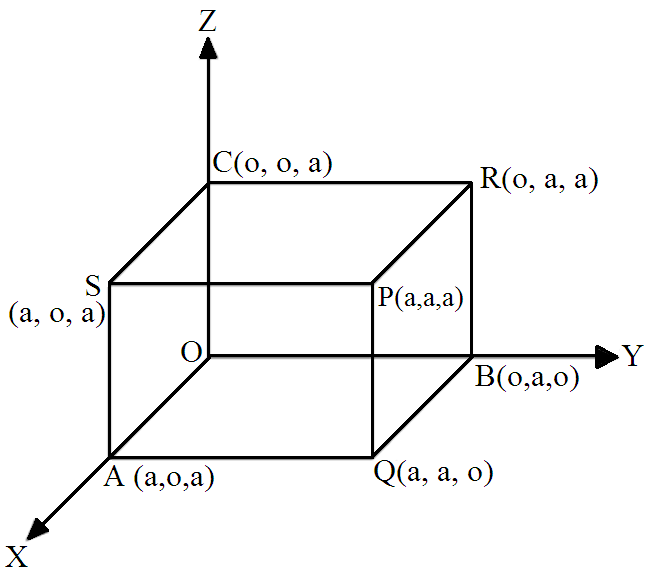
Let a be the length of an edge of the cube and let one corner be at the origin as shown in the figure. Clearly, OP, AR, Consider the diagonals OP and AR.
Direction ratios of OP and AR are proportional to a - 0, a - 0, a - 0 and 0 - a, a - 0, a - 0, e.i. a, a, a and -a, a, a, respectivelly.
Let $\theta$ be the angle between OP and AR. Then,
$\cos\theta=\frac{\text{a}\times-\text{a}+\text{a}\times\text{a}+\text{a}\times\text{a}}{\sqrt{\text{a}^2+\text{a}^2+\text{a}^2}\sqrt{(-\text{a})^2+\text{a}^2+\text{a}^2}}$
$\Rightarrow\cos\theta=\frac{-\text{a}+\text{a}^2+\text{a}^2}{\sqrt{3\text{a}^2}\sqrt{3\text{a}^2}}$
$\Rightarrow\cos\theta=\frac{1}{3}$
$\Rightarrow\theta=\cos^{-1}\Big(\frac{1}{3}\Big)$
Similarly, the angles between other pairs of the diagonals are equal to $\cos^{-1}\Big(\frac{1}{3}\Big)$ as the angle between any two diagonals.
View full question & answer→MCQ 471 Mark
A line passes through the points (6, -7, -1) and (2, -3, 1). What are the direction ratios of the line?
Answer - (−4, 4, 2)
Solution:
Direction ratios of a line passing through points (x1, y1, z1) and (x2, y2, z2) are represented by ±(x1−x2, y1−y2, z1−z2)
Hence for the given line, direction ratios are (6 − 2, −7−(−3), −1−1)
⇒ ±(4, −4, −2)
⇒ (−4, 4, 2) or (4, −4, −2)
View full question & answer→MCQ 481 Mark
The d.rs of the lines x = ay + b, z = cy + d are:
Answer - a, 1, c
Solution:
Given x = ay + b and z = cy + d
$\Rightarrow\frac{\text{x}-\text{b}}{\text{a}}=\text{y}$ and $\frac{\text{z}-\text{d}}{\text{c}}=\text{y}$
$\Rightarrow\frac{\text{x}-\text{b}}{\text{a}}=\frac{\text{y}}{1}=\frac{\text{z}-\text{d}}{c}$
Therefore Drs of given line is a, 1, c
View full question & answer→MCQ 491 Mark
Choose the correct answer from the given four options.
The sine of the angle between the straight line $\frac{\text{x}-2}{3}=\frac{\text{y}-2}{3}=\frac{\text{z}-2}{3}$ and the plane $2\text{x}-2\text{y}+\text{z}=5$ is:
- A
$\frac{10}{6\sqrt{5}}$
- B
$\frac{4}{5\sqrt{2}}$
- C
$\frac{2\sqrt{3}}{5}$
- D
$\frac{\sqrt{2}}{10}$
Answer - $\frac{\sqrt{2}}{10}$
Solution:
We have, the equation of line as
$\frac{\text{x}-2}{3}=\frac{\text{y}-2}{3}=\frac{\text{z}-2}{3}$
This line is parallel to the vector $\vec{\text{b}}=3\hat{\text{i}}+4\hat{\text{j}}+5\hat{\text{k}}$
Equation of plane is $2\text{x}-2\text{y}+\text{z}=5$
Normal to the plane $\vec{\text{n}}=2\hat{\text{i}}-2\hat{\text{j}}+\hat{\text{k}}$
Its angle between line and plane is $'\theta'.$
Then $\sin\theta=\frac{|\vec{\text{b}}\cdot{\vec{\text{b}}}|}{|{\vec{\text{b}}}||{\vec{\text{b}}}|}$
$=\frac{\big|(3\hat{\text{i}}+4\hat{\text{j}}+5\hat{\text{k}})\cdot(2\hat{\text{i}}-2\hat{\text{j}}+\hat{\text{k}})\big|}{\sqrt{3^2+4^2+5^2}\sqrt{4+4+1}}$
$=\frac{|6-8+5|}{\sqrt{50}\sqrt{9}}$
$=\frac{3}{15\sqrt{2}}=\frac{1}{5\sqrt{2}}$
$\sin\theta=\frac{\sqrt{2}}{10}$
View full question & answer→MCQ 501 Mark
The direction cosines l, m, n of two lines are connected by the relations l + m + n = 0, lm = 0, then the angle between them is:
- A
$\frac{\pi}{3}$
- B
$\frac{\pi}{4}$
- C
$\frac{\pi}{2}$
- D
$0$
View full question & answer→