Questions

M.C.Q (1 Marks)

🎯

Test yourself on this topic

11 questions · timed · auto-graded

MCQ 11 Mark
If $\vec{a}$ is a nonzero vector of magnitude ' $a$ ' and $\lambda$ a nonzero scalar, then $\lambda \vec{a}$ is unit vector if :
  • A
    $\lambda=1$
  • B
    $\lambda=-1$
  • C
    $a=|\lambda|$
  • $a=\frac{1}{|\lambda|}$
Answer
Correct option: D.
$a=\frac{1}{|\lambda|}$
(D) $a=\frac{1}{|\lambda|}$
View full question & answer
MCQ 21 Mark
The unit vector along the vector $\vec{a}=-2 \hat{i}+3 \hat{j}-\hat{k}$ is :
  • A
    $\frac{2 \hat{i}}{\sqrt{14}}-\frac{3 \hat{j}}{\sqrt{14}}+\frac{\hat{k}}{\sqrt{14}}$
  • B
    $\frac{2 \hat{i}}{\sqrt{14}}-\frac{3 \hat{j}}{\sqrt{14}}-\frac{\hat{k}}{\sqrt{14}}$
  • C
    $\frac{2 \hat{i}}{\sqrt{14}}+\frac{3 \hat{j}}{\sqrt{14}}-\frac{\hat{k}}{\sqrt{14}}$
  • $\frac{-2 \hat{i}}{\sqrt{14}}+\frac{3 \hat{j}}{\sqrt{14}}-\frac{\hat{k}}{\sqrt{14}}$
Answer
Correct option: D.
$\frac{-2 \hat{i}}{\sqrt{14}}+\frac{3 \hat{j}}{\sqrt{14}}-\frac{\hat{k}}{\sqrt{14}}$
(D)
$\begin{aligned}
\text { Unit vector }
  =\frac{\text { Vector }}{\text { Modulus of vector }} \\
=\frac{-2 \hat{i}+3 \hat{j}-\hat{k}}{\sqrt{(-2)^2+(3)^2+(-1)^2}} \\
=\frac{-2 \hat{i}+3 \hat{j}-\hat{k}}{\sqrt{(14)}}=\frac{-2 \hat{i}}{\sqrt{14}}+\frac{3 \hat{j}}{\sqrt{14}}-\frac{\hat{k}}{\sqrt{14}}
\end{aligned}$
Hence the correct option is (D).
View full question & answer
MCQ 31 Mark
If the magnitudes of two vectors $\vec{a}$ and $\vec{b}$ are $\sqrt{3}$ and 2 respectively and $\vec{a} \cdot \vec{b}=\sqrt{6}$. Then the angle between $\vec{a}$ and $\vec{b}$ is:
  • A
    $\frac{\pi}{2}$
  • B
    $\frac{\pi}{3}$
  • C
    $\frac{\pi}{6}$
  • $\frac{\pi}{4}$
Answer
Correct option: D.
$\frac{\pi}{4}$
(D)
$
\begin{aligned}
\cos \theta & =\frac{\vec{a} \cdot \vec{b}}{|\vec{a}||\vec{b}|}=\frac{\sqrt{6}}{\sqrt{3} \times 2}=\frac{\sqrt{3} \times \sqrt{2}}{\sqrt{3} \times \sqrt{2}} \\
\cos \theta & =\frac{1}{\sqrt{2}}=\cos \frac{\pi}{4} \\
\theta & =\frac{\pi}{4}
\end{aligned}
$
Hence the correct option is (D).
View full question & answer
MCQ 41 Mark
The value of $\hat{i} \cdot(\hat{j} \times \hat{k})+\hat{j} \cdot(\hat{i} \times \hat{k})+k \cdot(\hat{i} \times \hat{j})$ is:
  • A
    0
  • B
    -1
  • 1
  • D
    3
Answer
Correct option: C.
1
(C)
$
\begin{array}{lc}
\hat{i} \cdot(\hat{j} \times \hat{k})+\hat{j} \cdot(\hat{i} \times \hat{k})+k \cdot(\hat{i} \times \hat{j}) \\
\Rightarrow \hat{i} \cdot(\hat{i})+\hat{j} \cdot(-\hat{j})+k \cdot(\hat{k}) \\
\Rightarrow 1-1+1=1
\end{array}
$
Hence the correct option is (C).
View full question & answer
MCQ 51 Mark
The magnitude of the vector $\frac{1}{\sqrt{3}} \hat{i}+\frac{1}{\sqrt{3}} \hat{j}-\frac{1}{\sqrt{3}} \hat{k}$ is:
  • A
    3
  • 1
  • C
    -1
  • D
    2
Answer
Correct option: B.
1
(B)
$
\begin{array}{l}
\text { Magnitude }=\left|\frac{1}{\sqrt{3}} \hat{i}+\frac{1}{\sqrt{3}} \hat{j}-\frac{1}{\sqrt{3}} \hat{k}\right| \\
=\sqrt{\left(\frac{1}{\sqrt{3}}\right)^2+\left(\frac{1}{\sqrt{3}}\right)^2+\left(\frac{-1}{\sqrt{3}}\right)^2}=\sqrt{\frac{1}{3}+\frac{1}{3}+\frac{1}{3}} \\
=1
\end{array}
$
Hence correct option is (B).
View full question & answer
MCQ 61 Mark
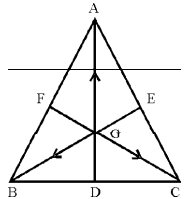
If G is the centroid of triangle ABC , then the value of $\overrightarrow{ GA }+\overrightarrow{ GB }+\overrightarrow{ GC }$ will be :
  • A
    $3 \overrightarrow{ GA }$
  • B
    $3 \overrightarrow{GB}$
  • C
    $\overrightarrow{0}$
  • D
    $3 \overrightarrow{ GC }$
Answer
Let $\mathrm{D}, \mathrm{E}$ and F be the mid-points of the sides $\mathrm{BC}, \mathrm{CA}$ and $A B$ respectively in $\triangle A B C$. The position vectors of points $B$ and $C$ with respect to $G$ are $\overline{G B}$ and $\overline{G C}$ respectively. Since D is the mid-point of the side BC,
$\therefore \quad \overline{\mathrm{GD}}\left\lvert\,=\frac{1}{2}(\overline{\mathrm{~GB}}+\overrightarrow{\mathrm{GC}})\right.$Now point G is the centroid of triangle ABC. Hence G will divide AD in the ratio 2 : 1.
$\begin{aligned} \frac{\mathrm{AG}}{\mathrm{GD}} & =\frac{2}{1} \\ \mathrm{AG} & =2 \mathrm{GD} \\ \overline{\mathrm{AG}} & =2 \overline{\mathrm{GD}}\end{aligned}$
Image
From equations (1) and (2),
$\begin{aligned} \overrightarrow{\mathrm{GB}}+\overrightarrow{\mathrm{GC}} & =2 \overrightarrow{\mathrm{GD}}=\overrightarrow{\mathrm{AG}} \\ \overline{\mathrm{GB}}+\overline{\mathrm{GC}} & =-\overline{\mathrm{GA}} \\ \overline{\mathrm{GA}}+\overline{\mathrm{GB}}+\overrightarrow{\mathrm{GC}} & =\overrightarrow{0}\end{aligned}$
Hence the correct option is (C).
View full question & answer
MCQ 71 Mark
If the vectors $3 \hat{i}+2 \hat{j}-\hat{k}$ and $6 \hat{i}-4 p \hat{j}+q \hat{k}$ are parallel. Then the values of $p$ and $q$ will respectively be :
  • $-1,-2$
  • B
    $-1,2$
  • C
    1,2
  • D
    $1,-2$
Answer
Correct option: A.
$-1,-2$
(A)
For being parallel
$
\begin{aligned}
\frac{a_1}{a_2} & =\frac{b_1}{b_2}=\frac{c_1}{c_2} \\
\frac{3}{6} & =\frac{2}{-4 p}=\frac{-1}{q}
\end{aligned}
$
$\Rightarrow \quad \frac{1}{2}=\frac{2}{-4 p}=\frac{-1}{q}$
So $\quad \frac{1}{2}=\frac{-1}{q} \Rightarrow q=-2$
and $\quad \frac{1}{2}=\frac{2}{-4 p} \Rightarrow-4 p=4 \quad p=-1$
Hence $\quad p=-1$ and $q=-2$
Hence the correct option is (A).
View full question & answer
MCQ 81 Mark
If the position vectors of $A$ and $B$ are respectively $\vec{a}-3 \vec{b}$ and $6 \vec{b}-2 \vec{a}$, then the position vector of the point dividing $A B$ in the ratio $1: 2$ will be :
  • A
    $-\vec{a}+3 \vec{b}$
  • B
    $\frac{\vec{b}-\vec{a}}{3}$
  • C
    $\frac{-\vec{a}+3 \vec{b}}{3}$
  • D
    $\overrightarrow{0}$
Answer
Let point $R$ divide the position vectors of $A$ and $B$ in the ratio $1: 2$. Then the position vector of $R$
$\begin{aligned}& =\frac{1 \times(6 \vec{b}-2 \vec{a})+2(\vec{a}-3 \vec{b})}{1+2} \\& =\frac{6 \vec{b}-2 \vec{a}+2 \vec{a}-6 \vec{b}}{3}=\frac{0}{3}=0 \\& =\overrightarrow{0}\end{aligned}$
Hence the correct option is (D).
View full question & answer
MCQ 91 Mark
If the position vectors of the vertices of any triangle are $\vec{a}, \vec{b}, \vec{c}$, then the position vector of the centroid of the triangle is :
  • A
    $\vec{a}+\vec{b}+\vec{c}$
  • $\frac{\vec{a}+\vec{b}+\vec{c}}{3}$
  • C
    $\frac{\vec{a}+\vec{b}+\vec{c}}{6}$
  • D
    None of these.
Answer
Correct option: B.
$\frac{\vec{a}+\vec{b}+\vec{c}}{3}$
(B)
The position vectors of the vertices of triangle are $\vec{a}, \vec{b}$ and $\vec{c}$. So, the position vector of the centroid will be $\frac{\vec{a}+\vec{b}+\vec{c}}{3}$.
Hence the correct option is (B).
View full question & answer
MCQ 101 Mark
If vector $\vec{a}$=2 \hat{i}+5 \hat{j}$ and $b=2 \hat{i}-\hat{j}$ then unit vector in the direction of the vector $\vec{a}$+$\vec{b}$ is :
  • A
    $\hat{i}+\hat{j}$
  • $\frac{\hat{i}+\hat{j}}{\sqrt{2}}$
  • C
    $\sqrt{2}(\hat{i}+\hat{j})$
  • D
    $\sqrt{2}(\hat{i}-\hat{j})$
Answer
Correct option: B.
$\frac{\hat{i}+\hat{j}}{\sqrt{2}}$
(B)
$
\begin{aligned}
\vec{a}+\vec{b} & =2 \hat{i}+5 \hat{j}+2 \hat{i}-\hat{j}=4 \hat{i}+4 \hat{j} \\
\therefore \quad|\vec{a}+\vec{b}| & =|4 \hat{i}+4 \hat{j}|=\sqrt{(4)^2+(4)^2} \\
& =\sqrt{16+16}=\sqrt{32}=4 \sqrt{2}
\end{aligned}
$
Unit vector in the direction of vector $(\vec{a}+\vec{b})$
$
\begin{array}{l}
=\frac{\vec{a}+\vec{b}}{|\vec{a}+\vec{b}|} \\
=\frac{4 \hat{i}+4 \hat{j}}{4 \sqrt{2}}=\frac{\hat{i}+\hat{j}}{\sqrt{2}}
\end{array}
$
Hence the correct option is (B).
View full question & answer
MCQ 111 Mark
If the position vectors of the points A and B are $\vec{a}$ and $\vec{b}$ respectively, then the position vector of the mid-point of the line $A B$ will be :
  • $\frac{1}{2}(\vec{a}+\vec{b})$
  • B
    $\vec{a}-\vec{b}$
  • C
    $\vec{a}+\vec{b}$
  • D
    $\frac{1}{2}(\vec{a}-\vec{b})$
Answer
Correct option: A.
$\frac{1}{2}(\vec{a}+\vec{b})$
(A)
The position vectors of the points A and $B$ are $\vec{a}$ and $\vec{b}$ respectively. Hence the position vector of the mid-point of line AB .
$
=\frac{1 \cdot \vec{a}+1 \cdot \vec{b}}{1+1}=\frac{\vec{a}+\vec{b}}{2}
$
Hence the correct option is (A).
View full question & answer
M.C.Q (1 Marks) - Maths STD 12 Science Questions - Vidyadip