Questions

2 Marks Questions

🎯

Test yourself on this topic

12 questions · timed · auto-graded

Question 12 Marks
A particle is moving 1.5 times as fast as an electron. The ratio of the de-Broglie wavelength of the particle to that of the electron is $1.813 \times 10^{-4}$. Calculate the particle's mass and identify the particle.
Answer
Self
View full question & answer
Question 22 Marks
A plane electromagnetic wave of frequency 52 MHz travels in free space along the x -direction. At a particular point in space and time, $\overrightarrow{ E }=8.4 \hat{k} V / m$. What is $\vec{B}$ at this point ?
Answer
Self
View full question & answer
Question 32 Marks
Draw phasor diagram for $X _{ C }> X _{ L }$ and $X _{ C }< X _{ L }$ and give the disadvantages of this method.
Answer
Self
View full question & answer
Question 42 Marks
A solenoid of length 0.4 m has a radius of 1 cm and is made up of 500 turns. It carries a current of 10 A . What is the magnitude of the magnetic field inside the solenoid?
Answer
Self
View full question & answer
Question 52 Marks
Draw the nature of the graph of average binding energy per nucleon against atomic mass number and explain its notable points.
Answer
Self
View full question & answer
Question 72 Marks
"Emf is induced in a coil when magnetic flux through the coil changes with time. Discuss the observations of Faraday's experiments using this fact."
Answer
Self
View full question & answer
Question 102 Marks
Explain the Rutherford atomic model and its limitation.
Answer
As the planets revolves around the Sun, Rutherford suggested in the proposed atomic model, that nucleus at the centre and the electrons orbiting it around the nucleus.
$\rightarrow$ Thus the basic difference between the two is that the planets in the system of Sun are captured by gravitational force while the nucleus electron intersects according Coulomb law in a atom.
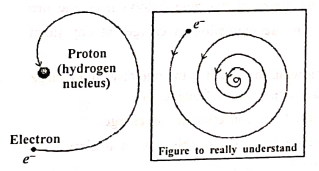
$\rightarrow$ The limitation of the Rutherford atomic model: According to classical physics, there is no constraint on the radius of the orbit of electron.
$\rightarrow$ Electron moving in a circular orbit performs an acceleration motion.
$\rightarrow$ According to classical electromagnetic theory an accelerated charge radiates energy in the form of electromagnetic radiation hence its energy goes on decreasing.
$\rightarrow$ Hence, its orbit would not be circular, it will be spiral terminating at its nucleus which is shown in the figure.
Image
$\rightarrow$ Thus, such an atom cannot be stable.
$\rightarrow$ Further, according to the classical electromagnetic theory, the frequency of the electromagnetic wave emitted by the revolving electrons is equal to the frequency of revolution.
$\rightarrow$ As the electrons spiral inwards, their angular velocities and hence their frequencies would change continuously and so will the frequency of the light emitted. Thus, they would emit a continuous spectrum in contradiction to the line spectrum actually observed.
$\rightarrow$ Hence, Rutherford's atomic model states that classical ideas are not sufficient to explain the atomic structure. Because, this model fails to understand the stability of atom.
View full question & answer
Question 112 Marks
Explain the Young's experiment, arrangement and experiment to produce stationary interference pattern.
Answer
The British physicist Thomas Young made a ingenious technique to obtain coherent sources by the division of a wavefront and demonstrated a stationary interference.
Image
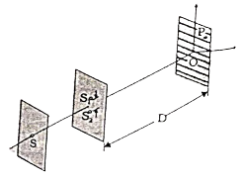
$\rightarrow$ An experimental arrangement of Young's experiment is shown in the figure.
$S=$ small hole on screen A. $S_1, S_2=$ two pinholes parallel to screen $A, S_1$ and $S_2$ are two pinholes on screen B and distances $SS _1$ $= SS _2$, the distance between pinholes $S _1$ and $S _2$ is small (in the order of mm ). $C =$ screen parallel to B and a screen is at D distance in the order of meters.
$\rightarrow$ Hole S is lit by a bright source, light spread out from S and fall on both $S _1$ and $S_2$. Distance $SS _1$ and $SS _2$ are equal to they behave like two coherent sources.
$\rightarrow$ Because light waves coming out from $S_1$ and $S_2$ are derived from the same original source and any abrupt phase change in S will manifest in similar phase change (equal) in the light coming out from $S _1$ and $S _2$.
$\rightarrow$ Thus, the two source $S_1$ and $S_2$ will be locked in phase. Thus they will become coherent sources.
View full question & answer
Question 122 Marks
Give characteristics of electric field lines.
Answer
(i) A tangent at any point on electric field line gives direction of electric field at that point.
(ii) Two electric field lines never intersect each other. If they do so, then there will be two tangents at the point of intersection and hence two directions of electric field at the same point, which is not possible. Hence, two field lines can never cross each other.
(iii) The distribution of electric field lines in any region of field gives intensity of field in that region.
(iv) Field lines of uniform electric field are equidistant and parallel to each other.
(v) Field lines of stationary electric charge do not form closed loops.
$\rightarrow$ In practice, number of field lines passing through any region of field is controlled such that, number of field lines passing through unit area which is normal to field line at that point is proportional to the intensity of the given field.
View full question & answer
2 Marks Questions - Physics STD 12 Science Questions - Vidyadip