Questions

2 Marks Questions

🎯

Test yourself on this topic

12 questions · timed · auto-graded

Question 12 Marks
Suppose a pure Si crystal has $5 \times 10^{28}$ atoms $m ^{-3}$. It is doped by 1 ppm concentration of pentavalent As. Calculate the number of electrons and holes Given that $n_i=1.5 \times 10^{16} m^{-3}$.
Answer
Self
View full question & answer
Question 22 Marks
Two stable isotopes of lithium ${ }_3^6 Li$ and ${ }_3^7 Li$ have respective abundances of $75 \%$ and $92.5 \%$. These isotopes have masses $6.01512 u$ and $7.01600 u$, respectively Find the atomic mass of lithium.
Answer
Self
View full question & answer
Question 42 Marks
What is diffraction? Who discovered it ? What kind of diffraction phenomenal occurs in waves?
Answer
Self
View full question & answer
Question 62 Marks
A 44 mH inductor is connected to $220 V, 50 Hz$ ac supply. Determine the mH value of the current in the circuit.
Answer
Self
View full question & answer
Question 82 Marks
Derive an expression for the periodic time of simple harmonic motion of a electric dipole kept in a uniform magnetic field.
Answer
Self
View full question & answer
Question 112 Marks
Derive an expression for capacitance of the parallel plate capacitor.
Answer

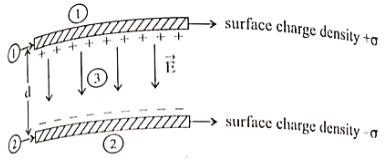
Image
$\rightarrow$ As shown in figure, the charge on plate 1 and 2 are $+Q$ and $-Q$ respectively. And ' d ' is the separation between them, A is the area of each plate.
$\rightarrow$'d' is much smaller than the linear dimension of the plates $[d \ll A]$ so we can use the result on electric field $E =\sigma / 2 \varepsilon_0$ by an infinite plane sheet of uniform surface charge density
where, $\sigma=$ surface charge density, $\pm \sigma= Q / A$
$\varepsilon_0=$ permittivity of space
$A=$ Area of plate, $Q=$ charge on plate
$\rightarrow A s=$ shown in figure in region (1),
$E=\frac{\sigma}{2 \varepsilon_0}-\frac{\sigma}{2 \varepsilon_0}=0 \ldots(1)$
$\rightarrow$ In region (2)
$E=\frac{\sigma}{2 \varepsilon_0}-\frac{\sigma}{2 \varepsilon_0}=0 \ldots(2)$
$\rightarrow$ Electric field between plate 1 and 2 ,
$E=\frac{\sigma}{2 \varepsilon_0}+\frac{\sigma}{2 \varepsilon_0}=\frac{\sigma}{\varepsilon_0}=\frac{\sigma}{\varepsilon_0 A}\ldots(3)$
$\rightarrow$ For uniform electric field,
$\begin{aligned}
V & =E \cdot d \\
& =\frac{Q}{\varepsilon_0 A} \cdot d \ldots(4)
\end{aligned}$
$\rightarrow$ Capacitance $C=\frac{Q}{V}=\frac{Q}{\frac{Q d}{\varepsilon_0 A}}=\frac{\varepsilon_0 A}{d}\ldots(5)$
$C=\frac{\varepsilon_0 A}{d}$ is the equation of parallel plate capacitor.
View full question & answer
Question 122 Marks
Write any four properties of electric field lines.
Answer
(i) A tangent at any point on electric field line gives direction of electric field at that point.
(ii) Two electric field lines never intersect each other. If they do so, then there will be two tangents at that point and hence two directions of electric field at the same point, which is not possible.
(iii) The distribution of electric field lines in any region of field gives intensity of field in that region.
(iv) Field lines of uniform electric field are equidistant \& parallel to each other.
(v) Field lines of stationary electric charge do not form closed loops.
View full question & answer
2 Marks Questions - Physics STD 12 Science Questions - Vidyadip