Lines and Angles · Gujarat Board (GSEB) STD 6 (GSEB - English Medium). 24 questions.
Questions
1 Marks Question
🎯
Test yourself on this topic
24 questions · timed · auto-graded
Question 11 Mark
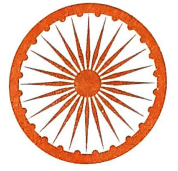
The Ashoka Chakra has 24 spokes. What is the degree measure of the angle between two spokes next to each other? What is the largest acute angle formed between two spokes?
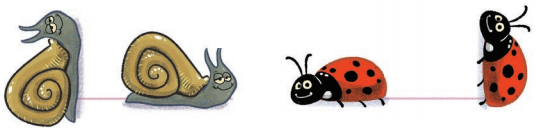
Observe the images below where there is an insect and its rotated version, fan angles be used to describe the amount of rotation? How? What will be the arms of the angle and the vertex? Hint: Observe the horizontal line touching the insects.
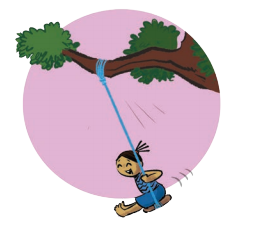
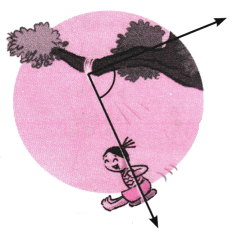
Vidya is enjoying her time on the swing. She notices that the greater the angle with which she starts the swinging, the greater is the speed she achieves on her swing. But where is the angle? Are you able to see any angle?
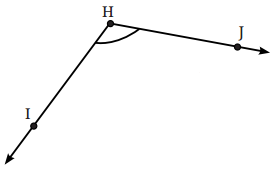
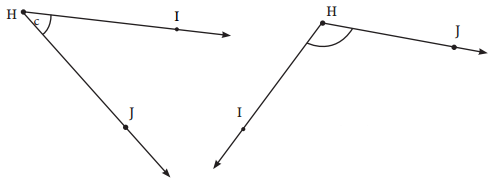
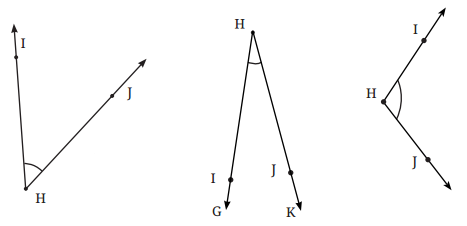
Find the degree measures for the angles given below. Check if your paper protractor can be used here!
Answer
In first figure, we get $\angle I H J=45^{\circ}$ In second figure, we get $\angle I H J=115^{\circ}$ Explanation To accurately measure these angles, insure your paper protractor is precise and that it can measure the angles in given figure.
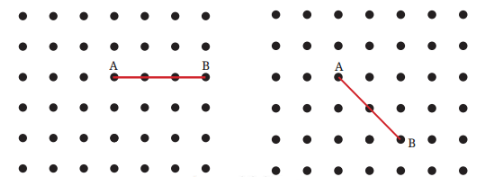
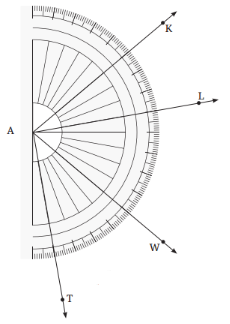
(a) The number of units of 1 degree angle between $K A$ and $A L$ is 30. $\therefore \angle K A L=30^{\circ}$ (b) The number of units of 1 degree angle between $L A$ and $A W$ is 50. $\therefore \angle W A L=50^{\circ}$ (c) The number of units of 1 degree angle between $K A$ and $A T$ is 120. $\therefore \angle T A K=120^{\circ}$
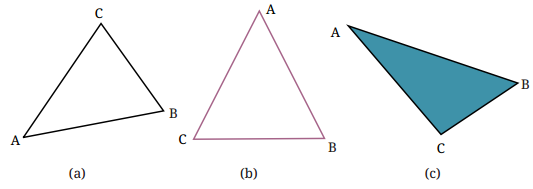
(a) For triangle (a), on measuring angles $\angle A, \angle B$ and $\angle C$ using protractor, we get $\angle A=45^{\circ}, \angle B=65^{\circ}$ and $\angle C=70^{\circ}$ On adding all the three angles, we get $45^{\circ}+65^{\circ}+70^{\circ}=180^{\circ}$ (b) For triangle (b), on measuring angles $\angle A, \angle B$ and $\angle C$ using protractor, we get $\angle A=60^{\circ}, \angle B=60^{\circ}$ and $\angle C=60^{\circ}$ On adding all the angles, we get $60^{\circ}+60^{\circ}+60^{\circ}=180^{\circ}$ (c) For triangle (c), using protractor, we get $\angle A=35^{\circ}, \angle B=55^{\circ}$ and $\angle C=90^{\circ}$ On adding all the angles, we get $35^{\circ}+55^{\circ}+90^{\circ}=180^{\circ}$ Now, we can say that the sum of all the angles of a triangle is $180^{\circ}$.
Do you know what the words acute and obtuse mean? Acute means sharp and obtuse means blunt. Why do you think these words have been chosen?
Answer
The word 'acute and obtuse' are used to describe angles because they reflect the visual characteristics of the angle. • Acute angles are called sharp because they are less than 90° and appear pointed, similar to the sharp edge of a knife. • Obtuse angles are called 'blunt' because they are greater than 90° and appear wider, similar to the blunt end of an object. Explanation These words help to visualise the nature of the angles where an acute angle looks more pointed and an obtuse angle looks wider and less pointed.
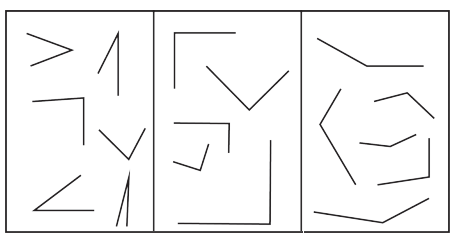
Identify acute, right, obtuse and straight angles in the given figures.
Answer
In the first group, all the angles are less than a right angle. So, these are acute angles. In the second group, all the angles are right angles. In the third group, all the angles are more than a right angle. So, these are obtuse angles.
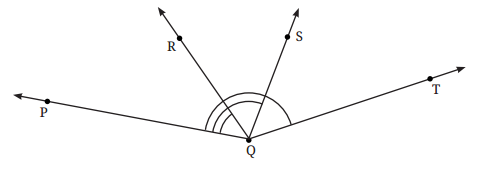
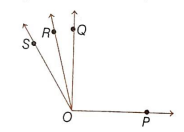
Find the degree measures of $\angle P Q R, \angle P Q S$ and $\angle P Q T$.
Answer
In the given figure, on measuring each angle by placing the protractor at the vertex Q and reading the angles formed by the rays, we get $\angle PQR =45^{\circ}$, $\angle P Q S=80^{\circ}$ and $\angle PQT =150^{\circ}$
Here is a ray $\overrightarrow{ OA }$ in given figure. It starts at O and passes through the point A. It also passes through the point B. (a) Can you also name it as $\overrightarrow{ OB }$ ? Why ? (b) Can we write $\overrightarrow{ OA }$ as $\overrightarrow{ AO }$ ? Why or why not ?
Answer
(a) Yes, we can also name of ray $\overrightarrow{O A}$ as ray $\overrightarrow{O B}$ because initial point of both is same and going on endlessly in the same direction. (b) No, we cannot not write $\overrightarrow{O A}$ as $\overrightarrow{A O}$ because initial point of a ray cannot be changed.
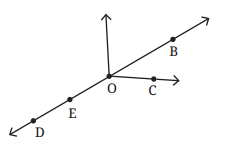
In the figure, name (a) five points (b) a line (c) four rays (d) five line segments
Answer
(a) Five points are D, E, O, C and B. (b) In the given figure, a line is $\stackrel{\leftrightarrow}{D B}$. (c) Four rays are $\overrightarrow{O C}, \overrightarrow{O B}, \overrightarrow{E B}$ and $\overrightarrow{O D}$. (d) Five line segments are $\overline{D E}, \overline{E O}, \overline{O B}, \overline{D O}$ and $\overline{E B}$.
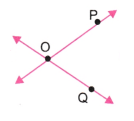
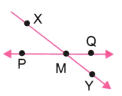
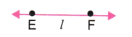
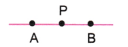
Draw a rough figure and write labels appropriately to illustrate each of the following: (a) $\overleftrightarrow{O P}$ and $\overleftrightarrow{O Q}$ meet at 0. (b) $\overrightarrow{X Y}$ and $\stackrel{\leftrightarrow}{PQ}$ intersect at point $M$. (c) Line L contains points E and F but not point D. (d) Point P lies on AB.
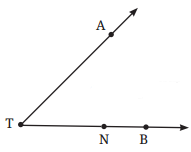
Rays in the given figure are $\overrightarrow{T A}, \overrightarrow{T N}$ and $\overrightarrow{T B}$. Yes, $T$ is the starting point of each of these rays in given figure.
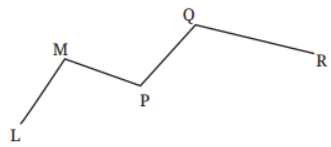
The line segments in the given figure are $\overline{L M}, \overline{M P}, \overline{P Q}$ and $\overline{Q R}$ Points $L$ and $R$ are on exactly one of the line segments and points $M, P$ and $Q$ are on two of the line segments.
Rihan marked a point on a piece of paper. How many lines can he draw that pass through the point. Sheetal marked two points on a plece of paper. How many different lines can she draw that pass through both of the points? Can you help Rihan and Sheetal, find their answers?
Answer
Yes, Rihan can draw infinite lines passing through a point and Sheetal can draw only one line passing through both of the points.
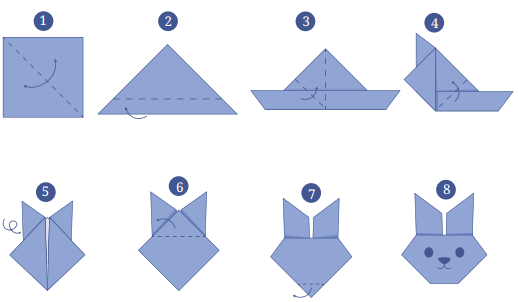
Make the paper craft as per the given instructions. Then, unfold and open the paper fully. Draw lines on the creases made and measure the angles formed.