Question types

Patterns in Mathematics question types

63 questions across 8 question groups — pick any mix to generate a MATHS paper with step-by-step answer keys.

63
Questions
8
Question groups
5
Question types
Sample Questions

Patterns in Mathematics questions

One sample from each question group in this chapter. Select any group above to see the full set with answer keys.

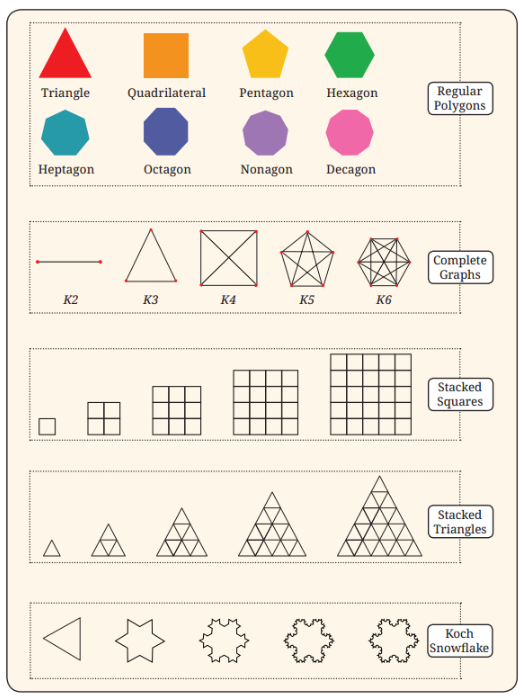
Which of the following is an example of a shape sequence?
  • Regular polygons
  • B
    Adding counting numbers up and down
  • C
    Adding odd numbers to get square number
  • D
    None of the above

Answer: A.

View full solution
Assertion (A) The next term in the sequence 2, 3, 5, 7, … is 11.
Reason (R) Prime numbers have two factors, which are 1 and itself.
  • Both A and R are true and R is the correct explanation of A.
  • B
    Both A and R are true but R is not the correct explanation of A.
  • C
    A is true but R is false.
  • D
    A is false but R is true.

Answer: A.

View full solution
Assertion (A) The sequence 1, 3, 6,10, … is called Triangular Numbers.
Reason (R) The sequence 1, 4, 9, 16,… is called squares.
  • A
    Both A and R are true and R is the correct explanation of A.
  • Both A and R are true but R is not the correct explanation of A.
  • C
    A is true but R is false.
  • D
    A is false but R is true.

Answer: B.

View full solution
Which sequence do you get when you start to add the All 1’s sequence up? What sequence do you get when you add the All 1’s sequence up and down?
View full solution
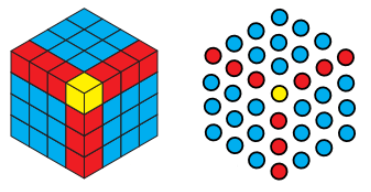
By imagining a large version of your picture, or drawing it partially, as needed, can you see what will be the value of 1 + 2 + 3+……+99 + 100 + 99+…….+ 3 + 2 + 1?
View full solution
How has mathematics helped propel humanity forward? (You might think of examples involving: carrying out scientific experiments; running our economy and democracy; building bridges, houses or other complex structures; making TVs, mobile phones, computers, bicycles, trains, cars, planes, calendars, clocks, etc.)
View full solution
What happens when you start to add up powers of 2 starting with 1, i.e. take 1,1+2,1+2 +4,1+2+4+8,...? Now add 1 to each of these numbers-what numbers do you get? Why does this happen?
View full solution
What happens when you add up pairs of consecutive triangular numbers? That is, take 1 + 3, 3 + 6, 6 + 10, 10 + 15,……..? Which sequence do you get? Why? Can you explain it with a picture?
View full solution
Q 283 Marks Question3 Marks
Try and redraw each sequence in Table 3 in your notebook. Can you draw the next shape in each sequence? Why or why not? After each sequence, describe in your own words what is the rule or pattern for forming the shapes in the sequence.
View full solution
Column AColumn B
(i) 1, 3, 9, 27, 81, …(a) Triangular: Numbers
(ii) 1, 2, 3, 5, 8, 13, …(b) Odd Numbers
(iii) 1, 3, 6, 10, 15, 21, …(c) Powers of 3
(iv) 1, 3, 5, 7, 9, 11, 13, …(d) Virahanka Numbers
View full solution

Generate a Patterns in Mathematics paper free

Pick question groups from the list above, set marks and difficulty, and export a branded PDF with step-by-step answer keys. First 3 chapters free — no signup.
Download App